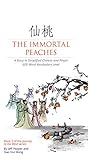
BOOK: “The Immortal Peaches” [Vol. 3 of “Journey to the West”] Ed. by Jeff Pepper / Trans. by Xiao Hui Wang

The Immortal Peaches: A Story in Simplified Chinese and Pinyin, 600 Word Vocabulary (Journey to the West Book 3)The Immortal Peaches: A Story in Simplified Chinese and Pinyin, 600 Word Vocabulary by Jeff Pepper
My rating: 5 of 5 stars

Publisher Site – Imagin8

This is the third volume in this Journey to the West series aimed at language learners. It covers Chapters 5, 6, and 7 of the book, which includes events from Sun Wukong’s return to heaven acknowledged with the title “Great Sage Equal to Heaven” through the conflicts that result from his lack of control and decorum to Buddha’s bet with Monkey King.

I’ve enjoyed this series. The pinyin is interspersed with an abridged and linguistically simplified Chinese telling of the story on a paragraph basis, and the English translation is at the end. This allows one relatively quick access to the pinyin without continually cheating by stray glance. Also, one can determine whether one wants to read the English translation before or after reading the Chinese, as is appropriate to one’s level and language learning strategy. The book also has a glossary of all the Chinese words it uses, and the words beyond the most basic (beyond HSK3, or so) are footnoted. (I read on kindle, so looking up translations of any words is as quick as highlighting them.)

This is a great language learning tool, featuring one of Chinese literature’s most engrossing stories. I’d highly recommend it for those learning Mandarin Chinese with Simplified script.

View all my reviews

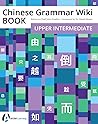
BOOK: “Chinese Grammar Wiki BOOK: Upper Intermediate” ed. by John Pasden

Chinese Grammar Wiki BOOK: Upper IntermediateChinese Grammar Wiki BOOK: Upper Intermediate by John Pasden
My rating: 5 of 5 stars

Publisher Site — AllSet Learning

This is the third and final book in this series. It’s a straightforward grammar that’s easy to use and well-organized. The book contains basic rules in a concise format, examples, and any exceptions or points of confusion that may exist. With examples, it presents the Hanzi (Chinese characters,) pinyin (Romanized phonetic script,) and English translation adjacently. (This is a feature that I don’t like in readers, but which I find useful in a grammar.)

If you’re trying to learn the basics of Mandarin Chinese in Simplified Script, this is a useful series. I can’t speak to how good it is or isn’t for someone who intends to take the HSK tests, but for my purposes it was just what I needed with not much more (no extraneous information or complications.)

View all my reviews

BOOK: “Old Master Q Chinese Idioms LOL 5” by Wong Chak

Old Master Q Chinese Idioms LOL 5Old Master Q Chinese Idioms LOL 5 by Wong Chak
My rating: 4 of 5 stars

Publisher Instagram – Ng Hing Kee

This collection of chengyu (four-character Chinese idioms) are presented by means of humorous comic strips. Each idiom takes up one page, which includes: the chengyu in both Traditional Chinese characters and pinyin (Romanized phoneticization,) very brief literal and colloquial definitions as well as a statement of the general circumstances under which the idiom might be used, and a four to six panel comic strip that shows the reader a humorous scenario for which the idiom is applicable.

The book is divided into five parts, and at the end of each part there are a few pages of exercises to test the reader’s understanding of that section’s material. (Answer keys are provided — upside-down at the end of each quiz.)

As someone learning Chinese, I found this book to be useful. However, it doesn’t require any Chinese literacy to learn. If you’re interested in compact bits of wisdom or quotes, you may find this book worthwhile.

View all my reviews

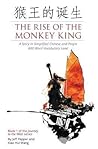
BOOKS: “Rise of the Monkey King” ed. / trans. Jeff Pepper & Xiao Hui Wang

The Rise of the Monkey King: A Story in Simplified Chinese and Pinyin, 600 Word Vocabulary Level (Chinese Edition)The Rise of the Monkey King: A Story in Simplified Chinese and Pinyin, 600 Word Vocabulary Level by Jeff Pepper
My rating: 5 of 5 stars

Publisher Site – Imagin8

This is an abridged and linguistically simplified telling of the first two chapters of Journey to the West. It contains the birth story of Sun Wukong (i.e. the Monkey King) and describes his studies with a sage in an attempt to become immortal.

As someone learning Chinese but at a point where I can only read grammatically and lexically simple content, it’s not easy to find reading material that is both fun to read and readable. The discovery of this series was a godsend. It’s hard to get more thrilling than the story of the Monkey King, and it helps that I’ve already read translations – and so have a bit of context to piece together challenging sentences and to avoid the misunderstandings that can arise when reading a new language. It’s much easier to be a disciplined reader when reading something that is neither a children’s book nor the life story of a preternaturally typical person [which is the usual adult equivalent of a beginner level reader.]

I was pleased by how this book was laid out. Often reading material for learners puts the Chinese characters (hanzi,) the Romanized phonetics (pinyin,) and the English translation all in adjacent rows. While this has its advantages, it also makes it too easy to cheat by eye saccade and not be reading as well as one thinks one is. This book does have all three elements, but it alternates paragraphs of hanzi and pinyin but then puts the translation in an unbroken format after the Mandarin. The book also has a glossary of the book’s vocabulary.

Whether you’ve already read Journey to the West or not, if you’re just learning to read Simplified Chinese, I’d highly recommend this book.

View all my reviews

BOOKS: “Chinese Grammar Wiki BOOK: Intermediate” ed. by John Pasden, et. al.

Chinese Grammar Wiki BOOK: IntermediateChinese Grammar Wiki BOOK: Intermediate by John Pasden
My rating: 5 of 5 stars

Publisher Site – AllSet

I’ve found this series helpful in offering a basic guide to grammar for learning Mandarin through Simplified Characters and pinyin. It provides plenty of examples and is not dense with explanation and elaboration but rather focuses on the core principles as well as demonstrations of common pitfalls. It covers the B1 grammar points which is a designation used by, but not original to, the series. (As far as I can tell, it’s a European standard that has been applied across languages to organize the concepts one should be able to express at a given level of language learning.

This is the second book of the series that I’ve worked through (the third if one counts the “Just the Basics” level which is a subset of the Beginner level book,) and I intend to continue on to the “Upper Intermediate” guide.

This may not be the series you want if you’re a linguist looking for nuanced insight into Chinese grammar, but it’s excellent for your average language learner. [It also seems to be quite affordable compared to many competing grammar books and series.]

View all my reviews

BOOKS: “The Story of Chinese Characters” by Fang Zeng

Languages - The Story Of Chinese Characters: 汉字的故事 (Bilingual Chinese with Pinyin and English - Simplified Chinese Version) - Preschool, Kindergarten (Educational ... Books For Smart Kids: 聪明宝宝益智成长绘本 Book 2)Languages – The Story Of Chinese Characters: 汉字的故事 (Bilingual Chinese with Pinyin and English – Simplified Chinese Version) – Preschool, Kindergarten by Elite Panda book
My rating: 5 of 5 stars

Publisher’s YouTube Channel

This story book is apparently perfect for preschoolers and definitely is for someone newly learning Chinese. It is the tale of a man who goes hunting and his mild trials and successes. It’s not a gripping tale, but that’s perfect for those new to the language as it allows simple language and concepts. The language is grammatically and semantically straightforward. This bilingual book presents Chinese characters, pinyin with tone markers, and the English translation all on the same page.

The story teaches a few rudimentary Chinese characters (person, mountain, boat, bird, etc.,) particularly ones that are either pictographic or lend themselves to pictographic memory tricks. (For those unfamiliar with Chinese, it is a common misconception that all the characters are pictographic. In fact, about eighty percent of characters appear as they do because of their spoken sound quality [i.e. they appear similar to another character with the same sound, but often with an entirely unrelated meaning.]) The illustrations not only tell the story but invokes the shape of the character that is under study.

I found this book useful for learning to read in Chinese. A little more separation of the pinyin and characters might be nice so one could cover it up to focus on reading characters, but I was clearly not the intended demographic. I don’t see any reason why the book couldn’t work either way, i.e. for English learning Chinese speakers as well as English speaking Chinese learners.

View all my reviews