“Mulberry Picking” [採桑子] by Ouyang Xiu [w/ Audio]

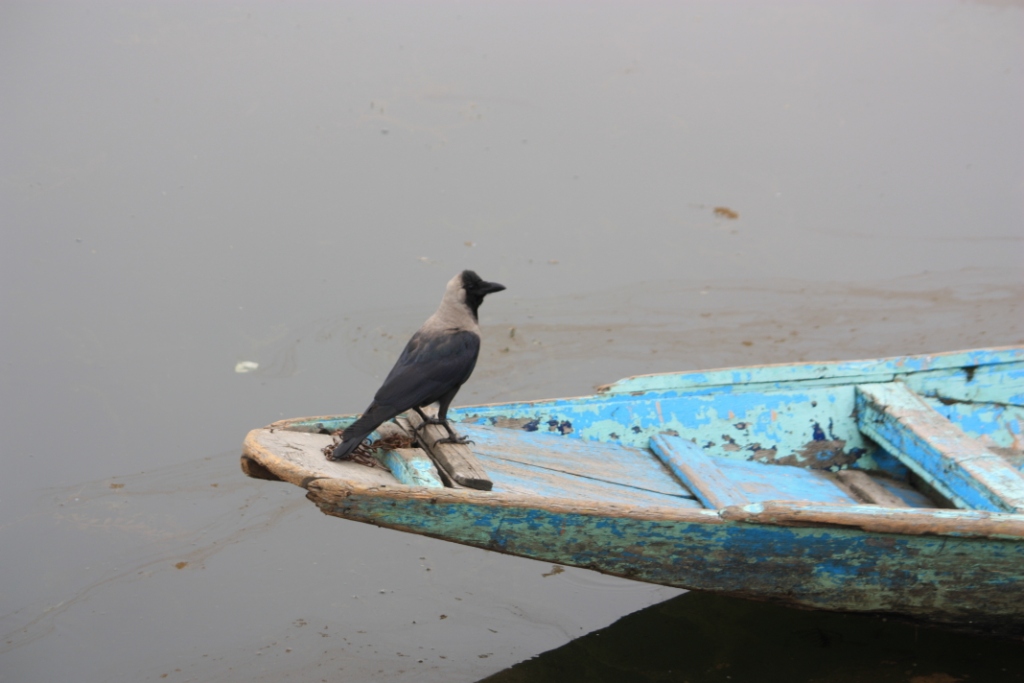
West Lake is beautiful from a small boat.
Green water wends its way through the lotus,
Sweet grass grows thickly all along the bank,
Faint music wafts from unknown points ashore.

When the wind quits, the Lake is glassy smooth;
The boat is perfectly still for a beat,
Then its movement is betrayed by ripples
And startled waterfowls' furious flapping.

Note: The title “Gathering Mulberry Leaves” was used by Xu Yuanchong for his translation. The Chinese title is: 採桑子 (Cǎi Sāngzǐ)

BOOKS: “The Art of Writing” Trans. / Ed. by Tony Barnstone and Chou Ping

The Art of Writing: Teachings of the Chinese MastersThe Art of Writing: Teachings of the Chinese Masters by Tony Barnstone
My rating: 5 of 5 stars

Publisher Website

This thin volume is packed with insights on writing — especially, but not exclusively, poetry. It consists of four chapters. The first two are the ars poetica of Lu Ji and Sikong Tu, respectively (i.e. The Art of Writing and The Twenty-Four Styles of Poetry.) The second half of the book consists of two chapters of collected sayings and poetry commentary excerpts.

I haven’t read a book so dense with quotable lines in a while. Some of the advice offered is universal and timeless (e.g. avoid cliches and read voraciously,) but some of it reflects a uniquely Chinese perspective rooted in Taoist and Zen sentiments (e.g. how to use wu wei [effortlessness] in one’s writing and so forth.)

There is a preface and each of the sections has its own editorial opening, but these never feel like padding (which often happens with books that come out to less than a hundred pages of content.) Instead, this ancillary material is concise and helps to offer historic and cultural context.

I’d highly recommend this book for writers and those interested in Eastern aesthetics and literature. That said, you don’t necessarily have to be interested in both. Any writer could pick up some beneficial tips while reading this book, and it’s compact, highly readable, and even humorous in places.

View all my reviews

“Picking Mulberries” by Ouyang Xiu [w/ Audio]

Adrift on West Lake in a wine-laden, colorful skiff:
As flutes play fast and lutes, deftly
And a jade cup circuits swiftly,
The boat's calm rocking lulls the drunk into sleep.

Thin clouds seem to float right under the rudderless boat.
The water's blue matches the sky's,
As lake to sky and back move eyes,
"Do the clouds above match those that in the water float?"

“Walking to Guanghua Temple by Moonlight” by Ouyang Xiu [w/ Audio]

Sound of water cascading over rock.
A silent mountain in the night.
Bright moonlight washes over the pines.
One thousand peaks, all in one color.

BOOKS: “Deep, Deep the Courtyard” [庭院深深] trans. by Xu Yuanchong

庭院深深:最美的宋詞英譯新詮 (Traditional Chinese Edition)庭院深深:最美的宋詞英譯新詮 by 吳俁陽(賞析)
My rating: 5 of 5 stars

Publisher Website

This is a bilingual (Chinese / English) anthology of Song Dynasty poetry. It features more than 140 poems by almost fifty poets of the Song Dynasty, but a few of the Song poetic rockstars are particularly well represented (e.g. Su Shi, Qin Guan, Ouyang Xiu, and Xin Qiji.) The principal language of the book is Chinese (Mandarin) and so, while the poems themselves appear in English as well as Chinese, the ancillary matter is only in Chinese. Said ancillary matter includes notes, contextual information, bio-blurbs on the poets, and brief front and back matter.

I learned after reading the translations, that the translator was Xu Yuanchong and that he was (i.e. he’s now deceased) a very big deal as a translator, translating classical Chinese poetry into both English and French. All in all, I enjoyed the translations and found them to be sound as poems in their own right. That said, my personal preference would have been to have had less effort put into maintaining rhyme. I suspect a closer transmission of the ideas of the originals could have been achieved without the forced constraint of rhyme. Furthermore, while in many cases metering was attended to, sometimes it was not, leaving those poems to have a doggerel quality. [I come to this conclusion by comparing a few of the poem’s translations to those by other translators as well as to literal translations.] That said, the translator was clearly no slouch, and his stylistic choices were likely informed by what was popular during his career.

This book is part of a series. Other volumes include: In the Thick Woods a Deer Is Seen at Times (Tang Dynasty poems) and A Pair of Swallows Fly (from The Book of Songs, a.k.a. The Classic of Poetry.) I picked this book up in Taipei’s Zhongshan Book Street (Eslite Bookstore,) and don’t know how widely available the books of this series are outside of Taiwan, but if you are interested in Classical Chinese poetry and can find a copy, I’d recommend it.

View all my reviews

BOOK REVIEW: Poetry and Prose of the Tang and Song [Trans. by Yang Xianyi & Gladys Yang]

Poetry and prose of the Tang and SongPoetry and prose of the Tang and Song by Yang Xianyi
My rating: 5 of 5 stars

Amazon.in Page

This collection includes works from eighteen prominent poets and writers from the Tang (618-907 AD) and Song (960 – 1279 AD) Dynasties of China. Among the most famous of the included authors are: Wang Wei, Li Bai, Du Fu, Bai Juyi, Wang Yucheng, and Su Shi. The included works (mostly poems but including some brief prose writings) explore subjects such as nature, social justice, patriotism, travel, and drinking. If some of those topics surprise you, you’re not alone. I may be letting my biases show, but I was surprised by how much social outrage and humor was contained in these works from the China of 750 to 1,400 years ago. That said, most of the works do present the kind of sparse imagist depictions of natural scenes one would likely expect from Chines poets in days of yore. (Think haiku, but longer — though no less devoid of analysis or judgement.)

As someone who isn’t an expert on Chinese literature or even a speaker of any of the Chinese languages, I can’t comment intelligently on how precise the translations are. However, the English language versions contained in this volume are evocative, clever, and, occasionally, funny.

To give one an idea of the kind of humor, I’ll offer this quote from a poem by Xin Qiji:

Last night by the pine I staggered tipsily
And asked the pine, “How drunk am I?”
When I imagined the pine sidling over to support me,
I pushed it off saying, “Away!”


I enjoyed this collection, and would highly recommend it.


View all my reviews