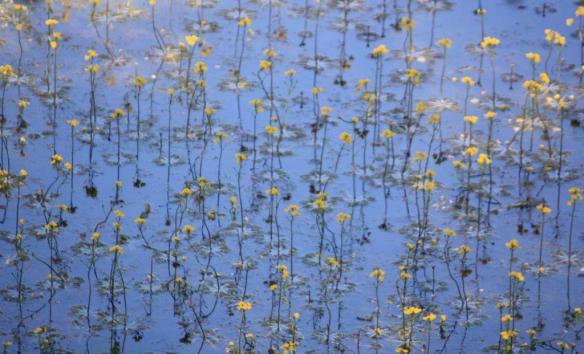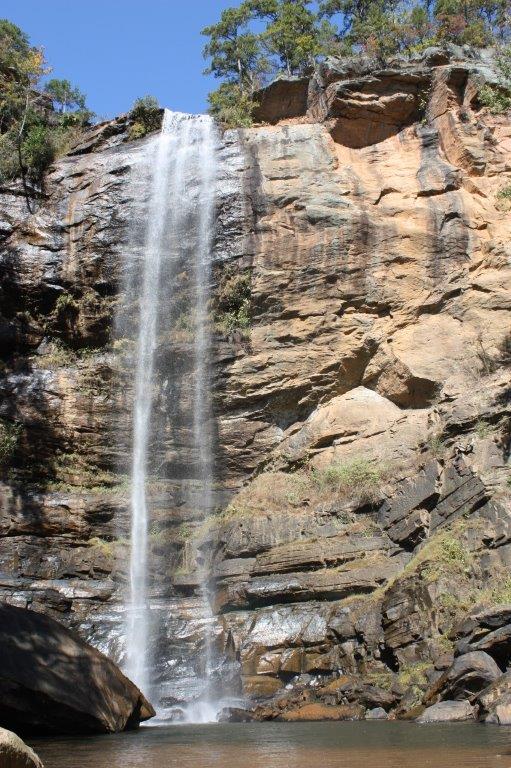
Taken at Toccoa Falls in the autumn of 2011

Taken at Toccoa Falls in the autumn of 2011

Taken in June of 2011 on Stone Mountain

On mountain trails, the sound of running water
— burbling or rushing —
is a stalwart companion.
Even the rushing water, rushes lazily,
having surrendered to gravity.
Stagnation requiring an act of might —
a Herculean struggle against the flow —
that no drop can muster.
Should an unfortunate splash
spray a drop into a rocky pool,
even then,
time will insist it give itself to condensation.
All paths lead to the sea,
but no two paths are the same.

Taken in the autumn of 2011 at Lake Lanier

a mushroom cap
mango and red, burnished
rises from the forest floor
decomposition painted into a setting sun
what a masterpiece nature makes of rotting gunk
 that’s my forest
— deep and dark —
but, yet, I see cracks of azure dome
through the canopy gaps,
and when it undulates
competing species wave together —
tousled by the same hand
so, even though each sways at its own rate,
it looks like one gasping organism
 Second Nature: A Gardener’s Education by Michael Pollan
My rating: 5 of 5 stars
This isn’t simply a discussion of lessons of gardening, though it does tread that ground. However, Pollan uses that topic as a jumping off point to explore a couple of broader topics. First, what defines the American approach to lawns and gardens, which is clearly distinct from that of our Old-World ancestors / comrades? Second, what does it mean to say some approach is more or less “natural” in an ecosystem that has been shaped by the hand of man? As a neophyte balcony-container gardener, I was attracted to the book for its gardening lessons, but I found myself most provoked to thought by these other questions.
This book starts with an Introduction to set the stage and a first chapter that contrasts two approaches to lawn and garden that Pollan saw within his own family. The other eleven chapters are divided into seasonally themed parts. These parts – Spring, Summer, Fall, and Winter – touch upon the life of a gardener during each, respective, season.
The section entitled Spring discusses the challenge of getting plants to grow against the onslaught of competitors and consumers: animal, vegetative, and other. It also discusses mowing, the open approach to lawns found throughout America, and what the latter means for the former. (It has long intrigued me that many Americans who will pledge liberty or death, often aren’t so big on their neighbor’s liberty if said individual’s lawn gets to about four inches of shag.) Lastly, Pollan educates the reader about the gardener’s passion for compost.
The three Summer chapters explore what happens through the middle of the growing phase, including the need to weed. Though Pollan explores the criticisms from the “keep it natural” camp. There’s a lot of discussion of the ideas of Emerson and Thoreau, and how they represented a change from previous thought on the garden. However, the first chapter in this section is about Pollan’s experiences with growing roses, a provocative subject among gardeners, apparently.
Fall is harvest season, but the chapter in this section that I found most intriguing was one about planting a tree. This is where Pollan brings the question of what it means to be “natural” to a head. He discusses a nearby piece of protected forest that was decimated by a tornado. There was an ardent debate between those who thought that nothing should be done with the land and it should be allowed to grow back however nature saw fit and others who thought intervention was necessary. The argument can end up turning a position on its head. What if one does nothing and the land is overtaken by a non-indigenous invasive species?
The last section has an amusing chapter on garden catalogs and how companies’s style and emphasis varies in an attempt to corner a segment of the market.
I enjoyed this book, and would highly recommend it not just for gardeners, but for individuals who have an interest in the interplay between nature and humanity.
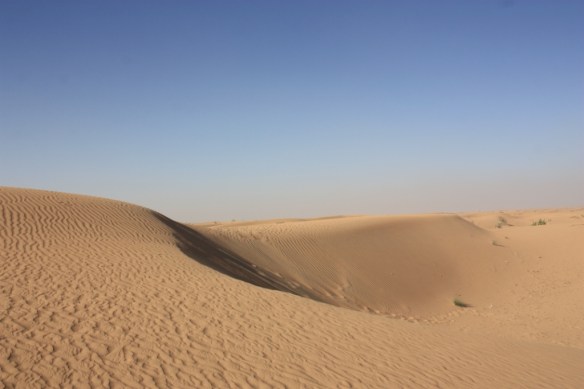
Taken in May of 2016 in the United Arab Emirates

Taken in July of 2014 at Barachukki Falls