BOOK REVIEW: Boxing Fitness by Ian Oliver

Boxing Fitness: A Guide to Get Fighting Fit (Fitness Series)Boxing Fitness: A Guide to Get Fighting Fit by Ian Oliver
My rating: 4 of 5 stars

Amazon page

How does one skip rope, work the pads, or avoid nipple rash? If you think that boxing would be a fun way to get fit, this would probably be a useful book for you. Oliver shows a range of fitness practices—many specific to boxing, but others that are used in a number of sports and fitness activities—that will help one improve one’s fitness.

The reader will gain insight into bagwork, padwork, and boxing drills–from beginner to advanced. While the book’s emphasis isn’t on boxing technique, there’s a minimal discussion of the basics of footwork and punching designed to allow a reader to safely begin practice of bagwork and padwork. One also learns about roadwork, the basics of weightlifting as it’s useful for boxers, calisthenics, and other exercise routines that boxers use. It’s a small book and, therefore, doesn’t go into great detail on any particular subject. However, it does offer useful tips in a concise form.

There’s a chapter on equipment, but throughout the book the author gives advice on equipment as it’s relevant to the discussion at hand. The same is true of safety tips. There’s a chapter on injury and illness, but you’ll find insights into how to avoid injuries woven throughout.

I liked the approach of this book. While it shows one the age-old practices of fighters, it also describes more recent developments. In other words, it’s neither crusty and obsolete, nor does it try to re-invent every wheel in order to prove itself cutting edge. I also appreciated the author’s pragmatism—e.g. emphasizing the benefit of a strong core over that of six-pack building and suggesting dietary practices that are sound and simple rather than fads and fables.

Graphics include black and white photographs throughout a few diagrams. Most chapters have photographs, and they are generally sufficient to convey the necessary information without being overwhelming.

While this is a book of the basics, I found it to be a beneficial read and I appreciated the way it was arranged and the way information was conveyed. I’d recommend it for anyone interested in fitness for combative sports or who thinks boxing would be a good way for them to stay motivated to get fitter.

View all my reviews

BOOK REVIEW: The Harvard Medical School Guide to Tai Chi by Peter M. Wayne & Mark Fuerst

The Harvard Medical School Guide to Tai Chi: 12 Weeks to a Healthy Body, Strong Heart, and Sharp MindThe Harvard Medical School Guide to Tai Chi: 12 Weeks to a Healthy Body, Strong Heart, and Sharp Mind by Peter Wayne
My rating: 5 of 5 stars

Amazon page

This book provides an overview (and a laymen-friendly literature review) of the scientific findings about tai chi, and it helps a beginner get started in his / her own practice. (Tai chi, short for tai chi chuan, is a Chinese martial art that is called an internal–or soft–style.)

The authors achieve an impressive tightrope act. And they manage to do it in a way that reads sincerely, while at the same time providing useful information for all readers. Often books on the science of Eastern health-enhancing activities (e.g. tai chi, chi gong, or yoga)–even if they are positive on the results of such activities—take digs at people’s beliefs about ideas like chi, prana, meridians, or chakra as the authors attempt to distance themselves from such beliefs. On the other hand, books that cater to the spiritually inclined—even when they are couched in scientific terms—may resort to third-hand anecdotes about the supernatural powers of some ancient master or report methodological train wrecks that support their views alongside sound studies, as long as the latter don’t present any evidence contrary to their belief system. In short, such books often talk in scientific lingo while showing a complete lack of understanding of the scientific method. In this book, Wayne manages to navigate these rocky shores because he’s both a scientist and a longtime tai chi practitioner who genuinely accepts that there may be more at work in the practice than science fully understands. Thus, he knows the importance of testable hypotheses and when a study needs to be validated by more a robust follow-up study, but he also reports on the traditional beliefs and isn’t adverse to writing about studies evaluating the benefits of spirituality (note: showing that being spiritual has benefits doesn’t mean that the benefits result from anything spiritual or supernatural.)

The book has 14 chapters divided into three parts. The first part introduces the reader to tai chi, describes the dimensions along which tai chi has been shown to offer benefits (the authors call these “the 8 active ingredients of Tai Chi,” relating them to pharmacological medicines), and explains how tai chi can be simplified for beginners (even the short form sequences take a while to be memorized—let alone building any grasp of the intricacies of said forms.) The second part consists of six chapters that report the findings of studies on the health effects of tai chi, as well as discussing the possible mechanisms of those benefits. The topics discussed in this section include: increased balance, bone density, pain mitigation, cardiovascular health, mental performance, psychological well-being, and sleep quality. The book’s last part suggests ways in which the reader can build a tai chi practice. The five chapters in this section deal with the interactive practices of tai chi (tai chi isn’t just the solo forms that you’ve seen elderly people do in the park), integrating tai chi with other health and fitness practices, the potential for practicing tai chi at work, the role of tai chi in creative practices, and tai chi as a practice of lifelong learning (this last chapter gives beginners tips about how to start a practice.) There is also an afterword about how tai chi might play a part in building improved health and well-being in the present era.

I found the book to be well-organized to achieve its objective. It’s packed with food for thought. Neophytes will find a lot of benefit in this book, but I suspect even advanced practitioners can glean insights—particularly if said advanced practitioner hasn’t been reading up on the scientific findings. Humor, quotes, and stories are used to lighten the tone and illustrate key points. There are some photos and other graphics where needed (mostly in chapter 3), but they are relatively sparse for a book on a practice like tai chi. (That’s not a complaint. I think there are far too many attempts to teach movement arts through books—an impossible task—and not enough effort put into conveying the kind of ancillary information that is transmissible in book form.)

I’d recommend this book for anyone who’s interested in knowing more about the health benefits of tai chi, and moving beyond the platitudes often heard but seldom evaluated.

View all my reviews

BOOK REVIEW: Fight Like a Physicist by Jason Thalken

Fight Like a Physicist: The Incredible Science Behind Martial ArtsFight Like a Physicist: The Incredible Science Behind Martial Arts by Jason Thalken
My rating: 4 of 5 stars

Amazon page

When I saw this book’s title, I imagined a bloodied and battered Poindexter in a bow-tie–a professorial type dying in a puddle of his own bodily fluids as he calculated the Bayesian probability of winning given that initial beating. After all, physics is a highly cerebral activity, and being cerebral in a fight is a certain path to a beat down. However, Thalken makes a good point with his explanation of the title (and the book’s theme.) He’s suggesting that one use tactics and techniques that are supported by evidence and rooted in a sound understanding of the science of combat—as opposed to mindlessly doing whatever your sensei tells you or–worse yet–just muddling through on a combination of instinct and ignorance. In short, be skeptical, but inquiring. It turns out that there is a time for a fighter to be cerebral, but it’s when they are making decisions about how to train.

The book is divided into two parts. The first part explains how classical mechanics can help one to be a better fighter. There are four chapters in this section that deal with center of mass and its crucial role in a fight, the differences between high momentum and high energy strikes and how each is achieved, differences in circular versus linear paths and where the advantage in each lies, and what simple machines (i.e. levers and wedges) can do for a fighter. This section is what one would expect from such a book. Unlike the second section, which deals largely with sport fighters, the advice on offer in the first section is as applicable to those involved in self-defense or other real world combative situations as it is to fighters in the ring.

The second section examines the issue of concussions and brain damage in some detail, including consideration of the degree to which gloves and headgear do—or don’t—make one safer. The reader gains great insight into the mechanics and neuroscience of a knockout. While the majority of the section offers advice for those engaged in combative sports, the last two chapters take a bit of a turn. The first of these two deals with the myths perpetuated by Hollywood—which, let’s face it, is the source of most people’s information on what combat is. Debunking the notion that a person who gets shot is always and everywhere instantly incapacitated is a central theme this chapter. The last chapter deals with the issue of pseudoscience in the martial arts, and the insanity of believing one can defeat an opponent with chi (also qi, or—in Japanese Romanization–ki) or mind power alone. These last two chapters seem like a turn from the main theme of the book, but they do stay under the umbrella of the martial arts through a scientific lens.

While this is a book about science, it’s readable even for an educated non-scientist. All the math is put in boxes that the reader can opt to skip, or to follow, depending upon his or her comfort level with equations. There is no complex jargon, nor any incomprehensible concepts. The physics is largely high school level Newtonian mechanics.

Diehard believers in the supernatural or pseudo-scientific conceptions of the universe should be warned that this isn’t the book for you unless you like your sacred cows flame-broiled. You won’t learn about chi (qi) in this book except to be reminded that it’s a make-believe concept.

I’d recommend this book for those who are interested in how science can be applied to the martial arts or human movement more generally. It’s short, readable, and offers some interesting food for thought.

View all my reviews

Flexibility & Power in Kalaripayattu: Confessions of a Gravitationally-Challenged Student

IMG_4269Learning third level material was when Kalaripayattu became daunting. Until then, it was just exhausting.


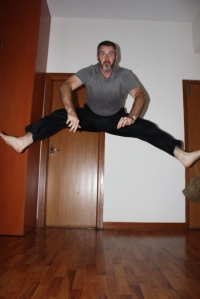
I’d been doing a lap of the kalari consisting of high kicks flowing into Hanumanasana (a scissors split.) Each split is on the opposite side from the last. By yoga standards, my split alignment was off. My hips weren’t perpendicular to my legs, but I’d allowed them to twist open to make the split easier. However, that was probably the least of my errors, and–unlike in yoga practice during which one might take minutes to ease into this intense split–the cadence in kalari was kick – split – struggle to one’s feet. [Okay, the “struggle” shouldn’t have been, but it’s an accurate description of my rendition.]


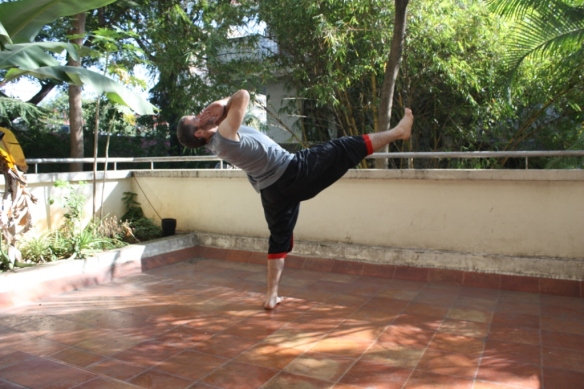
This wasn’t the hard part, by the way. I’ll get to that. The structure of the class up to that point was logically arranged to facilitate those splits. The practice started with warm ups of rapid repetitive motions that got the muscles and core warm. Then there were a series of kicking exercises that also served as dynamic stretches. Next, there was a vertical version of the splits done in a static form. With the inner edge of one’s bottom foot posted along the base board, the heel of one’s upper foot is slid up a piece of wood lathe worn smooth that has been tied vertically–perpendicularly to the steel burglar bars that one uses to pull oneself into the stretch. (This is an inner city kalari, and not the traditional version dug into the ground.) Then one revisits a high kick, swinging the leg with greater intensity. Only then does one do the lap of splits.

A traditional kalari looks like this. This is the Kalari Gurukulam in Chikkagubbi (parent school to the one at which I train.)

A traditional kalari looks like this. This is the Kalari Gurukulam in Chikkagubbi (parent school to the one at which I train.)


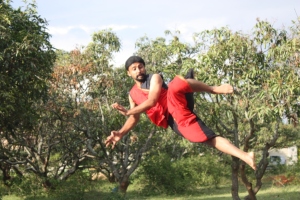
The next piece is where the third level kicked my butt. One’s hamstrings and quads stretched to the max, feeling more like limp noodles than coiled springs, one is now expected to work through a series of leaping maneuvers. There are seven leaping exercises (besides some basic warm-up leaps): a leaping circle kick, a spinning kick that takes one 360-degrees, a split kick in which one leaps up and kicks out laterally in both directions simultaneously, a split kick in which one leaps up spinning 360 degrees [theoretically] and does the same split kick in the middle, a flip kick in which one kicks up and forward and flips one’s body over in mid-air to come down on one’s hands and feet (in a lunged position with palms down next to the feet), and then there are two versions of leaping/spinning kicks that proceed down the length of the kalari.


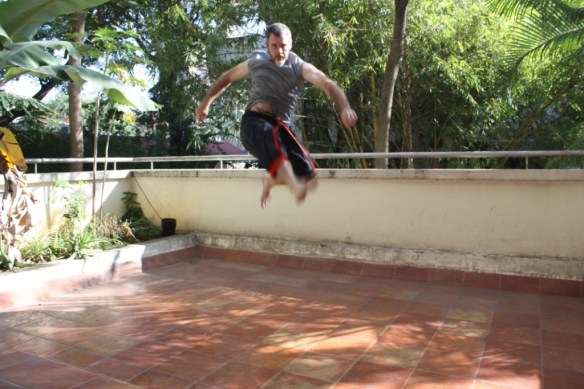
IMG_1661Why does one do these plyometric techniques in the wake of such intense stretching? I suspect that experts in exercise science would tell me this isn’t the best way to improve my leaps. One should do the leaps when one’s muscles are more like rubber bands than al dente linguine. Still, I dutifully comply. Maybe there’s an ancient wisdom at work here. Maybe there’s not. There’s no way to find out without giving it a try. I fall down a number of times that first day, and on all subsequent sessions. As I write this, I’m now learning level five material, but I continue to revisit the leaps every session for two reasons. First, I’m not happy with my abilities. Second, I want to find out whether I can improve my balance of flexibility and power, and whether the kalari approach does the trick. (Note: I’m using the word “power” in the specific sense of work performed per unit time. In other words, it’s not synonymous with strength. It’s a function of both speed and strength.) At any rate, I still fall down.


IMG_2278However, looking beyond my own limited capacity to have my cake and eat it too (i.e. retain flexibility as I gain power), I see evidence of the success of this approach. There are a number of advanced people who’ve been using this approach for many years and have a preternatural balance of flexibility and jet propulsion. Said individuals seem to go from deep stretches to phenomenal vertical leaps without difficulty.


If nothing else, I’ve learned a great deal about my muscular composition. While I’m challenged by ballistic movements, my stamina is quite respectable. Type I (slow twitch) musculature seems to be disproportionately common in comparison to type II (fast twitch) in my body. While I’m including more power building training in my workouts, my progress is glacial. If I was smart, I’d take up long-distance running or some other endurance activity. But I tend to find such activities tedious, while I love the martial arts. And so I struggle.

IMG_4275


2015 Top 10: Highlights From the Year That Was

These aren’t necessarily in any order.


1.) Trekking the Great Himalayan National Park [June]:

IMG_1898


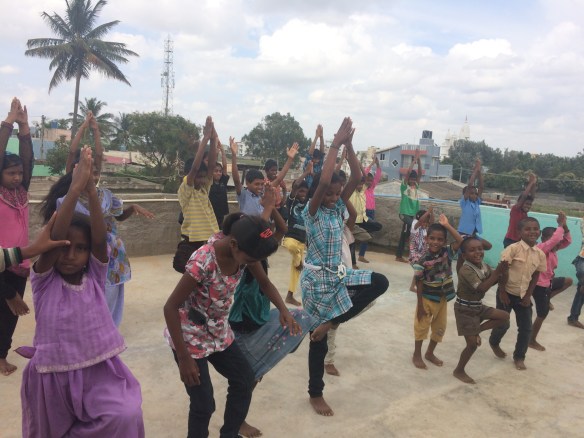
2.) Teaching kids at KAMMS and Socare [September & October]: I finished my RCYT course in April and have been teaching kids when I have a chance:

IMG_0101


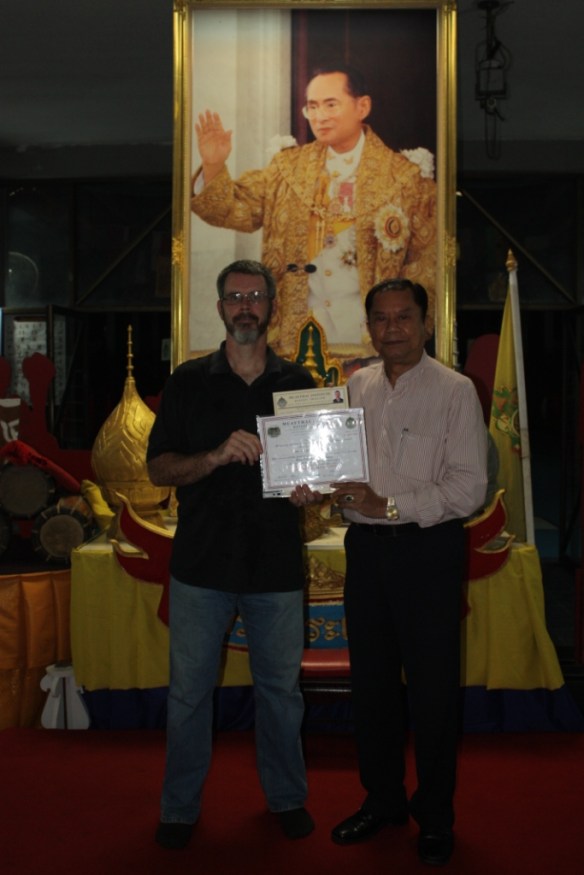
3.) Completing Level I Examination at the Muay Thai Institute [September]:

IMG_1926


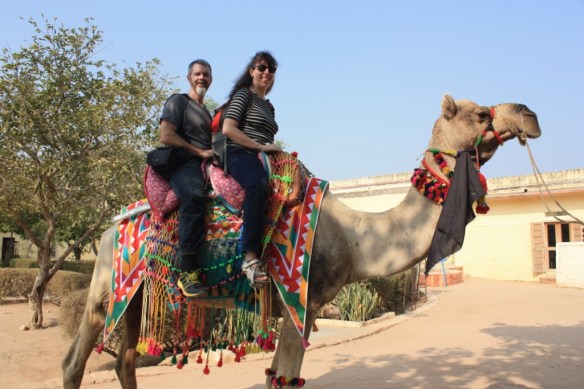
4.) Riding camels at Pushkar and Jaipur [November]:

IMG_3002


5.) Boating on the Ganges in Varanasi [October]:

IMG_3538


6.) Wandering around a coffee plantation near Chikmaglur [April]:

IMG_1966


7.) Completing the Level III and IV reviews in Kalaripayattu [February & August]:

IMG_4289


8.) Touring the Glenloch tea factory in Sri Lanka [May]:

IMG_0572


9.) 108 Surya Namaskara Against Child Trafficking [March]:

IMG_3331


10.) Junk boat tour of Ha Long Bay, Vietnam [December]: This may be jinxing us to put it on the list,  before we’ve been (we leave tomorrow) but I’m optimistic that our three weeks in Vietnam will be awesome, and I’m told Ha Long


What to expect in 2016? Lilla and I will be moving back to the States around mid-year. (To where, exactly, remains a mystery.) In January and February I’ll be doing an RYT-300 course to round out my 500 hour yoga teacher certification. I plan to make at least one more trip to Thailand to MTI for Level II. I’d also like to complete the 10-day Vipassana meditation course before returning. Lilla and I are thinking about another Himalaya trek for the summer.

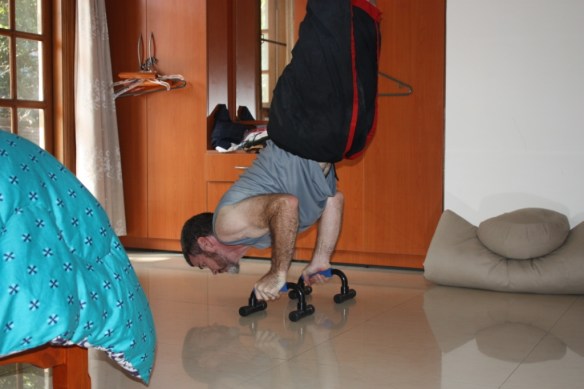
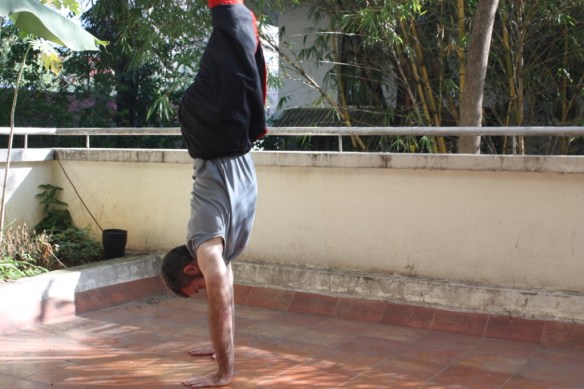
I’ll also be continuing to work on press handstand progression, as that’s been a focus for me of late and I still have a ways to go.

IMG_4354

IMG_4342

BOOK REVIEW: Ninja: A History by John Man

Ninja: 1,000 Years of the Shadow WarriorNinja: 1,000 Years of the Shadow Warrior by John Man
My rating: 3 of 5 stars

Amazon page

The author, John Man, isn’t the first historian to fall for the siren call of ninja history only to plummet into a catch-22, but he’s the one I’m reviewing right now. So, while his book isn’t exceptionally bad, it’s tremendously flawed in a manner common across ninja histories. What is said catch-22? On the one hand, ninja excite the imagination and a half-way decent book on them is sure to sell. On the other hand, there’s very little known about the ninja. If the myth of the ninja is an elephant, the ninja as we truly know him is a grasshopper. [So much so that the first Westerner to write such a history, Stephen Turnbull, has now spun 180, proposing that the ninja never existed but were purely a post-Warring States construct.] While it would seem that Turnbull goes too far given the existence of manuals and vague mentions, what we don’t know about are the nitty-gritty details of ninja missions and those are the stories that the reader desires but which time and the ninja’s legendary secrecy have put forever beyond our reach.

What is in the book? If not tales of ninja stealing into castles to abscond with information or to assassinate an enemy General, and the effect of those actions on the outcome of wars? First, there’s a lot of information that is already widely available in other English language books, such as the influence of Sun Tzu’s chapter on espionage on the birth of the ninja (probably spurious given the centuries in between) and description of the seven types of disguises. Second, there’s a lot of general Japanese history that is necessary to some degree as background, but at some point one realizes the author has ventured beyond background into padding. Finally, speaking of padding, about a third of the book by page count (cleverly disguised as only three chapters) occurs long after the end of the ninja. Don’t get me wrong; some of the World War II material is fascinating, but it’s as if one were reading a biography of Blackbeard and—all of a sudden—one finds oneself reading about a Somali hijacking of container ships in 2011. (Even while you are fascinated, you can’t help but feel that you’ve been the victim of bait-and-switch.) In short, the book has a lot of repetition and padding, and not much that’s both new and on topic. (One of the reasons that I didn’t give the book too low a rating is that if it’s the first book you are reading on the subject, it’s readable and interesting.)

There’s one more flaw that comes from the dearth of information. The author cites everyone and anyone who has said something interesting on the subject, but we don’t really know how reputable said sources are. Some may be sterling and others full-of-shit. It’s easy to say something fascinating about the ninja; it’s much more difficult to say something that’s true and fascinating.

So what does the book do right? It’s well written in terms of being readable and offering frequent mind candy. The author does challenge a few statements as he reports them. My last paragraph may have led one to believe that Man just shot-gunned information out there, but he actually takes a suitably skeptical view for addressing such a murky topic. The problem is that we don’t know how serious to take claims he refutes or those he appears to endorse because he’s not an expert in the field. He is an Asianist historian with a list of books that is all over the map. [I did see just one factual error in which he refers to the companion sword of a samurai as a tanto. A tanto is a dagger, the companion to the katana is the wakizashi. But I don’t know how big of a deal to make out of that sin as I can’t say that I noticed any others (not that I necessarily would as I’m no expert either.) On the other hand, a little fact checking…]

If you’ve never read a history of the ninja before, you’ll probably find this one interesting. If you’ve read the other books out there, it’s less clear that you will. However, I did find the discussion of Iga no Ran (the battle of Iga, a campaign meant to crush the ninja of Iga) to be intriguing. At any rate, as long as you realize the last one-third of the book is off-theme and are alright with that, you should find it palatable.

View all my reviews

BOOK REVIEW: The Karate Way by Dave Lowry

The Karate Way: Discovering the Spirit of PracticeThe Karate Way: Discovering the Spirit of Practice by Dave Lowry
My rating: 3 of 5 stars

Amazon page

This book collects 29 essays on karate—specifically, traditional Okinawan Karate–into a slim volume. I suspect the essays were initially either magazine columns or possibly blog posts because they all weigh in at a similar length, i.e. six pages. This isn’t to say they weren’t reworked or edited for inclusion into the book, it’s just conspicuous that the chapters to stick to such a tight word count restraint. It’s also evident in the lack of cohesive organizational structure—i.e. the essays don’t build on each other or reference each other, and it doesn’t read like a book that was built from an outline up. This isn’t meant as criticism (that’s coming later.) It’s a perfectly respectable approach to building a book, and the word constraints probably made the book more concise, and the lack of rigid organizational structure likely made it more creative.

Lowry covers a wide range of topics that a student of karate (or one considering becoming one) might find valuable. The questions addressed include: How does one keep motivated? Which is better a teacher who is technically a genius but morally a jackass or one that couldn’t fight his way out of a wet paper sack but is the pinnacle of virtue? Does one need to go to Japan to get high level training? How important is rank and a black belt? Does one need to hit things? What was training like in the old days? Some chapters deal more with technical aspects of common techniques (e.g. side kicks, stance, front thrust kick, etc.), but not in a highly technical or detailed manner (e.g. there are no graphics in the book.) Other essays deal with the philosophy of martial arts (e.g. “victory is in the scabbard”) and/or foreign concepts that may seem strange to a Westerner (“buji kore kaere meiba,” or “it’s a noteworthy horse that can return its rider to safety.”)

I found the book interesting, although it’s not my favorite Dave Lowry book for reasons I’ll get into below. The author does provide interesting insight into the history and development of karate over time. For example, I learned that historically Okinawan karate teachers weren’t so interactive with students as one expects today (this reminded me of what I’ve been told about old school yoga teachers who would quietly watch from a seated position at a distance.) I was also fascinated by the discussion of how “ikken hisatsu” (killing with a single blow) wasn’t a part of Okinawan karate in the early days, though it’s a ubiquitous (if ridiculous) feature of the tactics of many karate styles today. However, one is left feeling—as one sometimes does as a student of Japanese martial arts—a little like one is being told to shut up and accept that it’s just the way it is.

Any book that begins with an apology for sounding pretentious is likely going to be grating in places, and Lowry doesn’t disappoint in that regard. He does display some of the “self-congratulatory smugness” that he claims wasn’t his intent. It’s most notably seen in gratuitous assertions that he puts across as truisms but which seem more controversial. It feels as though he figures that you bought the book because you take him as the expert and will defer to whatever he says. A lot of said assertions involve accepting the traditional way because it’s such a grand avenue to personal growth and development—except that it doesn’t seem like it is. (It seems like a good way to build an army—e.g. blind obedience and faith-based martial arts [by this I mean eschewing competition and randori—free form training / sparring–in favor of form-based practice], but a poor route to personal growth. Note: maybe the preceding sentence is entirely wrong, but you won’t find out why in Lowry’s book because he takes the virtue of the traditional approach as axiomatic.)

Having leveled my criticism, I will say that Lowry is great at explaining himself and making analogies as necessary. He is incredibly knowledgeable. The book is readable and frequently interesting. I’d recommend it for martial artists—whether they practice karate or other styles/systems—but some readers are likely find it more appealing than others. I suspect the more in tune one is with the traditional Okinawan and Japanese approach to martial arts (i.e. in Lowry’s words if you practice “serious karate”) the more satisfying you’ll find this book (you, too, can radiate the glow of self-congratulatory smugness.) If you question the value of the traditional approach and wonder on what basis one should take it as superior, then you’ll probably find the book less satisfying—but still thought-provoking.

View all my reviews

BOOK REVIEW: Legends of the Martial Arts Masters by Susan Lynn Peterson

Legends of the Martial Arts MastersLegends of the Martial Arts Masters by Susan Lynn Peterson
My rating: 4 of 5 stars

Amazon page

This book consists of 21 short stories from the lives of martial arts masters: some modern, some historical, and some anonymous folktales with unknown origins. The majority of the stories are about Japanese or Okinawan martial artists, but Chinese, Thai, American, and Koreans are also represented.

These stories can be roughly grouped by theme (though they aren’t organized in that way in the book and some stories cut across more than one of the themes.) The first theme is peacefulness, non-violence, or minimization of violence. This idea is central to the stories featuring Tsukahara Bokuden and his school of “no sword,” Yasutsune Itosu who invites an attacker for tea, Hisamori Takenouchi who is taught the folly of war by an old man, and Gichin Funokoshi who gives robbers cake.

The second theme is the power of an immovable mindset. This can be seen in the story of the sumo wrestler Onami who had to overcome a stint of choking, the parable of the tea master who is challenged to a duel and is advised by a swordsmanship teacher to take up the sword with the mindset with which he takes up his tea utensils, and the tale of the unbreakable prisoner Gogen Yamaguchi. There are also stories about the ability to win by preventing the opponent from achieving this mindset. This was most famously achieved by Miyamoto Musashi (on several occasions,) but it’s also seen in the story about an archer who is unable to make a shot from a perilous position even though the shot wouldn’t be a hard one for him from stable ground.

The third theme is the importance of the student/teacher relationship and the value of a teacher’s wisdom. This can be seen in the stories about American Karate founder Robert Trias and his experience with the master who wanted to trade him Hsing-I lessons for his own boxing lessons, about Morihei Ueshiba’s demystification of mysteries that perplexed his students, and about Chatan Yara’s reversal of a would-be student’s tactic.

The final story theme deals with the virtue of being diligent in one’s training. These include the amazing feats of the likes of Sokon Matsumura (an Okinawan fighter who fought a bull), Nai Khanom Tom (a Muay Thai legend who defeated twelve of Burma’s best fighters in rapid succession), and Mas Oyama who sentenced himself to training exile for what most would consider a minute infraction. There are other tales in this category such as how Duk Ki Song and other Korean students practiced secretly under a martial arts prohibition or how Yim Wing Chun got out of an arranged marriage to a cad through her diligent training.

This is a short book (about 120 pages) and most stories are only 4 to 6 pages. If you are a long-time practitioner of martial arts, you’ll probably have heard some of these stories, but you’re also likely to come across something new. There are obscure tales intertwined with one so popular it’s been made into multiple movies (e.g. Mu-lan.)

It should be noted that this is more of a collection of morality tales than historical accounts. One shouldn’t take these stories as established history as opposed to mythology or folktales. To her credit, Peterson leaves tales like the parable of the tea master and the tale of the three sons anonymous. Famous martial artists, like Miyamoto Musashi, are often cast into these stories either because people read a fictional account that borrowed from folktales, to lend more power to the story, or because the facts have become muddled in retelling. However, for example, the chapter on the Bodhidharma is most likely wrong. (The consensus view among historians is that Bodhidharma didn’t introduce martial arts to the Shaolin temple as is popularly thought, and that the popular myth is the result of revisionist history.) That doesn’t mean the story doesn’t have virtue—it’s got great hang time for some reason.

I’d recommend this book for martial artists who are interested in the philosophy and ethos of the martial arts. It’s a quick and easy read.

View all my reviews

BOOK REVIEW: When Buddhists Attack by Jeffery K. Mann

When Buddhists Attack: The Curious Relationship Between Zen and the Martial ArtsWhen Buddhists Attack: The Curious Relationship Between Zen and the Martial Arts by Jeffrey K. Mann
My rating: 4 of 5 stars

Amazon page

Mann’s book considers one of Asian history’s intriguing little questions: How is it that one of the most pacifistic of world religions, i.e. Buddhism, came to be integrally connected to some of the world’s most fearsome and devastatingly effective warriors? Specifically, the author looks at the connection of Zen Buddhism to warrior traditions like the samurai of Japan and—to a lesser extent—the Shaolin monks of China. It should be noted that while Zen was one of the most firmly established intersects of Buddhism and martial arts; it’s not the only one. Branches of Vajrayana (esoteric) Buddhism had their own warrior-monk traditions—which he mentions as well as Shugendō’s (combines Buddhist, Shinto, and Taoist elements) warrior connection. The book is heavily weighted toward the Japanese martial arts. This may be in part owing to the author’s particular background, but also because many of the works that establish this firm connection between Zen and martial arts are Japanese (e.g. works by Takuan Sōhō, Yagyū Munenori, and even Miyamoto Musashi.)

It’s worth noting that both Buddhists and modern martial artists have tried to downplay or outright deny the connection between these traditions. However, Mann suggests the connection is undeniable in the face of historical evidence, and that it even has a logic that belies the apparent contradiction. (Note: Presumably many Buddhists deny this connection because they want to distance themselves from the taint of violence, and many modern martial artists deny it so their religious students won’t ditch the art because it isn’t 100% secular [or based entirely in the student’s religious belief structure.])

The book consists of eight chapters as well as front matter and an Epilogue that explores the question of whether the Zen of samurai lore is truly Zen Buddhism. The first couple chapters give the reader an introduction to Buddhism and, specifically Zen. There are then chapters that show the linkage between Zen and the martial arts of East Asia. The book then considers the nature of the advantages offered by Zen to martial artists that made it so appealing to warriors like the samurai. It also considers the interpretation of violence that allows for the dichotomy under discussion, and explores the degree to which the connection between Zen Buddhism and martial arts is relevant in the modern era. The book is a mix of history, religious studies, philosophy, and the art and science of fighting systems. So if one’s interests are eclectic, there’s a lot to take away from this book. If you have narrow interests, you’ll want to make sure they include the aforementioned central question (i.e. Why pacifistic Buddhism has helped produce some of the world’s greatest fighting systems.)

The book is well-researched and documented. There are many interesting and informative stories throughout the book. For example, I’d never read about the 19th century jujutsu murders until this book. This is a fascinating case in which several experienced students of one particular school of jujutsu were found dead with the exact same wound. While the murderer wasn’t captured, investigators quickly discerned his (or her) method. That is, the killer knew the trained responses of this school and made a feint to draw a certain defense and then exploited a vulnerability the response presented. How is this story relevant? It speaks to the perceived advantages of Zen, which emphasizes avoiding habituation and residing in the moment.

I’d recommend this book for martial artists who are interested in the history and cultural context of their arts [and of the martial arts in general.] There’s a class of martial arts student who may want to avoid the book. If you’re a devout adherent of a Western religion who practices a traditional style of East Asian martial art and think that there isn’t an imprint of the local religion on that art, your delusions may be shattered by this book. Buddhists may find the discussion of the less absolutist interpretation of ahimsa (non-violence) to be illuminating (or—for all I know—infuriating.) It’s a short book, coming in at around 200 pages, but is end-noted and referenced in the manner of a scholarly work. It has a glossary and bibliography, but no graphics.

View all my reviews

The Most Dangerous Combative Sport? Study Shows Boxing Beats MMA for Brutality

kangaroo_boxingA study by researchers at the University of Alberta found that while mixed martial arts (MMA) fighters are more likely to suffer minor injuries, boxers are more likely to suffer severe injuries like concussions or detached retinas. The study, to appear in the print edition of the Clinical Journal of Sports Medicine, involved 1181 mixed martial artists and 550 boxers who’d fought in Edmonton between 2003 and 2013. This was all fighters who fought professionally in that city in those two sports.

This finding seems counter-intuitive, given that so many more methods of delivering mayhem are allowed in MMA and the protection is less at least with respect to gloves.

Gloves may be an important factor. This isn’t a result from the aforementioned study, but it’s an idea put forth by MMA boosters. It goes like this, “Yes, the lightweight MMA glove offers less protection to the one being hit, but it also offers less protection to the hand of the one delivering the hit, and, ergo,  an MMA fighter is more likely to moderate his / her punches to avoid the (in this case ironically-named) ‘boxer’s break’ to the bones of said fighter’s hand.”

MMA style gloves on the left and 16oz. boxing gloves on the right

MMA style gloves on the left and 16oz. boxing gloves on the right (the same hand fits inside.)


I haven’t seen any rigorous scientific studies of whether the argument above has merit. There was a National Geographic Fight Science episode that made a comparison of gloves, but it was looking at a little different question. It studied how much force barehand, MMA glove, and boxing glove delivered to a heavy bag. Incidentally, it found minimal difference in force delivered between the two types of gloves, which at least might help to hush those who make a big deal about MMA’s “thin gloves.” However, this doesn’t tell us whether fighters put the same level of force into hitting a bony target when wearing the two types of gloves. Still a YouTube clip of the test is below for your information.


There are other explanations for why MMA fights might be less prone to cause concussions and severe head injuries. For example, there’s less time spent at an optimal distance to deliver strikes with maximal force. Once fighters are in close, there’s less room to get strikes up to speed. Once fighters are on the ground, putting a lot of body weight into a strike may be impossible. While submissions, whether chokes or joint locks, may seem brutal to the home viewing audience, it’s not clear that they result in major injuries to anything but the fighter’s self-esteem. (Though this might be an area that needs to be factored into studies.)

I’d like to see how muay thai compares to the two sports covered in the aforementioned study. I suspect it’s the only combative sport that might beat out these two. (All the nastiness of boxing, none of the close range grappling, plus elbows and shins to the side of the head.) Though, who knows?  Judoka do seem to land on their heads an unfortunate percentage of the time.

I’m curious about what you think about which combative sport is most damaging, and why?

FYI: The citation for the study mentioned above is:
Karpman, Shelby, et al. 2015. Combative Sports Injuries: An Edmonton Retrospective. Clinical Journal of Sports Medicine. To be published. Available on-line at: http://journals.lww.com/cjsportsmed/Abstract/publishahead/Combative_Sports_Injuries___An_Edmonton.99628.aspx. Last accessed: November 13, 2015