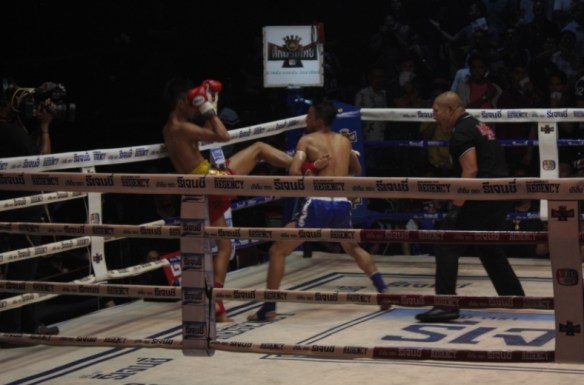
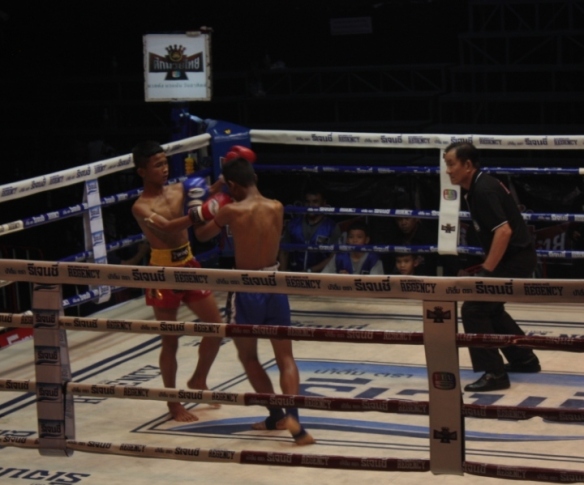
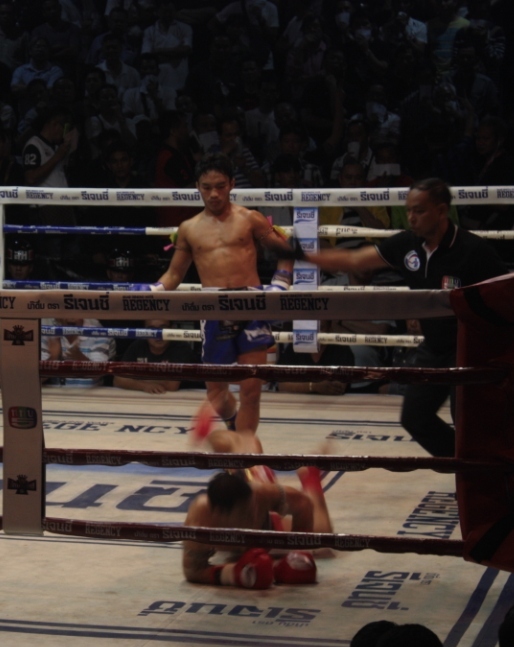
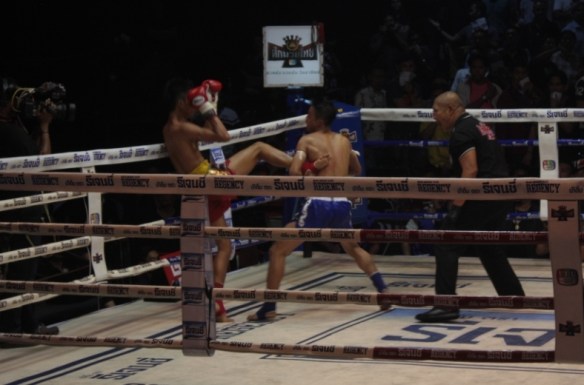
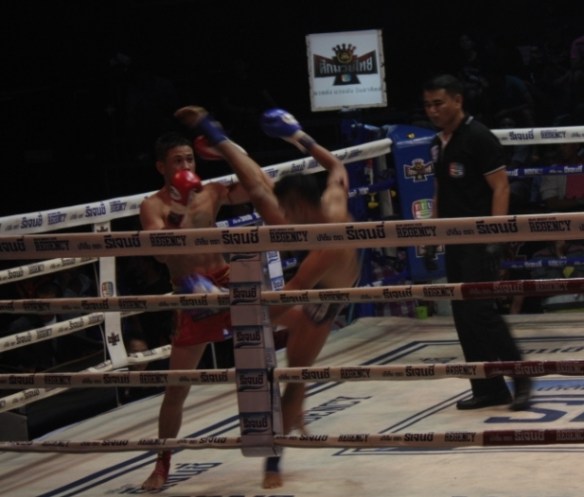
DAILY PHOTO: Rangsit Fight Night Takedowns

Taken on February 19, 2017 at Rangsit Boxing Stadium

Taken on February 19, 2017 at Rangsit Boxing Stadium


img_6515

img_6458

img_6344

img_6338

img_6560

BOOK REVIEW: Let Every Breath by Scott Meredith

Let Every Breath: Secrets of the Russian Breath MastersLet Every Breath: Secrets of the Russian Breath Masters by Vladimir Vasiliev
My rating: 3 of 5 stars

Amazon page


This book presents an introduction to breath exercises employed by the Russian martial art called Systema. Systema is one of a number of drill & spar-centric (as opposed to technique-centric) martial arts that have developed in modern times in an attempt to cast off the unrealistic and needlessly complicated elements that tend to grow within traditional martial arts (e.g. Krav Maga is a well-known exemplar of such a martial art.) Among the unique aspects of this system is its focus on, and approach to, breath—and breath is crucial in the martial arts, in a fight, and in life.

I had mixed feelings about this book. I’ll begin with positive aspects and then get into what I found off-putting. First, the book offers a clear explanation of principles and drills that are straight forward and will increase one’s awareness of breath. That is laudable. Are these particular principles and drills the end-all-be-all that will take one to heights that no other approach to breathing could (as the book suggests?) No. But is it a solid approach to breath that will yield benefits by making you more aware of breath while helping you to use it more effectively? Yes. Second, the book doesn’t have a lot of competitors in the “breathing for martial arts” space, and so it fits into a substantial void. (Note: the book doesn’t get into martial arts / self-defense drills or techniques, and doesn’t claim to.)

Now, here’s the other half of the open-faced shit sandwich. You’ve likely already gotten a hint of my problem with the book. This will seem like a two-part criticism, but it condenses into one problem with the book’s attempt to sell the reader on Systema. The starting point, as another reviewer noted, is that this system isn’t as completely novel and unmatched as is presented. Is that a damning indictment? It wouldn’t be. Just because this approach shares concepts applied elsewhere and is constrained by the nature of the human body doesn’t mean that it can’t offer its own unique value-added. The problem is that we are told how unique and completely peerless this system is so often that it becomes a bad info-mercial.

I get it. Systema is a product that has to compete in an intense market place with the likes of Krav Maga, MMA, Total Combat Systems, Defendu, and a ton of other self-protection oriented martial arts. It’s Pepsi, and it has to carve out a market share by convincing us of the unlikely fact that Coke products aren’t even in the same ballpark. The problem is that when it dismisses systems like yogic pranayama and Taoist chi gong, it does so in a way that shows virtually no understanding of those systems. When the author is telling us how the Systema approach to breath is superior to pranayama, he describes an asana (posture-oriented) class. If you’re going to convince us that the several thousand year old yogic tradition completely missed an approach to breath so groundbreaking that it will take one on an e-ticket ride to self-perfection, at least have some idea of the scope of what the yogis learned and how they present those lessons to their students.

The second half of this rant is that there is a lot of hagiography to delve through before one gets to the meat of the subject. Now, in general, authors of martial arts books tend to pay homage to their teachers and lineage. It’s not unreasonable that there is some near-deification of teachers in this book. However, at some point it becomes hard to tell whether the book exists to inform readers or as a monument to someone’s ego. This book gets disconcertingly close to the line. (The arrogance issue is made worse by confusion about authorship. It’s said that Meredith wrote the book, but Vladimir Vasiliev takes the by-line. This creates an odd situation because the book tells us how Vasiliev is both an exceptional human being, and humble as well. You can see my problem. Without evidence to the contrary, I can easily accept that Vasiliev is exceptional. I can also believe that he is humble. But when a book with his name on it tells me both of these things, I’m forced by the dictates of logic to reject at least one of them [and doubt is cast upon both.])

If you are looking to expand your understanding and awareness of breath, you may want to give this book a try. I certainly wouldn’t endorse every claim it makes, but there are some interesting ideas presented.

View all my reviews

5 Bits of Ancient Eastern Wisdom to Make Your Modern Western Life Happier

img_12811.) The Dispassionate Witness:  A person’s default setting is to repress emotions and pretend they don’t exist. On the one hand, this seems to work because others rarely notice one’s clenched jaw or downing of Prozac, and it’s true that fist-fights rarely break out in workplaces and classrooms. On the other hand, this approach leads to a lot of passive-aggressive behavior and stress-related illness. I just read in some material on Flow and business that 2/3rds of performance issues in businesses result from strained relationships.

The alternative is to take time to observe one’s emotional state, but to watch it without dumping fuel onto the fire. This process puts one’s feelings in perspective so that one can respond in a careful, but not repressed, manner. It doesn’t mean one won’t still be mad, sad, or scared, but one will be in a position to act in a manner that is neither petty and knee-jerk, nor one that consists of gobbling antacids. This brings us to #2.


2.) The Second Dart: [Siddhartha Gotama] Buddha talked about the mind’s response to an event as the second dart, suggesting that the second dart produces much more prolonged misery than the first. Imagine one is walking along and gets hit by a dart. Ow!  It hurts. But what makes it agonizing is when one’s mind becomes obsessed with the injury. It’s unfair that someone threw a dart at me. What if the wound doesn’t heal right? What if the wound heals up too well, and I don’t have a cool scar at story time?

This point is closely related to #1. One has to observe, but not let mind run wild. The first dart is real. The second dart is immaterial, a figment of the mind.


3.) Relaxation is Part of the Process: Anyone who’s attended a yoga class is familiar with closing in savasana (corpse pose.)  Occasionally, a student wants to get up and walk out at this point. They “aren’t paying __ $’s to lay around on their a##.” For Americans, rest is something begrudgingly accepted between actually doing stuff.

The problem with the “rest as laziness” approach isn’t just that one is likely to suffer a relaxation deficit, but also that the rest one gets isn’t effective. But how can rest be effective? I’m glad you asked. Because when you’re doing savasana or yoga nidra (yogic sleep) you’re not just letting your monkey mind run wild as it does when one is watching television or stuck in afternoon rush hour.


4.) Breath is Anything but Mundane: Since breathing is constantly going on and one can choose not to think about it, people dismiss it as unworthy of consideration. However, breath is the one point at which we can consciously influence our autonomic nervous system. [Well, there’s also blinking, but to my knowledge there’s no evidence that one can adjust one’s energy level or emotional state through blinking–but you can with breath.]  Breath is the key to improved physical performance, but it’s also a powerful tool to train the mind.


5.) Use the Belly: I haven’t studied a large number of martial arts, but I’ve trained in a diverse few that were extremely different in both approach and priorities. It could be said that these arts (budō, tai chi chuan, muaythai, and kalaripayattu) had nothing in common. Except they did. They all valued strength in a point below the navel. Sometimes it was called dan tien; other times tanden. However, regardless of the pronunciation, name, or the precise anatomical location, there was this commonality.

Strength in the belly is tied to both breath and mental concentration.

img_1786

BOOK REVIEW: Zen Bow, Zen Arrow by John Stevens

Zen Bow, Zen Arrow: The Life and Teachings of Awa Kenzo, the Archery Master from Zen Bow, Zen Arrow: The Life and Teachings of Awa Kenzo, the Archery Master from “Zen in the Art of Archery” by John Stevens
My rating: 4 of 5 stars

Amazon page


Awa Kenzo is variously known as an archer without compare, a Zen master, or as the teacher of Eugene Herrigel. Herrigel was a German philosopher who wrote a thin book entitled, “Zen in the Art of Archery” that gained a global following. Herrigel’s book was about his time as a student of Kenzo and the insight that he gained into both Zen and Kyūdō—Japanese style archery—through his studies. Kenzo lived from 1880 to 1939, a period during which arts like kyūdō were used more for development of character than as fighting arts, and Kenzo was important figure in this transformation.

Stevens’ book is a thin volume (< 100 pages) consisting of three parts. The first is a short biography of Awa Kenzo. One shouldn’t expect a thorough treatment, but that may be for the best (i.e. Kenzo’s life is of interest because of his mastery of archery, but probably only his most ardent fans would want to read a 400 page biography on his life.)


The second part is a set of lessons and aphorisms attributed to the master archer. This section includes a few pages by the author to put Kenzo’s brief statements in context. The lessons themselves are sometimes in prose, sometimes in poetry, and occasionally in the form of lists. These lessons offer insight into archery, mindset, and life in general. Archery is portrayed as a lifestyle.

The third section consists of three short (very short) stories in which archery as a means to develop one’s character is at the forefront.

In addition to the three sections, the book includes front matter, annotations, a bibliography, and a few photos.

I enjoyed this book and would recommend it for those seeking insight into the nexus between Zen and the martial arts.

View all my reviews

BOOK REVIEW: Meditations on Violence by Rory Miller

Meditations on Violence: A Comparison of Martial Arts Training & Real World ViolenceMeditations on Violence: A Comparison of Martial Arts Training & Real World Violence by Rory Miller
My rating: 5 of 5 stars

Amazon page


I’ve long realized that all martial arts are models. Models are simplifications; they inevitably leave elements out—sometimes because those elements don’t seem relevant and sometimes because they can’t realistically (re: sanely) be included. Those of us trained as social scientists say two things about models. 1.) All models are wrong, and 2.) All models lie. The question is whether your martial art is the least wrong, i.e. tells the most acceptable lie, for your purposes. Rory Miller’s work illuminates the most crucial part of what martial arts leave aside, violence and the context in which it takes place in the modern world. I say the most crucial part because it’s not excluded because it’s irrelevant; it’s left out because it’s impossible to shun safety / encourage violence without the practice devolving into a last man standing competition. (FYI: If you’re saying, “Man, the martial art I study is completely street realistic,” then you need this book more than anyone.)

While it’s important to have safety in a training environment and, therefore, true violence must be prohibited (simulated, but not carried out), it’s important to understand violence so that one can prepare one’s mind for it and train oneself to recognize various types of violence so that one knows the best approach to avoid a bad outcome. One doesn’t want to end up wondering “how could this happen” as one is bleeding out on the ground as martial artists from a range of styles have experienced. I’m not saying martial arts aren’t valuable, and I don’t think Miller is either (he’s long practiced them, as have I.) While martial arts may not prepare one perfectly for a violent conflict, they move one in the right direction. The only real downside is if one allows oneself to be deluded into thinking one is going to roll through waves of enemies without a scratch like Jet Li or Steven Seagal on the silver screen. That’s why it’s important not only to read such a book as this, but to give serious thought to changing the narrative that plays out in one’s mind about the nature of violence so as to move it away from movie / sport fighting towards an approach that is most likely to get one and one’s loved ones out alive.

The book consists of seven chapters, plus front and back matter. The first chapter introduces two matrices as ways to frame one’s thoughts on the conflict. The first, the tactical matrix, looks at different types of attacks one might experience (eg. surprise ambush through preemptive attack) relative to allowable use of force (can one legitimately injure or kill one’s opponent?) The second, the strategic matrix, considers the various types of combative endeavors (e.g. self-defense, duel, sport, combat/military operations) and there goals, approaches, and dangers.

Chapter two is entitled, “How to Think,” and the emphasis is on “to think.” The central lesson is to not take ideas on faith, particularly ideas about the nature of violence from people who haven’t experienced it—particularly when those ideas seem to run counter to reality. Because violence is such a rarity, it is a subject for which there is a great disconnect between expertise and experience. (i.e. Chances are your plumber has unclogged tens to thousands of drains, but also that the person teaching you knife disarms has never been in a single knife fight.) The chapter considers the various fallacies and how they can be resistant to destruction. Emphasis is given to understanding your goals, making them realistic, and having a pragmatic path to achieving them. The take-away quote is, “Do not let yourself be crippled by something that only exists in your mind.” The chapter ends by looking at decision-making at the speed of a fight, which is pretty quick.

Chapter three gets to the heart of the subject, violence. It differentiates various types of violence, and considers the context (setting, timing, and the nature of the interaction) in which violent interactions take place. Much of the discussion revolves around what Miller calls the “monkey dance” -an attempt to exert dominance that often escalates into a fight. This is differentiated from predatory violence that demands a different approach. This section also addresses the neurochemical cocktail that gets shot into one’s system and the effects that it typically has—which is a leading cause of events unfolding differently than expected.

Chapter four describes the various types of individuals with whom one might find oneself engaged in a violent altercation. This is an important topic because the path to a best outcome varies depending upon the nature of the criminal, and so one’s ability to differentiate types of predator and to know how to best deal with each is as essential a skill as knowing the technical nuances of a punch or choke.

The fifth chapter examines training approaches, and how the typical martial arts education leaves one with blind-spots and built-in flaws. The chapter begins by looking at the many ways in which martial arts make modifications from realistic conditions in order to be safe. Most martial artists realize that they are training techniques or drilled responses into their subconscious so that their bodies can respond automatically–without the need for [slow] conscious thought–during a conflict. However, there’s a further assumption that the unrealistic parts of that movement (e.g. slowness or avoiding vulnerable targets) will go away under real life conditions. In an earlier chapter, there was a discussion of the fact that attacks are usually faster, harder, at closer range, and more surprising than expected (Miller calls it the four basic truths), and this chapter considers some ways that one can prepare for those realities.

The sixth chapter considers how one can make self-defense work. It should be pointed out that this isn’t just about how to engage in the fight, but also how to stay out of a fight or get away from it as quickly as is possible. There’s also a discussion of set rules for determining when one must fight. This is the type of notion that one must think about ahead of time, because one can’t expect to think clearly once the adrenaline has been dumped into one’s system. The remainder of the chapter explores how one is most likely to get out of an altercation alive once the fight has become inevitable.

The final chapter delves into the question of what comes after the violent encounter. This is also a subject on which many martial artists have unrealistic notions. If one survives in an unheroic / ungraceful way, one may have guilt or dismay about how imperfectly events unfolded. On the other hand, say everything works out for one, but one kills the predator. Most people seem to think that this won’t be troubling, because it was justified. This misses the fact that there are many traumatized soldiers who were also completely justified, but if you aren’t a hardcore psychopath, you aren’t wired for killing.

I found a lot of valuable food for thought in this book. The author includes many stories (sometimes funny and sometimes disturbing) that help to make the lessons memorable and poignant. Tables, charts, and the occasional photograph are used to illustrate points as well.

I’d recommend this book for anyone who’s concerned about violent altercations. If you’re a martial artist who has no such concerns because you think you have a lock on it, then you probably doubly need this book.

View all my reviews

BOOK REVIEW: The Sensual Body by Lucy Lidell

The Sensual Body: The Ultimate Guide to Body Awareness and Self-FulfilmentThe Sensual Body: The Ultimate Guide to Body Awareness and Self-Fulfilment by Lucy Lidell
My rating: 3 of 5 stars

Amazon page

This is a book about body awareness. It explores the subject by presenting tidbits from a range of movement and posture systems.

The book is divided into three parts. The first is a brief overview of the subject of bodily awareness. This section discusses what it means to be aware of the body, how body and mind / emotion are connected, and it sets up the need for the practices described throughout the rest of the book. The second part deals with a series of solitary activities that one can do to improve one’s quality of posture and movement. It forms the bulk of the book. The nine chapters of this portion of the book can themselves be divided in two. Three of them deal in aspects of bodily awareness: breathing / voice-work, grounding, and sensation. These sections borrow and adapt from established systems in a generic sense (e.g. the section on grounding uses a number of techniques drawn from yoga.) The other six chapters each deal with a system of bodywork, including: self-massage, African dance, Tai Chi, Eutony, Kum Nye, and running.

I’ll describe two of these specifically because they aren’t household names. I suspect most readers can imagine what the following look like: self-massage, African dance (even if it’s from a Paul Simon video), Tai Chi (from old folks in the park), and running. However, it’s probably reasonable to assume that some readers will have no idea what Eutony or Kum Nye are. Eutony is a system developed by a Danish teacher, Gerda Alexander, during the 20th century to use explorative movement to work toward more efficient movement. As far as I can discern, the founder is no relation to F. Matthias Alexander who developed–the more famous–Alexander Technique (AT is mostly well-known among actors, actresses, and would-be entertainers.) However, Eutony might be put in the class of techniques like the Alexander Technique and Feldenkrais that were developed last century and work toward improved use of the human body. However, the approach seems much different from Feldenkrais, which is highly structured, while Eutony is apparently not.

Kum Nye isn’t well-known either, but not because it’s a johnny-come-lately, rather because it’s ancient and obscure. Kum Nye is a Tibetan system of yoga. A lot of the techniques shown seem to be designed to help one gain the suppleness needed for extended sitting in meditation, but there are also “flying” techniques and other standing techniques that will help loosen one up, perhaps to free one up for more meditation.

The third part is shorter: three chapters presenting systems of partner-work. The first chapter is on Aikidō. For those unfamiliar, this is a Japanese martial art founded by Morihei Ueshiba that emphasizes harmony and flow. The chapter features a few basic drills from that martial art. The next chapter is on relating to others in a general sort of way, e.g. body language, emotion, etc. The last chapter is about massage.

Graphics are utilized heavily throughout the book. These include color photographs and drawings. Given what the book tries to do–showing these various approaches to movement–the graphics are essential. In the unlikely event that there are any prudes who read my reviews, you may want to make a note that there is a fair amount of nudity throughout the book. It’s not gratuitous or raunchy, but if you’re one of those people freaked out by nudity, this is probably not the book for you (nor the subject to be studying, for that matter.)

The book’s strengths are its valuable subject, its organization, and its use of graphics. Its weakness is in the number of approaches that it examines. There are too many for one to get any great insight into any particular system, but it’s too few if the goal is to give the reader a menu of movement and bodywork systems from which to find on right for them. I guess I wasn’t really clear what the objective was. If it is to show the reader a variety of paths so they can find the one best for them, the menu is too small. However, if it’s to show the reader one path consisting of all these elements, then it’s muddled. Among Western health and fitness purveyors there’s a tendency to think that if you take anything that’s good and ram it together with anything else that’s good, you’ll get something great. This is clearly not true; sometimes you get a pudding sandwich. This book feels a lot like a pudding sandwich.

If you are looking for a limited survey of movement and body awareness systems, and are okay with the list mentioned, you should check this book out. It also has some good general information about body awareness, though it’s a bit pedestrian for experienced practitioners.

View all my reviews

BOOK REVIEW: Krav Maga: Real World Solutions to Real World Violence by Gershon Ben Keren

Krav Maga: Real World Solutions to Real World ViolenceKrav Maga: Real World Solutions to Real World Violence by Gershon Keren
My rating: 4 of 5 stars

Amazon page


This is a comprehensive guide to the Krav Maga Yashir style of Krav Maga. The fact that there are multiple styles of Krav Maga was news to me. Yashir means “straight” or “direct” and this system was founded by the book’s author, Gershon Ben Keren, drawing heavily upon Imi Lichtenfeld’s original program, but modified to make it relevant for a modern, civilian practitioner. (To offer an example of said modification, Lichtenfeld’s system presumed that the fighter was an infantryman with a pack on his back, and so the original Krav Maga avoided movements that would be hazardous when so loaded down, but that are feasible for the average civilian on the street.) The author has a scholarly background in the psychology of violence, and emphasis on the realities of violence is a recurring theme.

The book follows a typical format for martial arts books. The early pages discuss the philosophy and approach of the system in detail. The book then proceeds to discuss basics such as stance and the fundamentals of punching and kicking. Finally, it delves into progressively more challenging self-defense scenarios (unarmed, armed, multiple attacker, and from various directions) and the counters that the system offers.

The book succeeds in its objectives. The photographs are well-done and provide the requisite clarity. One particularly nice feature is that the scenario photographs are taken in realistic settings so as to reinforce the importance of recognizing and using one’s environment. Key concepts are reiterated throughout so as to facilitate learning. The organization is systematic and builds logically through progressively more challenging situations.

The biggest criticism is of some of the book’s repetitiveness. Repetitiveness is not necessarily a bad thing. It can be an important tool for learning, particularly with ideas that need to be thoroughly ingrained—e.g. self-defense concepts. However, some of the repetition in this book is more wasteful than beneficial. The scenario sections feature a textual description of the attack / defense event, and then there’re captioned photos that visually portray how the scenario plays out. The captions repeat much of the text, and they do it so close to the original text that it’s hard to imagine it being much more than an annoyance.

I’d recommend this book for someone who is considering whether to take Krav Maga classes, or for martial artists looking for insight in to the nature of this system. It has some sound general advice on self-defense that those interested in that topic might find useful.

View all my reviews

BOOK REVIEW: Imi Lichtenfeld: The Grandmaster of Krav Maga by Gaetano Lo Presti

Imi Lichtenfeld - The Grand Master of Krav MagaImi Lichtenfeld – The Grand Master of Krav Maga by Gaetano Lo Presti
My rating: 2 of 5 stars

Amazon page

I bought this book because it’s the only English language biography of Imi Lichtenfeld (a.k.a. Imrich Sde-Or) that I could find, and by all accounts the man led a fascinating life. Lichtenfeld is most famous for founding the Israeli martial art known as Krav Maga. For those unfamiliar, Krav Maga is a self-defense system that prides itself on using as much of the human body’s natural instinct as possible in defense. It eschews the fancy and unrealistic techniques widely found in martial arts in favor of simple and direct tactics. However, it’s not the founding of Krav Maga that makes Lichtenfeld’s life so intriguing. (Believe me, there are plenty of founders of martial arts whose lives would less than engrossing reads.) Lichtenfeld was also a Holocaust survivor / resistance fighter, a circus performer, and a skilled athlete.

The good news for biographers is that there is still plenty of room for a bestselling biography of this man. There are two major problems with this book. I should point out that both problems result from the fact that this book is written by an apparently dedicated student of Krav Maga, and not by a professional writer, a biographer, or a master of creative nonfiction. I suspect the author did as good a job as he could, given that a proper primary source-based biography would take over a person’s life, is an art and science that must be learned, and—unfortunately—a lot of sources are now deceased / destroyed.

Anyway, back to the problems: First, it’s a translation that seems to have been done without the help of a translator or editor with native English competency. In fact, some of it reads like it was put through Babel Fish or Google Translate. As far as I know, the original Italian edition maybe a brilliantly written, if brief, biographical outline of Lictenfeld’s life. Second, the book is an outline of Lichtenfeld’s life, and it doesn’t offer enough detail to give the reader the visceral reading experience that learning about this man’s life should have been. There’s no in-depth research of the dramatic events in which Lichtenfeld was involved. Contrary to popular advice on writing, the author tells–not shows.

The book is actually a short biographical sketch of Lichtenfeld, followed by what might be considered a “biography” of Krav Maga, and that is followed by bio-blurbs of some of the more well-regarded students of Lichtenfeld.

On the positive side, the book is a cheap and quick read. It will give one some insight into Lichtenfeld, but—I fear—will leave many readers with a craving to know more. I wouldn’t recommend it for someone who wants a biography of Lichtenfeld, but, if you’re looking for a biographical sketch or are interested in the lives of prominent martial artists, it will probably serve your purpose.

View all my reviews

POEM: Kung Fu Calumny

Source: cliparts.co

                                                              Source: cliparts.co


I have a particular set of skills.

No, not ones that pay the bills.

While Liam Neeson may kick some ass,

my skills are more in the realm of sass.

My course won’t teach you a spinning kick,

or how to head-butt to a brick.

No, nothing so stoic or taciturn,

for mine is the art of the kung fu burn.


If you wish to unleash the power of derision,

tell them their kung fu lacks vigor and precision.

If that has not the effect desired,

tell them their kung fu is sloppy and uninspired.

If you haven’t yet gotten their goat,

tell them their moves makes vomit rise to your throat.


That’s just a sampler; wisdom ain’t free.

But you can learn more for a nominal fee.


[Disclosure]

Just one thing, whatever you do.

Don’t use against anyone who knows kung fu.

(Even the old ladies who do Tai Chi in the park,

may rip you apart like a school of bull sharks.)

BOOK REVIEW: Budō by Morihei Ueshiba and Kisshōmaru Ueshiba

Budo: Teachings of the Founder of AikidoBudo: Teachings of the Founder of Aikido by Morihei Ueshiba
My rating: 4 of 5 stars

Amazon page

This book is really three separate booklets bound into one. In this case, I believe the three parts work together quite well, and it doesn’t feel like a trick of padding to make a pamphlet into a salable book. I only mention this to point out that the three sections are quite different on several levels (i.e. authorship, subject, and content), and to put the reader on notice of it.

The first part is an “Introduction” by Kisshōmaru Ueshiba. The reason I put introduction in quotes is that it’s really a brief biography of Morihei Ueshiba (often called Ōsensei by practitioners of his art.) At 16 pages, it would be somewhat long for an introduction to the (130pg) book, but it introduces the martial arts master who founded the martial art of aikidō and who wrote the second part of the book nicely. The bio is a good use of space. Morihei Ueshiba wasn’t only an accomplished martial arts master, but he led an interesting life as well. I found this biography to be intriguing, and it made me want to read a full biography of the man. I must point out that there are a couple spots that will trigger the BS-meter of any rational skeptic (i.e. comments about Ueshiba being bulletproof or invincible.) Even though I don’t believe for a minute that the man was either bullet-proof or invincible, I think that most of this biography is true, and even that which isn’t gives one insight into the man as a combat veteran (and it certainly says something that some of his students literally deified him.) In addition to biographical text, this part includes various photos from both inside and outside the dōjō.

The second part is the beating heart of the book. This is a manual on martial arts written by Morihei Ueshiba, himself. It features prose, photos, technique descriptions, and even poems. While the bulk of the section consists of descriptions of techniques along with illustrative photos, there’s some philosophy of martial arts in both the early text and poems at the beginning and ending of the section. This section is almost 50 pages long, and the translator provides explanatory end-notes that help to make sense of the text for non-specialists.

The last section is technically the longest. However, it contains almost no text other than a translator’s introduction and technique names. It’s a series of technique sequence photos. The photos were taken in 1936 and were taken at the behest of the president of Kodansha Ltd. at the time, Seiji Noma—hence, they’re referred to as the “Noma Dōjō Techniques.” The shots of the sequences are tight enough that one can follow the flow of Ueshiba’s movement. For me, this section wasn’t particularly valuable. However, for practitioners of Aikidō, I can imagine how it could be invaluable. In other words, if one is familiar with the techniques, one might spot something that would give one a new insight. For the rest of us, this section just gives a crude taste of the nature of Aikidō.

I found this book to be interesting and informative. I’d recommend it not only for aikidō practitioners, but for those interested in the martial arts more generally. There is certainly insight to be gained from this phenomenal martial arts master.

View all my reviews