PROMPT: Romantic [Or, romantic]

Daily writing prompt
What’s your definition of romantic?

Depends on the context. If I’m thinking about poetry or philosophy (which I often am,) then it pertains to the early nineteenth century movement that counterpoised the Enlightenment. Those “Romantics” disliked what they saw as the cold rationality of Enlightenment thinking; they valued spiritual and mystical experiences, and they believed it was important to not throw out the spiritual “baby” with the bathwater. That is, like many Enlightenment thinkers, they realized that it was necessary to jettison many of religion’s noxious ideas (e.g. the concept of “chosen people”) and also realized that mindlessly following moral dictates that may or may not have made sense in the pre-Christian Levant could be detrimental to their present-day life experience. However, unlike most Enlightenment thinkers, they did find value in spiritual views of the world as well as in the pursuit of mystical experiences. William Blake (even though he is often labeled pre-Romantic) provides an excellent example. His poems are spiritual to the core, and yet explicitly reject a lot of the moralizing and toxic aspects of conventional religion.

Of course, that variety of “Romantic” is usually given a big-R, and so I suspect the question is after a more colloquial definition. With that in mind, I believe “romantic” means “that which facilitates the unity of two (or more, I don’t judge) people in an immersive intimate experience of each other during a common period of time.” I’m not big on trappings. I think people obsess over trappings because it allows them to slack on the physical / cognitive demands of being fully engaged. This is why sex (done well) is such a great tool both for relationship building and for personal development. It makes it relatively easy (i.e. rewarding) to stay fully engaged in a common experience and in the moment, and to not fall into the attentional abyss.

Suspect Alterations [Common Meter]

To say you love, but require change
     is so deeply fishy.
 To mold the nature of your love
      as if her soul were squishy.

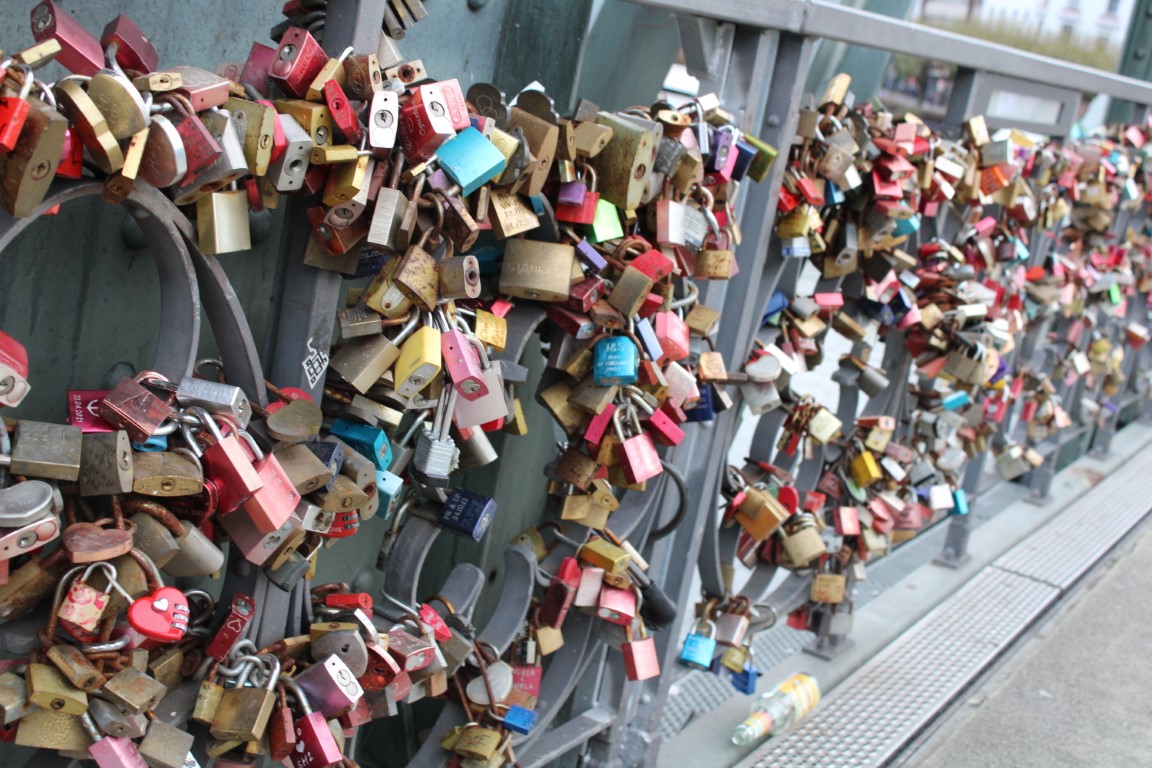
Love Locks [Free Verse]

Wandering through a new city,
 I come upon a bridge:
  its rails loaded with locks.
   They call them "love locks."

It gets me wondering how many locks
 long outlived the love they memorialized?

How many were lust locks --
 linked to the bridge before 
  the couple really knew each other's
   vexing peccadillos?

How many were like ill-advised back tattoos,
 a lover's name - someone one met in Vegas - 
    and whose name one wouldn't
       otherwise remember, 
     were it not inked across one's spine
        in a 120-point flame-festooned font?

Exit Wound [Free Verse]

What tears away in leaving,
  when one has grown into:
         - a person?
         - a place?

Can one grow into someone
      (or somewhere) such that 
      one is fused in a way that
      won't allow separation 
      without leaving a sacrifice?

Maybe one can't help but be
       webbed into some wider world,
       and can't help but leave
       pieces of oneself littering the Earth. 

What I Don’t Know… [Lyric Poem]

I know nothing
         of the sea-bottom,
         or of the darkest void.

I know nothing 
         of the ancients' lives
         or how most are employed.

I know nothing 
         of an atom's look,
         or how works, gravity.

I know nothing
         inside my organs
         or nasal cavity.

I can but know
         these simple truths
         that live within my mind.

That it's better
        being together, and
        to err toward being kind.

Mythic Love [Free Verse]

Myths cheapen love
with potions &
pointy passion projectiles,

pansies squeezed over 
the eyes of cold souls
[when paired with a proper
incantation] 
can make love from naught
or turn love on its head,

but that which can be
turned on its head
is not love --
& never was love.

Tributary [Free Verse]

Your river is a tributary.
My river is a tributary,
merging
&
flowing to a sea.

I feel your molecules,
floating past my own,
intermingling
& 
in some way tingling:
a jangled excitation.

And, 
[at the sea]
we will be, together
&
[at the sea]
we will be together.

I no longer worry
that I'm a river with no name --
an anonymous tributary -- 
because every sea 
has many names.

BOOK REVIEW: Iranian Love Stories by Jane Deuxard & Deloupy

Iranian Love StoriesIranian Love Stories by Jane Deuxard
My rating: 5 of 5 stars

Amazon.in Page

Out: December 14, 2021

This graphic novel shows what life is like in Iran. A French couple engaged in immersion journalism converses with Iranian men, women, and couples. As the title suggests, the theme of the book is intimate relationships (and marriage, when it – sadly – doesn’t fall into that category,) and the trials of love under an ultra-conservative theocratic regime. The book offers insight into how singles sneak love, how arranged marriages work (or don’t,) and how the bizarre in-law dynamics of arranged marriage are navigated. One also learns about non-amorous elements of Iranian life – i.e. the illicit nature of dog owning, workplace dynamics, etc.

The people Deuxard talked to were overwhelmingly wealthy, educated, and unhappy with the regime. That said, there’s a range of views presented. There were a few who were mostly happy – e.g. one young woman complained about the impossibility of openly dating, but said she was ultimately happy not to live in the West where she would probably have to work and / or take on other responsibilities she was freed of as an Iranian housewife. Additionally, one girl said that a relationship in Europe would offer no thrill because, you know, no one will murder you for smooching your boyfriend in Denmark. There were also many who desperately wanted out of the country, some of whom felt trapped and others who were working toward getting away (there are measures in place to make this difficult for many – e.g. if you have an Iranian degree, you have to pay it off before you’re granted an exit visa.) Some were hopeful that the theocracy would be overthrown, but most were resigned to a tormented life.

As a traveler, I’m fascinated by how people live at various places around the world, and so I found this book intriguing and thought-provoking. However, I can see how those who aren’t interested in such questions might find it a bit dull. It’s essentially documentary-style interviews in graphic novel format. That said, I thought the artist and writer did a good job of conveying mood. If you want to know what life is like in Iran, check it out.

View all my reviews

Stone Lotus [Tanka]

the stone lotus
carved in the temple wall
will outlast
lovers and real lotuses -
such a clumsy copy

BOOK REVIEW: Symposium by Plato

SymposiumSymposium by Plato
My rating: 5 of 5 stars

Amazon.in Page

Project Gutenberg (FREE)

Symposium is a collection of speeches in praise of Love (the Greek god and the emotional experience) given at a banquet in Ancient Greece. The participants are men of renown, including: a playwright, a physician, a philosopher, a statesman, etc. The narrative is delivered as a secondhand telling after the fact, and isn’t intended as a verbatim transcript of all the speeches.

There are seven speeches, each unique and most playing off the others. Phaedrus starts by emphasizing the underrecognized importance of the unsung god, Eros. Next, Pausanias stresses that there isn’t one kind of love, but two. Eryximachus focuses on the all-pervasive nature of love and, as a physician, mentions the bodily dimension of love. Aristophanes’s speech seems largely in jest, but stresses the fact that people don’t comprehend the power of love. Agathon rebukes the others for emphasizing love as a gift to humans, and, instead, suggests one should focus on praise of the deity. Socrates’s encomium is a departure, as one might expect given his love of questioning and hatred of speechmaking. First, he questions Agathon about whether love is really synonymous with beauty or good, as the youth’s speech had suggested. Second, he recounts his instruction on the subject from Diotima, which is mostly a recounted dialogue between her and he.

The last speech is afield. A drunken Alcibiades wanders in late. [The others decided not to drink because most drank too much the previous day.] Alcibiades gives a speech in praise of Socrates, his once lover, with whom he’s on the outs. From Alcibiades we learn not just about his relationship with Socrates, but also some interesting biographical facts about the philosopher, such as his proclivity to get lost in thought for extended periods and his bravery in combat.

This is an interesting work, and well worth reading.


View all my reviews