
Truth in advertising is so refreshing.

Truth in advertising is so refreshing.
 I’m driving along, my mind roving, the droning radio only faintly registering in my subconscious, and suddenly I’m ripped from my reverie by a shrieking siren. I punch the brakes, slowing from a present speed that, unbeknownst to me, is two miles an hour below the limit to an octogenarian crawl. I hear the screech, and look into my rear-view mirror to see the black behemoth, an SUV, becoming ever bigger. The driver’s solitary finger pressed up against the window, not pointing at me accusingly, but rather straight up in the air. The SUV slows just enough to not ram me. We travel onward in our respective soiled underwear, I not looking back, her boiling rage now just a flush face and a fading headache (or at least that’s what I expect from my vast experience in her shoes.)
I’ve been punked by a stranger, an audio tech who likes to put background noises into every news story or ad spot to gain the attention of an ADD -riddled populace. Yes, I should have been more in the moment; that’s how they get you.
I would be remiss if I didn’t act as a mouthpiece for another individual wronged by similar antics. I have a cat that only gets about 20.5 hours of sleep per day, and he’s inevitably robbed of precious slumber whenever he hears a “BING-BONG.” This is another much beloved sound effect for the wicked curs in radio. This particular cat can comfortably ignore any other sound in the universe–including my high-volume rants about use of various personal possessions as a scratching post. I don’t know why our cat knows what a doorbell is. Does he get lots of visitors when we are not there? Who is he expecting? These are questions that I cannot answer.

The one Oscar winner I saw
I only watched part of the Oscars last night. At some point I realized it wasn’t worth continuing. I see about three movies in the theater per year, and rarely are any of them Oscar material. At 10:00 pm all I had to show for watching was the chorus of the ditty “We Saw Your Boobs” echoing through my brain. (Damn you, Seth MacFarlane, for that catchy, clever, melodic jingle that still runs like a gerbil in the rodent-wheel of my mind.)
The three movies I saw in the theaters last year were: The Avengers, Dark Knight Rises, and This is 40. The first two will no doubt convince you that I am a 12-year-old boy trapped in a middle-aged man’s body, and the last will convince you that I have poor judgement. (This is 40 had its humorous moments, but there was far too much screaming for my taste, although we did see Leslie Mann’s boobs– damn you, again, Seth MacFarlane.) I saw another half-dozen 2012 films on long Korean Air flights, but these were equally lowbrow titles (Men in Black 3, Prometheus, and Brave– the latter at least won an Oscar during the hour and a half I was watching, I think it was for Best Animated Makeup Artistry.)
I’m not altogether lowbrow. I will see most of the big winners eventually, when they finally make it to basic cable. For example, I watched The Hurt Locker on Saturday, just one day before the Oscars. So I am only three or four or five years out of synch. The Hurt Locker is a particularly fine example of going the other way because I understand its distinction is being the lowest grossing Best Picture winner ever.
This year’s Best Picture Argo is definitely a film that I will see in the next five years–barring Zombies, the apocalypse, or a Zombie Pandemic Apocalypse. So there’s a 60% chance that I’ll see it. The Iranian hostage crisis is one of the first historical events that I remember seeing on the news first-hand. Had I been in the country when Argo came out–I might have seen it in the theaters, but probably not.
Part of me thinks that I should grow up and start watching the “right” movies. However, part of me says, “wait, there’s this one day a year when everybody is talking about these movies, and the other 364 days they are talking about Dark Knight Rises and The Avengers“ So in some sense, I already am watching the “right” movies.
My rating: 3 of 5 stars
Humorist George Mikes’ main premise in this book is that humans created God in their image. The book is a series of essays designed to instruct God, if he or she exists, in being a more reasonable facsimile of the ideal human–dear old mom.
Actually, the micro-essays that make up the chapters of this book cover a wide range of subjects. Some of them stay on topic more closely than others. A few of the chapters seem to be stories that the author found interesting (and they are), but which didn’t have a lot to do with supporting his argument. For example, he discusses the two good deeds he has done in life, and he has a chapter on episodes of coincidence. The former may be a tongue-in-cheek support for the argument that even the worst of us are good sometimes. The latter may have been an attempt to bolster a more general argument for atheism by stating that coincidences are not miracles. However, if that is his point, while true, he doesn’t explicitly close that loop in any but the most gratuitous way. At barely over 100 pages, it felt like some of the material, while entertaining, was in the book not to address the topic but to hit the lower bound on a page range.
Mikes weaves together amusing anecdotes with shock-essayist statements that are not so much humorous as gratuitously provocative. With respect to the latter, I’m thinking of his discussion of Hitler and Stalin as basically good guys–if at least in their own minds.
The book is a mixed bag. It’s sometimes though-provoking and humorous, but other times it drifts into shock and awe gratuitous assertions. I suspect he could have hit his page mark by supporting his arguments better and still maintained the humor (realizing that exposition can be death in humor writing.)
A prime example of the book at its best is a story about a woman meeting with her doctor [paraphrased herein.] This is in a section about mini-gods, i.e. those people that we quasi-deify–such as judges and medical doctors. The doctor is trying to convince the woman to have surgery, but the woman refuses.
The doctor asked, “how did you get here today?”
The lady replied, “I took the bus.”
“And you trusted the driver, a complete stranger, with your life. But you won’t trust me–an expert in my field?”
“Yes, of course, the difference is vast.”
“How so?”
“The driver was on the same bus.”
If you find a copy, this book is worth a read. It’s not much of a time investment. It’s an illustrated 105 page book. If your attitude is, “Sacred cow? it’s what’s for dinner,” you’ll probably like it overall. If you are pious, you’ll probably hate it. If you are neither, you’ll probably find that it has its moments.
Let me begin by being forthright; I know almost nothing about art. If you’re thinking this post might offer you insight into what makes for a good painting, you’re in the wrong place. A few years back, I did get a couple books on “art for philistines” (…isms: Understanding Art and 50 Artists You Should Know) Being fascinated by just about everything, I immensely enjoyed both books. However, my objective wasn’t to develop any great expertise, but simply to not be a clod. I wanted to be able to tell Monets from Manets from mayonnaise. And I did learn some nifty lessons, mostly about what art wasn’t. Did you know that Neo-impressionist art is NOT art that makes a new impression on one, as contrasted with paleo-impressionist art that makes one feel their inner-caveman. Secessionism was NOT the art of the Confederate States. Neither sensationalism nor naturalism necessarily involve nudity, darn. One the other hand, Pointillism is exactly what it sounds like, paintings made of little pointills.
As a writer, the story that I see in a painting has a lot to do with its appeal to me. That’s why there aren’t any Jackson Pollack’s or Mark Rothko’s on my list. I’m sure their work is aces in aesthetics, but I don’t get much out of it.
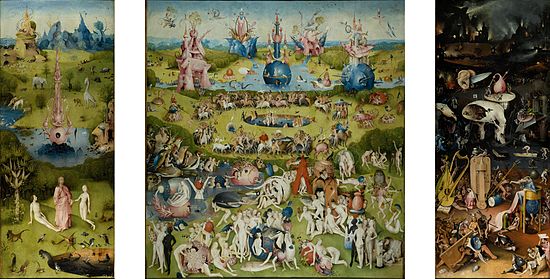
The Garden of Earthly Delights by Hieronymus Bosch, 1510
I usually don’t care for paintings that are as busy as The Garden of Earthly Delights, but I find it fascinating that an early 16th century artist could produce so much wild surrealism. I didn’t even know they had LSD in the Netherlands back then. Today we have decades of monster movies to help us think up weird and bizarre images, but Bosch had only his imagination.
There are an infinite number of stories packed into this tri-sectional painting. A question being the root of a story, a world in which some people have flowers and berries blossoming from their heinies, makes for a lot of fodder. However, the first thing that strikes the eye is that God is the only one wearing clothing. (Lets avoid a tautology. One could say that the only reason I know that that’s God is that he’s wearing clothing. If he were naked too, the viewer would just assume that he was a perv trying to horn into a menage a trois. I would say the world’s first threesome, but if you look in the middle section, you can see that about everyone is getting their freak on.) So why is God wearing robes? We can assume that it’s not that he has shame. He’s God, you can be sure he’s sporting the perfect specimen of masculinity (if he cares about such things.) Is it drafty in heaven? If so, doesn’t his omnipotence extend to the heavenly thermostat, or is it that the Holy Ghost likes to crank the AC? I see tension, and tension is the root of a story. (I realize that I said that a question was the root of a story. Live in the moment.)

The Sea of Ice by Caspar David Friedrich, 1823
Sea of Ice, also called The Wreck of Hope, at first looks like just a landscape. However, if one directs one’s glance to the right hand side, one can see the stern of an old sailing ship. As the alternate title suggests, it’s about a shipwreck. A shipwreck in the sailing age in the Arctic Ocean makes an outstanding setting for a story. Those men are all going to die, but not with the suddenness of drowning. They will freeze to death over the course of hours. If they can start a fire, they may have many hours, but they are not going to be rescued and they cannot walk to home. The tension between wanting to survive and knowing you are just extending your misery is good stuff for story-telling. If this image doesn’t send a shiver down your spine, nothing will.

Olympia by Édouard Manet, 1863
Olympia was a scandalous painting when Manet first revealed it. Nudity has been around for ever in paintings, right? Certainly, but it’s the context that enraged people. Society was used to characters of classical mythology being nude, e.g. Venus. They were also used to Biblical nudity (see Garden of Earthly Delights above.) However, Olympia made them think of the Parisian prostitutes that they didn’t visit, but somehow knew exactly what they looked like. There are several stories to be told here. The one that springs to mind is why the servant is about to try to suffocate Olympia with a pillow. Will she, or won’t she, go through with it? If she does, will she prevail? Olympia looks like a fighter. If she doesn’t, will the cat?

Impression: Sunrise by Claude Monet, 1872
In Impression: Sunrise two boats are out on the water, even though the sun has broken over the horizon. They are rivals. The early bird got the worm, and the other will have to fish with fake lures.

Lighthouse Hill by Edward Hopper, 1927
Lighthouses make good settings for tragedy. They are remote. Ships depend upon them to avoid the rocky shoals. This lighthouse keeper’s family left because they didn’t like living in the middle of nowhere with a drunk. Now it’s just a man living in a big house alone. He runs out of Jack Daniels, and drives off to town at dusk. Being on the other side of the hill, he can’t see the lighthouse when he briefly glances into his rear-view mirror and wonders, “Did I turn the beacon on?”

The Persistence of Memory by Salvador Dalí, 1931
The Persistence of Memory, a.k.a. Melting Time, is a dream state. It makes no sense. Nature is ordered into square edges. Watches are the only evidence of humanity’s existence. There is one creature living, or once living, that looks like the Thalidomide abortion of a three-way mating between a donkey, a Portuguese man of war, and Dalí himself. The story is about being trapped in a dreamscape where time has become stuck. Our protagonist must seek the wisdom of the Portuguese man-o-Dalí.
 Life, the Universe and Everything by Douglas Adams
My rating: 4 of 5 stars
My review of: Hitchhiker’s Guide to the Galaxy
My review of: Restaurant at the End of the Universe
Arthur Dent and company are back for a third volume, and this time they must save the universe. This installment in the Hitchhiker’s Guide to the Galaxy (H2G2) series leaves off where the second stopped.
Readers will recall that at the end of the second volume,Restaurant at the End of the Universe, Arthur and Ford Prefect were marooned on the Earth two million years before their time (i.e. before the Earth was destroyed for a hyperspace bypass.) The two are reunited after Ford spent some time in solitude experimenting with being insane. They catch a ride forward in time on a piece of couch-shaped jetsam caught in an eddy in the space-time continuum.
Arthur and Ford are then picked by Slartibartfast, designer of fjords, who convinces them that they must go on a mission to save the universe from the inhabitants of the planet Krikkit. Actually, he can’t convince Ford of that, but he does convince him to go to the longest running party in the universe. Unknown to Ford, Slartibartfast wants to prevent the Krikkiters from attaining a requisite part that happens to be located at the party.
Arthur plays a particularly important part in this volume. After a run-in with a creature that he has killed numerous times in various bodies, the H2G2 straight man develops the knack for not hitting the ground after throwing himself downward (i.e. he can fly.) This new skill plays an important role in ultimately winning the day.
Arriving at Krikkit, the group finds that the locals aren’t much interested in destroying the universe anymore.This leads the band them to uncover a plot of intrigue and hilarity.
Given that there are two more books, you probably believe that the universe wasn’t destroyed, but I’ll avoid spoilers.
As always, Adams is the master of absurdist science fiction. Sure he gets his characters out of jams by flukes of the infinite impossibility drive or, in this book’s case, randomly appearing and disappearing couches, but it’s the wackiness that we enjoy and not the tautness or logical consistency of the tale.

Bonus pages for active readers
I miss the days when they put extra blank pages at the end of a book so that you could rewrite an unsatisfactory ending. (Someone once tried to tell me that the extra pages were the result of bulk paper cutting methods. They said it was cheaper to include the blank pages than to remove them. Yeah, I know. How ridiculous, right?) Of course, it wasn’t long before ads began to sully these blank pages, making them less than blank.
I’m not a fan of wastefulness, but if I have to rewrite your ending, why should I incur the cost of paper.
Being lazy, there are not many cases in which I feel compelled to rewrite someone else’s ending. Most books that manage to get published have at least a tolerable ending.
One book always springs to my mind when I think of bad endings. It’s a book called Hostage by a writer named Robert Crais. For those who saw the movie, the movie ending is vastly different–presumably because moviegoers would have insisted on their money back otherwise. While Hostage is not among Bruce Willis’s best, it’s also a prime example of the rare case when the movie is better than the book–for just this reason.
Part of the disappointment stems from the fact that the book has an outstanding premise for a thriller, and in my opinion it was carried off well until the end. (Another reason that I don’t come across too many terrible endings may be that I jettison books that aren’t so good, but this one fooled me.) Anyway, three delinquent kids rob a house and end up with a hostage situation with the homeowner’s two kids. The tension is ratcheted up when it turns out that the upscale home where the kids are being held up is owned by a mob accountant. Inside is evidence that could put half the mob away. The mob gets proactive by taking the police chief’s (i.e. the protagonist’s) family (ex and child) hostage and insisting that he get the evidence out before the house is stormed by the sheriff’s department and falls into an evidence locker.
SPOILER ALERT: Ultimately, our hero has no agency in the survival of himself or his family. It’s purely the decision of a mob enforcer that leaves them alive. I guess it could have been worse. It could have ended with him awaking from a dream.
What book gets your award for “worst-ending-ever”?

Taken at the Red Cross Snake Farm, Bangkok
Once upon a day in February
ruminating about creatures scary
staring at a flaring cobra hood
I thought, maybe this serpent ‘s just misunderstood
I know its bad rap (wrap?) is Biblically-inspired,
but perhaps it’s time that rap be retired
if you stepped on me, I’d bite you too
well, perhaps not bite, but in the harshest tone bid you adieu
The crocodile has a snappy smile
and is always dressed in dapper style
if you evict him from his birthday suit
to suit your needs for some snazzy boots
I think we’ll all understand, if he claims as his your right hand
don’t think it’s some vast assault on man
think of it as a reptilian guru teaching one Zen koan
and, to you, the sound of one hand clapping will be known
hint: it sounds like a bloodcurdling scream
and requires a readied surgical team

Taken at Budapest Zoo
Your bigger tiger can be a grumpy cat
when unwise souls encroach its habitat
just don’t pitch a tent like you own the place
if you value the features on your face
think of yourself as that visiting kin
for whom “just passing through” looks like “moving in”
you don’t feel nice calling Uncle Bob a pest
think how the tiger feels ripping your heart from your chest

Taken at a “bear park” in Veresegyház, Hungary
Grizzly bears’ hairiness inspires scariness
but under that fur is the motive for wariness
it may look like rolly-polly flab
but bears have muscular six-pack abs
you think you’ve got him in your trap
but wonder how your spine just snapped
a minor miscalculation on the tranq front
and your life is liquids through a shunt
can you blame him, the trap ‘s a rusty, toothy maw
that you just caused to kill his paw

Source: Kennedy Library
Presidents live the ultimate catch-22, the only way to reliably boost their approval ratings is to shuffle off this mortal coil (i.e.become worm food.) The more decomposed a president, the more fond our remembrances of him. The worst thing that anyone ever says about a long dead president is nothing at all. When was the last time you heard a scathing character impeachment of Millard Fillmore? (I do realize that a person with the supreme narcissism needed to be president may find silence more insufferable than being called the son of a syphilitic donkey whore.)
(Quick, without looking, name a president from the 19th century other than Jefferson or Lincoln [or Fillmore]?) FYI- there were 23 or 24 of them. If you drank your entire cup of coffee before you could come up with one of the other twenty names, congratulations you are a typical American– or an exceptional non-American.
I first noticed this phenomena when watching the Reagan funeral. Everyone from all walks of life had great things to say about our 40th president on that day. However, while I was still a minor at the time, I distinctly remember half of the country loathing the man spectacularly and engaging in ad hominem attacks against him at any opportunity. Well there was one period during which no one was saying horrible things about Reagan’s character and that was during the brief period after the assassination attempt when his opponents thought he might die — at which point they went into dead presidents mode. Had Reagan passed away at the hands of John Hinckley, he would’ve achieved a level of freedom from being crapped upon usually reserved for a our first few (long decomposed) presidents.
Still, Reagan has achieved the broadly beloved status of being the Democrat’s “In-your-face President” just like Kennedy serves in that role for Republicans. An “In-your-face President” is one that political parties use to attempt to show that their current opposition is on the lunatic fringe by indicating that that iconic leader supported something vaguely, roughly approximal in a similar sort of way to what they are trying to do in the present day. These statements being followed by a silent, but understood, “IN YO’ FACE.”
I’m sure that when Carter dies, equally lovely things will be said about him — though never has a bigger train wreck of state been seen then the term of James Earl Carter. To be fair, some of the wheels that rolled off the RV-of-state were not his fault, but we give all the credit and all the blame to the president. Why do you think Clinton is always grinning like he just had sex? No, it’s not because he just had sex– though he did (the speaking circuit is like fishing with dynamite), it’s because he reigned over the big bubbly part of the bubble. When we were rich because we thought we had a lot of valuable stuff, before anyone bothered to look inside and see what we had was rotten at the core.
Admittedly, Nixon’s demise did challenge everybody’s ability to grin and say nice things. Comments were made such as, “That Checkers was a good boy, such a good boy, yes he WAS… YES he WAS. Oh yeah, and how about that China thing, that was a real work of diplomacy.” (Checkers was one of Nixon’s dogs, made famous by a Vice Presidential speech of the same name.) The word “China” was used at Nixon’s funeral more than it was used at the Chinese Conference on China in Beijing, China. Of course, there wasn’t much nice to say about Nixon. Democrats can’t even take advantage of the fact that the Environmental Protection Agency (EPA) was a Nixon Administration initiative. Nixon can’t be an “In-your-face President.” It’s too much like slapping your opponent with a bloated dead fish; you may hit them, but you’re going to get the stink on you never-the-less.
I recently saw this posted on Facebook. I, being a doofus, believed I had stumbled upon the black box recording that would show archaeologists the moment it all went sour for the human race– the dawn of the rise of the apes. As soon as our self-aware brethren learn to take our technology and use it against us, we are surely doomed. Being damned dirty, the apes will own humans. [Participle dangle intended.]
Of course, I felt compelled to do a Snopes check because– believe it or not– sometimes people put things on the internet which are fake. I know, I know, hard to believe.
It turns out the video is a piece of viral advertising for the next Planet of the Apes movie. “Lesser” primate use of technology is still about right here:
Viral advertising is the latest craze. One leaks intriguing footage onto YouTube and doesn’t label it or say what it is. Then you hope a bunch of schmucks fall for it, and they will– because that’s the defining characteristic of we schmucks. It’s tautological. This kind of video will stick in one’s mind and get more media attention than would a regular trailer.
The problem is that movie-makers have the ability to make really convincing fakes. (That’s what they do.) My well-read reader will certainly have heard of the Orson Welles War of the Worlds incident. People who didn’t hear the beginning of the broadcast, which was formatted like a news bulletin, freaked out about the alien invasion. Some people jumped out windows (why, I have no idea. I don’t think they thought the value of that through.) Some people fled to Canada (assuming, of course, that the aliens wouldn’t be interested in that icy wasteland.)
My problem with all this isn’t that people are duped; it’s the “boy who cried wolf” effect. One day when we’re under attack by aliens, apes, or artificial intelligence, people are going to be like, “Dude, that’s a really convincing looking ray-gun… NOT!”


 Tiger Riding for Beginners