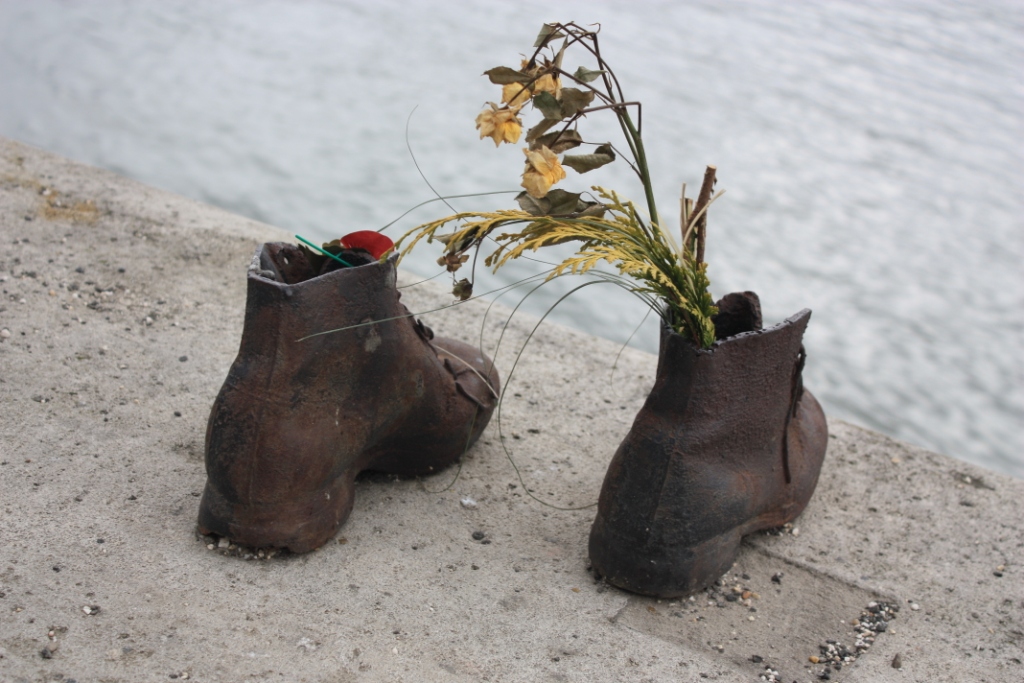
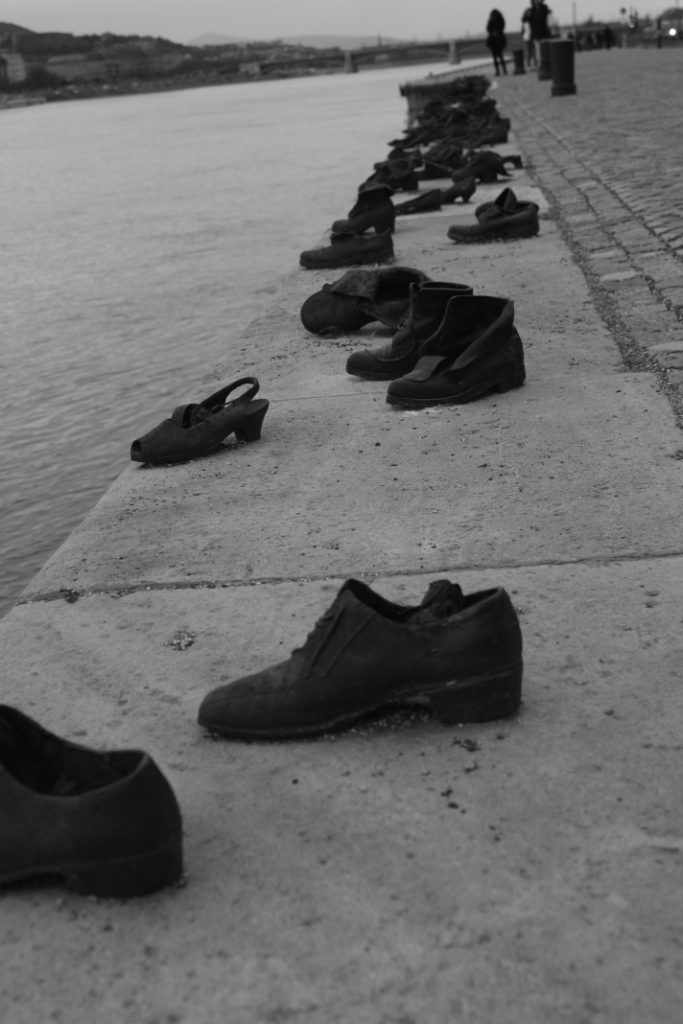
On the bank of the Danube, Pest-side just south of the Parliament building, there is an eery memorial consisting of an irregular row of shoes. The shoes are made of metal, but their brown rust looks like worn, brown shoe leather. It is in remembrance of the victims of the Arrowcross Militia who were shot there and left to topple into the river.
The Arrowcross Militia were Hungary’s Nazis. Hungary was allied with Germany at the beginning of World War II, but at one point (in 1944, as I recall) Hungary tried to break this alliance. Germany responded by taking over Hungary, and giving the Arrowcross (their fellow hardcore fascists) greater power and influence.
I’m back from Hungary with a load of photos to share. Here’s the first installment.
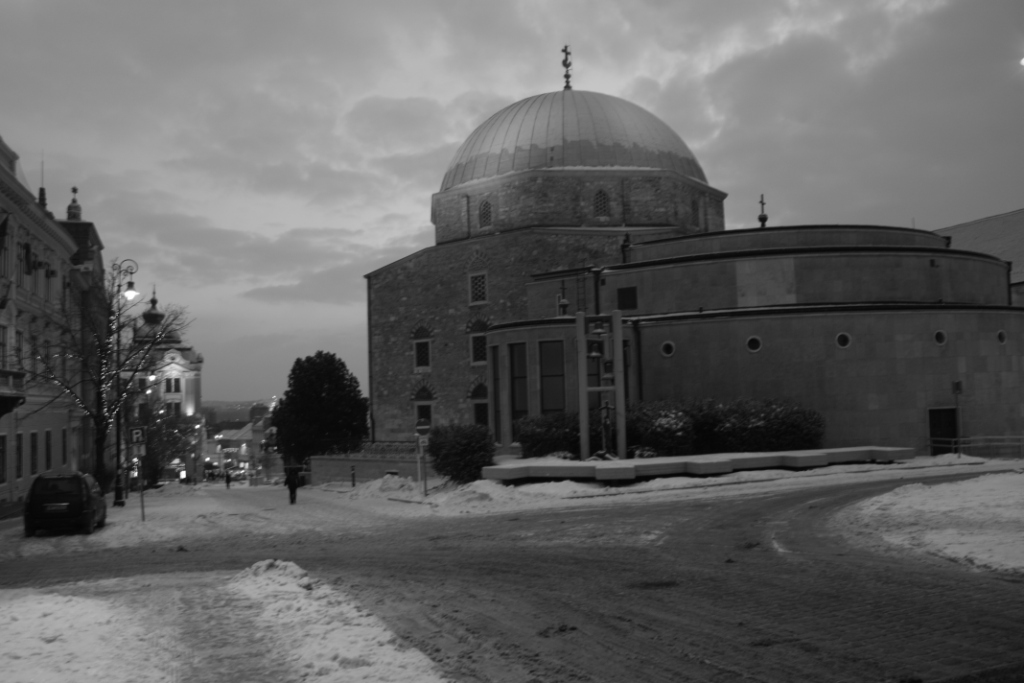
This building is also–and currently–known as the Downtown Church of the Blessed Virgin Mary, and in the intervening period was known as St. Bartholomew’s Church. It’s located on Széchenyi Tér in downtown Pécs. It was built as a mosque in the latter half of the 16th century under Ottoman control, but was converted to a Roman Catholic Church when the Turks were defeated. There are several such re-purposed mosques in the area, but this one has been said to be the best example of Turkish architecture in Hungary.
Unfortunately, the first thing one notices about this book is what seems like a typo in the title. Instead of “Pirates of the Far East,” it’s Pirate of the Far East, which suggests piracy wasn’t so much of a problem in the region because there was only the one pirate—and that the author isn’t a fan of either definite or indefinite articles. I’m sure this was done intentionally, but it does read oddly and sounds tinny.
This slim book is a typical edition of the Osprey military history series. All of these books are less than 100 pages, illustrated, and focus on a specific class of warfighter over a defined period. In this case, the book presents a class of pirates called wako for the period from 811 to 1639. Wako literally refers to Japanese pirates, but–in fact–these marauders of the high seas were often mixed nationality crews. The book also provides information about counter-piracy activities and those groups of warriors, such as Shaolin monks, who fought against piracy back in those days.
This book covers a range of topics including: the life of a pirate, pirate ships, strategy, tactics, and weapons—as well as the history of these groups. The book has five actual chapters, but there are short units providing important information that would usually be appendices, e.g. a chronology, a discussion of museum exhibits, and an annotated bibliography.
The illustrations are mostly drawings, but include maps and photographs as well. Some of the art is drawn in the present-day by the illustrator Richard Hook, but some are historic pieces from art collections. The photographs also include some present-day photos of locations that were once bases of piracy, as well as photos of museum exhibits (e.g. topographic and other models.) The graphics are helpful in showing how pirates dressed/armored and were armed. The maps and drawings are particularly helpful.
I’d recommend this book, but I do think it’s overpriced at full price. At a mere 64 pages—a pamphlet more than a book–paying $10 or more seems a bit pricey despite the useful graphics and the fact that the author is among the most renowned authorities on Japanese warriors and medieval military tactics. All that said, there are relatively few books on the topic, and it’s not easy to get this information from other sources.
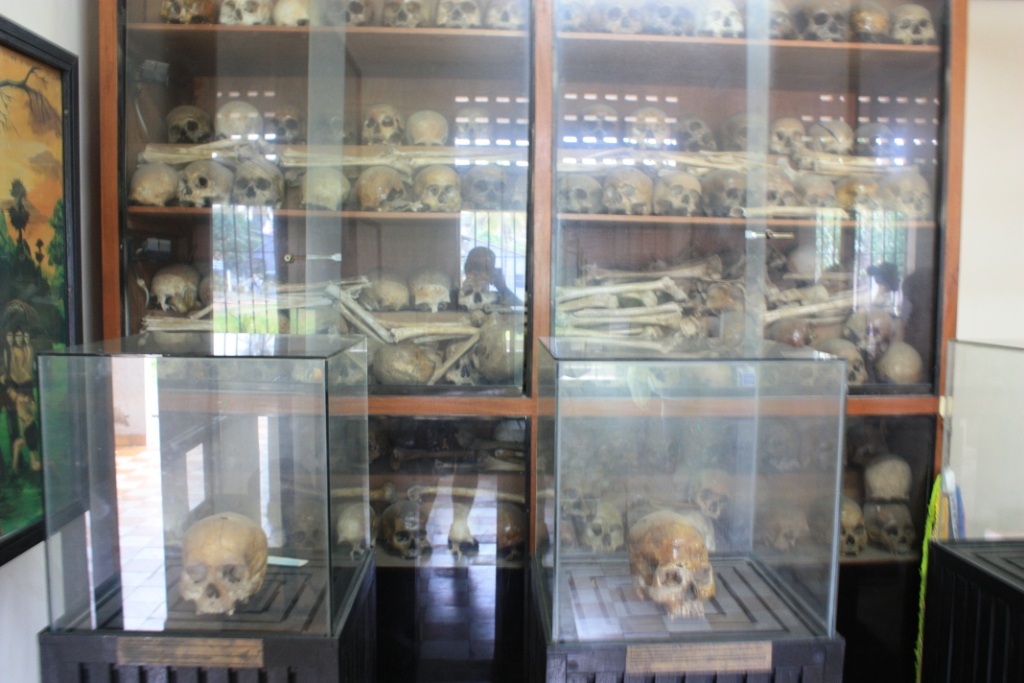
These display cases of skeletal remains are at the Tuol Sleng Genocide Museum in Phnom Penh. Just one of the many horrific legacies of the Khmer Rouge.
This book is a collection of 50 short essays on various topics (origins, history, arts, sciences, products, and entertainment) as they relate to Hungary and Hungarian-ness. There isn’t a great deal of depth to most of the essays, and so this isn’t the book for someone who is well-acquainted with Hungary and Hungarians and wants a deep level understanding. However, it would be a very useful and easily digested resource for travelers visiting Hungary who want insight into this smallish nation with its very long history. For those familiar with Hungary, this nation has a national character that is quite unique and which is characterized by intelligence, solitariness, and a certain variety of gloominess.
Hungary has had a much larger impact on the world than either its size would suggest, or than most of the world recognizes. Famously, the Manhattan Project, which produced the first atomic bomb, wouldn’t have achieved success in such a rapid timeframe—if at all–if it weren’t for a slate of Hungarian-educated scientists including Edward Teller, Leo Szilard, Eugene Wigner, and Jon Von Neumann. Few of his peers would have disputed the statement that Von Neumann was the smartest person on the planet during his day. Challenging explosives calculations that made the atomic bomb possible are just part of a legacy that also included being the father of game theory–an approach to strategic interactions that is in widespread use in Economics and the social sciences today.
There are some areas in which Hungary has certain niche. For example, while Hungary might not be thought of as an athletics powerhouse, generally speaking, the Hungarians dominate in the sport of water polo and are frequently strong contenders in some swimming events.
This book’s chapters are roughly organized, but not formally grouped, into alike topics. For example, foods, beverages, spices, and desserts are all one after the other. Various history topics are presented together, and the same is true of the arts. Some of the chapters are on much more concrete topics than others. For example, there are chapters on “Fate” and “Soul” up front that are more conceptual than the average chapters. As I indicated, this is a collection of essays by various authors, and that means that there’s not a solitary tone and approach throughout the book. However, there was a single chief editor, and so the chapters aren’t distractingly disparate either.
I believe the book was unfortunately named. “The Essential Guide to Being Hungarian” makes it sound as if this would be a perfect gift for the children of emigrants, i.e. people who’ve visited the country and spent time around Hungarians, but who want to learn more about their native culture. It probably doesn’t give enough depth and new information for such people. For example, the chapters on cuisine talk about pogácsa and gulyas (i.e. goulash), and don’t delve into the exotic, but rather stick with the everyday cuisine with which any visitor to Hungary will already be familiar. On the other hand, tourists and travelers for whom this book might be ideal could be led astray, thinking the book is offering them more depth than they want, need, or can reasonably digest. That being said, there are chapters on niche subjects such as “contemporary writers” or “folk dancing” from which even a veteran visitor to Hungary might pick up something new.
I’d recommend this book–particularly for those who haven’t yet spent a great deal of time in Hungary or who work or interact with Hungarians and want more insight into their nature. Each essay is short and easily digested.
Standage’s book takes a fascinating look at the effect that six key beverages had in the unfolding of world events, as well as how the beverages themselves made friends and enemies. The drinks in question are beer, wine, spirits, coffee, tea, and cola. There are two chapters for each of these drinks. They follow a chronological order based upon when the respective drink rose to prominence, but within the discussion there is overlap of time periods. For example, both the chapters on spirits and tea consider the effect of those beverages on the American Revolution (i.e. the Whiskey Rebellion and the Boston Tea Party, respectively.)
As the author points out, there’s a natural subdivision to the book, which is that the first three beverages are alcoholic and the last three are caffeinated. There’s another way of looking at it, and that’s the means used to achieve a drink that wasn’t a health hazard. The first three drinks achieve germ-killing by fermentation, the next two by boiling, and the last through technology.
The era of beer is associated with the Agricultural Revolution and the growing importance of cereal grains. Geographically, the region of focus is the Fertile Crescent and Egypt. Among the more interesting points of discussion is the role of beer (along with the related commodities of cereal grains and bread) in the development of written language.
The era of wine is associated with the civilizations of ancient Greece and Rome. Readers of the classics will be aware that wine was much celebrated among the Greeks and Romans, so much so that they developed gods of wine in their mythologies (Dionysus and Bacchus, respectively.) Of course, wine played no small role in Christian mythology as well–e.g. Jesus turns water to wine.
Spirits are related to the Colonial period, though they were first developed much earlier. The author emphasizes that these were the first global drinks. While beer and wine were robust to going bad, they could spoil in the course of long sea voyages.
Alcohol of all kinds has always attracted opposition. This conflict, of course, owes to the fact that people under the influence of alcohol frequently act like idiots. One might expect that the transition to discussion of non-alcoholic beverages would correspond to the end of controversy, but that’s not the case. Each of the beverages brought controversy in its wake. There were attempts to ban coffee in the Islamic world where its stimulative effect was conflated with intoxication. Coca-Cola became associated with capitalism and American influence, and drew its own opposition because of it. It seems there’s no escape from controversy for a good beverage.
The most fascinating discussion of coffee had to do with the role of cafés as corollaries to the internet. Centuries before computers or the internet as we know it, people went to cafés to find out stock values and commodity prices, to discuss scholarly ideas, and to find out which ships had come and gone from port.
The role of tea in world history is readily apparent. Besides the aforementioned Boston Tea Party, there were the Opium Wars. This conflict resulted from the fact that the British were racking up a huge tea bill, but the Chinese had minimal wants for European goods. Because the British (through the East India Company) didn’t want to draw down gold and silver reserves, they came up with an elaborate plan to sell prohibited opium in China in order to earn funds to pay their tea bill. Ultimately, Britain’s tea addiction led to the growing of tea in India to make an end-run around the volatile relations with China.
The book lays out the history of Coca-Cola’s development before getting into its profound effect on international affairs. A large part of this history deals with the Cold War years. While Coca-Cola was developed in the late 19th century, it was really the latter half of the 20th century when Coke spread around the world—traveling at first with US troops. The most interesting thing that I learned was that General Zhukov (a major Soviet figure in the winning of World War II) convinced the US Government to get Coca-Cola incorporated to make him some clear Coca-Cola so that he could enjoy the beverage without the heart-burn of being seen as publicly supporting an American entity (i.e. it would look like he was drinking his vodka, like a good Russian should.) General Zhukov was perhaps the only person to stand in opposition to Stalin and live (the General was just too much of a national hero to screw with.)
There’s also an interesting story about how the cola wars played out in the Middle East. Both Coke and Pepsi wanting access to the large Arab market, and were willing to forego the small Israeli market to pave the way for that access. When Coke finally had to relent due to public outrage and accusations of anti-Semitic behavior, Pepsi slid in and followed Coca-Cola’s policy of snubbing Israel in favor of the Arab world.
I enjoyed this book, and think that any history buff will as well. One doesn’t have to have a particular interest in food and beverage history to be intrigued by stories contained in this book.
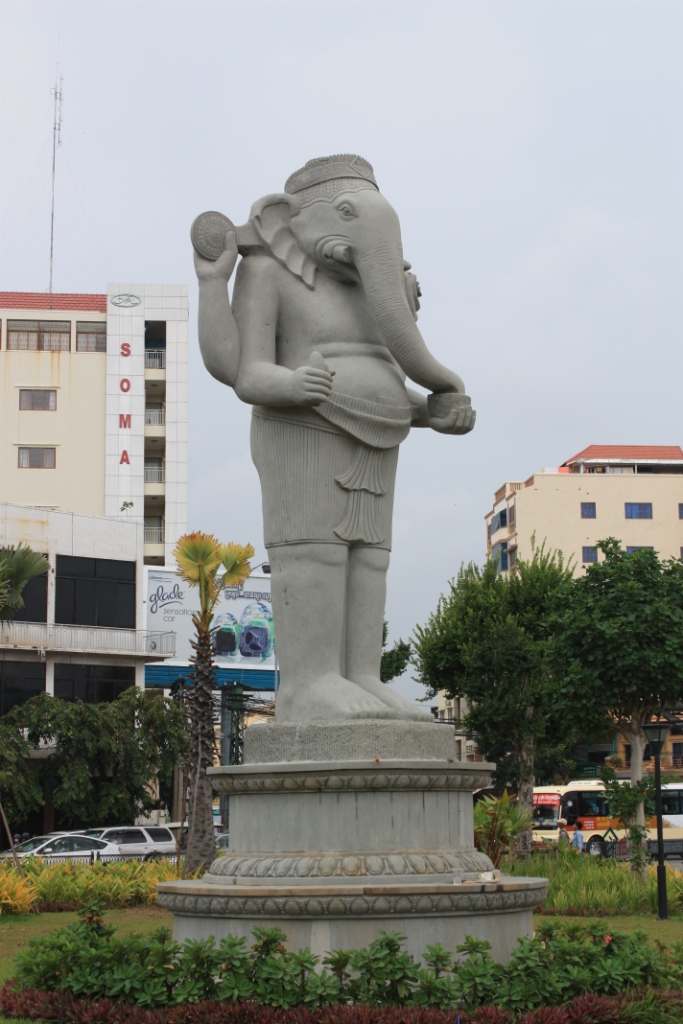
An estimated 95% of Cambodians are Buddhist, and Buddhism has been the dominant religion since the time of Jayavarman VII (i.e. the late 12th century.) This begs the question, why might one see a statue of a Hindu deity in a public space in Cambodia’s capital city?
If you’ve visited Angkor, you know that Hindu imagery abounds. This is because before Jayavarman, the Khmeris were Hindu. In a great early act of recycling, Vishnu sculptures became Buddha sculptures by decree. (In what is–as far as I know–a coincidence, many Hindus believe that Buddha [Siddhartha Gautama Buddha] was an avatar, or incarnation, of Vishnu.)
This still doesn’t explain why a relatively new sculpture of Ganesha would reside in present-day Phnom Penh (Phnom Penh is not as old as Angkor, and by the time it was founded Buddhism was dominant.) Just as contemporary taxi and auto-rickshaw (tuk-tuk) drivers in India display Ganesha in appeal to this “remover of obstacles,” 10th century maritime traders did the same. This desire to court the favor of the remover of obstacles has continued on into the modern-day.
It’s an interesting commentary on how cultures never interact without getting some of their chocolate into the other culture’s peanut butter and vice versa (for those who have no idea what I’m talking about, that’s a reference to an old Reese’s commercial and not some dark coded message.)
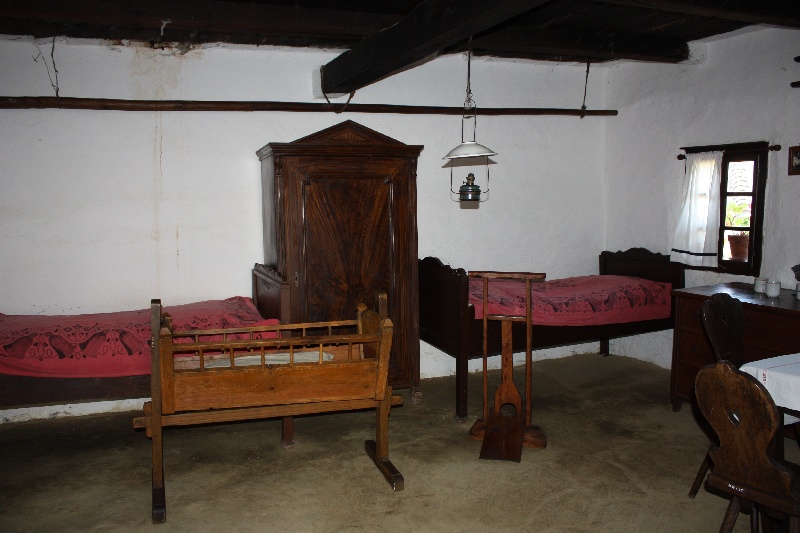
These were taken at a homestead restoration in Western Hungary in the area called the Őrség. This is how one might have lived in the late 18th century.
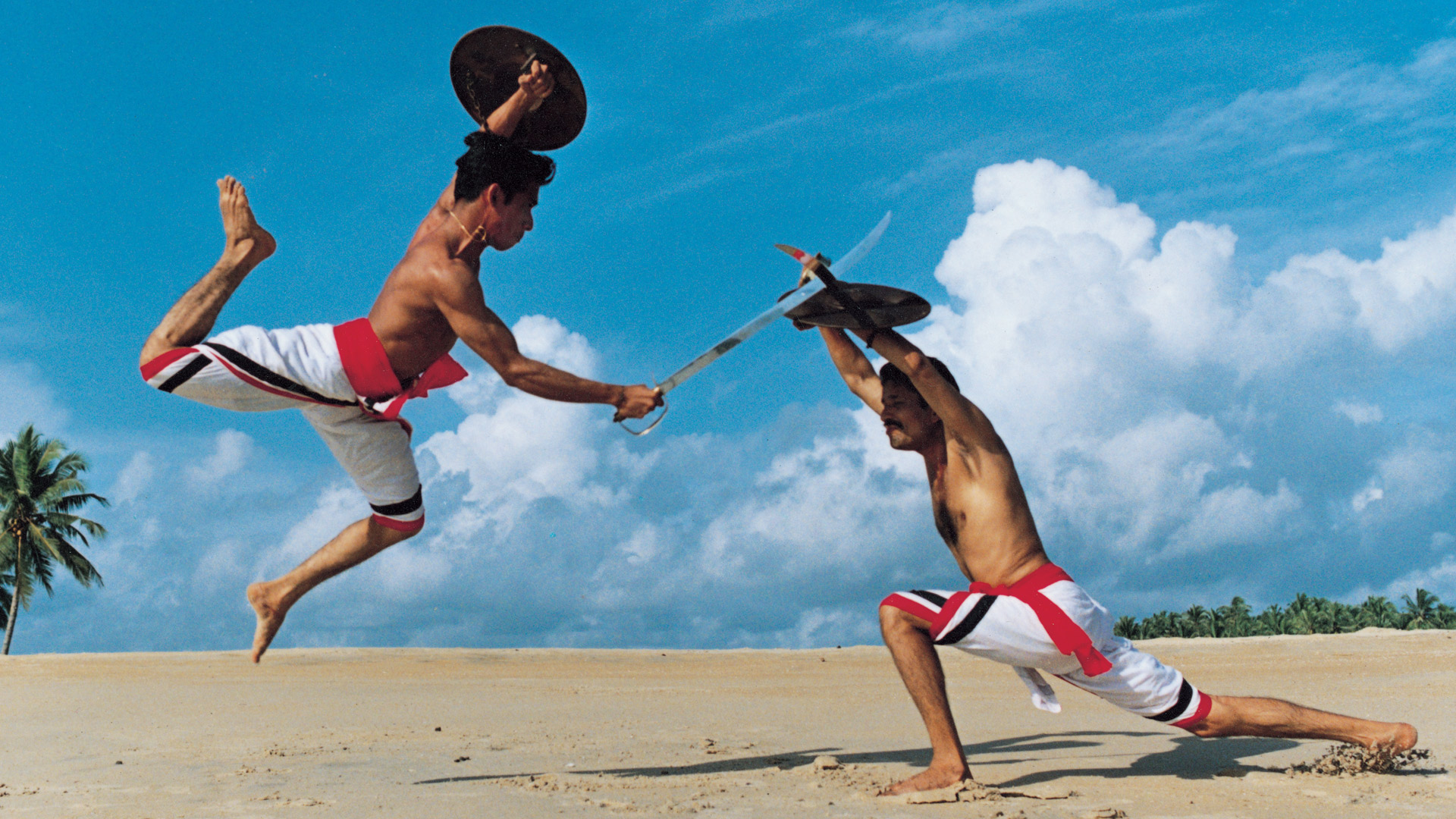
Outside of India, Kalaripayattu isn’t a household name like karate, kung fu, or judō. However, within India, this homegrown martial art is a source of great pride. It’s said to be one of the few indigenous martial arts that survived into modernity (with unbroken transmission, i.e. without a period in which no one was diligently practicing it.) Some consider it to be the mother of Asian martial arts (for reasons I both address and critique in an earlier post.) It’s a mainstay of Bollywood (and non-Bollywood Indian cinema—yes, there is such a thing) and makes frequent appearance in dance performances and plays.
I’ve been attending Kalaripayattu classes for the past 4 or 5 months. While this hardly makes me an expert on the subject, it does give me some insight into the art beyond reading or watching videos. I’m also able to make comparisons to other martial arts–one in which I have an extensive background, and others with which I also have limited experience. I’ve, therefore, put together a collection of answers to questions I’ve been asked as well as others that I can imagine being asked.
Pre-Question Question: “Kalaripayattu” is a long name, can I call it by something shorter?
Answer: Kalaripayattu is often just called “Kalari.” Note: “Kalari” also refers to the place where the martial art is practiced (i.e. not unlike the words “dōjō” or “training hall”.) If someone refers to “the kalari” or “a kalari” they’re probably talking about a physical location, whereas if they say “Kalari”– without an article—they’re likely talking about the martial art.
As an aside, a kalari, historically speaking, has a precise design approach and dimensions. It’s dug into the ground so that from the outside the building can look like it’s for Hobbits, but inside its ceilings are adequate even for the long weapons used in the art. This method presumably began in an attempt to reduce the effect of the south Indian sun. Of course, in modern times, kalari take many forms (e.g. the kalari I attend is on the 3rd or 4th floor of a building.)
Q1: The most common question is, “Kalari? So, what’s that like?” [In this case, the questioner wants to know what classes are like.]
Answer: My stock answer to what classes are like is that if one imagines a class which includes yoga, modern dance, and a hard style of Okinawan Karate, one wouldn’t be far off.
Of course, most people have a tough time imagining such disparate elements in a coherent class, so I’ll describe what a typical class (at least at the beginner level) is like. Each hour-and-a-half class can be divided into five parts. The first is warm-ups, which consist mostly of joint articulations, dynamic yoga poses, and—lastly—leaping drills. Warm-ups may also include those old martial arts mainstays, running laps and side-to-sides (facing one direction and moving to the side without crossing one’s feet.)
The second section is a series of leg exercises, which are mostly kicks done on alternate legs in laps up and down the kalari. These get more challenging as one progresses. The highest level that I currently practice involves going into scissors splits (Hanumanasana) as one does these laps.
The third section is animal poses or movements (depending on one’s level.) One does animal poses in the first level. Now that I’m in the second level, I’m doing animal movements, which involve movement repeated up and down the length of the kalari. I believe there are more challenging versions of the animal movements in the subsequent level(s.) There are eight postures and eight basic movements that are designed to emulate animal behavior.
The fourth section is stretching. This involves a series of yogasana (yoga poses) and core work common to yoga.
The final section involves what in Japanese arts might be called kata (memorized forms–or set sequences of strikes and kicks) and striking drills.
Q2: The second most common question is, “Kalari? So, what’s that like?” This sounds like the exact same question, but in this case the inquisitor is asking what the martial art is like, more generally. [I blame the modern educational system and Twitter for this lack of clarity in language.]
Answer: The answer to the first question gives one a little insight into this question as well, but I’ll expand upon it. First, Kalari is a comprehensive combative system. That mouthful just means that it involves unarmed striking, grappling, and a range of weapons. This should come as no surprise as any martial art that predates sport martial arts is likely to be comprehensive. (In combat, one has to be well-rounded because one can’t plan on a combatant sticking to protocol.) Oddly, we think of “mixed martial arts” as the latest craze, but arts that specialize in either striking or grappling are the new kids on the block.
Second, I have read that the warriors in the area of present-day Kerala (i.e. where Kalari developed) didn’t use armor, and—in a related fact—tended to use weapons that were faster and were employed with greater agility than in other parts of India where armor was more common–as well as, the heavier weapons needed to be lethal against armored opponents .
Third, besides including wide-ranging unarmed and weaponry techniques, Kalari has a massage and medicinal component that has been handed down along with it. Readers familiar with either the Japanese and Chinese forms of acupressure massage (Shiatsu or Tui Na, respectively) and either Kobudō or Kung fu, will not be surprised to learn that the same vital points that are manipulated in massage in one way are exploited in martial arts in another. In Kalari, these points are called marma.
Q3: Who practices Kalari, and for what purpose?
Answer: At the risk of angering some readers, Kalari has little value for either self-defense or for preparing for combative sports (beyond the choreographed competitions that are Kalari-specific.) Because these two objectives are among the most common reasons for learning a martial art, it’s often asked what type of person practices Kalari and what do they hope to get out of it?
It looks to me like practitioners fall into three categories. First, there are those who want to get fit. Kalari succeeds tremendously in this regard. If one practices diligently, one will likely see growth in flexibility, cardio-vascular stamina, agility, and both core and extremity strength. (To be frank, this fitness building is why I said that Kalari has “little value for self-defense” rather than saying that its techniques are “of less value than randomly thrashing about in a fight.” One’s physical capacities rise considerably, and that might serve one even if the motions that are drilled into one’s body have no pragmatic value in fighting a skilled opponent—except in surprising them with one’s flamboyantly acrobatic but excessively expansive and vulnerable motions. I’ll also note that there’s a degree of fearlessness that results from training with metal weapons—even choreographed movement with unsharpened metal weapons—that shouldn’t be ignored as a potent benefit if one were ever to have to fight an advanced Kalari practitioner.)
[For those who haven’t seen Kalari and think I’m being excessively douche about its combat ineffectiveness. Below is a video of a couple of very athletic and skilled Kalari performers, and you can ask yourself–in your heart of hearts–if these moves seem likely to be effective against a focused and experienced opponent who has done a lot of free-form sparring.]
Second, there are dancers and performers who want to impress with the martial moves of Kalari. Hopefully, I can make amends to those who I’ve offended in the preceding paragraphs. While someone employing Kalari techniques would likely be thrashed to within an inch of his or her life if they employed them against someone using Krav Maga, Systema, or even Muay Thai, on stage Kalari moves are far and away more impressive to watch than any of the aforementioned systems. Kalari makes for a great show. The things superheroes do in movies aren’t very realistic either, but we “oooh” and “aahh” when we see them.
Third, there are people like me who are interested in the art in a scholarly sort of way from a historical, cultural and /or movement interest. I want to see what this system has in common with other martial arts, and to think about how it might have evolved. I should point out that I suspect that Kalari was at some point much more pragmatic as a combat system (and correspondingly much less thrilling to watch), and that it evolved to a new purpose over time. This same thing could be said of many arts that evolved into sports or entertainment enterprises (e.g. many forms of Kung fu are also unlikely to gain one success in a fight, but are nonetheless beautiful to watch. Also, I don’t know whether Capoeira evolved away from combat effectiveness or was born that way, but it certainly got there somehow.) One can also learn about movement in a generic way that might be applied in ways that can be useful.
Q4: Is Kalari a unified art or an umbrella term? (To make this clear, consider the word “karate.” If someone says that she studies “karate,” one really knows very little about the art that person studies. However, if one says he studies Isshin-ryūKarate or ShōtōkanKarate, then one might know what that person’s training really looks like.)
Answer: As I understand it, there are two different styles encompassed in Kalari. The northern style is called Tulumanadan, and the southern style is Vadakanadan. By “northern” and “southern” we’re talking about the northern and southern parts of the southwest tip of India, i.e. what is present-day Kerala, but which includes parts of other states–such as Karnataka. I don’t know how much variation is contained in each of those two styles.
Q5: How fit do I have to be to join Kalari training?
Answer: Like any physical activity, you certainly don’t need to be able to do what you see the advanced practitioners doing when you start. There’s a gradual build up from simple movements to ones that are more challenging. There is also, some allowance for one’s (temporary and permanent) physical limitations–because we are all different and have our own unique set of strengths and weaknesses.
Having said that, if someone apparently non-athletic asked if they should sign up, I’d probably suggest they first take a few yoga classes of a challenging nature (e.g. Power yoga, Hatha Vinyasa, or Ashtanga Vinyasa.) The Kalari classes will ask every bit the same of one’s flexibility and core strength, and substantially more of one’s extremity strength and stamina.












 Tiger Riding for Beginners