BOOKS: The Canceling of the American Mind by Greg Lukianoff & Rikki Schlott

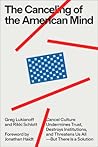
The Canceling of the American Mind: Cancel Culture Undermines Trust and Threatens Us All―But There Is a SolutionThe Canceling of the American Mind: Cancel Culture Undermines Trust and Threatens Us All―But There Is a Solution by Greg Lukianoff
My rating: 5 of 5 stars

Amazon.in Page

This book presents an in-depth exploration of cancel culture in its many varied manifestations, from both the left and the right of the American political spectrum. The biggest part of the discussion is with respect to the educational system, and particularly higher education. Sadly, this is because the institutions that used to be among the most formidable bulwarks of free speech, expression, and academic freedom have increasingly become untenable to multiple points of view. (The authors point out that there have been more dismissals of faculty members for cancel culture speech and expression issues than there were during the McCarthy era for political stance.)

However, the book doesn’t restrict itself to education, but also investigates cancelations in journalism, publishing, the scientific community, standup comedy, and the medical and psychiatric communities. The authors also present cases of the effect that wokeness and other expression limiting activities are having in these areas. One of the most disturbing revelations to me was the role of wokeness in psychotherapy and the negative effect it may have on people getting the help they need.

The book presents a series of cases in detail to advance the discussion. It also has a couple chapters that examine the tactics that are used to apparently “win” debates by silencing / demoralizing the opposition while avoiding any actual contest of ideas. The authors go through tactics favored by the Right as well as those by the Left. (Though it’s clear that, in a race to the bottom, both sides adopt the approaches of the other side that seem to be effective. e.g. the Left is getting into book banning (historically a Conservative tactic) and the Right is getting into cancelling and shout-downs (usually Progressive tactics.)) I think it was smart to have two authors, one from the left and one from the right, in order to help ensure balance in the project. That said, as the Left has been in the cancel culture vanguard, they come up more often.

Some have called this a sequel to “The Coddling of the American Mind,” with which it shares a co-author, Greg Lukianoff. I don’t know that I’d think of it that way. While it does address some of the same issues as background, psychology and child development are not at the fore in this book (Jonathan Haidt – the other co-author of “Coddling” is a psychologist,) but rather are the legal, cultural, and political issues.  

This is probably the most important book I’ve read this year (and, being late November, it’s likely to retain that status) and I’d highly recommend it for all readers.

View all my reviews

Fool’s Wisdom [Free Verse]

license to speak
           is 
license to think.

the jester can say,
 apparently in jest,
 what he feels to be real,

and, if he does so with 
 sufficient linguistic dexterity
  to not be murdered by the monarch,

he has fool's wisdom. 

BOOK REVIEW: Free Speech: A Very Short Introduction by Nigel Warburton

Free Speech: A Very Short IntroductionFree Speech: A Very Short Introduction by Nigel Warburton
My rating: 5 of 5 stars

Amazon.in Page

Get Speechify to make any book an audiobook

This concise guide outlines the debate on the perennially precarious issue of freedom of speech and expression. What factors (if any) should determine whether speech is restricted or not? Only when harm will be done to other individuals or to society at-large? Under a set of predefined conditions designed to advance societal harmony, or, perhaps, jingoism?

Some of the most interesting discussions in the book involve questions of whether any individuals or entities should have special privileges vis-a-vis freedom of speech? Historically, religions have claimed to be beyond criticism, but even as blasphemy restrictions have been softened (or applied equally to minority as well as majority religions,) there are still other groups seeking special status. For example, should a renowned artist who produces something that would otherwise violate public decency standards be able to publicly display said work because it has some redeeming artistic merit? (One can imagine the challenge presented by this question, given the inherently subjective nature of “artistic merit.”)

The book generally describes two or more opposing stances on any given issue, almost ensuring there will be points with which one agrees and others with which one doesn’t. I found the book thought-provoking, which led to a couple interesting realizations. For one thing, while I’ve been dismayed about how some groups are trying to carve out sacred spaces in which they are beyond criticism, challenge, or even [the nebulous] “being offended,” I was reminded that this is nothing new, and that whether it’s royal families or “the Church” there’s always been some group who wanted “freedom from” offense, challenge, or critique. It’s just a question of which groups make said demands that’s changing. For another thing, while I’m generally about as close to a free speech absolutist as one sees, I did learn that there is one question on which I don’t take the most pro individual liberty stance (in part because I didn’t recognize it as part of the debate.) The issue in question is copyright protection. There are those who argue that access to knowledge should be free and unimpinged, and that – furthermore — this would advance creativity. [I don’t really understand this stance as it seems to assume that creators of intellectual property will work even harder if they don’t get paid, but that’s a discussion for another time.]

If you’re interested in questions of free speech, particularly as they pertain to religious beliefs, pornography, and the changing state of intellectual property, you may want to read this book.


View all my reviews