BOOKS: “How to Fight Tough” by Jack Dempsey

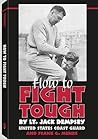
How to Fight ToughHow to Fight Tough by Jack Dempsey
My rating: 5 of 5 stars

Read online at Archive.org

This book was put out by the Coast Guard during World War II as a commando fighting manual. The lead on the project was heavyweight boxing champion Jack Dempsey, aided by a small team of others — all with varied bona fides in Combatives.

This is a fun book to read. It’s loaded with 1940’s slang, over-the-top reminders to fight tough and mean, and jokes that — while dated — still amuse with their quirky language. Seriously, the voice in my head was playing in Trans-Atlantic dialect (1940’s radio announcer voice) or as James Cagney playing a gangster the whole time I was reading this book.

That said, while the text was campy, the actual techniques are solid. The book consists of eighteen lessons that are built on well-established grappling and submission techniques such as hadaka jime (rear naked choke.) Also, while there is often only one (or — at most — a few) photos per technique, they seemed to put some effort into doing them conscientiously. (And they are almost full-page shots, so one can actually see a bit of detail.) The techniques include: unarmed v. various unarmed attacks, unarmed v. knife, unarmed v. gun (holstered, and front and rear approaches,) and unarmed v. bayonet.

I’d highly recommend reading this book. It’s a quick and amusing read with some useful techniques inside.

View all my reviews

BOOKS: “The Book of Five Rings” by Miyamoto Musashi [trans. by Thomas Cleary] [w/ Yagyu Munenori’s “Book of Family Traditions”]

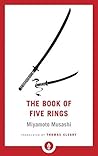
The Book of Five Rings: A Classic Text on the Japanese Way of the Sword (Shambhala Pocket Library)The Book of Five Rings: A Classic Text on the Japanese Way of the Sword by Miyamoto Musashi
My rating: 5 of 5 stars

Publisher Site – Shambhala Publications

This edition, i.e. The Shambhala Pocket Library edition, contains two guides to strategy, tactics, and philosophy of combat by famous early Edo Period swordsmen. The titular work is Miyamoto Musashi’s The Book of Five Rings, but the volume also contains Yagyu Munenori’s The Book of Family Traditions. The naming of the book is meant to capitalize on the continuing popularity of Musashi, who remains well-known to this day not only because of his own works and legend, but because of an afterlife in pop culture that ranges from Eiji Yoshikawa’s novel to a recent Netflix animated series. That said, one shouldn’t conclude Yagyu Munenori was some sort of slouch. He was, in fact, a martial arts teacher to the Shogun’s son, and he founded a branch of his family’s martial arts school that continues to this day.

It is interesting to see these two guides back-to-back, being by authors whose lifespans largely overlapped, though – in other ways – their lives were quite different. While there is some conceptual overlap in these guides, the two definitely show two very different minds at work, Musashi the pragmatic eccentric and Yagyu the Zen philosopher of noble standing.

Miyamoto Musashi is probably the most famous swordsman in Japan’s history. Oddly enough, he’s not known for his experience in battle (he lived at the tail end of the Warring States period and was only in a couple battles), but – rather – for his 62 duels. The Book of Five Rings and other works he left behind are certainly important factors in his continuing fame. Musashi was a bit of a renaissance man: painter, poet, and sculptor in addition to a swordsman. He also left behind a school of swordsmanship, Niten Ichi-ryū.

The Book of Five Rings is divided into five parts: earth scroll, water scroll, fire scroll, wind scroll, and void scroll.

The earth scroll provides an overview of martial science and an introduction to Musashi’s school, which is noted for its simultaneous use of both the large and short sword. A section is devoted the rhythm of martial arts, a crucial topic. It also includes what might be considered Musashi’s 9-point budō kun (a list of warrior precepts.)It’s worth mentioning a couple of these:
#7 Become aware of what is not obvious.
#9 Do not do anything useless.

The Water scroll describes Musashi’s approach to swordsmanship. It covers a range of elements of a martial art including footwork, the focus of one’s eyes, physical posture, mental posture, techniques, and approaches to cutting and thrusting.

The Fire scroll deals with the strategic or interactive aspects of the battle.

The Wind scroll explores other martial arts. Musashi discusses martial arts that use an unusually long sword, an atypically short sword, that focus on powerful strikes, and those that focus on many rapid strikes. He contrasts other martial arts with his own on subjects such as their focus with the eyes and their footwork.

The void scroll deals with, well, emptiness. It’s actually a short wrap-up.

Yagyu’s guide is much more philosophical and mind-centric. It’s not that Musashi doesn’t deal with such topics, but he also devotes considerable space to more practical nuts and bolts of swordsmanship and strategy. It’s also true that Yagyu gets into technical considerations such as control of distancing (if in a bit more poetic way than Musashi.) One can get a feel for the nature of Yagyu’s Book of Family Traditions [on the Art of War] by seeing how it is organized into three parts: “The Killing Sword,” “The Life-Giving Sword,” and “No Sword.” The latter two indicating the author’s belief in the importance of not equating warrior and killer (nor winning with killing) as well as not fixating on the sword.

These two men had great insight into strategy and the tactics of swordsmanship, their guides are worth being read and reread. And the two authors do offer two intriguingly different approaches to a similar subject.

View all my reviews

Rough & Tumble [Lyric Poem]

Oh, no, no! Don’t you get your gun.
It’s not that kind of wicked fun.
It’s just that rough and tumble stuff
Where one can say, “Enough ‘s enough!”
And go your separate ways, knowing
That the fight is still ongoing,
And it’ll never really be done
‘Cause it’d never truly begun.

BOOK REVIEW: Wrath of the Dragon by John Little

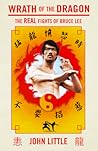
Wrath of the Dragon: The Real Fights of Bruce LeeWrath of the Dragon: The Real Fights of Bruce Lee by John Little
My rating: 5 of 5 stars

Amazon.in Page

Release Date: September 5, 2023

There are many Bruce Lee biographies out there, from general bios (such as Matthew Polly’s Bruce Lee: A Life) to those that are much more narrowly focused (e.g. Rick Wing’s Showdown in Oakland about Lee’s fight with Wong Jack Man.) This book is somewhere in between in that it is theme-focused (Lee’s fights and matches,) but it does offer insights from Lee’s childhood through to his death as they pertain to these fights and sparring experiences. The book explores all of the known real-world scraps and matches, as well as some of the more telling sparring sessions. Fights range from Lee’s adolescent skirmishes as a punk kid through the challenge matches with extras on the set of Enter the Dragon as an astute (if still quick-tempered) master. When I say that the book includes sparring sessions, I’m not talking about every time Lee sparred, but rather those exchanges that offered particular insight into Lee’s prowess, such as his last ever sparring session with his old Wing Chun teacher, Wong Shun-Leung (a senior student of Ip Man’s) as well as those with athletes at the top of their respective combative sports.

The point of the book is to challenge a belief — widespread at times — that Lee was a blow-hard offering banal quasi-mystical Eastern philosophy and martial insights that were based only on a few Wing Chun lessons from Ip Man. In contrast, the book paints a picture of a broadly experienced fighter who was obsessive about his betterment as a martial artist. Lee was an innovator and trained with great endurance and intensity. The book portrays Lee as a martial artist of such speed and athleticism that even World Champion competitors were left in awe.

While reading, one does have to question how objectively the information is being presented. After all, Little is definitely a bit of a fanboy and he’s clearly taking a stance on Lee’s prowess. Furthermore, the fact that (at one point, I’m not sure about presently) Little was the only one with full access to Lee’s archived notes suggests his message was sufficiently on point for Lee’s family to feel comfortable with him. That said, I felt there was enough admission of Lee’s weaknesses and mistakes as well as a willingness to present competing statements when details were in question that I believe this is an honest attempt to get the details right (within the unavoidable constraints of memories of events being decades in the past and being seen from multiple perspectives — psychologically as well as geographically.)

I found this book to be fascinating from cover to cover, and well worth reading. In addition to the stories of the fights, the author discusses the lessons that Lee learned along the way. Even in winning, Lee was sometimes dissatisfied with his own performance, and this drove him to adapt and to develop new training methods. I’d highly recommend this book for those interested in the martial arts or who love a good biography.

View all my reviews

The Futility of War [Haiku]

two young gazelles
 lock horns and head-wrestle, 
  then quit and move on.

BOOK REVIEW: Meditations on Violence by Rory Miller

Meditations on Violence: A Comparison of Martial Arts Training & Real World ViolenceMeditations on Violence: A Comparison of Martial Arts Training & Real World Violence by Rory Miller
My rating: 5 of 5 stars

Amazon page


I’ve long realized that all martial arts are models. Models are simplifications; they inevitably leave elements out—sometimes because those elements don’t seem relevant and sometimes because they can’t realistically (re: sanely) be included. Those of us trained as social scientists say two things about models. 1.) All models are wrong, and 2.) All models lie. The question is whether your martial art is the least wrong, i.e. tells the most acceptable lie, for your purposes. Rory Miller’s work illuminates the most crucial part of what martial arts leave aside, violence and the context in which it takes place in the modern world. I say the most crucial part because it’s not excluded because it’s irrelevant; it’s left out because it’s impossible to shun safety / encourage violence without the practice devolving into a last man standing competition. (FYI: If you’re saying, “Man, the martial art I study is completely street realistic,” then you need this book more than anyone.)

While it’s important to have safety in a training environment and, therefore, true violence must be prohibited (simulated, but not carried out), it’s important to understand violence so that one can prepare one’s mind for it and train oneself to recognize various types of violence so that one knows the best approach to avoid a bad outcome. One doesn’t want to end up wondering “how could this happen” as one is bleeding out on the ground as martial artists from a range of styles have experienced. I’m not saying martial arts aren’t valuable, and I don’t think Miller is either (he’s long practiced them, as have I.) While martial arts may not prepare one perfectly for a violent conflict, they move one in the right direction. The only real downside is if one allows oneself to be deluded into thinking one is going to roll through waves of enemies without a scratch like Jet Li or Steven Seagal on the silver screen. That’s why it’s important not only to read such a book as this, but to give serious thought to changing the narrative that plays out in one’s mind about the nature of violence so as to move it away from movie / sport fighting towards an approach that is most likely to get one and one’s loved ones out alive.

The book consists of seven chapters, plus front and back matter. The first chapter introduces two matrices as ways to frame one’s thoughts on the conflict. The first, the tactical matrix, looks at different types of attacks one might experience (eg. surprise ambush through preemptive attack) relative to allowable use of force (can one legitimately injure or kill one’s opponent?) The second, the strategic matrix, considers the various types of combative endeavors (e.g. self-defense, duel, sport, combat/military operations) and there goals, approaches, and dangers.

Chapter two is entitled, “How to Think,” and the emphasis is on “to think.” The central lesson is to not take ideas on faith, particularly ideas about the nature of violence from people who haven’t experienced it—particularly when those ideas seem to run counter to reality. Because violence is such a rarity, it is a subject for which there is a great disconnect between expertise and experience. (i.e. Chances are your plumber has unclogged tens to thousands of drains, but also that the person teaching you knife disarms has never been in a single knife fight.) The chapter considers the various fallacies and how they can be resistant to destruction. Emphasis is given to understanding your goals, making them realistic, and having a pragmatic path to achieving them. The take-away quote is, “Do not let yourself be crippled by something that only exists in your mind.” The chapter ends by looking at decision-making at the speed of a fight, which is pretty quick.

Chapter three gets to the heart of the subject, violence. It differentiates various types of violence, and considers the context (setting, timing, and the nature of the interaction) in which violent interactions take place. Much of the discussion revolves around what Miller calls the “monkey dance” -an attempt to exert dominance that often escalates into a fight. This is differentiated from predatory violence that demands a different approach. This section also addresses the neurochemical cocktail that gets shot into one’s system and the effects that it typically has—which is a leading cause of events unfolding differently than expected.

Chapter four describes the various types of individuals with whom one might find oneself engaged in a violent altercation. This is an important topic because the path to a best outcome varies depending upon the nature of the criminal, and so one’s ability to differentiate types of predator and to know how to best deal with each is as essential a skill as knowing the technical nuances of a punch or choke.

The fifth chapter examines training approaches, and how the typical martial arts education leaves one with blind-spots and built-in flaws. The chapter begins by looking at the many ways in which martial arts make modifications from realistic conditions in order to be safe. Most martial artists realize that they are training techniques or drilled responses into their subconscious so that their bodies can respond automatically–without the need for [slow] conscious thought–during a conflict. However, there’s a further assumption that the unrealistic parts of that movement (e.g. slowness or avoiding vulnerable targets) will go away under real life conditions. In an earlier chapter, there was a discussion of the fact that attacks are usually faster, harder, at closer range, and more surprising than expected (Miller calls it the four basic truths), and this chapter considers some ways that one can prepare for those realities.

The sixth chapter considers how one can make self-defense work. It should be pointed out that this isn’t just about how to engage in the fight, but also how to stay out of a fight or get away from it as quickly as is possible. There’s also a discussion of set rules for determining when one must fight. This is the type of notion that one must think about ahead of time, because one can’t expect to think clearly once the adrenaline has been dumped into one’s system. The remainder of the chapter explores how one is most likely to get out of an altercation alive once the fight has become inevitable.

The final chapter delves into the question of what comes after the violent encounter. This is also a subject on which many martial artists have unrealistic notions. If one survives in an unheroic / ungraceful way, one may have guilt or dismay about how imperfectly events unfolded. On the other hand, say everything works out for one, but one kills the predator. Most people seem to think that this won’t be troubling, because it was justified. This misses the fact that there are many traumatized soldiers who were also completely justified, but if you aren’t a hardcore psychopath, you aren’t wired for killing.

I found a lot of valuable food for thought in this book. The author includes many stories (sometimes funny and sometimes disturbing) that help to make the lessons memorable and poignant. Tables, charts, and the occasional photograph are used to illustrate points as well.

I’d recommend this book for anyone who’s concerned about violent altercations. If you’re a martial artist who has no such concerns because you think you have a lock on it, then you probably doubly need this book.

View all my reviews

BOOK REVIEW: Fight Like a Physicist by Jason Thalken

Fight Like a Physicist: The Incredible Science Behind Martial ArtsFight Like a Physicist: The Incredible Science Behind Martial Arts by Jason Thalken
My rating: 4 of 5 stars

Amazon page

When I saw this book’s title, I imagined a bloodied and battered Poindexter in a bow-tie–a professorial type dying in a puddle of his own bodily fluids as he calculated the Bayesian probability of winning given that initial beating. After all, physics is a highly cerebral activity, and being cerebral in a fight is a certain path to a beat down. However, Thalken makes a good point with his explanation of the title (and the book’s theme.) He’s suggesting that one use tactics and techniques that are supported by evidence and rooted in a sound understanding of the science of combat—as opposed to mindlessly doing whatever your sensei tells you or–worse yet–just muddling through on a combination of instinct and ignorance. In short, be skeptical, but inquiring. It turns out that there is a time for a fighter to be cerebral, but it’s when they are making decisions about how to train.

The book is divided into two parts. The first part explains how classical mechanics can help one to be a better fighter. There are four chapters in this section that deal with center of mass and its crucial role in a fight, the differences between high momentum and high energy strikes and how each is achieved, differences in circular versus linear paths and where the advantage in each lies, and what simple machines (i.e. levers and wedges) can do for a fighter. This section is what one would expect from such a book. Unlike the second section, which deals largely with sport fighters, the advice on offer in the first section is as applicable to those involved in self-defense or other real world combative situations as it is to fighters in the ring.

The second section examines the issue of concussions and brain damage in some detail, including consideration of the degree to which gloves and headgear do—or don’t—make one safer. The reader gains great insight into the mechanics and neuroscience of a knockout. While the majority of the section offers advice for those engaged in combative sports, the last two chapters take a bit of a turn. The first of these two deals with the myths perpetuated by Hollywood—which, let’s face it, is the source of most people’s information on what combat is. Debunking the notion that a person who gets shot is always and everywhere instantly incapacitated is a central theme this chapter. The last chapter deals with the issue of pseudoscience in the martial arts, and the insanity of believing one can defeat an opponent with chi (also qi, or—in Japanese Romanization–ki) or mind power alone. These last two chapters seem like a turn from the main theme of the book, but they do stay under the umbrella of the martial arts through a scientific lens.

While this is a book about science, it’s readable even for an educated non-scientist. All the math is put in boxes that the reader can opt to skip, or to follow, depending upon his or her comfort level with equations. There is no complex jargon, nor any incomprehensible concepts. The physics is largely high school level Newtonian mechanics.

Diehard believers in the supernatural or pseudo-scientific conceptions of the universe should be warned that this isn’t the book for you unless you like your sacred cows flame-broiled. You won’t learn about chi (qi) in this book except to be reminded that it’s a make-believe concept.

I’d recommend this book for those who are interested in how science can be applied to the martial arts or human movement more generally. It’s short, readable, and offers some interesting food for thought.

View all my reviews

Dueling Mantras: Competing Tactical Tenets in Martial Arts

There are many rules of thumb that are used to convey useful generalizations to martial arts students. One that I’ve heard for years is:

“Use as big a movement as you have time for.”

The idea is that big movements are more powerful and, thus, more likely to be effective in damaging/dissuading the opponent–if they land. Big movements use major joints and muscle groups, and allow one to put one’s body-weight into the target. There is, of course, a trade-off that’s recognized in the latter part of the tenet, and that’s that big movements are slower movements and slower movements are less likely to succeed. (i.e. One needs to streamline one’s big movements.)

Like any generalization, this tenet can be valuable only as long as one recognizes where its truth falters. I think this rule of thumb is great as long as the student does sufficient sparring / randori (after they’ve learned the basics.) If one doesn’t (e.g. if one only practices forms,) one can easily develop a false impression of how much time one has against an opponent who doesn’t practice the same art–and how big a movement one can make work. In other words, one’s enemy may dance about pummeling one about the head and neck as one lunges with big (futile) movements.

The aforementioned tenet isn’t the only way of looking at the question of whether to favor big (long/slow) or small (short/fast) movements.

One might also suggest:

“Use as small a movement as will sufficiently damage the opponent.”

Again, there’s a trade-off. While small movements offer relatively high odds of success–they are hard to see and counter–they aren’t as likely to achieve a much sought-after coup de grace (meaning a fight-ender, not necessarily a killing blow.) The risk one faces if one follows this second tenet too blindly and without sparring is becoming extremely fast while unable to punch one’s way through a wet paper sack. This is kung fu movie style martial arts, very impressive to look at but not so so effective in a combative sense.

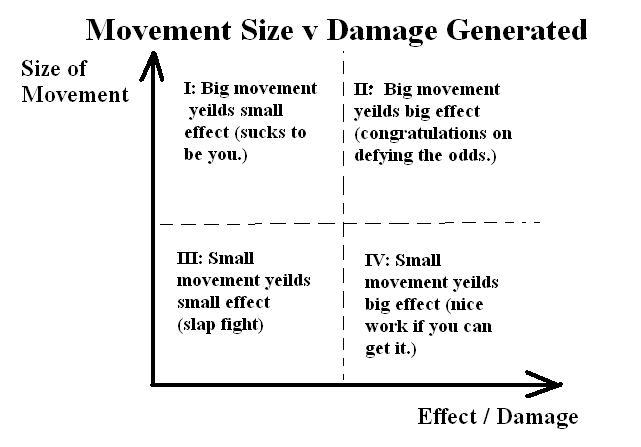
I would argue that one should take advantage of any opportunity to deliver substantial damage with small movements (quadrant IV of the first graph), but be aware that these opportunities don’t grow on trees. How does one defy the trade-off? As an example, I have found that moving an elbow into the line of attack of an incoming limb can destroy said limb’s effectiveness briefly, offering one an exploitable opportunity. This is extremely hard for the opponent to see and respond to once they are committed to an attack.


Size v Damage


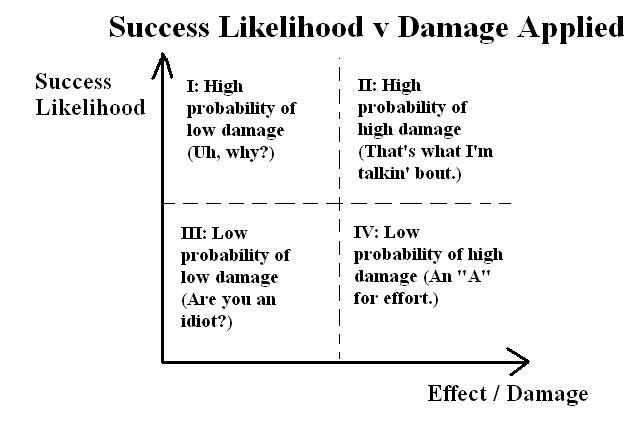
So the ultimate question is whether one favors big/slow/low probability/high consequence movement over small/fast/high probability/low consequence movements. As per my second graph I would suggest one finds a way to employ tactics that are as close to quadrant II as possible, while realizing they’re a tall order in a combative situation.

Likelihood v Damage


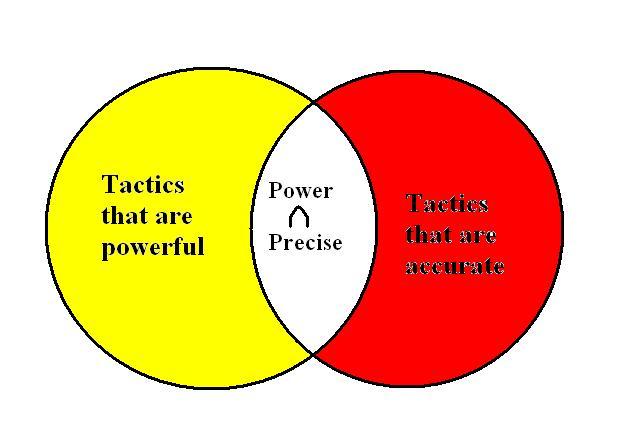
Figuring out how to manage these trade-offs requires a journey to the intersection of accuracy and power.  It’s extremely difficult to be precise in a combative environment, everything is in motion and time isn’t aplenty. However, as one  fine-tunes one’s technique, one should consider what trade-offs are being made and how one can increase power without sacrificing accuracy and vice versa. Ultimately, it all boils down to practicing conscientiously, constantly, and with as much realism as is safe.

power&precise_venn

Now I know what you are thinking, “What kind of nerd puts three graphs in a martial arts blog post?”

This kind [Jutting both thumbs in my own direction simultaneously.]

BOOK REVIEW: Write the Fight Right by Alan Baxter

Write The Fight RightWrite The Fight Right by Alan Baxter

My rating: 3 of 5 stars

Amazon page

I was going to pan this for being the wrong book, but then I read through the blurb (and even the subtitle) and realized that it was largely my fault that I got the wrong book. Furthermore, I recognized that the information contained in this tiny e-book is good and that it’s packaged in a concise form. I, thus, concluded that this is the right book for someone—just not me nor many of you. I’ll, therefore, devote the bulk of this review to differentiating for whom the book will be beneficial and for whom it won’t. Because of the dearth of books on the topic I was interested in, I can imagine others erroneously purchasing this book and having (the albeit tiny) $2.50 worth of buyer’s remorse.

I purchased this book (and another one that returned on the search for “writing fight scenes”) because I’m rewriting a chapter in my novel in which fight scenes are prominent. I realized that there is a fine art to writing a good fight scene, and that I could use some help in being more effective at it. One needs fight scenes to have fast pacing and to be visceral. At the same time, one must avoid getting bogged down in detail even in the face of multiple attackers or unfamiliar and complex weaponry. This book won’t help you one iota in this regard, and, to be fair, it says in the blurb that the book will not help with one’s writing.

The book is about what it’s like to be in a fight and how to separate Hollywood myth and misconception from reality. As a long-time martial artist with both military and law enforcement training as well as an avid reader, there was nothing new or interesting in this book—though there wasn’t much I would disagree with either.

Three criteria for readership:
1.) You haven’t witnessed or experienced a fight (outside the choreography of the silver screen) since middle school. This book describes the experience and effects of fighting and what skilled fighters try to do in close-quarters combat. It aims to help writers purge theatrical nonsense from their fight scenes and inject some verisimilitude.

2.) Your fight scene is a standard 20th/21st century brawl. What is discussed is one-on-one fighting–unarmed or with weapons that one might see wielded today. One won’t gain insight useful in historical fiction, or anything that doesn’t echo today’s form of fighting.

3.) You don’t want to put a lot of time or effort into reading and / or researching the subject. The author does advise the reader to take martial arts or self-defense classes as a superior way to learn what he is trying to teach. What this book has going for it is that it’s only a 43 page (and a couple dollar) investment. If one is interested in getting a much deeper understanding of the topics covered, I would recommend a combination of Lt. Col. David Grossman’s On Killing in conjunction with any number of full-length martial arts books (I’m reading Bruce Lee’s Tao of Jeet Kune Do presently, and it’s certainly an excellent candidate.)

To summarize: this book is useful to teach one about realism in fight scenes, and not about structuring such scenes. There are only three examples (2 short and one long) in the book—none from what would be considered exemplary works. If you’ve taken a martial art or had military or law enforcement experience, there’s unlikely to be anything new or intriguing in this book. Even if you just watch MMA regularly and / or read about fighting or combat, there’s a good chance you won’t learn much.

However, if watch Crouching Tiger, Hidden Dragon or Rumble in the Bronx and say, “So that’s what a fight looks like,” you should definitely give this book a read.

View all my reviews

Kalaripayattu and Single Point Origin Myths

I just began my study of Kalaripayattu this morning. Kalaripayattu is an Indian martial art that is named for the training space (kalari) in which it is conducted. It’s a very different martial art from others I’ve studied, and is a great learning experience—as well as an excellent workout. Kalaripayattu is said to be one of the oldest formal martial arts that has survived into the modern era. I have no reason doubt this. The art is documented in the 11th century by a historian who attributes its development to wars between the Chola and Chera kingdoms.

However, there’s another common claim that is much more controversial, and that’s that Kalaripayattu is the “mother of all [Asian] martial arts.” With all due respect, I’m skeptical of this claim—even if we don’t take it in the literal sense (i.e. Asia is a big place and there are almost certainly places where martial arts were established before contact with the Buddhist diaspora.) I obviously don’t base my skepticism on what I have been taught—as that is, at this point, a miniscule portion of the most basic of basics.

While I can offer no definitive proof to discredit the claim, I do have specific reasons to be skeptical. The theory of Kalaripayattu as the origin of martial arts is based on the legend of Bodhidharma. The legend says that the famous monk shared martial arts with the monks of Shaolin in conjunction with the Zen (Cha’an) form of Buddhism, and from Shaolin as Buddhism spread so did the martial arts. I’ve read myths about the origins of the Japanese martial arts that I’ve studied that place the beginnings of their ancestor arts with Chinese Buddhists fleeing persecution during the T’ang Dynasty (as well as later periods.)

The first problem with this theory is that historians have found it to be unsubstantiated and dubious. While the belief that Bodhidharma introduced the Chinese to martial arts is one of the most widely believed and cited pieces of martial arts lore, Meir Shahar in his book The Shaolin Monastery [http://www.amazon.com/The-Shaolin-Monastery-History-Religion/dp/082483349X] states that the evidence doesn’t support this popular belief. Specifically, the only historical documentation of this theory is a document that was written in the 1600’s that the author claimed was “discovered” from an earlier time—the problem is that the language usage isn’t consistent with the claim that the document was from a much earlier period, and there are many verified mistakes in the document.

Even if Shahar and other historians are wrong, the evidence that Bodhidharma came from southern India and that he studied Kalaripayattu specifically seems to be non-existent. There is at least one popular theory of Bodhidharma that puts the origin of this famous spiritual leader outside of India altogether. If the aforementioned Indian historian was right and Kalari developed during 11th century wars, then it’s late for the life of Bodhidharma by some 500 years.

The challenge is that it’s difficult to compare the modern martial arts and see definitive evidence of historic connections. Some will say, “But Kalaripayattu doesn’t look like Shaolin Kung fu (or any other subsequent arts) at all.” While it’s not true that they don’t look anything alike, it’s true that they look very different. However, what one has to keep in mind is not only did Kung fu continue to evolve in order to optimize to its circumstance, its predecessor system (whether Kalaripayattu or otherwise) would have continued to evolve as well. The Kalaripayattu of today most likely looks quite different from 11th century Kalaripayattu, but we can’t know how so in any detail. This could make for some pretty rapid divergence. Others may say, “But, hey, I do see the similarities in kicks and postures and so forth.” This may be true as well, but can one be sure that one of those commonalities is causal of the other? What if it’s just the constraints of the human body that make all martial arts similar at some level of granularity?

My intent is neither to destroy origin stories nor to discredit any martial art. Obviously, Kalaripayattu has a long history, and the fact that it survived to modern times is a testament to its value over that time. Combat is a harsh evolutionary environment, and things that don’t work for the situations they face are likely to die with the people who practice those systems. However, I think it’s important for warriors to not succumb to false fables because they must see the world as it is and not as they wish it to be.