BOOK REVIEW: The Psychobiotic Revolution by Scott C. Anderson, et. al.

The Psychobiotic Revolution: Mood, Food, and the New Science of the Gut-Brain ConnectionThe Psychobiotic Revolution: Mood, Food, and the New Science of the Gut-Brain Connection by Scott C. Anderson
My rating: 5 of 5 stars

Amazon page


For centuries there have been cases in which a change in diet –often accidental– led to relief from a mental illness. However, given the sporadic nature of such effects and the complete lack of understanding of microbes, the enteric nervous system (i.e. the gut’s own “brain” that communicates with — but is also autonomous of — our “first” brain,) and the complexity the symbiotic relationships involved, these anecdotal cases had limited influence on the state of medicine. However, recent years have seen an explosion of understanding in this domain. This has resulted in a vast number of books being written on the role of microbes in the gut for overall health, the role that changing diet can have on changing our microbiota, and related topics such as how the overuse of antibiotics can have a deleterious effect on health by tossing out the microbial baby with the bath water. This book touches on all those topics (and more) as it explores the role of our bacterial hangers-on on our mental health.

The book consists of nine chapters. The chapters are organized so as to first present one with the necessary background to understand how changes to one’s gut microbiota can improve one’s health —particularly one’s mental health (though many of the mental illnesses influenced by microbiota are linked to physical ailments)— before moving on to the specifics of what microbes have been shown to have a given effect and what diseases can be influenced by consumption of probiotics.

The first five chapters give the reader an introduction to the topic and an overview of information one needs to know to understand the later chapters. Chapter three gives one an overview of the changing profile of one’s microbiota over the course of one’s life. Particular emphasis is given to one’s youth and to the transfer of bacteria to infants. [Readers may be aware of the problem that c-section births result in a failure of babies to receive a dose of beneficial microbes imparted by passage through the vaginal canal.] Chapter four takes one on a quick ride through one’s alimentary canal from mouth to rectum, with particular emphasis on questions such as how bacteria survive the stomach’s acid bath, and which parts of the digestive system contain which microbes (and to what effect.)

The last four chapters dig deeper into the specifics. These chapters look at specific probiotics, how one can get them into one’s system, and what science has found out about probiotics and psychobiotics (like probiotics, but specifically ones that influence mood and mental states) effects on specific ailments. Chapter eight, which deals with major diseases, does cover physical ailments as well as mental ones because – as mentioned— these afflictions often go hand-in-hand. The last chapter (Ch. 9) looks at where this body of knowledge is going. It delves into practices that are presently well-established, such as fecal matter transplants, but also into challenging works-in-progress such as attempts to develop narrower spectrum antibiotics so that we can get the life-saving benefits of these medications without their crippling side-effects.

The book has many graphics, as one would expect from a work that investigates such a complex scientific topic. I can’t really speak to the quality of the graphics as the review copy I read didn’t have completed graphics. However, the subjects of the graphics seemed appropriate and well-placed. The book also has a glossary, annotations, and a further reading section to assist the reader in the study of this subject.

I found this book to be informative and engaging, and would highly recommend it for anyone interested in the role of microbiota on mental health. The text was well-organized and readable. Given the scientific nature of the material, it’s easy for such a book to become ponderous, but the authors made attempts to keep the tone light and the presentation non-intimidating.

View all my reviews

BOOK REVIEW: How We Feel by Giovanni Frazzetto

How We FeelHow We Feel by Giovanni Frazzetto
My rating: 4 of 5 stars

Amazon page


Frazzetto’s book tells us what neuroscience can and can’t tell us about seven core emotions: anger, guilt, anxiety, grief, empathy, joy, and love. Doing so puts the neuroscience of emotion into a broader context of art, philosophy, the humanities, and the legal / political domains. Most often this serves to make the book more interesting by offering stories beyond the case files of neurologists and neuroscience researchers, but it does result in occasional editorializing.

The book consists of seven chapters, each of which is linked to one of the emotions listed in the preceding paragraph. These chapters always tell us the rudiments of what science has learned about the brain’s role in said emotion, but they often offer insights from other disciplines as well as providing more general information about the brain that the author found particularly relevant to the topic at hand.

The first chapter delves into anger. Besides the neuroscience of rage, we learn a bit about the expression of emotion (e.g. through facial appearance; a theme revisited in other chapters), and the degree to which genetics plays a role in proclivity towards anger. This chapter serves to set up general concepts, and so we also learn about what an absence of emotion looks like (e.g. indecisiveness.) And in compliance with the law that every pop science book on neuroscience tell the story of Phineas Gage (the foreman who got rebar shot through his brain and lived to tell the story—though in an uncharacteristically hostile way), Frazzetto knocks it out early.

Chapter two explores the topic of guilt. It should be noted that some of these chapters discuss more than one related emotion, and here we learn how shame and regret are differentiated from guilt. There’s an interesting story about Caravaggio and how his own guilt-ridden story influenced one of his most famous paintings.

Chapter three is about anxiety, and also takes on fear. In addition to the neuroscience, we get a discussion of relevant philosophy, specifically that of Heidegger. Here, the author also describes brain plasticity.

The next chapter investigates grief. As I suggested above, there are multiple points where emotional expression is discussed, and this chapter has one of the most extensive of such discussions. In terms of general concepts, Frazzetto introduces the reader to neurotransmitters. One also learns how grief is related to physical pain.

Chapter five elucidates empathy. A lot of this chapter discusses acting, and the need for actors and actresses to be able to acquire empathy from the audience. The reader learns the story of Stanislavski, and how he went about creating his self-named acting system which remains widely used. This chapter also explains mirror neurons that allow one to recognize expression and to mimic others.

The penultimate chapter is about joy, and here we learn more about expression of emotions and, specifically, the seeming universality of smiles. There is a discussion of poetry as it pertains to the emotion at hand. Having introduced neurotransmitters earlier, the reader learns about dopamine, its role in happiness, and how a number of drugs have been created that increase our natural dopamine’s effect or mimic it.

The last chapter is about love. Of course, we learn about oxytocin and vasopressin, two neurochemicals famously associated with loving behavior. There is also a fascinating discussion of Capgras Syndrome. In this condition, the patient feels that his loved ones have been replaced by impostors. That may not seem relevant until one realizes that the proposed mechanism for this illness is damage to parts of the brain that control emotional connection. Without an emotional connection, the person feels that said individuals can’t be his / her dearest friends and family—though his senses register that they are exact duplicates in every way. The brain builds a rationalization that they must be impostors. Of course, no emotion evokes more resentment towards materialist explanations rooted entirely in biology than that of love.

The book is extensively annotated and also has a bibliography. There are many graphics throughout the book from line drawn diagrams of brains to photos of brain scans to the artwork “David with the Head of Goliath” mentioned relative to the discussion of Caravaggio’s guilt.

There are a number of books in this domain (i.e. the neuroscience of emotion) and if you were only going to read one, I don’t think I’d recommend this one as it. However, if you are into this topic, it is definitely worth a read. It’s interesting and insightful, and has a unique approach.

View all my reviews

POEM: Abhaya

Stand atop the wall.
Feel the conch sound.
Watch the arrows sail.
Survey the killing ground.

Know you’ll someday die.
As will all, I suppose.
For those who die well,
it is no tale of woe.

BOOK REVIEW: What Does Fear Do To You? by J. Krishnamurti

What does fear do to you?What does fear do to you? by Jiddu Krishnamurti
My rating: 3 of 5 stars

Amazon page


This book is one in a series called “Krishnamurti for the Young.” It deals with an important subject: fear and the adverse consequences of fear unchecked. Jiddu Krishnamurti was an Indian philosopher who was being groomed for a leadership position in the Theosophical Society as a young man, but he withdrew from that organization to pursue a more independent-thinking and non-sectarian philosophy.

Judging from the fact that the first edition of this book is dated 2004 and Krishnamurti passed away in 1986, it’s safe to say that this work is cobbled together from a combination of unpublished and previously published speeches and writings. There’s a page of sources and acknowledgements that provides the citations for the previously published writings. This is presented in end-note format.

The first half of the book is a story from Krishnamurti’s life that transitions into the basic theme of the book. The second half is presented in the form of questions and answers. The questions are clearly of the type children would ask, and so they may have been from school visits and the like.

It’s a short book of fewer than 30 pages–appropriate in length for kids. It has simple child-friendly drawings that were based on originals drawn by children. While the text is edited to a readability level suitable for children, as I’ll explain below, the material by-and-large isn’t presented in manner conducive to reaching children.

The book is a bit cerebral for young children in places–both in terms of the approach to delivering the material and the concepts presented. It may be of use to older children (but they may feel it’s targeted for younger kids based on the graphics.) The central message is sound: that one can watch one’s fear and see that it’s a mental product and then one can figure out how to respond to the emotion without acting impulsively or destructively. However, a more story-centric approached would better serve kids. There’s a story at the beginning about Krishnamurti walking close to a rattlesnake, but after that it becomes much more of a philosophy and psychology lesson. Krishnamurti frequently uses Socratic Method (asking questions instead of lecturing to help the reader discover a conclusion.) This method is of greater benefit to adults and young adults than young children.

I also felt that this was clearly an adults-eye view that could have benefited from a more child-eyed worldview. There’s an assumption that kids are afraid of everything and everybody and that adults are the experts in being fearless who can teach kids everything they need to know. Only an adult whose inner-child had been brutally murdered could think something so inherently ridiculous. As someone who’s taught kids yoga and martial arts, I can tell you that this is clearly not the case. In some domains, kids are far more expert fearlessness than are adults. This is something that could be tapped into to better make the point.

It seems to me that this book might be most productively read by someone who’s going to teach kids about fear and how to manage their fears. It’s great information, but it’s not presented in a manner that seems likely to grab a child’s attention. It’s not presented in an interesting fashion, and it deals in topics like conscious and consciousness that are heady for a youngster.

View all my reviews

POEM: Mind Gravity: or, The Heft of Mental Putrefaction

depression-in-bed

Gravity pulls her head down into the pillow.

Like tar through a garden hose, thoughts flow.

Thoughts weighty, not freed of mass and matter.

As stuck in time and lost to reason as the Hatter.

Thoughts arise because they’re lighter than air.

Hers fell sodden, a lead balloon in the state fair.

The infection arose from a single putrid notion.

One drop floating free to fester across an ocean.

That she wasn’t enough. Enough for whom? Enough for what?

Unanswerable questions that congealed into a sluggish pus.

They say truth has weight, but truth lifts one to fly free.

What pulled her head to pillow was the mass of negativity.

As her thoughts hardened into a slag, devoid of truth or reason.

She summoned the strength for a search in her final season.

She scoured the four corners of the Earth for a fabled cure.

But it lie in a place close at hand, but vastly more obscure.

5 Courage Building Yoga Practices

Learning to manage and moderate one’s fears and anxieties needn’t involve strapping on a parachute, cold quitting a job, or bare-knuckle boxing in a back alley. In fact, it may be best to begin by quietly watching those anxieties at the other end of the spectrum, the one’s so subtle that conscious awareness of them can be blotted out by the noise of living–but which nevertheless have a physiological impact.


The ability to quietly and non-judgmentally witness one’s emotional state–as is taught in yoga and related practices such as Buddhist meditation–is crucial (and, in my opinion, is one of the most valuable lessons that these systems have to teach.) Crushing or repressing emotions is a demonstrably losing strategy. At best these feelings are tamped into one’s subconscious mind, still adversely affecting one’s outlook and, therefore, indirectly casting a pall over one’s life.


You’ll note that I’ve mentioned courage and moderating fear, but have not mentioned defeating emotions or quelling fear. Wrongly, our archetypes of fearlessness are characters like John McClane (i.e. the “Die Hard” movies), Katniss Everdeen (i.e.”The Hunger Games” trilogy),  or Yoda (i.e. the “Star Wars” movies.)  But neurologists who study patients whose brains have been damaged such that they are literally fearless tell us that the defining characteristic of such individuals is “paralysis by analysis.” In other words, Sheldon Cooper (i.e. “Big-Bang Theory”) is a more apt model. Also, the fearless tend to live short lives because they eventually do something fatally inadvisable.


We need our fear. However, while fear can keep us from doing stupid things, it can also turn us into the worst version of ourselves. Therefore, our fear needs to be moderated with courage and reason (to these, some would add “faith.”)


You may note that I tend toward the intermediate / advanced with the practices I mention. This is, in part, because that’s probably more likely the point at which one is ready to take this on. In beginning a practice, one may have one’s hands full to grasp the basics of alignment and breath.


Without further ado, here are a few yoga practices that I’ve used to help me witness my anxieties and learn to moderate them:


1.) Nauli (and other external breath retention [i.e. bāhya kumbhaka] techniques.): Breath retention can produce a subtle anxiety, even when one has full control of the timing of release and the next breath. In fact, subtle anxiety may cause one to have a less robust retention than one might otherwise. Truth be told, this practice has probably been more fundamental than any of the āsana practices that will follow, for me personally.  

Note: external retentions are relatively advanced practice and should only be added to one’s sadhana after one has been taught by an experienced teacher and is somewhat experienced with pranayama.

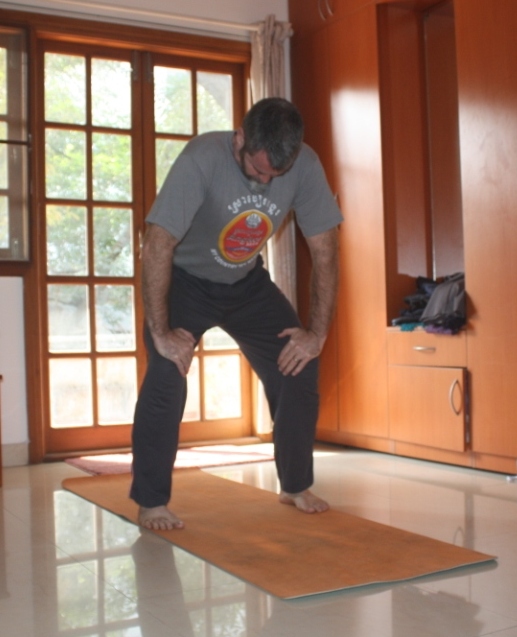
practicing nauli

practicing nauli


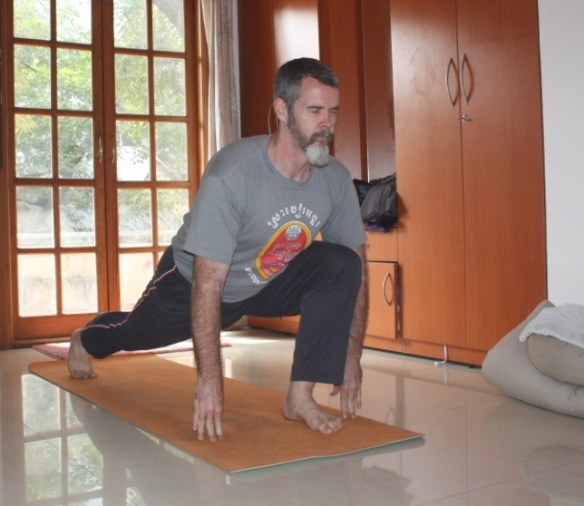
2.) Eyes closed: This is particularly effective with Surya Namaskara (Sun salutations), standing poses, and–at an advanced level–balancing poses. One should make sure that ones balance is solid throughout before attempting with one’s eyes closed. We have redundant systems to help achieve balance (i.e. inner ear, proprioceptive, and visual), but–for the sighted–going without vision can be nerve wracking.

ashwa sanchalanasana in Surya Namaskara

ashwa sanchalanasana in Surya Namaskara


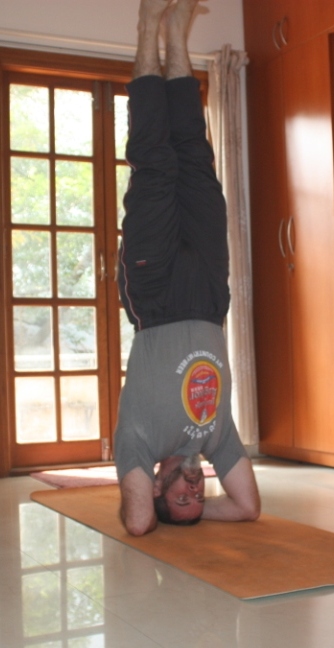
3.) Inversions: Inversions are meant to be calming because when the blood pressure to the head increases, it triggers reactions in the body to reduce it. However, it may take some time before that promised is reached. I’ve done a more extensive post on inversions that can be read here.

shirshasana (headstand)

shirshasana (headstand)


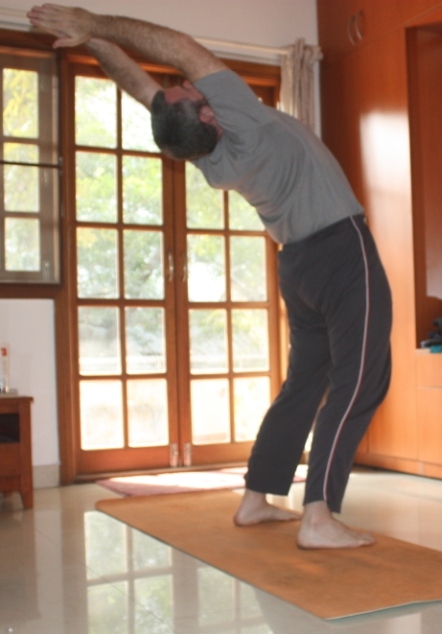
4.) Standing Back-bends: (Ardha Chakrasana / Urdhva Triangmuktasana / full Urdhva Dhanurasana) Simple back-bending can create the feeling that one is about to fall back onto one’s head. One may want to begin with a simple back-bend as one might do in Surya Namaskara before advancing to the complete Urdhva Dhanurasana in which one moves into a wheel pose (Chakrasana) from a standing position. (Urdhva Triangmuktasana is an intermediary in which one’s knees are more deeply bent, and one reaches back towards one’s Achilles tendon.)

ardha chakrasana

ardha chakrasana


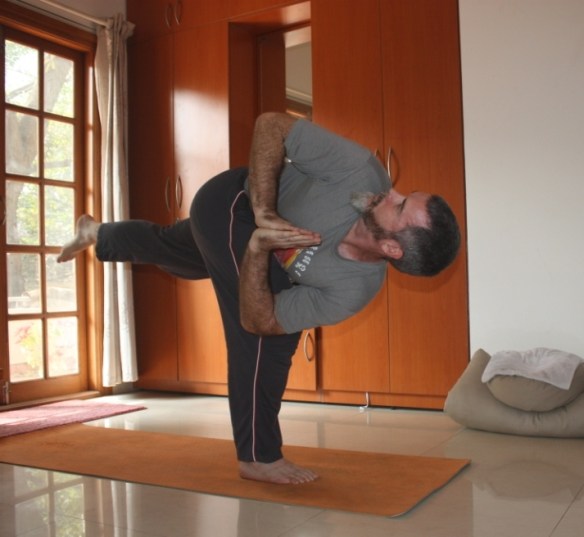
5.) Standing Balances: Depending on one’s level, anything from tree pose (vrksasana) to bound twisted half-moon pose (baddha parivrtta ardha chandrasana) may be applicable. I’ve shown the unbound version of the latter (parivrtta ardha chandrasana.) Twisting and balancing at the same time provides a great challenge, if one is already confident with balances generally.

parivrtta ardha chandrasana

parivrtta ardha chandrasana


Happy practice.

POEM: Angry Infusion

a slow kick

flipped it over

jiggling

not yet rigid

soon to be brick block

unyielding and unmoving

but dissolving

as sugar cubes in hot coffee

and when no trace remained

ubiquity

POEM: Too Happy

IMG_3368

I’m too happy to be crazy,

but the happy makes me lazy

Not lazy, but lacking focus.

Madness is a creative locus.


A sad gravity weighs one down,

as lip corners into a frown,

but in the pit resides a muse.

People pay to hear the blues.


If you could peer inside my mind,

you’d see stacks of rotting rinds.

The rinds pile up and they ferment.

Maybe to a soulful lament?


Or maybe they just start to  sour,

becoming fouler by the hour.

Until you can’t believe the stink,

and every word is wasted ink.


Even imaginary monsters get bigger if you feed them

Public domain image sourced from Wikipedia

Public domain image of Epictetus, sourced from Wikipedia

There’s a story about Epictetus infuriating a member of the Roman gentry by asking, “Are you free?”


(Background for those not into Greek and Roman philosophy. Epictetus was a Roman slave who gained his freedom to become one of the preeminent teachers of stoicism. Stoicism is a philosophy that tells us that it’s worthless to get tied up in emotional knots over what will, won’t, or has happened in life. For Stoics, there are two kinds of events. Those one can do something about and those that one can’t. If an event is of the former variety, one should put all of one’s energy into doing what one can to achieve a preferable (and virtuous) outcome. If an event is of the latter variety, it’s still a waste of energy to get caught up in emotional turbulence. Take what comes and accept the fact that you had no ability to make events happen otherwise.)


To the man insulted by Epictetus, his freedom was self-evident. He owned land. He could cast a vote. He gave orders to slaves and laborers, and not the other way around. What more could one offer as proof of one’s freedom? Of course, he missed Epictetus’s point. The question wasn’t whether the man was free from external oppressors, but whether he was free from his own fears? Was he locked into behavior because he didn’t have the courage to do otherwise?


I recently picked up a book on dream yoga by a Tibetan Lama, Tenzin Wangyal Rinpoche. Lucid dreaming has been one of my goals as of late. I wasn’t expecting to learn anything new about practices to facilitate lucid dreaming because I’ve been reading quite a bit about the science, recently. I just thought that it would be interesting to see how the Tibetan approach to lucid dreaming maps to that of modern-day psychology. Tibetan Buddhists are–after all–the acknowledged masters of dream yoga, and have a long history of it. Furthermore, I’ve been doing research about the science behind “old school” approaches to mind-body development, lately. At any rate, it turns out that there were several new preparatory practices that I picked up and have begun to experiment with, and one of them is relevant to this discussion.


This will sound a little new-agey at first, but when you think it out it makes sense. The exercise is to acknowledge the dream-like quality of one’s emotionally charged thoughts during waking life. Consider an example: You’re driving to an important meeting. You hit a couple long red lights. You begin to think about how, if you keep hitting only red lights, you’re going to be late and it’s going to look bad to your boss or client. As you think about this you begin to get anxious.  But there is no more reality in the source of your fear than there is when you see a monster in your dreams. There’s a potentiality, not a reality. Both the inevitability of being late and the monster are projections of your mind, and yet tangible physiological responses are triggered (i.e. heart rate up, digestion interfered with, etc.) It should be noted the anxiety isn’t without purpose. It’s designed to kick you into planning mode, to plan for the worst-case scenario. Cumulatively, one can get caught up in a web of stress that has a negative impact on one’s health and quality of life.  For most people, when they arrive on time, they forget all about their anxiety and their bodily systems will return to the status quo, until the next time (which might be almost immediately.) Some few will obsess about the “close call” and how they should have planned better, going full-tilt into a stress spiral.


Mind states have consequences, whether or not they’re based in reality. I’ve always been befuddled by something I read about Ernest Hemingway. He’d won a Nobel Prize for Literature and was universally regarded as one of the masters of American literature, but he committed suicide because he feared he’d never be able to produce works on the level that he’d written as a younger man. There seems to be more to it than that. Many others managed to comfortably rest on their laurels when writing became hard[er]–including writers with much less distinguished careers.  The monster may be imaginary, but if you feed it, it still gets bigger.


As you go about your day, try to notice your day-dreams, mental wanderings, and the emotional states they suggest. You might be surprised to find how many of them have little basis in reality. They are waking dreams.

An Unusual International Yoga Day Post: or, Dream Yoga and Fear Management

"The Sleep of Reason Produces Monsters" by Francisco Goya

“The Sleep of Reason Produces Monsters” by Francisco Goya

I awoke exuberant that I’d achieved lucidity in my dream and that I’d apparently slain a nasty character (picture Hans Gruber on a bad day)–a task that had seemed impossible before my eureka of “I’m lucid!” Only my exuberance was short-lived when I realized that Hans was also me. Do you have the courage to talk it out with your dream world nemesis instead of reacting from fear?

I was thinking that I should do a post on yoga for International Yoga Day (June 21st), but what to write about? My answer came in the wee hours of the morning when I had a minor breakthrough in lucid dreaming–also known as, dream yoga. I know this seems like a stretch because, despite “yoga” being right there in the name, this practice is much more firmly associated with Tibetan Buddhism than Hatha Yoga. But my last couple yoga posts (which were a while back on my experience with RYT300 teacher’s training and teaching a Yoga Kid’s Camp) were fairly conventional, so I’m due one that’s out there. Furthermore, I promise to try to make clear the relevance of dream yoga to my hatha yoga practice. (If you read the aforementioned posts, you’ll see that the theme of freeing oneself by managing one’s fears and anxieties is a recurring theme across all these posts. And that is the crux of the relevance of lucid dreaming to unifying mind, body, and breath [i.e. yoga.])


What is lucid dreaming? It’s becoming aware that one is in a dream as one is dreaming. One can then exert influence over the course of the dream. Maybe half of you have had this experience at some point in your lives, and so what I’m saying will not seem far-fetched. For those who don’t actively practice lucid dreaming, it’s much more common among the young, so maybe you had such dreams as an adolescent but don’t have them anymore.

For the other half, the whole idea may seem like poppy-cock. I could easily have been such a doubter. Without following a practice, I almost never remember dreams–let alone dreaming lucidly. At best, I get disappearing fragments of dreams that are ephemeral and hazy. I’m one of those people who might claim that he virtually never dreams, except that I read the science, which suggests that each of us dreams every night that we sleep long enough to cycle through REM (rapid eye movement) mode (and commonly 4 or 5 times a night.) We just don’t recollect these dreams. [However, I have had lucid dreams on rare occasions, and so my skepticism on the subject was curbed.]


Why do I practice dream yoga? While it wasn’t part of my formal hatha yoga training, dream yoga isn’t as far removed as one might think. I have been trained in yoga nidra (yoga sleep), which is an exercise that takes place in a hypnagogic state (on the edge between waking and falling asleep.) Commonly, yoga nidra is used as a deep relaxation exercise, but it can also help one to access the subconscious (as is reflected in repeating a sankalpa [a resolution] in the yoga nidra state.) Lucid dreaming is another approach to assessing the subconscious in order to see what’s going on in there and to try to make changes as necessary. Curiosity about the subconscious mind and its–largely unseen–influence on my daily life is what drew me to dream yoga. It’s just another aspect of knowing oneself and trying to expand one’s capacities of mind and body.


How does one practice dream yoga? Hardcore practitioners set alarms to wake themselves up when they think they’ll be in REM sleep. This, as I understand it, helps them reconnect with the dream when they drift back and greatly speeds the process. As I sleep with a wife who would clobber me with a brick if I set alarms for random times in the middle of the night, I’m not among those hardcore. My practice consists of three main aspects. First, I make resolutions to remember my dreams and to dream lucidly as I’m drifting off to sleep. Second, when I’m not making said resolutions, I try to just observe the subconsciously generated imagery that pops up as a witness–rather than letting my conscious mind go into its preferred mode of planning for an uncertain future. [One can tell the difference because the subconscious images don’t make a lick of sense, and–for me–are devoid of any verbal/language element–i.e. it’s all imagery.]  Finally, I keep a journal in which I record any dreams or fragments that I can recall–sometimes with drawings to supplement the text (though my artisticness is lacking, to say the least.) The first and last of these are among the most common recommendations one will hear from experts.

I should point out that there are a number of books on the subject by individuals much more qualified than I. Said books give detailed guidance into how one can begin one’s own practice. One that I recently finished reading and would recommend is Charlie Morley’s “Lucid Dreaming: A Beginner’s Guide to Becoming Conscious in Your Dreams.”  At some point, I’ll post a review of that book. Also, there is “Dreaming: A Very Short Introduction” by J. Allan Hobson, which I have reviewed.


As I wrote up the entry in my dream journal, I made a resolution to stop attacking the “bad guys” in my dreams and to try to understand them. Note: I don’t recommend this approach for dealing with real world axe-wielding maniacs, but I highly recommend giving it a try in one’s dreams.


Sweet dreams.