Paintings Through a Writer’s Eyes: 6 of my Favorites

Let me begin by being forthright; I know almost nothing about art. If you’re thinking this post might offer you insight into what makes for a good painting, you’re in the wrong place. A few years back, I did get a couple books on “art for philistines”  (…isms: Understanding Art and 50 Artists You Should Know) Being fascinated by just about everything, I immensely enjoyed both books. However, my objective wasn’t to develop any great expertise, but simply to not be a clod. I wanted to be able to tell Monets from Manets from mayonnaise. And I did learn some nifty lessons, mostly about what art wasn’t. Did you know that Neo-impressionist art is NOT art that makes a new impression on one, as contrasted with paleo-impressionist art that makes one feel their inner-caveman. Secessionism was NOT the art of the Confederate States. Neither sensationalism nor naturalism necessarily involve nudity, darn. One the other hand, Pointillism is exactly what it sounds like, paintings made of little pointills.

As a writer, the story that I see in a painting has a lot to do with its appeal to me. That’s why there aren’t any Jackson Pollack’s or Mark Rothko’s on my list. I’m sure their work is aces in aesthetics, but I don’t get much out of it.
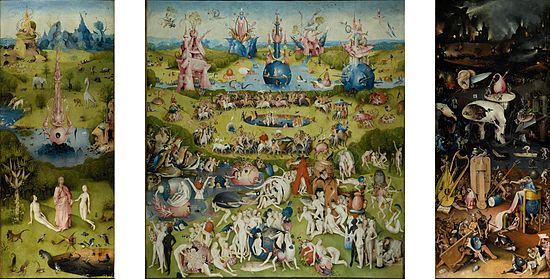
The Garden of Earthly Delights by Hieronymus Bosch, 1510

The Garden of Earthly Delights by Hieronymus Bosch, 1510

I usually don’t care for paintings that are as busy as The Garden of Earthly Delights, but I find it fascinating that an early 16th century artist could produce so much wild surrealism. I didn’t even know they had LSD in the Netherlands back then. Today we have decades of monster movies to help us think up weird and bizarre images, but Bosch had only his imagination.

There are an infinite number of stories packed into this tri-sectional painting. A question being the root of a story, a world in which some people have flowers and berries blossoming from their heinies, makes for a lot of fodder. However, the first thing that strikes the eye is that God is the only one wearing clothing. (Lets avoid a tautology. One could say that the only reason I know that that’s God is that he’s wearing clothing. If he were naked too, the viewer would just assume that he was a perv trying to horn into a menage a trois. I would say the world’s first threesome, but if you look in the middle section, you can see that about everyone is getting their freak on.) So why is God wearing robes?  We can assume that it’s not that he has shame. He’s God, you can be sure he’s sporting the perfect specimen of masculinity (if he cares about such things.)  Is it drafty in heaven? If so, doesn’t his omnipotence extend to the heavenly thermostat, or is it that the Holy Ghost likes to crank the AC? I see tension, and tension is the root of a story. (I realize that I said that a question was the root of a story. Live in the moment.)

The Sea of Ice by Caspar David Friedrich, 1823

The Sea of Ice by Caspar David Friedrich, 1823

Sea of Ice, also called The Wreck of Hope, at first looks like just a landscape. However, if one directs one’s glance to the right hand side, one can see the stern of an old sailing ship. As the alternate title suggests, it’s about a shipwreck. A shipwreck in the sailing age in the Arctic Ocean makes an outstanding setting for a story. Those men are all going to die, but not with the suddenness of drowning. They will freeze to death over the course of hours. If they can start a fire, they may have many hours, but they are not going to be rescued and they cannot walk to home. The tension between wanting to survive and knowing you are just extending your misery is good stuff for story-telling. If this image doesn’t send a shiver down your spine, nothing will.
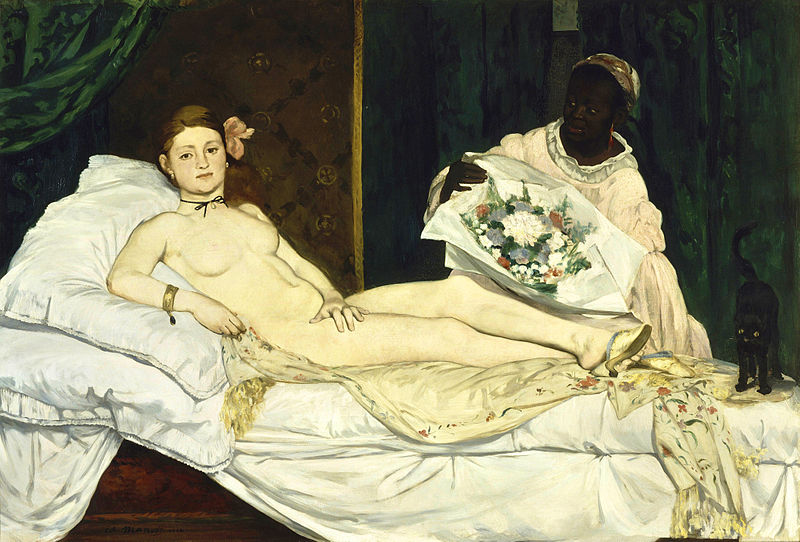
Olympia by Édouard Manet, 1863

Olympia by Édouard Manet, 1863

Olympia was a scandalous painting when Manet first revealed it. Nudity has been around for ever in paintings, right? Certainly, but it’s the context that enraged people. Society was used to characters of classical mythology being nude, e.g. Venus. They were also used to Biblical nudity (see Garden of Earthly Delights above.) However, Olympia made them think of the Parisian prostitutes that they didn’t visit, but somehow knew exactly what they looked like.  There are several stories to be told here. The one that springs to mind is why the servant is about to try to suffocate Olympia with a pillow. Will she, or won’t she, go through with it? If she does, will she prevail? Olympia looks like a fighter. If she doesn’t, will the cat?

Impression: Sunrise by Claude Monet, 1872

Impression: Sunrise by Claude Monet, 1872

In Impression: Sunrise two boats are out on the water, even though the sun has broken over the horizon.  They are rivals. The early bird got the worm, and the other will have to fish with fake lures.

Lighthouse Hill by Edward Hopper, 1927

Lighthouse Hill by Edward Hopper, 1927

Lighthouses make good settings for tragedy. They are remote. Ships depend upon them to avoid the rocky shoals. This lighthouse keeper’s family left because they didn’t like living in the middle of nowhere with a drunk. Now it’s just a man living in a big house alone. He runs out of Jack Daniels, and drives off to town at dusk. Being on the other side of the hill, he can’t see the lighthouse when he briefly glances into his rear-view mirror and wonders, “Did I turn the beacon on?”

The Persistence of Memory by Salvador Dalí, 1931

The Persistence of Memory by Salvador Dalí, 1931

The Persistence of Memory, a.k.a. Melting Time, is a dream state. It makes no sense. Nature is ordered into square edges. Watches are the only evidence of humanity’s existence. There is one creature living, or once living, that looks like the Thalidomide abortion of a three-way mating between a donkey, a Portuguese man of war, and Dalí himself.  The story is about being trapped in a dreamscape where time has become stuck.  Our protagonist must seek the wisdom of the Portuguese man-o-Dalí.

BOOK REVIEW: Life, the Universe, and Everything by Douglas Adams

Life, the Universe and Everything (Hitchhiker's Guide, #3)Life, the Universe and Everything by Douglas Adams

My rating: 4 of 5 stars

Amazon page

My review of: Hitchhiker’s Guide to the Galaxy

My review of: Restaurant at the End of the Universe

Arthur Dent and company are back for a third volume, and this time they must save the universe. This installment in the Hitchhiker’s Guide to the Galaxy (H2G2) series leaves off where the second stopped.

Readers will recall that at the end of the second volume,Restaurant at the End of the Universe, Arthur and Ford Prefect were marooned on the Earth two million years before their time (i.e. before the Earth was destroyed for a hyperspace bypass.) The two are reunited after Ford spent some time in solitude experimenting with being insane. They catch a ride forward in time on a piece of couch-shaped jetsam caught in an eddy in the space-time continuum.

Arthur and Ford are then picked by Slartibartfast, designer of fjords, who convinces them that they must go on a mission to save the universe from the inhabitants of the planet Krikkit. Actually, he can’t convince Ford of that, but he does convince him to go to the longest running party in the universe. Unknown to Ford, Slartibartfast wants to prevent the Krikkiters from attaining a requisite part that happens to be located at the party.

Arthur plays a particularly important part in this volume. After a run-in with a creature that he has killed numerous times in various bodies, the H2G2 straight man develops the knack for not hitting the ground after throwing himself downward (i.e. he can fly.) This new skill plays an important role in ultimately winning the day.

Arriving at Krikkit, the group finds that the locals aren’t much interested in destroying the universe anymore.This leads the band them to uncover a plot of intrigue and hilarity.

Given that there are two more books, you probably believe that the universe wasn’t destroyed, but I’ll avoid spoilers.

As always, Adams is the master of absurdist science fiction. Sure he gets his characters out of jams by flukes of the infinite impossibility drive or, in this book’s case, randomly appearing and disappearing couches, but it’s the wackiness that we enjoy and not the tautness or logical consistency of the tale.

View all my reviews

DAILY PHOTO: Union Station in Nashville

Union Station

Union Station

The gothic Union Station is now a hotel, but was once a major train station.

The Bullets that Bore no Name: or, the Burden we all Bear

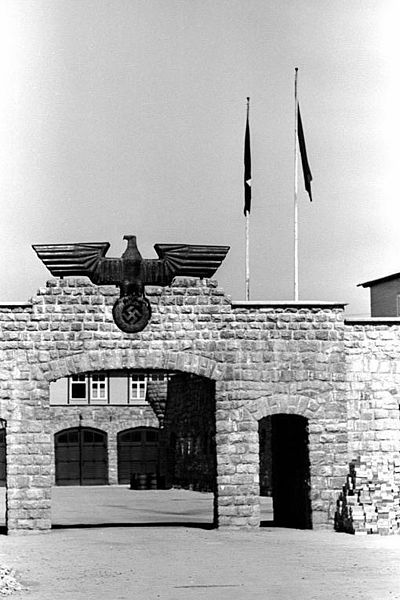
Attribution: Bundesarchiv, Bild 192-334 / CC-BY-SA

Mauthausen                     Attribution: Bundesarchiv, Bild 192-334 / CC-BY-SA

Thanks for joining me on the veranda. If you don’t know what I’m talking about, this post flows from a book review I did on Elie Wiesel’s Night, which can be seen here. But don’t wander off just yet.

I married into a family of holocaust survivors.

Being sufficiently narcissistic, I haven’t been able to avoid thinking of the profound impact this had on my life.  I am married to the most extraordinary woman in the universe [my apologies to all other women, I’m sure you’re someone else’s most extraordinary woman] by virtue of the strength of a man who wrestled his way to the top of a pile of corpses, bleeding profusely from multiple shrapnel wounds, clawing his way out of a pit, and cleaning the gashes with his urine. That man was married to a woman, tiny of body but colossal of mind, who was in the group force marched from Budapest to Mauthausen. After the war, they had a child–my mother-in-law. Yada-yada-yada. I have marital bliss.

Not being completely narcissistic, I’m reminded that every one of our lives have been shaped by strong people who lived through close calls. Each of us comes hither as a gift from men and women who passed through a hail of bullets that bore no name. Some, like my wife’s grandfather, were riddled by bullets bearing their name, and still refused to heed their deadly whisper.  Every holocaust survivor survived by a thin margin. Every battlefield veteran’s life is an execution order rescinded. Every prisoner of war was one germ away from an unmarked grave.

No pressure or anything, but that sounds like a heavy debt we  all bear.

Telling this story in greater detail is one of my bucket list tasks. It’s a project I’ve had on the back burner for far too long. There are several reasons for this. The most feeble of which is a hope to find the right timing. Sadly, there are so many such stories that I fear it will be lost amid a sea of sorrow.  Then there is my need to develop grace with language sufficient to do the story justice. In a way the two novels I have drafted, and whose mess I am now painstakingly trying to dance into shape, are practice exercises.  Wish me luck.

On the plus side, my wife’s uncle had the foresight to have her grandfather speak his story onto about 20 tapes before he died. With today’s technology, there’s no excuse for anyone’s life-altering story to go untold.  So I guess if there is a moral to my rambling post it’s this: don’t let anyone in your life with a spectacular story pass from this world without it being heard.

BOOK REVIEW: Night by Elie Wiesel

Night  (The Night Trilogy #1)Night by Elie Wiesel

My rating: 5 of 5 stars

Amazon Page

Nobel Prize Winner Elie Wiesel’s book, Night, tells his story as a boy caught in the Holocaust. A Jew from Sighet in Transylvania, Wiesel was evacuated from the ghetto as a teenager and shipped off to Auschwitz–later to be moved to Buchenwald.

At little over 100 pages, this thin book is tragedy distilled and condensed.

A few of Wiesel’s experiences stick with one because they are just so gut wrenching. One such story is about a woman in the train car who hallucinates fire and flames. Her insanity no doubt spurred by hearing of the massive crematoria. Her delusions were prophetic for all too many of those packed in that cattle-car.

Another key moment came after their train rolled into Auschwitz. Both Elie Wiesel and his father followed advice to lie about their ages, he to make himself older and his father to become younger. This got them both directed to the left; the people who would live for the time being– though they didn’t know that at the time.

The climactic portion of the book deals with the boy’s attempts to cope with his father’s severe illness. On the one hand, his father was all he had. On the other hand, he feared that he would not survive if he had to keep looking after the ill elder. Wiesel is quite frank about the dilemma that clouded his mind. His father’s death would make his own survival more likely. The guilt caused by these thoughts tormented him. This kind of guilt is a prevailing theme in genocide literature. It reminds me of Viktor Frankl’s comment in Man’s Search for Meaning in which he says that the sad truth survivors must live with is that, “the best of us did not return.”

I will end my review by suggesting that you read this book. It’s quick and–while not painless–insightful. I’d intended to ramble on with some personal experiences and observations, but have decided to make that its own post entitled <em>The Bullets that Bore no Name: or, the Burden we all Bear</em>.

If you’re just here for the Night review, thanks for visiting and Godspeed in your journeys through cyberspace.

If you’re at all curious about what I have to say, grab your mint julep and join me on the veranda. The veranda is this way.

View all my reviews

Who Am I?

“I” am a collection of cells.
some  expressly invited by “my” genes
others are interlopers,  “my” guts their cross-town bus
but these interlopers defend “me”  daily
fending off worse marauders
thankfully
so “I” let them stay inside “me”
“my” greatest shame? “I” am a slave owner.
the  mitochondria in “my” cells  are trapped and  forced to serve “me”
all this begs one fundamental question,
am “I” really just a “me?”
or  a  whole society?

If “my” parts
needn’t be fully integrated
where do “I” end and “you” begin?
can “I” say that “I” have been everywhere?
well, everywhere on this tiny, spherical-ish speck of galactic dust?

DAILY PHOTO: Plaza de Armas in Arequipa by Night

Basilica Cathedral

Basilica Cathedral

Arequipa is known as the White City for the appearance of the stone that serves as one of its most conspicuous building materials. Above is the Basilica Cathedral located on Plaza de Armas, which is the city’s main square. Arequipa is a beautiful city, and is the second most populous in Peru. One sees a level of indigenous wealth here that one doesn’t in say Cusco. There is vibrancy to this town.

One of the most impressive local sites is the Convent of Santa Catalina. There are also some impressive views of volcanic mountains that can be seen from the city.

TODAY’S RANT: Stuck with a Bad Ending

Bonus pages for active readers

Bonus pages for active readers

I miss the days when they put extra blank pages at the end of a book so that you could rewrite an unsatisfactory ending. (Someone once tried to tell me that the extra pages were the result of bulk paper cutting methods. They said it was cheaper to include the blank pages than to remove them. Yeah, I know. How ridiculous, right?) Of course, it wasn’t long before ads began to sully these blank pages, making them less than blank.

I’m not a fan of wastefulness, but if I have to rewrite your ending, why should I incur the cost of paper.

Being lazy, there are not many cases in which I feel compelled to rewrite someone else’s ending. Most books that manage to get published have at least a tolerable ending.

One book always springs to my mind when I think of bad endings. It’s a book called Hostage by a writer named Robert Crais. For those who saw the movie, the movie ending is vastly different–presumably because moviegoers would have insisted on their money back otherwise. While Hostage is not among Bruce Willis’s best, it’s also a prime example of the rare case when the movie is better than the book–for just this reason.

Part of the disappointment stems from the fact that the book has an outstanding premise for a thriller, and in my opinion it was carried off well until the end. (Another reason that I don’t come across too many terrible endings may be that I jettison books that aren’t so good, but this one fooled me.)  Anyway, three delinquent kids rob a house and end up with a  hostage situation with the homeowner’s two kids. The tension is ratcheted up when it turns out that the upscale home where the kids are being held up is owned by a mob accountant. Inside is evidence that could put half the mob away. The mob gets proactive by taking the police chief’s (i.e. the protagonist’s) family (ex and child) hostage and insisting that he get the evidence out before the house is stormed by the sheriff’s department and falls into an evidence locker.

SPOILER ALERT: Ultimately, our hero has no agency in the survival of himself or his family. It’s purely the decision of a mob enforcer that leaves them alive.  I guess it could have been worse. It could have ended with him awaking from a dream.

What book gets your award for “worst-ending-ever”?

DAILY PHOTO: Sapelo Island Lighthouse

Sapelo Island Lighthouse

Sapelo Island Lighthouse

This lighthouse is located at the southern end of Sapelo Island off the coast of the state of Georgia. Sapelo island can only be accessed by a ferry operated by the Georgia Department of Natural Resources (DNR.) Tours are available through DNR.

The island is home to the Hog Hammock community (Population 70), a mansion that was once owned by RJ Reynolds (as was the island), and a research facility associated with the University System of Georgia.

BOOK REVIEW: Story of O by Pauline Réage

Story of OStory of O by Pauline Réage

My rating: 3 of 5 stars

Amazon page: See Here

I haven’t read 50 Shades of Grey, but was surprised to hear that it began as Twilight fan fiction. From the descriptions that I’d seen, it seemed much more like a relatively softcore, commercial-fiction version of Story of O. I don’t whether the Story of O fits into this recent genre development called “mommy porn,” because the book predates that terminology.

In Story of O a successful fashion photographer named “O” is in love with a man whose tastes run to the extreme. Her lover, René, asks her to come into this lifestyle, and she willingly submits to his wishes. Submission involves some harsh tests of her willingness to endure.

I expect the initiated will point out that one major difference exists between the two works. 50 Shades seems to involve a monogamous relationship, whereas– in the Story of O— O is handed off from René to a more senior dominant for her “training.” O then begins to fall for her new master. Moreover, there is no monogamy in Story of O–whatsoever. (i.e. O is passed around like a doobie at a Greatful Dead concert.) I’m not saying they are the same books, just that they seem similar. They are both books about women who willingly surrendering to men with exotic (re: freaky) desires.

There also seems to be a difference in endings between the two story lines (vis-á-vis who walks), but I will not go into that.

Actually, one major fault of Story of O is that there is not a proper ending (completion of a narrative arc.) The version I have has a brief annotation that says the ending was suppressed. It goes on to give a description of two alternate versions of a similar ending. I suspect the drafts of those endings were lost to the ages because I have a copy of the 1973 edition (the book came out in the 50’s) and to my knowledge there is no subsequent edition.

Those who are freaked out by kinkiness will find Story of O hard to stomach. In terms of language, I’ve read that it’s calmer than 50 Shades…, but in terms of the actions carried out I suspect it runs a bit more toward the exotic. Another group that will find this book to not be their cup of tea are those who have strong feelings about women’s empowerment. If that’s you, you will likely find it hard to relate to a woman who has power in her life, but who willingly–nay, eagerly– relinquishes it. Moreover, O seems to thrive on being dominated. That is, she falls hardest for the man who will most forcefully enslave her.

View all my reviews