BOOK REVIEW: Watchmen by Moore & Gibbons

WatchmenWatchmen by Alan Moore

My rating: 4 of 5 stars

Amazon page

When one sees lists of must-read books, if there is a graphic novel on the list, it’s probably this one. Watchmen represents both the graphic novel and the super-hero tale at their best. It forgoes the unrealistic and hackneyed dialogue and internal monologue that usually plague this genre. While the “tough” style (see: Tough Sweet Stuffy by Walker Gibson)is used liberally–particularly for the voice of Rorschach–it has a natural ring to it.

At its heart, Watchmen is a morality tale that pits absolutist morality against the utilitarian approach. Rorschach (a.k.a. Walter Kovacs) represents the absolutist extreme. For Rorschach, the lesser of two evils is nothing more than an evil to be punished. On the other hand, Ozymandias (a.k.a. Adrian Veidt) represents the utilitarian view that to save the many one may have to sacrifice the few. The rest of the cast is in between, showing varying degrees of comfort with utilitarianism, but none willing to accept the absolutist extreme.

While my preceding paragraph may have made this sound dreadfully boring, in fact it’s anything but. The morality tale plays out inside a well-developed mystery plot. It begins with an inciting incident best described by a quote from Rorschach’s journal, “Tonight, a comedian died in New York.” That comedian was “The Comedian” one of the book’s cast of costumed heroes. As other heroes begin to be eliminated–not all by death, some by imprisonment or apparently self-imposed exile–the intrigue builds. Events pull individuals–such as Nite Owl and Silk Spectre–back into the game after many years out.

For those who have seen the movie, I will say that it follows the book far more than do most film adaptations. The movie borrows many of the exact words of dialogue. It even borrows a lot of the imagery almost exactly (e.g. the Comedian flying out the window enveloped by glass shards.) However, if you’re wondering whether it’s still worth reading, I’ll say two things. First, the book does cover a lot more detail than the movie. Besides the usual comic book style graphic panels, there are excerpts from fictitious novels, correspondence, magazine interviews, and another graphic novels that support the story line. Second, the biggest deviation between the book and the film is in the details of the devious plan that is revealed at the book’s end. In other words, there are a few surprises.

I would agree with the widespread notion that if you only read one graphic novel, make it this one.

View all my reviews

DAILY PHOTOS: Hanazono Inari Jinja in Ueno Park, Tokyo

Taken summer of 2008.

Taken summer of 2008.

DAILY PHOTO: Szent János Plébániatemplom in Szentendre

Taken in summer 2011.

Taken in summer 2011.

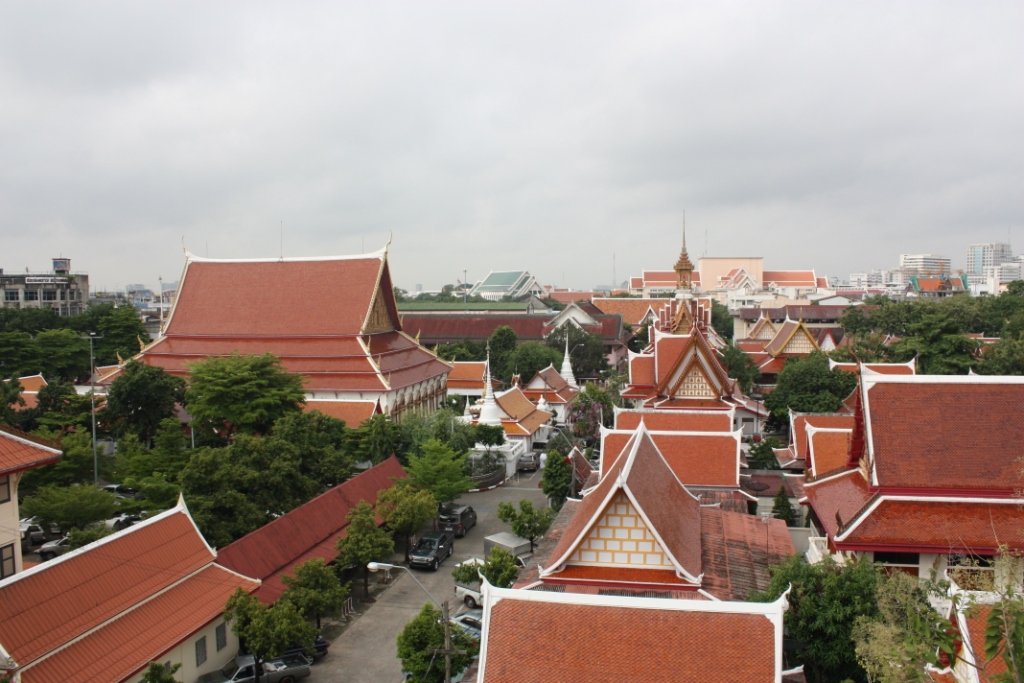
DAILY PHOTO: The Wat Chana Songkhram Complex

Taken October 2012

Taken October 2012 from atop the Rambuttri Village Inn.

DAILY PHOTO: Ray Charles Plaza in Albany, Georgia

Taken in December 2012.

Taken in December 2012.

DAILY PHOTO: Town Square at Mollepata, Peru

This is where the hike to Machu Picchu by way of the Salkantay Pass begins. Taken in 2010.

This is where the hike to Machu Picchu by way of the Salkantay Pass begins. Taken in 2010.

DAILY PHOTO: Atlanta’s Flatiron Building

Taken in the summer of 2012

Taken in the summer of 2012

BOOK REVIEW: The Classic Tradition of Haiku Edited by Faubion Bowers

The Classic Tradition of Haiku: An AnthologyThe Classic Tradition of Haiku: An Anthology by Faubion Bowers

My rating: 4 of 5 stars

Amazon page

The other haiku anthology I reviewed is Classic Haiku, located here.

This is the second haiku anthology that I’ve reviewed on my site. While they’re both thin volumes of traditional haiku, each has its distinct flavor. The previous volume was organized by season. This one is organized by author. The two books share several authors (e.g. the greats Bashō, Issa, and Buson), but diverge on many of the lesser known poets.

One nice feature of this book is that it offers multiple translations of many of the haiku. Poetry is notoriously tricky to translate as literal translations can be meaningless. Multiple translations can give one a better opportunity to hone in on what the author meant to convey. This volume does give the original Japanese poem in romanized transcription (for those who enjoy the sound the author conveyed as well as meaning), but–unlike the other volume–it does not include the kanji. (This doesn’t matter for me, as I don’t read Japanese, but I’m sure the kanji is a nice feature for readers of Japanese.)

Some favorites are:

clouds occasionally
make a fellow relax
moon-viewing

Matsuo Bashō

islands
shattered into a thousand pieces
in the summer sea

Matsuo Bashō

you’re the butterfly
and I the dreaming heart
of Sōshi

Matsuo Bashō

[Note: Sōshi is the Japanese name of the Taoist thinker Chuang Tze, and this references his famous statement about having dreamt he was a butterfly.]

that dream I had
of being stabbed–was true
bitten by a flea

Takarai Kikaku

oh, won’t some orphaned sparrow
come
and play with me

Kobayashi Issa

View all my reviews

DAILY PHOTO: It’s Time to Mow the Clock… Wait, What?

The clock at Wat Phnom in Phnom Penh, Cambodia. Taken in October of 2012.

The clock at Wat Phnom in Phnom Penh, Cambodia. Taken in October of 2012.

Wat Phnom is Phnom Penh’s temple on the hill. I say “the hill” because Phnom Penh is not rife with topography, and there is just the one hill.

DAILY PHOTO: The Lynchburg General Store

Taken Spring 2012

Taken Spring 2012

During Prohibition this general store is how the Daniel family made their living. It sits on the Lynchburg town square and is now mostly a souvenir shop. The distillers proudly proclaim that they only use each barrel once because by then the peak of it’s color and flavor attributes are used up. So there are a lot of barrels  to pile up. Some of them are sold to a Canadian whisky maker that is not so finicky. A few are included in the shipment to people who buy a whole barrel’s worth of whisky. Others get turned into anything imaginable and sold. They appear as garbage cans, decorative walls, containers, etc. The one thing they don’t sell in the shop is whiskey, because–ironically–it’s a dry county.