
Taken in 2007
This is the town square in the center of Ulan Bator. Off-frame to the right would be the Parliament Building fronted by a massive statue of Genghis Khan. Ulan Bator is a in interesting mix of Oriental, Soviet, and modern.
Taken in 2007
This is the town square in the center of Ulan Bator. Off-frame to the right would be the Parliament Building fronted by a massive statue of Genghis Khan. Ulan Bator is a in interesting mix of Oriental, Soviet, and modern.
I’m shocked by how easily a piece of “common wisdom” can become accepted despite being patently and demonstrably wrong. The best example may be, “There’s no such thing as a silly question.”
Oh, yeah:
“Do you wear spurs when you ride ostrich in the avian rodeo?”
“If you had to wear shoes made of cheese, of which cheese would you want them made?”
“Do you have purple-glazed doughnuts in honor of the St. Crispin’s Day unicycle rally?”
“May I twirl my way into an eternity of dandelion lunacy?”
I can do this all day.
Are you seriously going to tell me that none of the above questions is at least a little bit silly. As a person of silliness, it enrages me… well maybe not so much “enrages” as has no discernible effect… when people deny the potential for silliness. Folks, it’s all around us. So, the next time you say that there is no such thing as a silly question, my response is, “Do you really think you can make that stick like the Archbishop’s bugger to the side of an albino wino?”

Taken in the Summer of 2012.
Brunswick is a coastal port town in Georgia that claims to be the point of origin for Brunswick Stew. (A claim that is apparently refuted by Virginians.)
If you have no idea what Brunswick stew is, I’ve attached a recipe below that is from this website.
First the sauce:
In a 2 quart sauce pan, over low heat, melt ¼ cup of butter then add:
1¾ cups Catsup
¼ cup French’s Yellow Mustard
¼ cup white vinegar
Blend until smooth, then add:
½ tablespoon chopped garlic
1 teaspoon coarse ground black pepper
½ teaspoon crushed red pepper
½ oz. Liquid Smoke
1 oz. Worcestershire Sauce
1 oz. Crystal Hot Sauce or ½ oz. Tabasco
½ tablespoon fresh lemon juice
Blend until smooth, then add:
¼ cup dark brown sugar
Stir constantly, increase heat to simmer (DO NOT BOIL) for approx. 10 minutes.
Makes approx. 3½ cups of sauce (set aside – to be added later).
Then The Stew:
In a 2 gallon pot, over low heat melt ¼ lb of butter then add:
3 cups small diced potatoes
1 cup small diced onion
2 14½ oz. cans of chicken broth
1 lb baked chicken (white and dark)
8-10 oz. smoked pork
Bring to a rolling boil, stirring until potatoes are near done, then add:
1 8½ oz. can early peas
2 14½ oz. cans stewed tomatoes – (chop tomatoes, add liquid to the stew pot)
The prepared sauce
1 16 oz. can of baby lima beans
¼ cup Liquid Smoke
1 14½ oz. can creamed corn
Slow simmer for 2 hours
Yields 1 gallon

This was called Moscow Square at the time this was taken (late 1990’s, I believe), but is now called Kálmán Széll Square.

Attribution: Jim Wallace (Smithsonian Institution)
Bob, Bob! Why do you want to kill me? Bob.
In my dream I remember running, running away from Bob Newhart, a revolver gripped tightly in the comedic actor’s hand. I don’t know whether it was supposed to be Bob Newhart the person, or if my subconscious thought that Bob Newhart was the best actor to convey life’s dark comedy. I knew why Newhart was chasing me. I worked in a machine shop and had a less than reliable partner who had apparently made a wild promise that our little shop could never deliver upon. It must have been important to Newhart. So I understood why Bob Newhart was mad and I accepted it. If it was me, I might be homicidal too—because I just rage that way sometimes. Still, I didn’t want to die because I was associated with a dodgy rogue. I guess that’s what the dream was about.
There was a kid with me–not my kid–at least I don’t think the dream ran that far afield. I’m willing to accept that my subconscious would see me as a machinist—a career unlike any in my bookish résumé. Furthermore, I can fathom that my subconscious imagining Bob Newhart wanting to kill me with a snub-nosed revolver—even if for something that was not my fault. However, I can’t imagine my subconscious thinking I would have a kid.
Anyway, Newhart saw us as he was maniacally driving a car toward the machine shop. We, the kid and I, were walking down the sidewalk away from the shop, having just closed up for a glorious summer afternoon in the way of slackers everywhere. I don’t know where my shady partner was, the unreliable always escape unscathed—maybe that’s what the dream was about.
I saw the murderous gleam in Newhart’s eye, and turned to run back to the shop. I grabbed the kid by the arm and tugged him in that direction—maybe I do have some paternal instinct. My plan was to get into the shop, lock the door, and call the unreliable person to come and get shot by an enraged Bob Newhart. However, in the panic of thinking that Newhart, who had done a bootlegger-180 with his car and was now driving straight for us, was going to crush us under the car, I forgot to lock the door behind us. (Or maybe there are no working locks in dreamland.) Locking the door was, after all, the one good part of the plan. (I don’t know what I had been thinking about calling the unreliable person, unreliable people never show up when you call them–they show up at 2:30am on a Sunday morning wanting to borrow $20 and a condom.)
Anyway, Newhart parked legally, but when he got out I saw the snub-nosed revolver in his hand, framed perfectly in the window in a way that can only happen in dreams. I ushered the kid around a partition wall that separated the small storefront from the shop beyond.
Newhart was walking like one of those geriatric mall-walkers, or like a man who’d drunk a 32 oz. cola and driven six hours only to get to a rest-stop restroom that was probably locked. When Newhart threw open the door, the little bell tinkled cheerfully—the bell clearly didn’t know what was about to go down. As I rounded the partition wall, pushing the kid into the darkened shop, I picked up a steel pipe. Despite the perennial advice that one should never bring a steel pipe to a gunfight, I felt a cool calm wash over me. (Maybe it was that I knew gun-toting men Newhart’s age usually shot blanks in their dreams.) Anyway, I hid in wait.
Then I woke up. I’ll never know whether Newhart shot me or whether I bludgeoned one of America’s beloved comedic elder statesmen to death with a steel pipe. Maybe both would have happened. Maybe neither. I know if I go back to sleep, the dream won’t resume. They never do. I’ll never know. Maybe I don’t want to know. Maybe that’s the point of the dream.

Taken October 2012
This was taken in Chiang Mai, Thailand. I don’t even remember what the big white building in the background was–some government building. What’s interesting is the teak leaf roofed huts in the foreground. This is the traditional roofing method for a number of the hill-tribe people in that area. We saw such roofs in both Karen and Hmong villages.
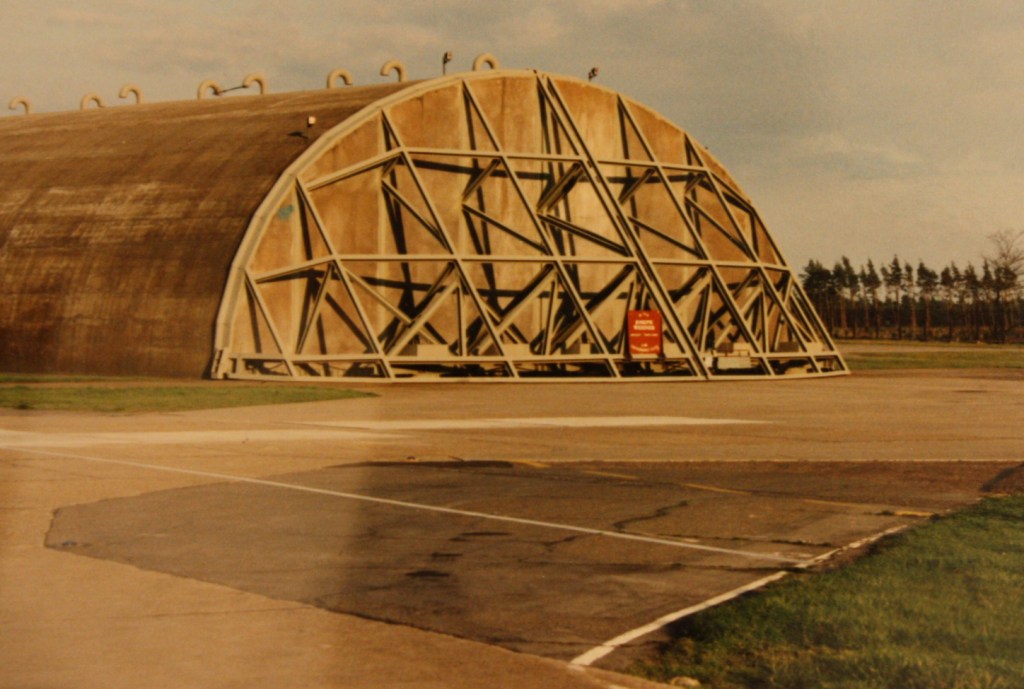
Taken in 1988 when I was stationed at RAF Woodbridge.
Hardened Aircraft Shelters (HAS) are heavy-duty aircraft hangers designed to prevent the wholesale destruction of planes as witnessed in the movie Independence Day at Marine Station El Toro. However, I think the Soviets were considered a more urgent concern than aliens at this particular time. (Oh, how times change.) This particular HAS contained A-10 “Warthogs”– a slow ugly plane that was built around a Gatling gun and that we were about to scrap until we started getting into wars that showed that if one wasn’t fighting dogfights with the Soviets–but rather fighting ground troops and armor of militaries devoid of operational air forces, e.g. in Iraq or Serbia– the A-10 was pretty much the most useful combative plane in the inventory.
I guess there were plenty of sunny days like this, but somehow my memories of England only come when it’s raining.

Taken in 2010
I took this in a village on the way to Colca Canyon to see the Condors.

San Ignacio, Belize street scene; Taken 2007
San Ignacio is a quaint town in Belize near the border with Guatemala. It’s a popular hangout for travelers visiting Mayan sites or caves in western Belize. It’s also an easy place from which to visit Tikal (one of the most impressive Mayan sites, which is located in Guatemala.)
My rating: 4 of 5 stars
When one sees lists of must-read books, if there is a graphic novel on the list, it’s probably this one. Watchmen represents both the graphic novel and the super-hero tale at their best. It forgoes the unrealistic and hackneyed dialogue and internal monologue that usually plague this genre. While the “tough” style (see: Tough Sweet Stuffy by Walker Gibson)is used liberally–particularly for the voice of Rorschach–it has a natural ring to it.
At its heart, Watchmen is a morality tale that pits absolutist morality against the utilitarian approach. Rorschach (a.k.a. Walter Kovacs) represents the absolutist extreme. For Rorschach, the lesser of two evils is nothing more than an evil to be punished. On the other hand, Ozymandias (a.k.a. Adrian Veidt) represents the utilitarian view that to save the many one may have to sacrifice the few. The rest of the cast is in between, showing varying degrees of comfort with utilitarianism, but none willing to accept the absolutist extreme.
While my preceding paragraph may have made this sound dreadfully boring, in fact it’s anything but. The morality tale plays out inside a well-developed mystery plot. It begins with an inciting incident best described by a quote from Rorschach’s journal, “Tonight, a comedian died in New York.” That comedian was “The Comedian” one of the book’s cast of costumed heroes. As other heroes begin to be eliminated–not all by death, some by imprisonment or apparently self-imposed exile–the intrigue builds. Events pull individuals–such as Nite Owl and Silk Spectre–back into the game after many years out.
For those who have seen the movie, I will say that it follows the book far more than do most film adaptations. The movie borrows many of the exact words of dialogue. It even borrows a lot of the imagery almost exactly (e.g. the Comedian flying out the window enveloped by glass shards.) However, if you’re wondering whether it’s still worth reading, I’ll say two things. First, the book does cover a lot more detail than the movie. Besides the usual comic book style graphic panels, there are excerpts from fictitious novels, correspondence, magazine interviews, and another graphic novels that support the story line. Second, the biggest deviation between the book and the film is in the details of the devious plan that is revealed at the book’s end. In other words, there are a few surprises.
I would agree with the widespread notion that if you only read one graphic novel, make it this one.


