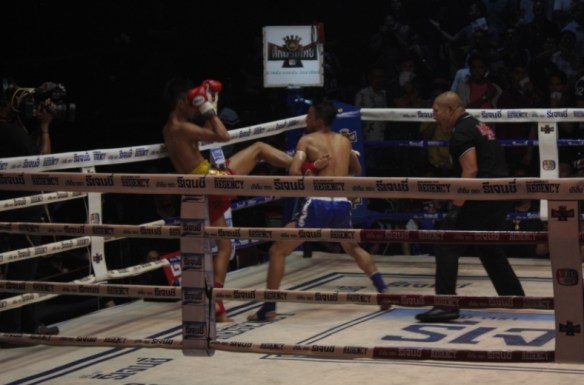
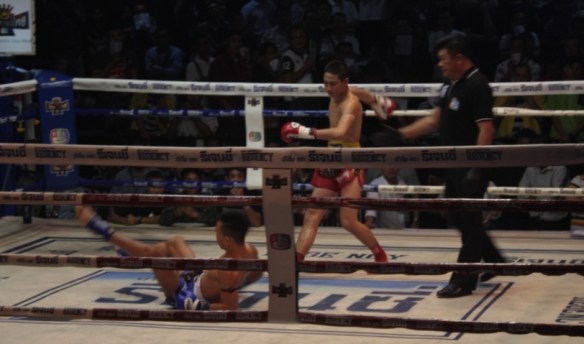
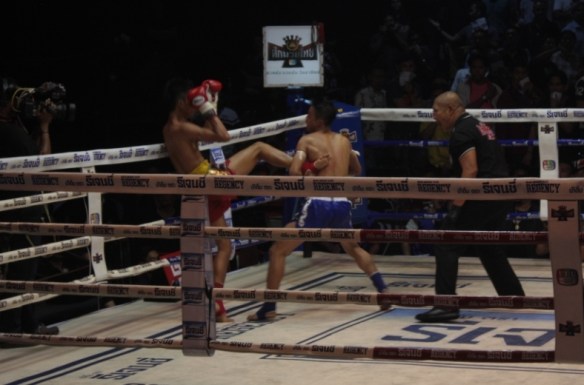
Taken February 19, 2017 at Rangsit International Boxing Stadium



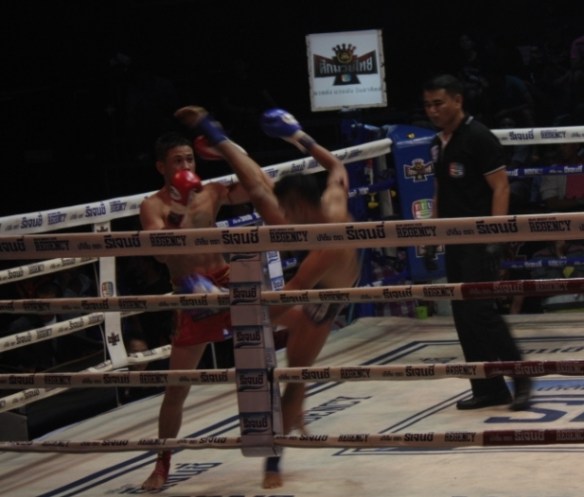
Taken February 19, 2017 at Rangsit International Boxing Stadium
It’s the time of year when people think about how to be better, fitter, and smarter; so I thought I’d drop a list of books that I found helpful and thought-provoking.
If you’re interested in learning more about any of these books, the hyperlinks take you to my review in GoodReads, and from GoodReads you can get to Amazon page.
1.) THE RISE OF SUPERMAN by Steven Kotler: How do extreme athletes achieve Flow when one false move will kill them?
2.) FASTER, HIGHER, STRONGER by Mark McClusky: How do elite athletes squeeze the most out of the potential of the human body?
3.) BECOMING BATMAN by E. Paul Zehr: What would it take, physically and mentally, to become the Caped Crusader?
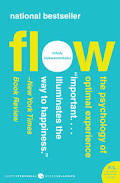
4.) FLOW by Mihaly Csikszentmihalyi: How does one achieve that state of relaxed and confident concentration in which we perform our best called Flow?
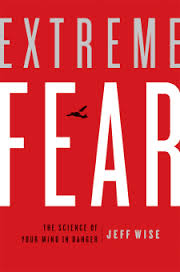
5.) Extreme Fear by Jeff Wise: How does one overcome anxiety and fear to perform one’s best?
 Judo by Reay
My rating: 3 of 5 stars
Tony Reay wrote this book when he was both a 6th degree black belt and Development Officer for the British Judō Association. So his qualifications are beyond a doubt. The book is an overview of the sport of judō that covers techniques, etiquette, rules, warm-up exercises, grading approaches, and other specialty topics. It covers the gamut of issues related to the sport of judō, but without going into much detail. It would be a suitable book for a youngster who is considering whether they might want to get involved. I emphasize that it’s about “sport judō” because there are those who consider judō to be an approach to self-defense and others who think of it as a whole-life philosophy. This isn’t the book for those who want to learn more about judō as anything other than a competitive sport.
The eight chapters of the book cover: history, the grading structure, recreational judo, fitness, techniques, competition, the judō instructor, and judō as an art. However, most of the chapters are cursory. The bulk of the book is devoted to showing 69 of the art’s most fundamental techniques, including: 40 throws, 12 holds, 10 chokes, and 7 arm-locks. For each of these techniques there is a line drawing and a brief description. In a few cases there are black and white photos taken of the technique being performed in competition. This overview of techniques is mostly of value for learning names and accounting for what techniques one has (or hasn’t) learned. There’s not enough detail–either graphically or textually–to help a practitioner improve a technique that they’ve learned. (The latter isn’t a point of criticism, but rather to let people know what they are and aren’t getting in the book.) Still, there are tips scattered throughout the book that might help a practitioner improve their techniques in a general sort of way.
There is a glossary of Japanese terms commonly used in judō.
I found this book to be a fine overview of the sport of judō, and would recommend it for that purpose. While I’ve found other books on the art much more useful for my purposes, I think this is a fine book for someone looking to get into the sport from ground zero. I should point out that the book is from the mid-80’s, and so there will probably be details on rules, scoring, and grading that have changed, but the bulk of it will remain of value.
 Choke: What the Secrets of the Brain Reveal About Getting It Right When You Have To by Sian Beilock
My rating: 4 of 5 stars
“Choke” in this book means to under-perform under high stakes. It doesn’t mean to be a poor performer, generally. This book is designed to help those who perform at a lower level when the pressure is on. It’s a condition that’s even been witnessed in Olympic caliber athletes–world champions who couldn’t get on the podium in the most important games of their careers. The book isn’t just about choking in sports; in fact, much of it is about bombing tests, and it also addresses under-performance in business environments.
“Choke” is organized into nine chapters. The first is called the “curse of expertise,” and it deals with just that—how experts are notoriously bad judges of how successful novices will be. This is because the causes of under-performance aren’t always straight forward. For example, some qualities that serve to make individuals strong contenders under low pressure conditions (e.g. a large working-memory) contribute to the cracking of the same individuals under high stakes. The second chapter explains how practice improves performance. Chapter three investigates why using our Prefrontal Cortex (i.e. our conscious mind) can do us in when the task calls for procedural memory that is unconscious to do its work.
Chapter four delves into the differences between the sexes in academic endeavors. Chapter five is about choking on tests in a scholastic environment, and it deals a lot with why minorities under-perform on standardized tests. Chapter Six presents some activities that have been shown to be successful in reducing choking including therapeutic writing, meditation, and changing one’s mode of thinking. There is a box at the end of the chapter that summarizes many of these cures.
Chapter seven discusses choking in sports. Choking in sports has some common ground with academic under-performance. However, it’s also different in that the object is often to quiet the conscious mind altogether. Some solutions for the yips in sports, such as mantras repeated in one’s mind to let the procedural memory take over, may not be as useful in an academic setting. Chapter 8 presents a range of techniques to prevent choking from practicing under more realistic conditions to getting on with it (i.e. not overthinking or slowing down) to distracting oneself to focusing on the goal (not the process.) The chapter also looks at the flip-side, why those who excel in physical performance often stink at coaching (i.e. they aren’t analytical about how it’s done.) This chapter also has a nice summary box of solutions. The final chapter looks at under-performance in a business setting, which again shares some things in common with choking in other domains, but also presents its own problems.
I found this book to be useful and thought-provoking. The advice is sound.
The discussion of bombing at tests and in the academic setting is largely applicable only to females or minorities as it focuses heavily on the issue of why these groups are disproportionately affected by academic under-performance. With respect to sports and business, the only condition necessary to benefit from the advice is a proclivity to choke or a desire to know how to help oneself or others avoid the fate. So depending upon what domain one is considering and one’s demographic, there may be other books that are either more or less relevant to one’s personal issue.
I’d recommend this book for those interested in the science of human performance.
Guide To Chinese Martial Arts by Li Tianji
My rating: 3 of 5 stars
This is a brief guide to the martial arts of China. The bulk of the book (about 150 pages of the book’s 178 pages) tells the reader about three major branches of Chinese martial arts: Chang Quan, Tai Chi Chuan, and Shaolin Kung fu at a general level. (The book devotes space to those arts in the same order–i.e. the largest number of pages discuss Chang Quan, then Tai Chi, and the smallest number to Shaolin. This may be surprising as your average non-Kungfu practitioner is least likely to have heard of Chang Quan—by name anyway. Chang Quan is a general term that encompasses several Northern Styles—some of which might be more familiar to general readers [of martial arts books.]) The book also has a brief chapter that describes the history of martial arts in China from ancient times through the modern era, and one that talks about the many schools of martial arts of China (in no great detail because there are so many of them) as well as the various strengths and purposes of these arts.
The bulk of the illustrations are line drawings used to show typical sequences for each of the three major branches of martial art mentioned above. However, there are some black and white photographs and copies of relevant art works and documents as well.
I found this book to be interesting and informative. There’s a bit too much space devoted to describing techniques for my taste. However, I realize that I may be in the minority in that regard. I don’t believe that martial arts can be taught via books or media, and, therefore, there’s a diminishing value to detailed descriptions of technique. In this sort of book one only needs to get a feel so as to be able to see how the martial arts compare and contrast with others.
I’d recommend this book for someone who wants to learn a bit about the nature of Chinese martial arts. It may not be of much value for an expert, but for a kungfu neophyte it provides some interesting information about the history, tactics, and training methods of Chinese martial arts. It’s originally published by Foreign Languages Press in Beijing, but I don’t suspect there is any more bias than there would be if it was published by anyone else (i.e. it’s the rare martial arts book that doesn’t present the martial art under discussion as the ultimate fighting art.)
Vo Dan Toc / Martial Arts by Hữu Ngọc
My rating: 3 of 5 stars
This book is part of a series that is subtitled “Vietnamese Culture: Frequently Asked Questions,” and that tells one a little about both the content and the format of the book. It’s better described as pamphlet than a book. At about 75 pages, it’s in bilingual format (i.e. one page is in Vietnamese and the adjacent page is the English translation.) So it’s about 38 pages in English that answer 11 questions about Vietnamese martial arts.
The 11 questions addressed by the book are:
1.) How have martial arts developed throughout Vietnamese history?
2.) How were training and examinations for martial arts organized by the court?
3.) What are the schools of Vietnamese martial arts?
4.) What are the main sects of Vietnamese martial arts in France?
5.) How did Liễu Ðôi become a village with a great wrestling tradition?
6.) Who killed a ferocious tiger in 1770 in Sài Gòn’s Tân Kiểng Market?
7.) How did the famous school of Lady Trà-Tân Khánh martial arts begin and develop?
8.) How did President Hổ Chí Minh keep himself fit?
9.) Who played a key role in the success of Thúy Hiển, the world wushu champion?
10.) What do foreigners think of Vietnamese martial arts?
11.) How did the female master Hổ Hoa Huệ impress the Europeans?
The listed questions tell the reader what the book is about. It starts with some general history from centuries past, and then goes on to discuss specific events. I have no idea to what degree propaganda / myth has seeped into the text—maybe not at all or maybe a lot. I purchased the book in Hue, and am not sure if it’s available outside Vietnam. As one can see from the questions, this book won’t give one much insight into the details of Vietnamese martial arts tactics or philosophy. Instead, one gets a bit of history that some readers will find interesting and others will not. There are black and white photos (about 8) that show static instances of Vietnamese martial arts practice, and there is a glossary.
I picked this book up because I was curious about Vietnam’s martial art history—knowing that it must have had an impressive one. There isn’t much English-language information available about Vietnamese martial arts other than Vovinam. Vovinam is a martial art that allegedly developed in the modern era utilizing pieces of other martial arts and arranged to be ideal for the typical Vietnamese body type. However, what one sees of Vovinam on-line is just a poor-man’s version of that signature move of Black Widow from the MCU movies, so I don’t know whether there is any substance there or if it’s just for show.
Considering that it’s only about $0.67 USD in bookstores in Vietnam, I’d say it’s worth picking up this little book if you want to learn something about Vietnam’s martial history. [If you buy pay alot for a copy on-line, you’ll probably be disappointed.]
 Boxing Fitness: A Guide to Get Fighting Fit by Ian Oliver
My rating: 4 of 5 stars
How does one skip rope, work the pads, or avoid nipple rash? If you think that boxing would be a fun way to get fit, this would probably be a useful book for you. Oliver shows a range of fitness practices—many specific to boxing, but others that are used in a number of sports and fitness activities—that will help one improve one’s fitness.
The reader will gain insight into bagwork, padwork, and boxing drills–from beginner to advanced. While the book’s emphasis isn’t on boxing technique, there’s a minimal discussion of the basics of footwork and punching designed to allow a reader to safely begin practice of bagwork and padwork. One also learns about roadwork, the basics of weightlifting as it’s useful for boxers, calisthenics, and other exercise routines that boxers use. It’s a small book and, therefore, doesn’t go into great detail on any particular subject. However, it does offer useful tips in a concise form.
There’s a chapter on equipment, but throughout the book the author gives advice on equipment as it’s relevant to the discussion at hand. The same is true of safety tips. There’s a chapter on injury and illness, but you’ll find insights into how to avoid injuries woven throughout.
I liked the approach of this book. While it shows one the age-old practices of fighters, it also describes more recent developments. In other words, it’s neither crusty and obsolete, nor does it try to re-invent every wheel in order to prove itself cutting edge. I also appreciated the author’s pragmatism—e.g. emphasizing the benefit of a strong core over that of six-pack building and suggesting dietary practices that are sound and simple rather than fads and fables.
Graphics include black and white photographs throughout a few diagrams. Most chapters have photographs, and they are generally sufficient to convey the necessary information without being overwhelming.
While this is a book of the basics, I found it to be a beneficial read and I appreciated the way it was arranged and the way information was conveyed. I’d recommend it for anyone interested in fitness for combative sports or who thinks boxing would be a good way for them to stay motivated to get fitter.
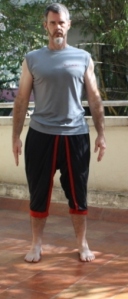 Learning third level material was when Kalaripayattu became daunting. Until then, it was just exhausting.
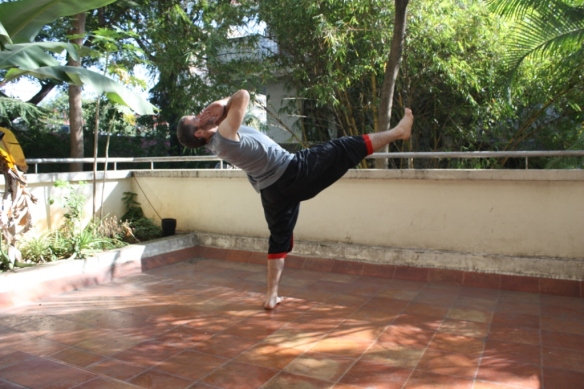
I’d been doing a lap of the kalari consisting of high kicks flowing into Hanumanasana (a scissors split.) Each split is on the opposite side from the last. By yoga standards, my split alignment was off. My hips weren’t perpendicular to my legs, but I’d allowed them to twist open to make the split easier. However, that was probably the least of my errors, and–unlike in yoga practice during which one might take minutes to ease into this intense split–the cadence in kalari was kick – split – struggle to one’s feet. [Okay, the “struggle” shouldn’t have been, but it’s an accurate description of my rendition.]
This wasn’t the hard part, by the way. I’ll get to that. The structure of the class up to that point was logically arranged to facilitate those splits. The practice started with warm ups of rapid repetitive motions that got the muscles and core warm. Then there were a series of kicking exercises that also served as dynamic stretches. Next, there was a vertical version of the splits done in a static form. With the inner edge of one’s bottom foot posted along the base board, the heel of one’s upper foot is slid up a piece of wood lathe worn smooth that has been tied vertically–perpendicularly to the steel burglar bars that one uses to pull oneself into the stretch. (This is an inner city kalari, and not the traditional version dug into the ground.) Then one revisits a high kick, swinging the leg with greater intensity. Only then does one do the lap of splits.

A traditional kalari looks like this. This is the Kalari Gurukulam in Chikkagubbi (parent school to the one at which I train.)
The next piece is where the third level kicked my butt. One’s hamstrings and quads stretched to the max, feeling more like limp noodles than coiled springs, one is now expected to work through a series of leaping maneuvers. There are seven leaping exercises (besides some basic warm-up leaps): a leaping circle kick, a spinning kick that takes one 360-degrees, a split kick in which one leaps up and kicks out laterally in both directions simultaneously, a split kick in which one leaps up spinning 360 degrees [theoretically] and does the same split kick in the middle, a flip kick in which one kicks up and forward and flips one’s body over in mid-air to come down on one’s hands and feet (in a lunged position with palms down next to the feet), and then there are two versions of leaping/spinning kicks that proceed down the length of the kalari.
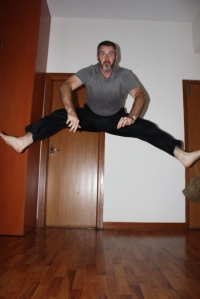 Why does one do these plyometric techniques in the wake of such intense stretching? I suspect that experts in exercise science would tell me this isn’t the best way to improve my leaps. One should do the leaps when one’s muscles are more like rubber bands than al dente linguine. Still, I dutifully comply. Maybe there’s an ancient wisdom at work here. Maybe there’s not. There’s no way to find out without giving it a try. I fall down a number of times that first day, and on all subsequent sessions. As I write this, I’m now learning level five material, but I continue to revisit the leaps every session for two reasons. First, I’m not happy with my abilities. Second, I want to find out whether I can improve my balance of flexibility and power, and whether the kalari approach does the trick. (Note: I’m using the word “power” in the specific sense of work performed per unit time. In other words, it’s not synonymous with strength. It’s a function of both speed and strength.) At any rate, I still fall down.
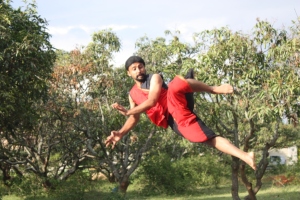 However, looking beyond my own limited capacity to have my cake and eat it too (i.e. retain flexibility as I gain power), I see evidence of the success of this approach. There are a number of advanced people who’ve been using this approach for many years and have a preternatural balance of flexibility and jet propulsion. Said individuals seem to go from deep stretches to phenomenal vertical leaps without difficulty.
If nothing else, I’ve learned a great deal about my muscular composition. While I’m challenged by ballistic movements, my stamina is quite respectable. Type I (slow twitch) musculature seems to be disproportionately common in comparison to type II (fast twitch) in my body. While I’m including more power building training in my workouts, my progress is glacial. If I was smart, I’d take up long-distance running or some other endurance activity. But I tend to find such activities tedious, while I love the martial arts. And so I struggle.
 Obstacle Race Training: How to Beat Any Course, Compete Like a Champion and Change Your Life by Margaret Schlachter
My rating: 4 of 5 stars
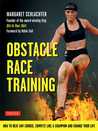
If you’re a neophyte to the obstacle racing scene, as I am, this is the book for you. That’s not to say that it wouldn’t be useful for someone with some experience, but if you’re a competitive racer looking to shave time off your runs to boost your standings, I suspect you might want more detail on some topics (e.g. details on various approaches for getting over/under/through/around particular obstacles and more explanations of variations on obstacles.) That said, this book hits the Goldilocks zone for someone who has no idea what they are doing, but would like to give some form of obstacle race a try. (i.e. Not so much information as to be overwhelming, but not so little that you’ll be unprepared to have a good run.)
It’s a short book, less than 200 pages, arranged into 18 chapters that are in turn divided into five sections. The first section introduces one to obstacle course racing. While this sport / social event (there are both competitive and non-competitive participants involved in most races and some events are more about comradery than competition) has been growing wildly in popularity in recent years, there will be many readers who are completely unaware of it. However, by the end of these first three chapters you’ll have a thorough sketch of the scene. The rest of the book goes through what one needs to do long before the race (e.g. picking a race, training [general fitness as well as obstacle-specific], and dieting), immediately before the race (e.g. dressing for the race and eating / hydrating for the race), during the race, and after the race (e.g. recovery, choosing a next race, and moving forward with your participation.)
I found this book to be packed with valuable information (e.g. The mantra DON’T WEAR COTTON ON RACE DAY will be forever etched into your brain.) I found Schlachter’s practical, no-nonsense approach to be a breath of fresh air. For example, with respect to diet, her advice is sparse but invaluable. Basically, it boils down to “eat good food in the portions needed for your body.” It may sound like I’m being dismissive, but I’m not. I appreciate her making sense on the subject and not drawing it out with fad baloney diet (figuratively or literally) quackery. (Pet peeve: I really don’t like hearing about people’s ludicrous ideas about how one can eat a pound of bacon a day, but you’ll die if a slice of wheat bread or a wedge of orange goes in your mouth.)
There are several nice features of this guide that I’ll mention specifically. One is that it has a chapter that shares insights from other high performing obstacle course racers. This gives one some useful and varied advice. Second, it actually shows one how to make a couple of obstacles, e.g. walls and spear targets, that are either common or challenging. Finally, it gives one tips for making this an affordable hobby. (If you’re at the stage of reading this book, you’ll probably have to pay the entry fee out of pocket—no sponsors– and have little to no chance of running well enough to earn winnings.)
If you’re considering running an obstacle race, whether a mud run or an obstacle course race, I’d recommend you give this book a read.




 Tiger Riding for Beginners