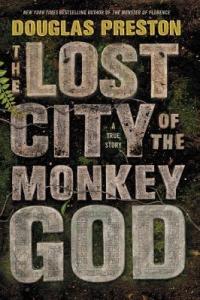
BOOK REVIEW: The Lost City of the Monkey God by Douglas Preston

The Lost City of the Monkey God: A True StoryThe Lost City of the Monkey God: A True Story by Douglas Preston
My rating: 5 of 5 stars

Amazon page


Preston tells the story of his participation in an expedition into the Mosquitia region of Honduras in search of a lost city, alternately called the White City (i.e. La Ciudad Blanca) or the City of the Monkey God. Preston was acting as a correspondent for National Geographic and was part of a larger team including a photographer, filmmakers, archaeologists, and a team of ex-Spec Ops escorts. It’s not a simple and straightforward tale of Indiana Jones types chasing after the artifacts of a long collapsed civilization (though it does capitalize on that sense of intrigue greatly from the title to the telling of both the historic and contemporary searches for this fabled lost city.) The book tells several stories that occur about and around this search, and they are arguably more interesting.

One of these side stories is the historic accounts of past explorers who searched for the White City. Those were the individuals who more closely corresponded to Indiana Jones–both because they didn’t have an airplane with a state-of-the-art Lidar system (lidar is the light/laser version of radar or sonar), and because they were more likely to engage in tomb-raiding and artifact robbery. This isn’t to say that the expedition that Preston was on didn’t have its share of snakes, quickmud, and other hazards that are the only reason that a huge city from a past civilization would remain undiscovered in the present day. The region in which the expedition took place had not only all the natural hazards of dense jungle, but the human hazards posed by operating in territory controlled by drug cartels. That said, they didn’t have to machete through hundreds of miles of jungle with no idea of where they were likely to find their objective.

One of the most interesting side stories occurred when Preston and many of the members of the expedition came down with leishmaniasis, a nasty tropical disease vectored by sandflies. The disease has a treatment that’s almost as likely to kill one as is the disease. It’s almost impossible to completely get rid of the disease. One can be cured in the sense of being made asymptomatic, but one may remain a potential carrier waiting to be bitten again and to pass the nasty parasite onto another sandfly so they can infect someone else. There are several elements of the disease story that are intriguing. The most interesting is speculation about the role that disease might have played in the sudden evacuation of this lost city. This is informed by a broader discussion of how “Old World” diseases spread through the “New World” with crippling effect. Another is how diseases are neglected when they almost exclusively infect poor and rural people (until a National Geographic correspondent tracks it back to the continental US, that is.)

For those outside of archaeology, one of the least interesting, but still interesting, side stories is that of the intense controversy in the field. Preston is very forthcoming about his talks with scholars who were angered and outraged by the use of terms like “Lost City” which hearken back to a period in which tomb-raiding was the norm and Westerners stole and shipped priceless artifacts back to the West by the ton. These internecine wars of academia reinforce the idea that this isn’t just musty history, but involves questions that many people feel intensely passionate about.

There is a photo section that provides images of both the cast of highly discussed people and a few of the artifacts uncovered. There’s also a section of sources and citations.

I found this book to be fascinating and I’d highly recommend it. Those interested in exploration and adventure tales will find it of obvious interest, but those with a curiosity about public health may find it unexpectedly of interest.

View all my reviews

BOOK REVIEW: The Guide by R.K. Narayan

The GuideThe Guide by R.K. Narayan
My rating: 5 of 5 stars

Amazon page

Get Speechify to make any book an audiobook 

This novel’s lead, Raju, is sitting by a riverside shrine when he’s mistaken for a holy man. In actuality, Raju was just released from prison for forging the signature of a woman with whom he has a complicated relationship. The woman is married to another man but she has a love of dance, and her husband wants her to give up such frivolities. She falls for Raju, who is working for her husband as a travel guide /expediter, because he supports her in the pursuit of dance. [One can see the dual meaning of the title as Raju is a travel guide by trade and becomes a spiritual guide to the villagers of the fictional town of Malgudi.] After experiencing some hard times with the shops left him by his father, Raju finds success by being not only the lover of the dancer but also her Col. Tom Parker (i.e. her promoter /manager.)

The story isn’t told in chronological order, but is easily enough followed and is the more interesting for its nonlinear telling. For example, we learn the details of Raju’s troubles as a confession he makes to the individual who first mistook him for a guru.

The book explores several themes. One is the power of charisma and bumper-sticker wisdom in building a sage. When Raju’s first student hears his confession, the young man is unswayed, following Raju unwaveringly. On a brighter note, one also sees how people’s strong beliefs, ill-founded as they might seem to be, can produce a guru. Ultimately, Raju becomes the teacher that the entire village thought him to be all along.

There’s also the issue of passion versus familial bonds and tradition. While Raju’s mother personally likes the dancer woman, the fact that the girl is of a lower class and caste (not to mention married to another man), creates a tension. Raju must decide between his love of the dancer and that of his mother. We also get to see the hard edge of tradition in the Raju’s uncle who puts all the bias of class and caste in its most explicit form.

I enjoyed this novel. It’s a nice compact story and is very thought-provoking. The character of Raju is well-developed and interesting. The reader finds Raju likable even though at times he’s a bit loathsome in his behavior. There’s more than one comedy of error in the story’s formulation to offer some lightness to contrast the family drama.

I’d highly recommend this book for fiction readers. It was also interesting for me as an ex-pat in India as it offers some insight into the culture. It should be noted that it’s set in a bygone era. But even though it’s dated, one can see the long shadow of cultural proclivities in the story elements.

View all my reviews

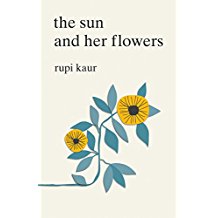
BOOK REVIEW: The Sun and Her Flowers by Rupi Kaur

The Sun and Her FlowersThe Sun and Her Flowers by Rupi Kaur
My rating: 5 of 5 stars

Amazon page


This is the second collection of free verse (with some prose) poetry and line drawn art by Rupi Kaur, an ethnically Indian Canadian poet. Like the first collection, “Milk and Honey,” this collection has been well received critically. The strengths of the collection include some beautiful, evocative, and unique use of language; the author’s willingness to lay it all on the line in a bold and brave fashion; and the often clever–if simple, verging on crude—artwork. Its greatest weakness is frequent restatement of clichéd notions and truisms that don’t stand up well juxtaposed to the more personal and illuminating lines.

The collection is divided into five parts, each of them reflecting a theme—while being tied together by the titular floral theme. “Wilting” is about breakups. This flows smoothly in tone into the second part, “Falling,” which is about sexual violence, depression, and the linkage between them. “Rooting” is about family and origins, and—in particular—the poet’s relationship with her mother. As an immigrant child who moved to Canada from Punjab while young, Kaur was more attuned to her new home than her parents—who were less at ease with their adopted homeland and more rooted to their ancestral home. The penultimate part, “Rising” is about love and relationships, and it takes the collection into brighter territory. “Blooming” is about feeling comfortable within one’s own skin, and—in particular—the female experience of it.

As hinted, the overall organization of the collection seems purposeful and intriguing. The two melancholy parts at the beginning are blended into the last two (more optimistic) parts by way of a chapter on roots and family. This bridging seems to be done on purpose to make a statement.

I enjoyed this collection, and would highly recommend it for poetry readers—particularly for those who enjoy free verse.

View all my reviews

BOOK REVIEW: Caesar’s Last Breath by Sam Kean

Caesar's Last Breath: Decoding the Secrets of the Air Around UsCaesar’s Last Breath: Decoding the Secrets of the Air Around Us by Sam Kean
My rating: 5 of 5 stars

Amazon page


A book about air and the gas molecules that float about in it may not sound gripping. However, Sam Kean has a gift for finding interesting little stories to make talk of nitrogen-fixing, the discovery of oxygen, and the improvement of the steam engine fascinating. Such stories include that of a vaporized resident of Mount St. Helens, a gas-belching lake that suffocated families in their sleep (not a horror movie plot—a documented event), the scientist who both made millions of new lives possible through his nitrogen-fixing process and then took killing to its most despicable with poison gas, the pig who survived nuclear fallout, and, of course, how the last breath of a Roman Emperor came to be his last–and how likely it is that you’re breathing some of it right now. Along the way you’ll learn about farts, about the use of nitrous oxide for fun and surgery, about Einstein’s venture into refrigerator design, about lighter-than-air air travel, and about what air might look like on another planet.

The book is divided into three parts and nine chapters. There are also eight “interludes” that each takes up an intriguing subject that is chemically or topically related to the preceding chapter. The first part, and its three chapters, addresses the components of air and where they come from. The three chapters explore sulfur dioxide and hydrogen sulfide as molecules released by geological processes (e.g. volcanoes,) the abundant but—without great effort—useless element of nitrogen, and oxygen—useful for breathing and setting the world on fire.

The middle part deals with how humans have used components of air for our own purposes. These three chapters discuss nitrous oxide’s invention, the exploitation of steam to power the Industrial Revolution, and the use of lighter-than-air elements for air travel.

The final part both describes ways in which humanity has changed the air, and looks at what we might have to contend with if we need to go to another planet to live. The seventh chapter explores nuclear testing and the radioactive isotopes that have been spread by it. The penultimate chapter examines the ways in which humans have tried to make weather more predictable by engineering it—usually with little to no effect. The last chapter is about what air might look like on other planets, be they planets on which we’d have to make air or ones that already have their own atmospheres.

There are a number of graphics, including molecule diagrams, photos, and artworks. There are also notes and a works cited section.

I’d highly recommend this book. I found it to be fun to read and fascinating. If you’re into science, you’ll love it, and—if you’re not—you may change your mind.

View all my reviews

BOOK REVIEW: The Claiming of Sleeping Beauty by A.N. Roquelaure (a.k.a. Anne Rice)

The Claiming of Sleeping Beauty The Claiming of Sleeping Beauty by A.N. Roquelaure
My rating: 3 of 5 stars

Amazon page


This is a bawdy take on the tale of Sleeping Beauty—and, in particular, the aftermath of her rescue and awakening. There are many such adult-targeted books based on children’s fairy tales, but the reader should be particularly aware of the nature of this story because it’s fairly hard-core. Since one may associate the fairy tale with lighthearted stories, many readers won’t be ready for the wide-ranging sexual and sadistic activity that goes on in this book. If you’re a hard-core sado-masochist, you may object that this isn’t so intense in subject matter. That’s probably true for you, but for the run-of-the-mill reader, it’s pretty wild stuff. In essence, Sleeping Beauty enters into a finite period of sexual slavery (technically more sexual indentured servitude) in repayment for her rescue.

Part of the reason that there may be misunderstandings of what this book is, is how it’s been marketed. There was a cover blurb on the version I read that says “If you liked 50 Shades, you’ll love the sleeping beauty trilogy.” This statement is clearly meant to capitalize on the success of those books. While I haven’t read any of the “Fifty Shades” books, I doubt that the claim is true. This book is somewhere between “Fifty Shades” and the works of the Marquis de Sade. While E.L. James’ books work on a one-on-one dynamic that forms an S&M tinged romance, Roquelaure / Rice’s book is about sexual servitude of individuals who are essentially stabled in a more harem-like situation. While they are both books that revolve around the psychology of dominance and submission, the dynamic of the two is quite different. From what I’ve heard about James’s works, Rice’s book is probably better written and it may even be a bit more psychologically sophisticated. However, if you’re expecting that “mommy porn” dynamic in which a man who is extraordinary in every way (billionaire / 6-pack having / philanthropist / speaks ten languages fluently / and has a doctorate in quantum rocket dynamics) takes a mediocre woman merely because she completely submits to him, you’ll probably be disappointed.

Because people’s ideas of what’s hard-core varies, I’ll touch on that. There is a huge amount of bondage and physical punishment. There’s no gore, no breaking of skin, nor any permanent damage /disfigurement. There’s no horror aspect to the book. As far as sexual acts are concerned, they are both heterosexual and homosexual in nature. There are a finite number of options, and I think they’re pretty much all touched on at some point. There’s no bestiality, scat, nor pedophilia—so if those are your limits, you’re safe.

This book was clearly outlined and written with the intention of being a trilogy or multi-part work. That is to say, the story arc is not particularly satisfying as a stand-alone book. This may, in part, also be because of the lack of importance of story to hardcore erotic works, but I suspect that the author / publisher had a thick tome and needed some place to chop it into standard length books to maximize revenue. I probably won’t read the other books, in part because this trend toward putting out books that don’t stand alone as stories cheeses me off a bit. As you might expect, the ending feels abrupt and seems more about leaving the reader dissatisfied (i.e. wanting to read the rest) rather than leaving them satisfied (having seen the character grow and change.)

Instead of making an explicit statement of recommendation, I’ll say that if you read the review and are intrigued, give it a read. If you read the review and are disgusted, avoid it. It’s as simple as that.

View all my reviews

BOOK REVIEW: A Midsummer Night’s Dream by William Shakespeare

A Midsummer Night's DreamA Midsummer Night’s Dream by William Shakespeare
My rating: 5 of 5 stars

Amazon page

Get Speechify to make any book an audiobook 

The backdrop for this story involves two young men (Lysander and Demetrius) and two young women (Hermia and Helena.) Both men have the hots for Hermia, which leaves poor Helena unloved though she loves Demetrius. Hermia loves Lysander, which means Demetrius is unloved by the one he loves and has no love for the girl pursuing him. Enter the village elders—notably Hermia’s dad, Egeus, and the Duke of Athens, Theseus—who really muck up the works by insisting that Hermia marry Demetrius (whose family apparently has more cash than does Lysander’s.) This causes Lysander and Hermia to elope into the forest, where things really get freaky. Helena, courting Demetrius’s favor, tells him where the eloping couple went, and Demetrius gives chase while Helena chases Demetrius.

In the woods outside Athens, there lived ferries. Oberon, king of the fairies, has in his possession a Cupid-like potion that will make its victim fall madly in love with the next person he or she sees. Oberon orders this potion deployed in two ways pertinent to the story. Seeing Demetrius quarreling with Helena, he orders his subject, Puck, to deploy it on Demetrius. In a fashion typical of a Shakespearean comedy, the potion is misapplied.

The other use of the potion (a subplot of the story) is on the faerie queen, Titania. Oberon is upset with Titania over an Indian boy of whom they’ve come into parentage. Titania falls for a workman who is in the woods rehearsing a play that may be the worst play ever. Most disconcertingly, she falls in love with this man, called Bottom, as he’s wearing a donkey head for his role in the play. As this is a comedy, the two unholy loves that developed are eventually rectified, but not before some amusing happenings.

At its most basic level, the play is a commentary on the folly of mucking about in love–whether as matchmaking elder or a Cupid-like faerie. On another level, it’s a critique of an unrealistic pursuit of a perfect vision of love. In this way, the message isn’t unlike Shakespeare’s Sonnet 130 (i.e. “My mistress’ eyes are nothing like the sun.”) This is seen in Demetrius’s ultimate recognition that he’s being an idiot by chasing after Hermia, when Helena is so clearly devoted to him. In other words, in love as in life the notion famously attributed to Voltaire that “The perfect is the enemy of the good” applies. As an aside, we also learn what Shakespeare sees as some of the mistakes of playwrights and theater companies as the assembled crowd watches Bottom and his comrades put on a hideous production.

I’d highly recommend reading this work for everyone. It’s Shakespeare; needless to say, the language is beautiful and the story is intriguing.

View all my reviews

BOOK REVIEW: The Sounds of Poetry by Robert Pinsky

The Sounds of Poetry: A Brief GuideThe Sounds of Poetry: A Brief Guide by Robert Pinsky
My rating: 4 of 5 stars

Amazon page


As the title suggests, this is a book about sound as a component of poetry. Besides the characteristics of noises made in reading poetry, the book details the various characteristics that shape the overall sound of a poem–such as the duration of a syllable and whether it’s stressed or unstressed. Having said that, a major theme of Pinsky’s work is that one shouldn’t be absolutist or rigid about these characteristics (e.g. stress versus unstressed) and should instead look at the relative traits (i.e. more or less stressed.) By adopting a more flexible view of the concepts like accent (stress), rhyme, similarity of sound, one opens up limitless options for poetry.

The book consists of five chapters. The front matter includes an introduction and a brief commentary on theory. The latter points out that there are no hard rules, but by paying attention to these concepts one can produce richer and more interesting sounding poems. Pinsky reviews the most common poetic terms (e.g. iamb, trochee, spondee, etc.) but also looks at how these are varied for effect in a way that is enjoyable to all but prosody hardliners.

The chapters are: 1.) Accent and duration; 2.) Syntax and line; 3.) Technical terms and vocal realities; 4.) Like and unlike sounds; 5) Blank verse and Free verse. (fyi: Blank verse is unrhymed verse that has a regular meter (most commonly iambic pentameter. Free verse is unrhymed verse with irregular meter.)

There are relatively few poems used as examples in this book. Some readers may find this a bit tedious and would prefer being exposed to more (and more varied) examples. However, other readers will enjoy drilling down into a few poems along several dimensions. That’s a matter of personal preference, but the reader should be aware of it.

The book is less than 150 pages even with the back matter, which includes recommended readings and glossary of names and terms. It’s a quick read.

I enjoyed this book. It’s not too technical, and can be followed by a reader whether they’ve had an extensive education into poetry or not. It’s not doctrinaire about prosody, which appeals to my personal preferences. It provoked some intriguing insights, such as the flexible approach to accent as well as poetry as an art that uses the body of reader as its medium—their respiratory systems, vocal chords, and related musculature how these sounds are produced.

I’d recommend the book for poets and readers of poetry who are serious about the endeavor.

View all my reviews

BOOK REVIEW: Trying Not to Try by Edward Slingerland

Trying Not to Try: The Art of Effortlessness and the Power of SpontaneityTrying Not to Try: The Art of Effortlessness and the Power of Spontaneity by Edward Slingerland
My rating: 5 of 5 stars

Amazon page


This book’s paradoxical title is perfect for its paradoxical subject matter, which is famously expressed in such quotes as, “When nothing is done, nothing is left undone” [ver. 48 of the Tao Te Ching.]  Slingerland lays down the ancient Chinese wisdom of wu-wei and de, but provides something novel by putting it in the context of the positive psychology and neuroscience of today. Wu-wei literally means “no doing,” but can be more meaningfully defined as “effortless action.” De (pronounced “duh”) is a charisma seen in people who have mastered the effortlessness and spontaneity of wu-wei.

While the book is built around the varied approaches of four Chinese philosophers—two Confucians (i.e. Confucius and Mencius) and two Taoists (i.e. Laozi and Zhuangzi)—the author relates this philosophy to the present-day thinking found in Daniel Kahneman’s “Thinking, Fast and Slow,” Mihaly Csikszentmihalyi’s conception of Flow, and the neuroscience of the subconscious.

The book consists of eight chapters. The introduction and the first two chapters outline the concepts of wu-wei and de using both Chinese and Western stories and examples to help clarify these arcane ideas and put them in the context of the social and spiritual spheres. Chapter 1 offers an extensive discussion of the operation of the brain as it relates to the discussion of effortlessness and spontaneity.

Chapters three through six make up the core of the book, and present the approach and thinking of Confucius, Laozi, Mencius, and Zhuangzi, respectively. This “boy-girl-boy-girl” Confucian-Taoist organization offers the reader sound insight into the varied approaches and allows one to see the evolution of thinking. Confucius gets the first cut, but his approach to effortlessness and spontaneity involves a great deal of effort and planning. It might seem that Laozi’s approach–which does away with effort and planning–might be more apropos, but it’s hard to imagine anything of benefit actually being spawned by such a loosy-goosy approach. The more nuanced approaches of Mencius and Zhuangzi offer additional insight, but do not eliminate the paradox. It’s this paradox that’s the subject of chapter seven.

The final chapter examines what the reader can take away–given that the paradox of wu-wei seems inescapable. The author proposes that, paradox or not, there is value in pursuit of effortlessness and spontaneity, and progress can be made by understanding and accepting said paradox.

The book has no graphics, but is annotated and has a bibliography–as well as an appendix table that summarizes the various approaches to wu-wei.

I enjoyed this book and found it fascinating. It’s highly readable, having humor and a wide range of examples from ancient myths to pop culture. The book offers a great value-added by considering the relevance of modern science and psychology to this ancient concept. I’d highly recommend this for individuals interested in Chinese / Eastern philosophy, as well as anyone hoping to bring a little more effortlessness and spontaneity into his or her life.

View all my reviews

BOOK REVIEW: Round Ireland with a Fridge by Tony Hawks

Round Ireland with a FridgeRound Ireland with a Fridge by Tony Hawks
My rating: 5 of 5 stars

Amazon page


When Tony Hawks and his friend Kevin see a man hitching with a refrigerator one night, a debate ensues that results in a ₤100 bet that Hawks can circumnavigate Ireland entirely by hitching rides–while carting a fridge with him. (When Kevin insists that no one could get a lift with a fridge, Hawk’s response sets the book’s tone and theme, “They could in Ireland, it’s a magical place.”) Showing a lack of business acumen, Hawks purchases a compact dorm fridge for ₤130, and sets off from Dublin in a counterclockwise fashion. The rules of the bet stipulate that Hawks must visit Tory island at the extreme north and Clear Island at the extreme south but otherwise can use whatever route he likes as long as he gets around only by hitchhiking, he keeps the fridge with him during his travels, and it takes him less than a month. Hilarity ensues.

Hawks’ book is a hoot. If there is anything that he makes funnier than a person questioning his intelligence / sanity for carting a fridge about, it’s his description of the people who politely ignore the absurdity of him hitching with a fridge. There’s also a fair amount of sour grapes humor as sometimes it seems the fridge has gained more of a celebrity status than the author. Of course, not all the humor is fridge-centric; some of it takes place in pubs with the people the gregarious Hawks meets along the way. The book mixes travelogue with humor writing, and nicely captures both the scenery of Ireland and the national character of the Irish. The book also has its serious moments, particularly as it draws to a close and the author realizes his adventure is at an ends.

In the end, Hawks proves that it can be done—in theory, at least. It should be pointed out that Hawks had the benefit of appearing on a national radio show regularly as well as on TV at the start and finish of his trip. Because of this, people were often on the lookout for him and likely more willing to give him a lift than if he were the average schlub. On the other hand, the need to meet scheduled appointments with media is one of the sources of tension in the book because they usually involve close calls. It seems it’s not always easy to call in from remote locations in rural Ireland while on the move, and the best example may be Hawks’ attempt to make it to Dublin on the last day to meet a PR event that a radio show had set up. He puts the reader on the edge of his seat, despite the lack of any real peril (it is just a guy trying to make media events related to his absurd adventure, after all.)

I’d highly recommend this book. If you’re interested in traveling in Ireland, it’s a light read to give you some ideas about places you might want to hit (or miss.) However, on its humor alone it’s worth a read even for readers who don’t normally read travel writing.

View all my reviews

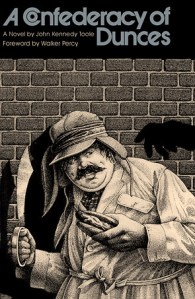
BOOK REVIEW: A Confederacy of Dunces by John Kennedy Toole

A Confederacy of DuncesA Confederacy of Dunces by John Kennedy Toole
My rating: 5 of 5 stars

Amazon page


If you’ve heard of this book, but not read it, you’re probably aware of the troubled circumstance of its publication. Several years after having failed to be published, Toole committed suicide. The story of the book would have ended there, except Toole’s mother found the typescript and carted it around to people in the literary community. After much persistence and not taking no for an answer, she managed to get Walker Percy to read the manuscript, and the rest is posthumous Pulitzer Prize winning history.

It would be easy to dismiss the editors involved in rejecting this manuscript as grade-A lunkheads, or as the lead character (Ignatius J. Reilly) likes to verbally skewer his victims “Mongoloids.” However, one can see how said lunkheads would find this much-beloved novel risky. It’s a character-driven novel in which the lead character is obnoxious and unlovable in the extreme. Reilly is a pretentious and pedantic professorial type–verbally speaking– wrapped into the obese body of a man-child who is emotionally an ill-mannered five-year old with a bombastic vocabulary. Reilly has no impulse control, takes no responsibility, and is prone to tantrums, sympathy-seeking dramatic displays, and wanton lies. He’s the worst because he thinks he’s better than everyone despite the fact that in all ways except his acerbic tongue, he’s worse than everyone.

That said, the book—like its unsympathetic lead character—is hilarious through and through. What it lacks in a taught story arc and a theme / moral argument (the latter being why the editor at Simon and Schuster rejected the book after showing initial interest in it) it more than makes up in hilarity.

I should point out that when I say that this isn’t a plot-driven book, it doesn’t mean that it doesn’t have an interesting wrap-up at the end—which I will not discuss to avoid spoiling it. The plot revolves around events in the life of a lazy man-child forced to go to work. It’s not a journey of change, discovery, or adventure. While, in most cases, a character-driven story with an unmalleable lead would be a recipe for a book that flops, here it keeps one reading to the last page because it’s Ignatius’s failure to become a better man that ensures the book is funny to the end. Reilly is constantly making decisions that are both overly contemplated and yet ill-considered.

The book follows Ignatius Reilly through an event that results in a tremendous loss of money for Ignatius’s mother. This forces her to finally put her foot down and insist the man—who she still thinks of as her little boy—get a job. It should be noted that Ignatius’s mother’s eventual coming around to the monster her son has become is a major driving force in the story—though we can see a distinct lack of taking of responsibility that echoes that of Ignatius, himself. Ignatius gets a fine—if lowly, clerical–job at the slowly-dying Levy Pants Company, but gets fired after he encourages a worker protest that goes awry. He then gets a job as a hot-dog cart vendor—a job considered the lowest of the low by both his mother and New Orleans’ society-at-large. The latter is the job he has at the end when a final chain of events unfolds (not without tension and drama, I might add.)

On the theme issue, the Simon & Schuster editor was correct that the book isn’t really about anything except how to muddle through life as a lazy, cranky, emotionally-stunted, and overly-verbose doofus. (But he was oh-so wrong about that being a lethal deficit—according to the Pulitzer Prize committee as well as innumerable readers.)

I’d recommend this for any reader with a sense of humor. You won’t like Ignatius J. Reilly, but you’ll find his antics hilarious, and you’ll want to know what happens to him in the end even if he is irredeemable.

View all my reviews