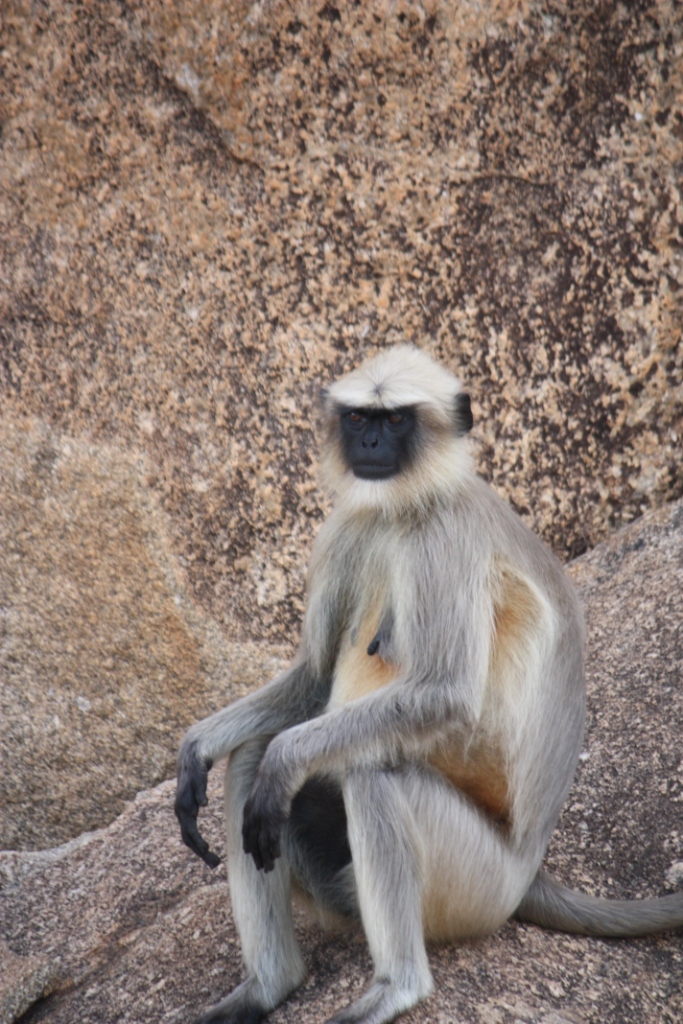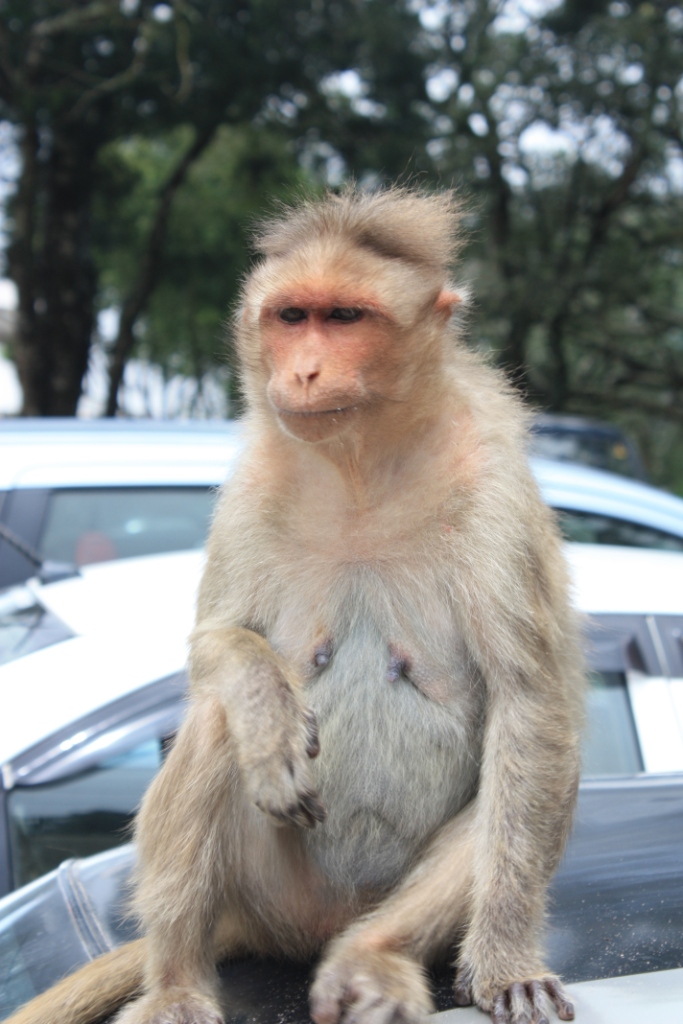
DAILY PHOTO: Gray Langur Watchmonkey

Taken Nov 3, 2013 at Hampi

Taken Nov 3, 2013 at Hampi

Gazing into the distance

he renders his assistance

to the mischievous monkeys–

making him a monkey flunky

A watchman of the langur pranks

yet not a part of their prankish ranks

He screeches warnings now and then

on sight of broom-wielding women

He neither seeks nor needs praise

just the occasional banana raise

He does it not for power or glory

just the occasional funny story

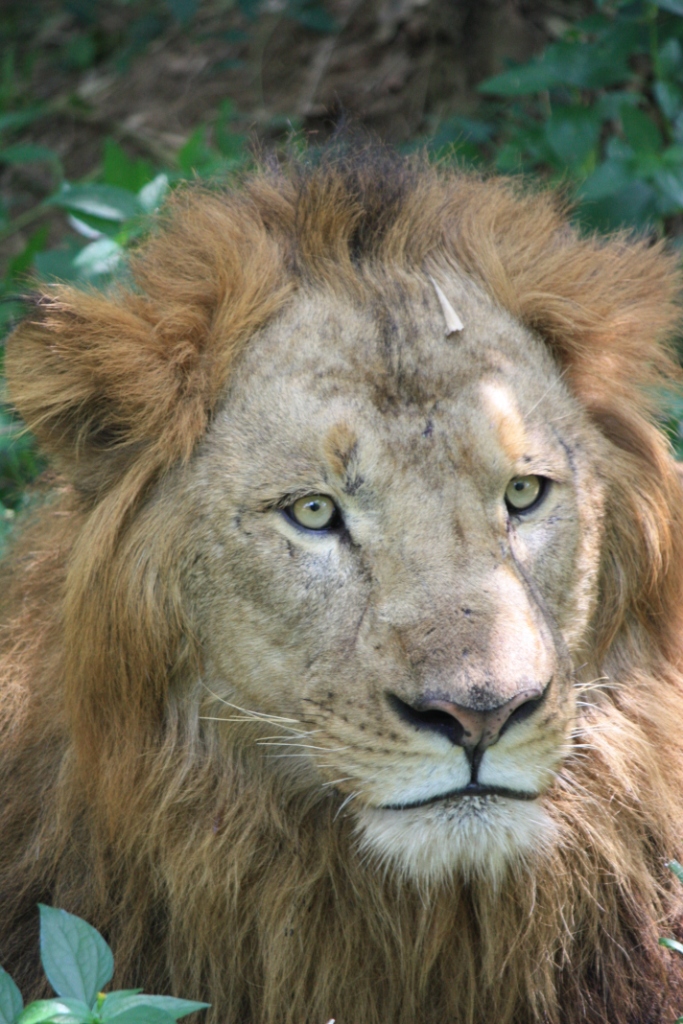
POEM: Lion Eyes (or Lionize or Lyin’ Eyes)

Taken Nov 10, 2013 at Bannerghatta National Park

Taken Nov 10, 2013 at Bannerghatta National Park

The lion is  a kingly beast

Whose eyes no lies can abide

If you don’t wish to be his feast

Please act with tact and don’t chide

He doesn’t take to teasing well

He’s still but to kill is in his blood

His placid face may look swell

But a strong heart pounds THUD-THUD…

THUD-THUD

&

another thing

He may look like a big plush toy

But he’s no fun for a girl or boy

Don’t get your kid a big feline

Unless your exit is a swift beeline

BOOK REVIEW: Gitanjali by Rabindranath Tagore

GitanjaliGitanjali by Rabindranath Tagore

My rating: 5 of 5 stars

Amazon page

Get Speechify to make any book an audiobook

Gitanjali is the most well-known work of the Bengali polymath Rabindranath Tagore. Tagore was the first non-European winner of the Nobel Prize for Literature (1913.) While Gitanjali is a work of poetry, Tagore didn’t restrict himself to this form, but also wrote stories, novels, plays, and music.

Gitanjali translates to “Song Offerings” and while the English version is a translation, it was translated by Tagore himself. Thus, there is no need to wonder whether the translator got it right or injected too much of his own worldview into the process.

This collection of 103 poems (the original Bengali has 157)displays both beautiful language and thought-provoking sentiments. This may be why the work is so beloved and stands the test of time.

I’ll share a few of my favorite passages:

“The child, who is decked out with prince’s robes and who has jeweled chains round his neck loses all pleasure in his play;…” -Poem VIII

“O fool, to try to carry thyself on thy own shoulders! O Beggar, to come to beg at thy own door!” -Poem IX

“On the day when the lotus bloomed, alas, my mind was straying, and I knew it not.” -Poem XX

“On the seashore of endless worlds children meet.” -Poem LX

“In the moonless gloom of midnight I asked her, ‘Maiden, what is your quest, holding the lamp near your heart? My house is all dark and lonesome,– lend me your light.’ She stopped for a minute and thought and gazed at my face in the dark. ‘I have brought my light,’ she said, ‘to join the carnival of lamps.’ I stood and watched her little lamp uselessly lost among lights.” -Poem LXIV

“And because I love this life, I know I shall love death as well.” -Poem XCV

The edition I have, which is published in India by Rupa Press, contains Tagore’s Nobel Prize acceptance speech as well. (The Amazon page I’ve linked to shows the edition that I read, but the cover shown above is a different version. The poems are all the same because Tagore self-translated, it is only the supplemental matter that is different.)

I highly recommend this collection of poems.

View all my reviews

POEM: Monkeys Make Me Smile

Monkeys always make me smile

Some have hair in human styles

Oh the vanity  their locks betray

Can you spot the one with a toupee?

IMG_0507

Faces so reminiscent of our kind

Eyes suggesting intelligent minds

Into their faces they’ll one day grow

but the youngsters all look like H. Ross Perot

IMG_0389

They’ll sit on your car like they just don’t care

And screw the haters who stop and stare

Have you the courage to leave your mark

on the windshield of one who double parks

IMG_0734

It amuses us that they sling their poo

So we banish them to the city zoo

But what of our words so vitriolic

We’re evolved to sling poo symbolic

POEM: Everything & Its Opposite

IMG_0235They say,
“Everything,
&
its Opposite,
is true of India.”

colors so bold
and brash
please the eye
despite the clash
Then there is
that darkest side
slain daughters
burning brides

curry scents
draw the drool
flowery fragrances
from lotus pools
still,
other scents
fill the air
piss,
poverty,
death,
& despair?

honking horns
jar the brain
the piercing blare
of a freight train
then silence
but for the mind
slowing, calming
freed from grind
&
Infinite possibilities.

TANKA: Crows

a murder of crows
call from trees in unison
hidden amid leaves
invisible but noisy
what secret taunts curse us

POEM: Phantom Mind

i washed up on a foreign shore
i saw no house, but just a door
through the door, light was dim
my mind was as phantom limb


my thoughts rang false
my mind chugged leaden
white mice danced a waltz
at the edge of Armageddon


a piercing tone slapped my mind
my eyes fell out and I was blind
squirming to a surface I couldn’t see
gasping, birthed, and then set free


another night in my phantom mind


Haiku from my daily walk

Hazy hilltop morn,
a resting hiker looks like
a granite Buddha

Chicks chirp noisily
each tremor anticipates
mamma coming home

DAILY PHOTO: Between the Crosses, Row on Row

Take December of 2012 at Andersonville National Cemetary

Taken December of 2012 at Andersonville National Cemetery

At a military cemetery like this one, a poem always plays in my mind. It was the first poem I ever memorized in full (not including snippets of some  disturbing mandatory children’s poems like “Ring Around the Rosie” [said to be about the Black Death] and–in Indiana–“The Little Orphan Annie” [about an enslaved orphan threatened with goblins.])

At any rate, the poem in question is In Flanders Fields by John McCrae. Sadly, I chose to memorize this poem for a school assignment of poetry recitation because it seemed short and it rhymed. However, in many subsequent re-readings it has become a very powerful bit of verse for me. It may not be perfectly apropos for Independence Day as it was written by a Canadian and is about an entirely different war. However, in some sense it’s about all wars and one motive that drives soldiers of free nations to fight them.

In Flanders fields the poppies blow
      Between the crosses, row on row,
   That mark our place; and in the sky
   The larks, still bravely singing, fly
Scarce heard amid the guns below.

We are the Dead. Short days ago
We lived, felt dawn, saw sunset glow,
   Loved and were loved, and now we lie
         In Flanders fields.

Take up our quarrel with the foe:
To you from failing hands we throw
   The torch; be yours to hold it high.
   If ye break faith with us who die
We shall not sleep, though poppies grow
         In Flanders fields.

BOOK REVIEW: The Classic Tradition of Haiku Edited by Faubion Bowers

The Classic Tradition of Haiku: An AnthologyThe Classic Tradition of Haiku: An Anthology by Faubion Bowers

My rating: 4 of 5 stars

Amazon page

The other haiku anthology I reviewed is Classic Haiku, located here.

This is the second haiku anthology that I’ve reviewed on my site. While they’re both thin volumes of traditional haiku, each has its distinct flavor. The previous volume was organized by season. This one is organized by author. The two books share several authors (e.g. the greats Bashō, Issa, and Buson), but diverge on many of the lesser known poets.

One nice feature of this book is that it offers multiple translations of many of the haiku. Poetry is notoriously tricky to translate as literal translations can be meaningless. Multiple translations can give one a better opportunity to hone in on what the author meant to convey. This volume does give the original Japanese poem in romanized transcription (for those who enjoy the sound the author conveyed as well as meaning), but–unlike the other volume–it does not include the kanji. (This doesn’t matter for me, as I don’t read Japanese, but I’m sure the kanji is a nice feature for readers of Japanese.)

Some favorites are:

clouds occasionally
make a fellow relax
moon-viewing

Matsuo Bashō

islands
shattered into a thousand pieces
in the summer sea

Matsuo Bashō

you’re the butterfly
and I the dreaming heart
of Sōshi

Matsuo Bashō

[Note: Sōshi is the Japanese name of the Taoist thinker Chuang Tze, and this references his famous statement about having dreamt he was a butterfly.]

that dream I had
of being stabbed–was true
bitten by a flea

Takarai Kikaku

oh, won’t some orphaned sparrow
come
and play with me

Kobayashi Issa

View all my reviews