BOOK REVIEW: The Science of Monsters by Meg Hafdahl & Kelly Florence

The Science of Monsters: Demystifying Film’s Most Notorious Vampires, Witches, Zombies, and MoreThe Science of Monsters: Demystifying Film’s Most Notorious Vampires, Witches, Zombies, and More by Meg Hafdahl
My rating: 4 of 5 stars

Amazon page

Scheduled Release: October 1, 2019

Monsters, especially movie monsters, and science don’t seem like peas in a pod – one being fictitious and favoring the outlandish and the other insisting on firm roots in reality. Still, the supernatural creatures that enter folklore or mythology (and many movie monsters derive from these sources – whether loosely or closely) often arise because of some real world phenomena, e.g. genetic conditions that cause one to grow hair everywhere or – conversely – that make one pasty complected and sun-avoiding. It’s these kernels of truth as well as the limits of what is possible that form the core of this book. It considers a wide range of “monsters” from psychopathic humans to mythical monsters to ghosts to aliens to mysterious creatures of unknown origins.

The two focal points of a book like this (e.g. monsters and science) are seldom equal. A popular class of nonfiction books has arisen that exists to convey scientific ideas by exploiting pop culture for examples. This isn’t that kind of book. I don’t say that as a criticism. There is room for both types of books. But in this one, the science is secondary to giving readers interested in movie monsters some context and background. This stress can be seen in the book’s organization (i.e. each of its chapters features a different horror [or horror-adjacent] film and its monster) as well the authors’ expertise (while they consulted scientists, the authors are more knowledgeable about horror movies.) Also, the focus is tighter on the type of monster under examination, and the discussion of science roams through different scientific disciplines (including social sciences and even humanities – and, in one instance, pseudoscience) as it discusses what Hafdahl and Florence are interested in, which is any real word bases for the plausibility of these monsters.

Again, the last paragraph isn’t so much a criticism as a statement of what kind of book this is — and isn’t. (Needless to say by this point, it’s also not a book about the science and technology of making credible monsters for movies [e.g. CGI or the anatomy of a credible kaiju,] which is another worthy topic of discussion for another book.) The fact that the book is inclusive of discussions beyond biology and physics and which range into the social sciences and other disciplines offers the reader interesting insights. The exploration of what makes an entity terrifying was fascinating to me, and there is a significant art, science, and psychology to that subject, itself.

I will say that there was at least one time when I couldn’t really grasp how the science under discussion was relevant to the topic (i.e. monster) under discussion. It seemed as though the authors had succumbed to a common ailment of writing – that is, the inability to pitch material that is good, hard worked for, but ultimately irrelevant.

All in all, I enjoyed this book. I learned about how the monsters of the silver screen relate to happenings in the real world. There were several references to how quirky little news stories influenced screenwriters and directors to come up with some of the iconic horror and dark sci-fi movies. If you are interested in the origins of monsters, I’d recommend you check this book out.

View all my reviews

BOOK REVIEW: The Coitus Chronicles by Olive Persimmon

The Coitus Chronicles: My Quest for Sex, Love, and OrgasmsThe Coitus Chronicles: My Quest for Sex, Love, and Orgasms by Olive B. Persimmon
My rating: 4 of 5 stars

Amazon page


In the midst of a five-year dry spell of sexlessness, Olive Persimmon decides not only to put an end to her inadvertent celibacy, but to turn her sex life around in a big and bold way. Besides a confessional of her varied adventures with boyfriends, ex’s, friends with benefits, and one-night stands gone awry, Persimmon describes a broader sexual education. Said education included workshops in bondage and domination as well as squirting (an eruptive glandular discharge that a small percentage of women experience naturally and that some others – apparently — go to workshops to learn to coax out.) Persimmon also learned one-on-one from an expert pickup artist as well as from a foot fetishist. She engaged in new-age sexual practices, including OMing (orgasmic meditation) and Western Neo-tantrism, and she even gave platonic cuddling a try (sexless cuddling between individuals who aren’t in an intimate relationship.)

Besides humorous and amusing sex stories, the book shines a light on the psychology that exists around sex and sexuality. The reader is granted access to both Persimmon’s therapy sessions and her internal monologue as she experiences these uncommon practices. Her pursuit of therapy resulted from a phobia about venereal diseases that was stifling her ability to have sex even with someone she trusted and while using protection. But what was more intriguing (not to mention being a source of much of the book’s humor) was the disconnect between how the reader is likely to see Persimmon, and how she sees herself. Many readers will feel that a person who would have an OM practitioner over to diddle her nethers, or who would hire a stranger to cuddle her, would be fearless and without boundaries. However, Persimmon presents herself as an endearingly awkward young woman, nervous and thinking that nervousness is apparent to all. In the process of presenting her adventures, Persimmon offers some insight into the differences between the way men and women see the world and how they communicate, and how those differences can cause tensions.

I found the book to be humorous and informative. I didn’t think that – by this point in my life — I was particularly unworldly or naïve, but there were a few things I learned about in this book that I hadn’t known existed [e.g. OMing and careers in cuddling.] With sexual subject matter (especially with such strange practices) there is plenty of room for humor, but it’s also nice to read books that challenge the generally uptight view of sex. I’d recommend the book for readers who read humor, memoirs, and who aren’t disturbed by discussion of sexual activity.

View all my reviews

BOOK REVIEW: Reality is Broken by Jane McGonigal

Reality is Broken: Why Games Make Us Better and How They Can Change the WorldReality is Broken: Why Games Make Us Better and How They Can Change the World by Jane McGonigal
My rating: 4 of 5 stars

Amazon page


The provocative title of this book captures why people are so drawn to games while they are, simultaneously, discontented with their real lives. McGonigal argues that all aspects of human activity could benefit from gamification, and that we should stop thinking of games as trivial endeavors to be engaged in in our spare time. After reading the book, I have a much better understanding of how turning activities into games can increase motivation, productivity, and – if done right – even human interaction. That said, I remain unsettled as to whether her overall thesis is sound.

On one hand, games are unambiguously motivating and captivating. To see it, one needn’t look further than the people playing games for free with at least as much (re: more) enthusiasm and attentiveness as they do those activities for which they are paid a salary. The mechanism by which games spur us is understood. Considering the question from the perspective of Mihaly Csikszentmihalyi’s “Flow” (as McGonigal does in ch. 2) we can see that constant feedback and an impetus to reach ever beyond our current capacity make games Flow-prone activities. Given that Flow is associated with both high productivity and positive mental states, that’s a sound argument in support of McGonigal’s ideas.

That said, I’m afraid that the need for constant, instantaneous feedback and the inability to remain mentally engaged for long periods when one must focus on something dull could have dire consequences for our species. Homo sapiens once had to follow wounded prey for days with constant vigilance, without instantaneous feedback, and with the possibility that the payoff could be lost at any moment. We developed attentiveness and mental discipline in the face of unstimulating conditions at great cost, and it has helped us to achieve great things. What will happen to our mental machinery when no one can pay attention for two minutes if there isn’t the possibility of an instantaneous virtual reward for it? To be fair, McGonigal does acknowledge — and to some degree discusses — these issues, but fails to take on such questions in much detail or with much objectivity. (It should be noted that she does extensively challenge the belief that gaming leads to lonely people living on their couches and never talking to real people in the real world.) The book is extremely thought-provoking, but shouldn’t be taken as an unbiased examination of the rise of gamification.

The fourteen chapters of the book are divided into three parts. The first part (ch. 1 through 6) both introduces what games are and offers insight into what they do for us. This includes an examination of what positive psychology (e.g. Csikszentmihalyi, as mentioned) has to say about games, as well as how games can foster collaboration and give us the ability to take on problems bigger than our individual capacities would allow. Chapter four offers one of McGonigal’s most powerful arguments: that games are a way for people to learn to fail with grace and resilience. Adult humans tend to be severely averse to failure. (There’s a great meme featuring a baby sitting like she just plonked down on her butt, and the caption reads, “What if babies decided after four or five falls, ‘This walking thing just isn’t for me?’”)

The second part (ch. 7 through 10) is entitled “Reinventing Reality,” and it considers how games can be brought into real life to make reality more invigorating. A great example of this can be seen in the discussion of “Chore Wars,” which is a game designed to take household chores out of the realm of mundane drudgery and to make them a competitive activity that excites people. McGonigal uses the story of real games that have been developed for various purposes extensively in both part II and part III. Another example is the “Tombstone Hold ‘Em” game that was designed to address the problem of declining visits to cemeteries. While there are games that address less unusual topics, these two examples are insightful in that they show how virtually any endeavor can be gamified.

The final part (ch. 11 through 14) suggest how games can be used to take on large and difficult problems. Such challenges often remain insufficiently addressed (or unaddressed altogether) because of a lack of immediate motivation to take them on or a structure to organize activities – games can help provide both the motivation and the organization. Readers learn how the wisdom of crowds can be harnessed, as well as how incentives to change behavior can be created. In this section, McGonigal highlights games such as one designed to help humanity move beyond our oil supply.

The book has a few graphics and appendices, and is annotated to support the author’s thesis.

I found this book to be thought-provoking and insightful. As I mentioned, it doesn’t address my fears that humans will become incapable of sitting down and reading Joyce’s “Ulysses” or weeding a garden if we tread the path needing some sort of Pavlovian pat-on-the-back every time we do anything. (Again, to be fair, the author does suggest that one limit time devoted to gaming – e.g. Appendix 2.) The book does do a good job of showing how games can be used to make people more motivated, productive, and happy. I would recommend it for people considering that question, as well as those trying to figure out how they might go about gamifying some activity that they think needs to be more motivating.

View all my reviews

BOOK REVIEW: Shakespeare: A Very Short Introduction by Germaine Greer

Shakespeare: A Very Short IntroductionShakespeare: A Very Short Introduction by Germaine Greer
My rating: 4 of 5 stars

Amazon page


This series (Very Short Introductions [VSI]) put out Oxford University Press [OUP] features several books about William Shakespeare and his works. Most of these “Introductions” deal with a subset of Shakespeare’s work, (e.g. the tragedies, the comedies, or his sonnets and other poems.) However, the book most likely to be confused with the one under review is “William Shakespeare: A Very Short Introduction” by Stanley Wells. Greer’s theme involves how Shakespeare’s philosophy and worldview are reflected in his plays (and to a small extent, his poetry.) While I haven’t yet read Wells’ book, it seems to take a history-centric approach, examining who Shakespeare was and the interaction between the the man and the times in which he lived on the work he produced.

The reason that I open with this distinction is that this is the kind of book that leaves some readers feeling duped. The title and inclusion in the VSI series might suggest to a reader that they are getting a basic overview of the the works of Shakespeare, leaving them surprised to find they are diving into arcane philosophical discussions. If the reader has a background and interest in both philosophy and the literature of Shakespeare, this may be just the book for which one is looking. However, if one is truly looking to be introduced to Shakespeare and his work, it is unlikely to be the book one is seeking. The biggest criticism is therefore about the title and placement of the book in this series, and not about it’s content, which is interesting and insightful.

The six chapters of Greer’s book begin with a brief biographical sketch of the man’s life and times. (This is where Greer’s work presumable overlaps most significantly with that of Wells.) The five remaining chapters each consider an aspect of the Shakespeare’s thinking and philosophy: poetics, ethics, politics, teleology, and sociology, respectively. There are extensive discussions of a few of the Shakespearean works as they pertain to the discipline under discussion, and snippets of text are used throughout to make points, but – again – the presumption is that that the reader has a basic familiarity with Shakespeare’s work.

There are graphics throughout the book, mostly portraits, playbills, and block prints from the era. There is a Further Reading section that is more than the usual bibliographical list, including descriptions of what is covered by the various books. Some will find this approach beneficial, and others may find it needlessly dense.

If one is looking for a book that considers how Shakespeare’s personal philosophy influenced his works, this is a good overview. However, if one hasn’t read Shakespeare’s works, or one has little understanding of philosophy, it’s probably not the book for which one is looking.

View all my reviews

BOOK REVIEW: The End of Killing by Rick Smith

The End of Killing: How Our Newest Technologies Can Solve Humanity’s Oldest ProblemThe End of Killing: How Our Newest Technologies Can Solve Humanity’s Oldest Problem by Rick Smith
My rating: 5 of 5 stars

Amazon page


Before one dismisses this book based on its seemingly pollyanna title, I’d suggest one think of it as an opening volley in what promises to be a series of crucial debates that will play out — one way or another — in the years to come. I believe Smith, founder and CEO of TASER and Axon, did a great job of presenting an argument for the pursuit of a range of technologies and policies intended to curb violence, as well as anticipating, presenting, and debating many of the opposing arguments. The book’s tone is more pragmatic than its bold and controversial title might suggest. That said, I don’t agree with all of the author’s conclusions by any means; though I do agree these questions need to be thoughtfully considered and debated.

I’d put the technologies and policies Smith advocates for into three basic categories. First, those that are nearly inevitable given societal winds of change and the nature of technological development (e.g. nonlethals becoming the primary weapons of the law enforcement community, automated systems being deployed to curb violence in schools, and ending the war on drugs.) Second, those which may be laudable, but which are hard to imagine coming to fruition in the world we live in [or are likely to see in the foreseeable future] (e.g. nonlethals becoming the primary [or exclusive] weapons of the military.) Third, those which are so full of the peril of unintended consequences as to be, frankly, terrifying – if not dystopian (i.e. the use of surveillance and profiling technologies to ACTIVELY attempt to prevent crimes that haven’t yet happened.)

Instead of describing the contents of the book chapter by chapter, I’ll discuss its ideas through the lens presented in the preceding paragraph – starting with the seemingly inevitable technologies. The central thrust of this book is that nonlethal technology needs to be developed / improved such that nonlethals can take up a progressively greater portion of weapons deployment and usage, with the aim of ultimately replacing firearms (and other lethal weapons) with nonlethal weapons. It’s important to note that Smith doesn’t suggest such a replacement could happen at present. He acknowledges that nonlethals are currently not as effective and reliable at incapacitating a threat as are firearms, and he isn’t advocating that people be put at risk by having to defend themselves with an inferior weapon. However, it seems reasonable, given the tremendous technological advances that have occurred, that nonlethal weaponry could become as or more effective than firearms.

If that doesn’t seem reasonable, I would remind one that firearms aren’t – as a rule — as instantaneously and definitively incapacitating as Hollywood portrays. One can find numerous cases of individuals still moving with a magazine’s worth of bullets in — or having passed through — them. (And that’s not to mention the lack of precision that tends to come with throwing a projectile via a controlled explosion.) The point being, one isn’t competing with perfection – so one doesn’t need to be perfect, only better than an existing [flawed] system.

Smith addresses the many dividends of nonlethal weapon usage over that of the lethal counterparts, and there are many. For one thing, killing isn’t easy on anyone (anyone who’s right in the head any way.) Even when a killing is legally justifiable and morally defensible (or even state-sanctioned) it often still results in traumatic stress. For another, there is the reduced cost of getting it wrong, and the adverse societal impacts (e.g. revenge killings) that result from wrongful deaths. Long story short, if one can produce a nonlethal that’s consistently as effective at incapacitating threat, it’s hard to make a rational argument for not fielding said weapon. The example of an automated system to respond to school shootings is an extension of the nonlethal weapons argument, as it’s ultimately based on nonlethals deployed by drone (or robotic system.) The chapter on the war on drugs (ch. 15) bears little discussion as it’s no news that that “war” has been a failure and a phenomenally ineffective way of addressing a societal problem.

That brings us to the laudable but unlikely category in which I put military use of nonlethals as primary (or exclusive) weapons. I’m not saying that military nonlethal weapon systems won’t continue to be developed, improved, and deployed. Given the degree to which war of late features non-state actors and unconventional warfare, it’s possible to imagine such weapons playing a dominant role in specific operations. After all, military members aren’t exempt from the psychological costs of killing. However, military forces deploying into a war zone with nonlethals as their primary weapons is almost impossible to imagine, especially considering the diversity of conditions and opponents for which a military needs to be ready.

In warfare, there is something called the “force multiplier” effect of wounding an enemy over killing an enemy. That is, if you wound someone, it takes two people to carry him or her, plus a chunk of a medic’s time. So, one can imagine four people being out of the fight because one person is severely wounded, versus the one person who would be out of commission (the dead person) if the individual were wounded. To be fair, Smith imagines technology (drones and robots) doing the heavy lifting. Still, it’s hard to imagine how one side in a conflict wins if they have to transport, warehouse, feed, and care for every enemy that is incapacitated while the other side is just killing away. Even if that one side is much more automated, it seems tremendously expensive – even for a relatively small-scale war.

That brings to me chapter five, which I found chilling. That chapter considers how artificial intelligence and surveillance programs (albeit with judicial oversight and other protections) could be used to anticipate crimes so that law enforcement could actively go forth to try to prevent them. (If this sounds a lot like the Tom Cruise movie loosely based on a PKD story, “Minority Report,” it’s because it essentially replaces the three pasty precognitives with computers and offers a bit more oversight. While Smith cautions against taking fictional stories too seriously, he employs some fictional scenarios that I believe might be as a pollyanna as the Spielberg film is dark.) At any rate, the word “actively” is crucial to my concern. I’m all in favor of what has historically been known as “preventive law enforcement” — activities such as putting more patrols in high crime areas, youth mentoring programs, and programs that inform people and businesses about how to be harder targets. However, the idea of police going out and engaging people as though a crime has been committed when none has been conjures images of cities on fire.

First, such an approach is predicated on watching everybody – at least everybody’s online activity – all the time. Which seems both dystopian and of limited effectiveness. [What percentage of people who post on FB that they want to shoot someone are likely to do so?] What about the judicial oversight and related protections? When is a warrant issued to surveil or arrest a person? The warrant is issued based on something an artificial intelligence system already flagged, meaning a government entity is watching everybody’s behavior on a constant fishing expedition. I’m not fond of that idea at all.

Second, we aren’t nearly as good at forecasting the future as we think. Violent crimes are rare and often spontaneous events, and that puts them in classes of behavior we are particularly bad at making predictions about. And, we haven’t eliminated the trade-off between type I and type II error. Imagine there is a question about whether individual X is to be detained based on what the AI spit out. X either was or wasn’t going to commit a crime. We can imagine a four-way matrix in which two of the solutions are correct (i.e. 1.) X was detained and was going to commit a crime; 2.) X wasn’t detained and he wasn’t going to commit a crime.) However, since we can’t know the future [like, at all] the potential remains for mis-estimating whether X was going to commit a crime. So, we have two potential errors (i.e. 1.) X wasn’t detained but he was going to commit a crime [and thus did]; 2.) X was detained but he wasn’t going to commit a crime [wrongful detention].) So, we want to minimize the first error because any violent crime is unacceptable? We go out and shake down more high risk individuals. While we succeed in preventing crimes, we also end up with more wrongful detention. Our legal system’s requirements with regards evidence suggest that as a society we are averse to wrongful disruption of a person’s freedom. Hence, while a “preponderance of evidence” is sufficient for cases where one might lose money in a civil case, if one might be imprisoned, the standard becomes “beyond a reasonable doubt.” Wrongfully detaining an individual when a crime was committed may be sad, but doing it when there is only a suspicion that a crime might likely be committed is tragic.

Of course, under present standards one can’t detain a person for very long. So you let them go, and maybe they do the crime – whether or not they intended to in the first place (ever heard someone say, “if you’re going to treat me like _______, I’m going to act like _______?” I’ll admit that it’s a bit far-fetched but if the system spurs one crime in a million subjects detained that wasn’t going to happen, is that acceptable?) Alternatively, one could place surveillance on the individual. In which case, one is essentially living in Stalin’s Soviet Union. Congratulations. It seems to me this approach offers either huge costs for a marginal gain, or you go full dystopia and knock out crime at a horrifying cost. Neither way seems appealing, but – then again – I am not willing to pay any price to keep anything bad from ever happening to anyone.

I found this book to have some fascinating ideas and to spur my thinking on subjects I might not otherwise have considered. While there was a significant bit that I found unsavory, I also discovered some ideas that were intriguing and worth pursuing. I would highly recommend this book for those interested in issues of technology and policy.

View all my reviews

BOOK REVIEW: Topographies by Stephen Benz

TopographiesTopographies by Stephen Connely Benz
My rating: 5 of 5 stars

Amazon page


This is a collection of travel essays exploring locales within America and abroad. The fifteen essays collected are reprints of periodical publications.

As Benz describes destinations and tells travel tales, he often presents local history such as a murder mystery in the Everglades, the fate of the Donner Party, the truth about the Rough Riders at San Juan Hill, and the nuclear test at Trinity, New Mexico. But not all of the essays mix history lessons into the travelogue, and some of the most evocative pieces touch on the local landscape in interesting ways such as walking a postman’s route in Havana or camping in Wyoming.

Some travel writing drills down on a single destination and other works spread out over a diverse set of locations. Benz’s approach is somewhere in between. While, except for a couple chapters set in Havana, the essays are about varied locations, only a couple (i.e. the ones on the Everglades and Moldova) stand out as far afield of the rest. Of the seven international essays, three feature Cuba and two Guatemala, and of the eight US essays, all but one is set in the West and three present Wyoming.

The essay collection is divided into two parts. The first eight essays are about locations within the United States, and the last seven describe foreign travels. I found the organization to be smartly arranged, with each of the two parts beginning an ending on essays that are among the strongest in the collection. In the case of Part I, the collection starts with a piece set in the Everglades which brings to life a historical murder, and it ends with a visit to the Trinity Site where the first nuclear test detonation took place.

With respect to the international chapters, they open with a visit to Moldova. The last travel essay I read about Moldova was in Eric Weiner’s “The Geography of Bliss.” If you’re wondering why a book on the happiest places on Earth would feature Moldova, it’s for the perhaps ironic but definitely instructive reason that Moldova often comes up as among the LEAST happy countries. Benz presents a similar portrait of Moldova without explicitly taking the dismal nature of the country as his theme. The last two chapters discuss the author’s time in Guatemala, and the last discusses the poetry scene in a country in a country under political upheaval.

The book has a prologue in verse and an extended epilogue in prose.

I’d recommend this book for readers of travel writing, particularly those interested in the American West and Central America. I found the writing to be both skillful and readable, and that the author recognized the value of an intriguing story.

View all my reviews

5 of My Favorite Books on Writing [So Far]

I’ve read enough books about writing to make it a challenge to pick a top five, but not so many that I would dare consider this list definitive. I know there are many great books on the subject that I’ve missed or are yet to come. I’m always interested in hearing about the picks of others, so feel free to comment.


5.) Writing Fiction from the Gotham Writers’ Workshop: This book is one-stop shopping for the fiction writer. Besides offering lessons on writing, it presents exercises to help one get down to the nitty-gritty. It explores character development, plotting, pacing, dialogue, revising — i.e. the whole ball of wax. While the book offers the advice of many and varied experts, it uses a Raymond Carver story [which is included as an appendix] as a connective tissue across the various chapters.


4.) Wired for Story by Lisa Cron: Cron explores what it is about stories that appeal to the human brain, and how to take advantage of such knowledge in crafting effective stories.


3.) Building Great Sentences by Brooks Landon: I bought the audio course from The Great Courses that this book is based upon and listened to it many times over. Landon’s approach to sentence crafting resonated with me, and while it might seem overly technical as one is perusing the Table of Contents, the author’s use of examples and his manner of explanation is clear and informative.


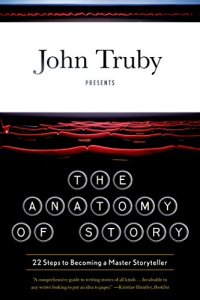
2.) The Anatomy of Story by John Truby: Like the GWW book above, this is a guide to crafting stories. However, while Writing Fiction gets into a lot of concrete details, Truby keeps a systematic emphasis on taking a flawed character through a course of events and decisions that will result in the character coming out of the story changed. Writing Fiction presents a greater diversity of views about what is important, but The Anatomy of Story offers a more cohesive approach to building one’s story.


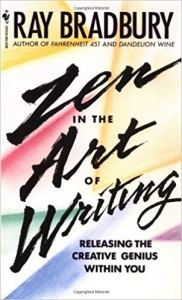
1.) Zen in the Art of Writing by Ray Bradbury: Ray Bradbury was, in my opinion, one of the best when it came to combining story-crafting and creative use of language. One gets a lot of the latter in this book. It’s not a guide in the sense that most of the books above are. It’s inspiration — explicitly, and by example.

BOOK REVIEW: Into the Woods by John Yorke

Into the Woods: A Five Act Journey Into StoryInto the Woods: A Five Act Journey Into Story by John Yorke
My rating: 5 of 5 stars

Amazon page


This is a book about story and story structure. While Yorke pokes fun at writers who have exacting structural formulae, one need not get past the subtitle to realize he’s advocating a form of structure himself: the five-act structure. And not just any old five-act structure, but Yorke proposes that there be symmetry around a third-act midpoint, and that the approach to story be fractal (to be elaborated upon below.)

The book is divided into five “acts,” or parts, but the theme of each part isn’t related to the role of that particular act in a story or play. The first act consists of five chapters that explain what makes a story. Yorke describes the three-act structure as well as five-act structure, and then explains how these forms are connected — i.e. how five acts can be overlaid, or mapped to, the three-act structure. One chapter, Chapter 4, is devoted to the crucial topic of change. After all, in a story we have a character who wants something and is put through the wringer as he / she attempts to get it, and the moral and / or psychological change that they experience as a result is a major determinant of how satisfying the story feels.

“Act II” explores the components of story – acts and scenes – and how they are arranged into a story. The first of the five chapters describes fractal structure. For those who don’t deal in mathematical concepts on a regular basis, a fractal is a shape that — if one zooms in — one finds smaller and smaller copies of the original shape. This applies to story telling in that one wants acts and scenes to follow a progression that echoes the overall story. That is, a character (at the scene level it may or may not be your hero) wants something, confronts opposition, and this clash either results in more conflict or a resolution. There’s a chapter devoted to the “inciting incident,” which is sometimes called the “first doorway,” and is an event that forces the hero to make a key decision that will put him or on the road of story.

The third “act” consists of only one chapter, Chapter 11, that is entitled “Showing and Telling.” This obviously references one of the most oft-recited (and trite) pieces of writing advice: “show, don’t tell!” As most writers soon discover, this advice is a great rule of thumb but a poor law. Hence, the need to discuss what would otherwise be a simple idea over the course of an entire chapter.

The penultimate “act” is about character, characterization, dialogue, and background. Like most books on story, the emphasis on making memorable characters is more about determining their wants, needs, and weaknesses, rather than being about figuring out how one will dress them or what accent one will assign them. Not that studying the latter isn’t worthwhile, but it’s a common error to produce a muddled character because one hasn’t given enough thought to who they are at the most fundamental level.

Chapters 15 through 17, address the subjects that are probably most responsible for poor story writing: dialogue, exposition, and subtext. The central challenge is to tell the reader just the right amount, neither letting the story get bogged down in needless information, nor leaving the reader thinking the story unbelievable because they don’t have the requisite background to understand what motivates characters. From “as you know, Bob” dialogue to Bond-villain monologuing, there are many ways to ruin a good premise by botching these story elements.

The final “act” deals mostly with the challenge of writing series. Series writing presents a huge challenge unto itself. We are all familiar with examples — such as the television show “Lost” — that started out with great promise and devolved into a pile of rubble by the end. The first three of the five chapters in the final part discuss television and series writing challenges in detail. The last couple chapters close out the book.

The book has seven appendices. Five of these are examinations of the structures of stories known for being exemplary: “Raiders of the Lost Arc,” “Hamlet,” “Being John Malkovich,” “My Zinc Bed,” and “The Godfather.” [“Being John Malkovich” may be included because Charlie Kaufman was known for strongly rejecting “formulaic” approaches to story structure, but Yorke wanted to show that structure happens organically even if it might not be purposely pursued.] The sixth appendix considers first and last act parallels. As I mentioned in the first paragraph, Yorke proposes that there is a symmetry around the midpoint that occurs in the third-act of a five-act story. The final appendix is a handy table that shows how the structures taught by masters of screenwriting (e.g. John Truby, Robert McKee, as well as Joseph Campbell’s “Hero’s Journey” [which is referenced throughout Yorke’s book]) map to five-act structure.

I found this book interesting and informative. Like other great books on story, there is extensive use of well-known stories [particularly cinematic, e.g. “Star Wars,” “The Godfather,” “Casablanca,” etc.] to help clarify the author’s points. I would recommend this book for those is interested in story, and how stories are structured to be best received by an audience. The space the book occupies is bit different from Truby’s “The Anatomy of Story” [which I reviewed recently.] While Truby’s book is the kind one would sit down with as a reference after reading it in order to help one build one’s story structure and scene weave, Yorke’s book is less of a hands-on guide and more of a light read to improve one’s ideas about story more generally.

View all my reviews

BOOK REVIEW: Second Nature by Michael Pollan

Second Nature: A Gardener's EducationSecond Nature: A Gardener’s Education by Michael Pollan
My rating: 5 of 5 stars

Amazon page


This isn’t simply a discussion of lessons of gardening, though it does tread that ground. However, Pollan uses that topic as a jumping off point to explore a couple of broader topics. First, what defines the American approach to lawns and gardens, which is clearly distinct from that of our Old-World ancestors / comrades? Second, what does it mean to say some approach is more or less “natural” in an ecosystem that has been shaped by the hand of man? As a neophyte balcony-container gardener, I was attracted to the book for its gardening lessons, but I found myself most provoked to thought by these other questions.

This book starts with an Introduction to set the stage and a first chapter that contrasts two approaches to lawn and garden that Pollan saw within his own family. The other eleven chapters are divided into seasonally themed parts. These parts – Spring, Summer, Fall, and Winter – touch upon the life of a gardener during each, respective, season.

The section entitled Spring discusses the challenge of getting plants to grow against the onslaught of competitors and consumers: animal, vegetative, and other. It also discusses mowing, the open approach to lawns found throughout America, and what the latter means for the former. (It has long intrigued me that many Americans who will pledge liberty or death, often aren’t so big on their neighbor’s liberty if said individual’s lawn gets to about four inches of shag.) Lastly, Pollan educates the reader about the gardener’s passion for compost.

The three Summer chapters explore what happens through the middle of the growing phase, including the need to weed. Though Pollan explores the criticisms from the “keep it natural” camp. There’s a lot of discussion of the ideas of Emerson and Thoreau, and how they represented a change from previous thought on the garden. However, the first chapter in this section is about Pollan’s experiences with growing roses, a provocative subject among gardeners, apparently.

Fall is harvest season, but the chapter in this section that I found most intriguing was one about planting a tree. This is where Pollan brings the question of what it means to be “natural” to a head. He discusses a nearby piece of protected forest that was decimated by a tornado. There was an ardent debate between those who thought that nothing should be done with the land and it should be allowed to grow back however nature saw fit and others who thought intervention was necessary. The argument can end up turning a position on its head. What if one does nothing and the land is overtaken by a non-indigenous invasive species?

The last section has an amusing chapter on garden catalogs and how companies’s style and emphasis varies in an attempt to corner a segment of the market.

I enjoyed this book, and would highly recommend it not just for gardeners, but for individuals who have an interest in the interplay between nature and humanity.

View all my reviews

BOOK REVIEW: How to Write a Sentence by Stanley Fish

How to Write a Sentence: And How to Read OneHow to Write a Sentence: And How to Read One by Stanley Fish
My rating: 4 of 5 stars

Amazon page


The sentence is the unit of writing at which beauty resides. So, while sentences might not be the sexiest scale of writing, it’s worth learning how to do them well. Stanley Fish offers a book which explores why we should care about the sentence and what separates the good and bad of sentences, before it moves into investigation of various types of sentences.

The first four chapters lay the groundwork by explaining what it is about sentences that make them worth mastering, and then outlines what makes a good sentence (while simultaneously explaining how truly great sentence construction might not come about through the sources and approaches that one has been led to expect.)

Chapters five through ten examine a few different classifications of sentences. Chapters five and six contrast the subordinating style with the additive style. The former sentences are hierarchically arranged, while the latter offers the freer / less ordered approach. Each of the two approaches has its advantages. The former make up many of the pithy bits of wisdom transmitted through sentence, while the latter supports a streaming consciousness style of writing (if done well.)

Chapter seven considers satire by sentence. Chapters nine and ten turn to a different classification scheme: first and last sentences, respectively. Both first and last sentences are disproportionately remembered, and each has a unique role in written works. The final chapter is about sentences that are self-reflective.

Throughout the book, Fish uses sentences – some famous and others from famous works – to offer the reader exemplars of the craft. The general approach is a good deal less technical and more reflective than most books on the subject. This makes Fish’s book both more readable, but also more contentious (in as much as a discussion of sentences can be contentious) than related works.

I’d recommend this book for writers and those interested in crafting language.

View all my reviews