POEM: Endless Fields of Green Zombies

img_2383

Trees talk.

Share sugar.

Stretch skyward.

Grow,

Compete,

Breath,

&

Eat.

Memorize weather.

Flock together.

Host birds of a feather.

Participate in pacts.

Never overreact.

House strangers.

Call out dangers.

Take things slow.

Never over grow.

But there are fields–

endless fields–

of green zombies.

Who cannot talk.

Who do not share.

Whose competitors

&

allies

are executed.

So they can fulfill a purpose

not their own.

DAILY PHOTO: Campsite Sheep-nanigans

Taken in July of 2016 in Kashmir

Taken in July of 2016 in Kashmir


img_1474 img_1503


On our Great Lakes of Kashmir trek this past summer, one night our campsite was across the creek from a maximum security sheep prison. I kid you not. At all hours of the night, beams of light would cut through our tent as roving guards made their rounds. And there was the occasional shrill whistle when the inmates would get out of line.

BOOK REVIEW: The Stationary Ark by Gerald Durrell

The Stationary ArkThe Stationary Ark by Gerald Durrell
My rating: 4 of 5 stars

Amazon page


If you’re like me, you have mixed feelings about zoos and aquaria. On the one hand, it’s an awe-inspiring experience to see the mighty, ferocious, and odd creatures that don’t make it into one’s backyard (for those who even have yards.) On the other hand, one has to wonder whether the creatures on display are as miserable as one would be in their shoes. (i.e. Figurative shoes. I do know that other animals don’t wear shoes… Except for horses… but I digress.)

In this book, Gerald Durrell examines the question of what makes for a zoo that’s good for the animals as well as for its human visitors. Most of us are sophisticated enough to realize that straight-up anthropomorphization (projecting human thought processes onto animals) isn’t a sound way to get to the bottom of an animal’s experience. Animals seem much more resilient than humans, but they aren’t infinitely tolerant. While one can’t conduct a “zoo resident satisfaction survey,” there are means by which to gain insight into the animal’s state of well-being, including: its health, its appetite, and its sex drive / reproductive success.

Durrell had the experience of opening a zoo, and was himself dismayed by what he saw at many of the zoos he visited. In some cases, they were designed for optimal viewing but didn’t give adequate consideration to the well-being of the animals. However, some zoos genuinely tried to act in the best interest of the animals, but they missed the mark by projecting human thinking onto animals–instead of examining the evidence for what conditions positively (or negatively) impact the animals’ health, appetite, and sex drive.

This short book (less than 150 pages) consists of seven chapters. The first chapter presents the challenges Durrell went through in trying to open a new and different kind of zoo. Chapters 2, 3, 4, and 6, respectively, examine the issues that must be taken into account with regards to enclosures, feeding, mating, and sick animals. Obviously, these chapters don’t cover the entirety of the subject in detail, but rather combine generalities with a few interesting (and often humorous) examples from specific species. Chapter 5 gets into the challenges of keeping records in a zoo that isn’t just about entertainment but is also focused on conservation and education. The last chapter sums up Durrell’s arguments for how Zoos can be of benefit to animal species other than humans.

There are no graphics, notations, or bibliography. It’s not that kind of book, but is rather an extended essay. It does feature both humor and insight in good measure.

I’d recommend this book for those who want to better understand what features of a zoo are good (or bad) for the animals, and how zoos might be restructured to advance their roles in conservation and education.

View all my reviews

DAILY PHOTO: Boulders


Taken in November of 2013 at Hampi

Taken in November of 2013 at Hampi

img_1008 img_0498 img_0419

POEM: Kashmiri Haiku

img_1423


mountain torn in twain

a ridge rended like a child’s

paper crafts project


the shikara slips

through inky predawn waters

a bare bulb aim point


burbling waters

ubiquitous, mountain soul

resonate to it


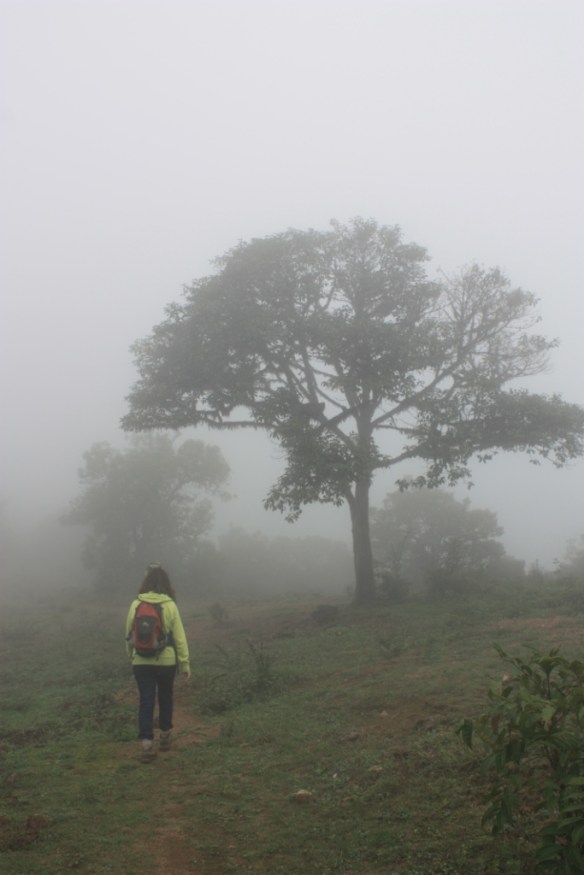
a glacier-fed lake

mirror clear until fog forms

filling the valley


foal copies its mom

grazing on neat pasture land

it’s never rushed


img_1662

POETRY: Half-a-Loaf Haiku

phnompenh-46
Half a loaf haiku
You may capture four seasons
While I have but two


In rainy season
Midnight downpours catch no cat
Out in the open


Butterfly dogfight
Jinking, dipping, and spiraling
Sketching a helix


Circling far above
Big winged hawks banking downward
Snapping up dinner


DAILY PHOTO: Black & White Butterfly… in Color

Taken in Panjim, Goa on October 9, 2016.

Taken in Panjim, Goa on October 9, 2016.

DAILY PHOTO: Sunflower in the Andes: Confused or Distracted?

Taken in Cuzco in July of 2011

Taken near Cuzco, Peru in July of 2011


Sunflowers are supposed to turn to look at the sun, but this one was looking over it’s shoulder. I wonder if it was confused or distracted?

DAILY PHOTO: Himalayan Lizard


Taken in July of 2016 on the trail between Naranag and Sonamarg

Taken in July of 2016 on the trail between Naranag and Sonamarg


This isn’t the wildlife I expected to see on our Kashmiri Great Lakes Trek, but I’ll take what I can get.

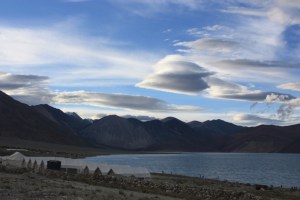
DAILY PHOTO: The Shore of Pangong Tso

Taken in August of 2016 at Pangong Tso in Ladakh

Taken in August of 2016 at Pangong Tso in Ladakh

img_2688 img_2610


With each change in cloud and sky, Pangong Tso looks like a different lake.


Pangong Tso is a long, narrow lake that crosses the border between India and China. By length, the majority of the lake falls in China, but these photos were all taken on the Indian side of the border.


It’s actually substantially higher than Lake Titicaca in Peru, which claims the title of highest navigable lake in the world. Pangong Tso is 4,350 m (14,280 ft) while Titicaca is 3810 m (12,500 ft.)


Don’t ask me what constitutes “navigable.” My wife and I tried to figure that out when we visited Titicaca several years ago. We didn’t see anything bigger than the boat we were on–nothing that would be called a ship. Of course, we saw not so much as an inner tube on Pangong Tso, and the fact that it’s so narrow in places may mean that a boat would have to have an exceedingly shallow draft to make it down the lake’s length. That is if one could travel the lake’s length without trigger happy Chinese or Indian military forces freaking out and blowing your boat out of the water.