BOOKS: “John Brown” by W.E.B. Du Bois

John BrownJohn Brown by W.E.B. Du Bois
My rating: 5 of 5 stars

Available free online at Project Gutenberg

“John Brown’s Raid on Harpers Ferry” is one of those historic events like the “Teapot Dome Scandal” that American kids have to memorize a rote fact about to regurgitate on an American History test a couple times during their scholastic lives, never to be thought of much again, forever a familiar name lacking all depth of understanding. (At least that’s how it was in my day.) Unlike the Teapot Dome Scandal, which I suspect is not learned about in detail because it was somewhat complex and boring, I think the minimalist coverage of John Brown might reflect a bit of national embarrassment. For Brown’s tale is not complicated, and it’s certainly not boring. Brown thought slavery was an abomination, and he devoted his life to freeing slaves by whatever means he could, which culminated in a raid on an arsenal at Harper’s Ferry, West Virgina, at the convergence of the Potomac and Shenandoah Rivers, a raid intended to liberate weapons to the cause of arming freed slaves and other abolitionist fighters.

It’s a shame that more is not learned about John Brown because he was such a fascinating and principled individual, and in a sense his story isn’t just an embarrassing tale of a sparse few virtuous people against a mainstream that was — at best — indifferent to slavery. But there is a potential for pride in the fact that Brown and those who fought with him were able to see slavery for what it was and to stand strong against that mainstream, to make the fight of the oppressed their fight and — in the case of Brown and others — to pay the ultimate price in the conduct of that fight.

W.E.B. Du Bois’ biography of John Brown came out in 1909 and may not be written in the novel-esque style that a writer today would write it, but it is well-written and readable. Du Bois’ book is a full biography of Brown, if focused on his abolitionist aspect. Du Bois tells a little of Brown’s backstory and of his work life and then explores his experiences fighting in Kansas. However, this book does really shine in its account of the Harpers Ferry Raid and its aftermath.

Readers interested in American History or the biographies of virtuous individuals are urged to read this account of the life of John Brown.

View all my reviews

BOOKS: “The Complete Poems of Paul Laurence Dunbar” by Paul Laurence Dunbar

The Complete Poems of Paul Laurence Dunbar (AmazonClassics Edition)The Complete Poems of Paul Laurence Dunbar by Paul Laurence Dunbar
My rating: 5 of 5 stars

Available online at Project Gutenberg

As the title suggests, this is all the published poetry of Paul Laurence Dunbar. With a career pre-dating the Harlem Renaissance, during which lyric poetry ruled the roost, Dunbar may not be as well-known today as several of the African American poets who came later, but it’s not for being any less masterful.

The collection includes a wide variety of lyric forms from simple quatrains to intermediate length poems of several pages. The content and tones also vary, and there is often a sense of whimsy in the poems that goes beyond just being lyrical in form. Dunbar wrote both in dialect and in standard English. He was a big fan of James Whitcomb Riley’s dialectal work, as a poem in Riley’s honor attests. The dialect poems are easy enough to follow and are a pleasure to read. Dunbar was by no means limited to dialectal writing; he also wrote in Standard English cleverly, and the juxtaposition of his very “proper” poems and the dialectal ones shows a great range.

I’d highly recommend this collection for poetry readers, particularly those who enjoy lyric and dialectal poems.

View all my reviews

“The Debt” by Paul Laurence Dunbar [w/ Audio]

This is the debt I pay
Just for one riotous day,
Years of regret and grief,
Sorrow without relief.

Pay it I will to the end --
Until the grave, my friend,
Gives me a true release --
Gives me the clasp of peace.

Slight was the thing I bought,
Small was the debt I thought,
Poor was the loan at best --
God! but the interest!

“The Paradox” by Paul Laurence Dunbar [w/ Audio]

I am the mother of sorrows,
I am the ender of grief;
I am the bud and the blossom,
I am the late-falling leaf.

I am thy priest and thy poet,
I am thy serf and thy king;
I cure the tears of the heartsick,
When I come near they shall sing.

White are my hands as the snowdrop;
Swart are my fingers as clay;
Dark is my frown as the midnight,
Fair is my brow as the day.

Battle and war are my minions,
Doing my will as divine;
I am the calmer of passions,
Peace is a nursling of mine.

Speak to me gently or curse me,
Seek me or fly from my sight;
I am thy fool in the morning,
Thou art my slave in the night.

Down to the grave will I take thee,
Out from the noise of the strife;
Then shalt thou see me and know me --
Death, then, no longer, but life.

Then shalt thou sing at my coming,
Kiss me with passionate breath,
Clasp me and smile to have thought me
Aught save the foeman of Death.

Come to me, brother, when weary,
Come when thy lonely heart swells;
I'll guide thy footsteps and lead thee
Down where the Dream Woman dwells.

BOOKS: “Color” by Countee Cullen

Color (AmazonClassics Edition)Color by Countee Cullen
My rating: 5 of 5 stars

Available on Project Gutenberg

This excellent collection of lyric poetry is by one of the greats of the Harlem Rennaissance. The poems include a range of forms and sizes from single quatrain epitaphs to poems of several pages, with those in between (including a number of sonnets) being most common. Like Dickinson, Cullen had a fondness for common meter (a.k.a. hymn meter,) and it is prevalent throughout. The topics include serious matters, such as race and death, but there is no lack of whimsicality within these pages.

The book is divided into four sections: “Color,” “Epitaphs,” “For Love’s Sake,” and “Varia.” The first is the most serious of tone. (Interestingly, the epitaphs and other poems on death often take a lighthearted, even humorous, tone.)

I’d highly recommend this collection for poetry readers. It’s fun to read, and the poems are skillfully crafted.

View all my reviews

“The Wise” by Countee Cullen [w/ Audio]

(For Alain Loch)

Dead men are wisest, for they know
How far the roots of flowers go,
How long a seed must rot to grow.

Dead men alone bear frost and rain
On throbless heart and heatless brain,
And feel no stir of joy or pain.

Dead men alone are satiate;
They sleep and dream and have no weight,
To curb their rest, of love or hate.

Strange, men should flee their company,
Or think me strange who long to be
Wrapped in their cool immunity.

BOOKS: “Harlem Shadows” by Claude McKay

Harlem Shadows (AmazonClassics Edition)Harlem Shadows by Claude McKay
My rating: 5 of 5 stars

Project Gutenberg

This 1922 poetry collection is wide-ranging and beautifully composed. As the title hints, this is a product of that great literary and artistic movement known as the Harlem Renaissance.

The seventy-plus poems include sonnets and various other forms of poems, mostly lyric and rarely more than a couple pages in length. Besides being varied in form, they poems are also diverse of tone — from frank invectives on race to sweet love poems. They take New York as their home and tap into the verve of the day. The collection includes many of McKay’s best-known poems including: “If We Must Die,” “America,” and “Harlem Shadows.” Though bucolic beauties such as “Spring in New Hampshire” and “The Snow-Fairy” are not to be skipped over.

I enjoyed these poems and found them powerful and lyrical.

View all my reviews

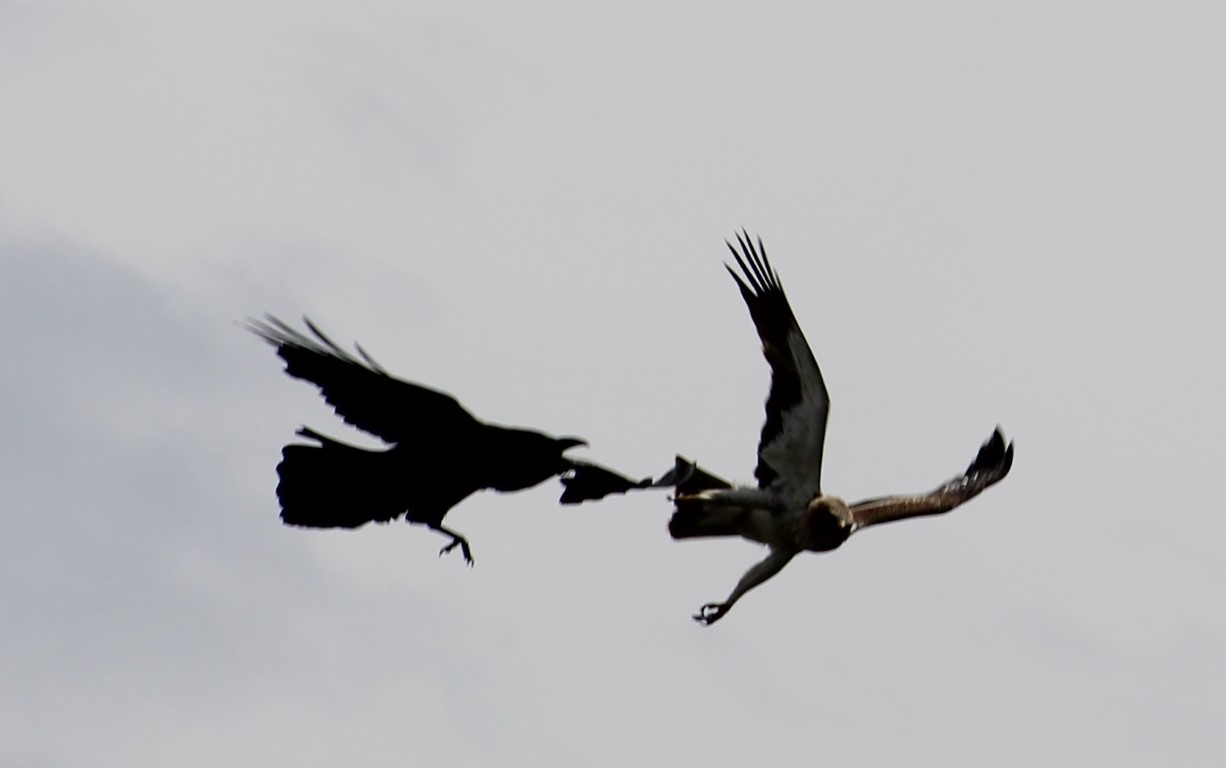
“Birds of Prey” by Claude McKay [w/ Audio]

Their shadow dims the sunshine of our day,
As they go lumbering across the sky,
Squawking in joy of feeling safe on high,
Beating their heavy wings of owlish gray.
They scare the singing birds of earth away
As, greed-impelled, they circle threateningly,
Watching the toilers with malignant eye,
From their exclusive haven -- birds of prey.
They swoop down for the spoil in certain might,
And fasten in our bleeding flesh their claws.
They beat us to surrender weak with fright,
And tugging and tearing without let or pause,
They flap their hideous wings in grim delight,
And stuff our gory hearts into their maws.

“Sympathy” by Paul Laurence Dunbar [w/ Audio]

I know what the caged bird feels, alas!
When the sun is bright on the upland slopes;
When the wind stirs soft through the springing grass,
And the river flows like a stream of glass;
When the first bird sings and the first bud opes,
And the faint perfume from its chalice steals --
I know what the caged bird feels!

I know why the caged bird beats his wing
Till its blood is red on the cruel bars;
For he must fly back to his perch and cling
When he fain would be on the bough a-swing;
And a pain still throbs in the old, old scars
And they pulse again with a keener sting --
I know why he beats his wing!

I know why the caged bird sings, ah me,
When his wing is bruised and his bosom sore, --
When he beats his bars and he would be free;
It is not a carol of joy or glee,
But a prayer that he sends from his heart's deep core,
But a plea, that upward to Heaven he flings --
I know why the caged bird sings!

“Retort” by Paul Laurence Dunbar [w/ Audio]

"Thou art a fool," said my head to my heart,
"Indeed, the greatest of fools thou art,
To be led astray by the trick of a tress,
By a smiling face or a ribbon smart;"
And my heart was in sore distress.
Then Phyllis came by, and her face was fair,
The light gleamed soft on her raven hair;
And her lips were blooming a rosy red.
Then my heart spoke out with a right bold air:
"Thou art worse than a fool, O head!"