BOOK REVIEW: Acid Dreams by Martin A. Lee & Bruce Shlain

Acid Dreams: The CIA, LSD and the Sixties RebellionAcid Dreams: The CIA, LSD and the Sixties Rebellion by Martin A. Lee
My rating: 5 of 5 stars

Amazon page


This is a microhistory of America’s interaction with LSD. LSD, commonly called “acid” from its full name Lysergic acid diethylamide, is a chemical substance that was originally derived from ergot fungus, and which causes distortion of perception, an altered state of consciousness, and – in some cases – hallucinations. When I say it’s American history, that’s an oversimplification because many of the events described happen overseas (e.g. LSD’s own story begins in Switzerland with chemist, Albert Hofmann, after all,) but most of the central players are American and the book’s two primary lines of investigation are both centered on America. One of these lines involves the covert research program designed to discover if acid could be used as a truth serum, a mind-control agent, an incapacitant, or otherwise to the benefit of the Central Intelligence Agency (CIA) and other covert agencies. The other line is about the role that LSD played in the countercultural revolution of the 60’s and early 70’s.

The book’s flow begins more heavily focused on the covert programs, then gets into what was happening with the youth in the 60’s, and toward the end discusses where the proceeding lines seem to run together with individuals like Ronald Stark who was a drug smuggler involved with an organization called the “Brotherhood for Eternal Love” but who many suspected of having ties with (if not direct employment by) the CIA – and not entirely without reason (though not with sufficient evidence that firm conclusions are drawn in the book.) I should mention that this just the general flow. The book has a chronological flow with topical segments within, so it’s not like it deals with these issues entirely independently.

If the covert research program had been carried out by competent scientists using accepted methodologies, then the discussion of these programs would probably be at best moderately interesting. (To be fair, some competent science may have occurred, but it’s so unnoteworthy compared to the wild and pranksterish that it draws no attention.) What the reader learns, however, is fascinating because it involves clean-cut and seemingly respectable g-men spiking unwitting subjects with acid like a teenage prankster-idiot might do – but without the “excuse” of being immature, stoned, and having not yet learned to behave responsibly. Perhaps the most bizarre program was Operation Midnight Climax, in which CIA agents hired prostitutes in San Francisco to spike the drinks of their johns so they could find out if the customers got loose-lipped. A CIA agent would watch on, dutifully making pipe-cleaner twists of the various sexual positions performed by the sex-worker and her customer.

The civilian history follows a path from Hofmann’s discovery at Sandoz Laboratories (now owned by Novartis) through the early years of Al Hubbard (the so-called “Johnny Appleseed of LSD”) through the trials of Timothy Leary to others who figured in the heyday of LSD such as Ken Kesey and his Merry Pranksters, and, finally, to the crackdown on psychedelics and the illicit smuggling rings that resulted. There is fascinating coverage of how Federal law enforcement tried to stifle production and smuggling of LSD, particularly with respect to training agents to infiltrate hippie organizations.

This book originally came out in the 80’s (though I read the 2007 edition) and while it has a post-script that discuss a bit of a resurgence that occurred beyond the 70’s, it doesn’t touch upon a more recent thaw in attitudes toward psychedelics as they’ve begun to be legalized (or sought out where they are legal) or the surge in popularity of “micro-dosing.” As of this book’s end all psychedelics remained Schedule I – a label which states that they have no legitimate medicinal value (which cooler heads have realized is blatantly wrong given substantial evidence that psychedelics can be of benefit in conquering addiction, in managing depression, and otherwise.)

I found this book intriguing. It’s a must-read if you are interested in any of the following topics: the 60’s counter-culture revolution, mind-control programs, or how public policy gets hijacked by history.

View all my reviews

BOOK REVIEW: Carl Lutz (1895-1975) by György Vámos


Carl Lutz by György Vámos
My rating: 5 of 5 stars

Amazon page (only the French edition is currently showing)


Carl Lutz was a Swiss diplomat assigned to Budapest in 1944, at the time the Nazis and their Arrow Cross comrades were trying to deport the Budapest Jewry to death camps. Lutz may not be as well know as his Swedish counterpart, Raoul Wallenberg, but that’s not for lack of saving lives. Like Wallenberg, he saved thousands of Jews by issuing protective documentation, and by fudging numbers and background documents where necessary to keep more people safe.

Lutz also oversaw a facility where the people issued these documents were allowed to stay to keep them out of the city ghetto from which they might get caught up in deportations. The Swiss-flagged facility was called the “Glass House” because it was on the grounds of a factory where specialty glass had been made, and the building’s façade was covered in multiple styles of glass as a way for perspective customers to see what products were available. Unfortunately, the property wasn’t designed for residential use, let alone for providing facilities for large numbers of people. Quarters were cramped and hygienic facilities were inadequate. However, the facility did keep people alive, even though it was raided by the Arrow Cross. [For those visiting Budapest, a small museum / memorial room can still be found at this same location, and this book’s author can offer more insight.]

The book is written in a scholarly style, i.e. employing a historian’s tone. It largely follows a chronological format. The book doesn’t discuss Lutz’s life much outside the war years, but it does give the reader background about Hungary’s anti-Semitic laws and actions as well as an overview of strategic-level events. [Hungary was allied with Germany in the Second World War, but in 1944 tried to separate itself and stop deportations. This resulted in Germany taking control and handing power to the Arrow Cross Militia, which was the Hungarian fascist party — akin to the German Nazis.]

The book is concise, weighing in at only 125 pages — about 17 of which are in an appendix of documents and photos regarding Swiss efforts to undermine the Nazi’s Holocaust.

As I said, the book is written in a scholarly / historical format, rather than the more visceral narrative approach of a journalistic or popular work. Still, it does become more intense reading in the latter half — when the author is describing events concerning the Glass House, Lutz’s issuance of protective documentation, and the siege of Budapest by the Russians at the end of the war. It will certainly give readers insight into a little-known rescue effort during the Holocaust.

If you’re interested in international efforts to thwart the Nazi’s plan to exterminate the Jews, this book will clue you in on events that aren’t well-known – particularly by English readers. I highly recommend this book.

View all my reviews

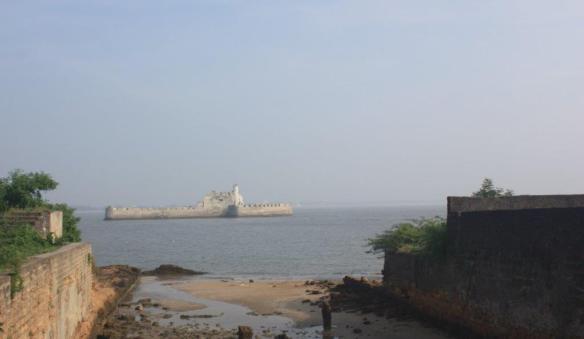
DAILY PHOTO: Views of Pani Kotha

Taken on November 30, 2019 in Diu


Pani Kotha (a.k.a. Water Fort, Fortim do Mar, and Alfiston Jail) is a Portugese prison positioned off-shore from the Diu Fort — between Diu island and the Ghoghola peninsula. The ship-shaped structure held prisoners — at least those that weren’t good swimmers.

BOOK REVIEW: Chloroform by Linda Stratmann

Chloroform: The Quest for OblivionChloroform: The Quest for Oblivion by Linda Stratmann
My rating: 4 of 5 stars

Amazon page


Stratmann’s book tells the story of the rise, fall, and debauchment of the anesthetic known as chloroform. As such, most of the book — particularly in the first half — is a medical history that offers detailed discussion of the debates that went on between doctors as to whether chloroform was the best form of anesthesia available, or whether an alternative approach was superior. (Contenders include: ether, nitrous oxide, or the old-fashioned approach of no anesthesia whatsoever.) The book also discusses a number of cases in which chloroform was used in the commission of a crime, or was speculated to have been. On the topic of vice, the use of chloroform as a recreational drug is also described. For those who aren’t medical historians, the explorations of chloroform in crime, vice, and licentiousness are where the book gets intriguing, and they tend to take place in the latter half of the book. [That makes sense from a chronological perspective as it took some time before laypeople became aware of the range of uses of this substance.]

The book is well-written and follows the intrigue. That said, it’s definitely a niche work. I came at it from the strange direction of one who is interested in consciousness (and, by extension, how it is lost.) This book could appeal to those interested in the history of medicine, true crime, or recreational drugs, but, regardless, it’s a niche within those niche fields.

The book has graphics, annotations, a bibliography, and even an appendix that describes the chemistry of chloroform. It comes with all the bells-and-whistles one might expect of a scholarly book, but tells a story skillfully. The author is neither a journalist nor a scientist, but she seems to have done an extremely thorough job of research.

If you only read one book on the history of chloroform this year, make it this one. [Disclaimer: As far as I know, this is the only history of chloroform, and it’s certainly the only one that I’ve read to date.]

View all my reviews

5 Historical Figures You May Not Realize Were Super-Freaky

5.) Jean-Jacques Rousseau: This French philosopher is probably best known for his ideas about social contract in governance. At least that’s what I knew him for when I was a student of the social sciences.

Unlike the Marquis de Sade, whose philosophy and sexual proclivities were intimately intertwined, one wouldn’t necessarily guess that Rousseau was a masochist into getting spanked by dominant women from his political theories. Although, all interest in governance is about who holds the whip and what the whipee gets in exchange for being subjected to it — figuratively speaking, of course.


4.) Peggy Guggenheim:  This  heiress  to  an  

artistic empire had a legendary libido — and not just in her youth. What interests people is not so much that she was sexually promiscuous, but that age didn’t seem to curb her desire for sexual conquest.

Even though her memoir is filled with discussion of her sexual dalliances, she is still more well known for discovering important 20th century artists and saving art from thieving Nazis.


3.) Wolfgang Amadeus Mozart: One of the all-time greatest musical minds, his genius for composition may have helped to keep him from being known for his scatological obsession.

This may seem far-fetched (not to mention grosser than the other proclivities discussed herein) but there’s even a Wikipedia page about it — so it must be true.

I knew from discussion of the movie “Amadeus” (which I, sadly, haven’t seen) that there was something unexpectedly scandalous about Mozart, but I never would have guess this was it.


2.) King Edward VII: It may be well-established that King Edward had some wild times, but the fact that he had custom sex furniture made tells you just how all-consuming his passions were.


1.) H.G. Wells:  The author of “War of the Worlds,” “The Island of Doctor Moreau,” and “The Time Machine,” Wells was all for free love, long before there was a free love movement. He is said to have had sex atop bad reviews. While I knew him as an early sci-fi author who famously predicted the atomic bomb (Physicist, Leo Szilard, cited Wells’ “The World Set Free” as an inspiration), he was — unknown to me — legendarily promiscuous.

POEM: A Mile of Murder

On a moonlit midnight —
between the bands of rain —
stretched a mile of murder.

Marched through the night
to keep day roads clear for troops,
Fascists sought to free themselves
of the ugly evidence of their crimes.

But sweeping the weary and woebegone
under the rug is not a rapid task,
and so a mile of murder
mass migrated towards the morn.

BOOK REVIEW: The Ocean of Churn by Sanjeev Sanyal

The Ocean of Churn: How the Indian Ocean Shaped Human HistoryThe Ocean of Churn: How the Indian Ocean Shaped Human History by Sanjeev Sanyal
My rating: 4 of 5 stars

Amazon page


This is a geographic and historical overview of the Indian Ocean from the geological processes that created it to the wave of independence movements that took hold in the wake of the Second World War. The author’s approach is to emphasize the interaction between – rather than within – the various nations of this region. [Though, India in particular, gets a great deal of space devoted to internal happenings. However, given its central location (trading to both the east and the west,) its size, and its cultural influence on the region, it’s not necessarily the case that this is an unfair bias.]

I was happy to find a book that seemed to be just what I was looking for. Having lived in India for more than five years, I’ve often been struck by the intriguing evidence of interconnectedness that I didn’t have the historical background to understand. From a discussion with a Nairobi cab driver who had no idea that chapati (a flat bread common in South Asia, but eaten as far afield as the Caribbean) was anything other than an indigenous Kenyan culinary invention to the fact that Tamil is one of the official languages of Singapore, I’ve often found myself curious about how these connections came to be. This book didn’t disappoint. Sanyal delves right into the fascinating fun facts without getting too bogged down in the who married whom and who fought whom that quickly becomes the tediousness contributing to a lack of enthusiasm for the subject of History among school children. (That said, there is – probably necessarily – some of the stuff that students are forced to memorize, here and there.)

The approach of the book, after an introductory chapter that gives the reader a contextual introduction to the region, is to proceed chronologically. This means the book starts out more geology, geography, and anthropology and gradually becomes more of a history. In the later half of the book, this history is particularly an economic history focused on the products whose trade drove interaction in the region – be it for conflict or for cooperation. Trade is important throughout the region’s history, but we also see a lot the spread of culture earlier, especially the spread of religion. From the spice that was much coveted in Europe to the opium that the British East India Company used to balance its trade with China (resulting in the Opium Wars,) this trade has had a profound impact on the world in which we live.

There are many graphics throughout the book, primarily maps. These are extremely beneficial. The book is annotated with end-notes that provide sources and elaborations.

I found this book to be both interesting and entertaining. The author throws in a one-liner joke now and again, but what I really found humorous were the fictions that were widely believed back in the day. Most of these resulted from merchants telling tall tales to make asking prices more palatable. It’s harder to scoff the price of a diamond if one thinks they were guarded over by gigantic snakes and the only way to get them was to throw meat into a canyon so that Eagles (the only things that could out move the snakes) might snatch up a diamond with its steak. It is also fascinating to learn how the same stories were heard from different sources, suggesting that false information behaving like an infection isn’t new to the internet age.

If I had one criticism of the book, it would be that in the final chapters the author leaves behind the historical objectivity that seems prevalent throughout most of the book. Instead of presenting the information and letting the reader make up their own mind about such events as Subhas Chandra Bose’s (Netaji’s) courting of the Nazis during the Second World War, Sanyal shapes the information he feeds to readers to persuade rather than to inform. I didn’t notice this in earlier parts of the book and suspect it was just easier to be dispassionate about the distant past.

All-in-all, I’d recommend this book for anyone wanting to learn more about history and trade across the Indian Ocean. I learned a great deal, and found the book readable and intriguing.

View all my reviews

BOOK REVIEW: The Tattooist of Auschwitz by Heather Morris

The Tattooist of AuschwitzThe Tattooist of Auschwitz by Heather Morris
My rating: 5 of 5 stars

Amazon page


At its core, this is a love story set in the most unlikely of places, the Auschwitz Concentration Camp – which was in reality an extermination camp where Jews and others were executed as part of the Nazi Final Solution. Lale, the lead character, owing to his skill with languages and his survival instincts, was a prisoner chosen to be the assistant tattooist and in short order the tattooist’s replacement. As tattooist, Lale was responsible for writing numbers indelibly on the arms of the adult prisoners coming to the Auschwitz and Birkenau camps. This position offered him an unusual freedom of movement that allowed him to carry on a secretive relationship with one of the young women that he’d tattoo’d and become instantly smitten with. It also allowed him to carry out a small-scale relief mission in which he purchased food and medicine from a couple of sympathetic Poles. Still, this covert charitable work didn’t erase his guilt of believing he was participating in the atrocity by way of the tattoo-branding of his fellow prisoners. In a place where everyday was a test of survival, it goes without saying that both his love affair and his covert purchases created a heightened risk of being killed. The tension is perpetually high as one never knows whether Lale or those dear to him will survive from one scene to the next.

It’s testament to how tight and engaging the narrative arc is that I was under the impression that it was completely fictitious until I got to the back matter – which included an epilogue, an afterword, and a photo section that clarified that the book was based on interviews with the real-life tattooist, Lale Sokolov. The book is presented as a novel, and that’s how it reads throughout, but it’s in some measure a memoir. It’s hard to know how much is fictitious, but it seems reasonable to suspect that the author took some liberties – otherwise it would presumably have been presented as a history / biography.

I found this to be one of the most intense and gripping books I’ve read this year, and I’d highly recommend it for all readers.

View all my reviews

BOOK REVIEW: Anarcha Speaks by Dominique Christina

Anarcha Speaks: A History in PoemsAnarcha Speaks: A History in Poems by Dominique Christina
My rating: 5 of 5 stars

Amazon page


This collection of poems, written by Dominique Christina and selected / arranged into a story by Tyehimba Jess, tells the story of a slave woman who was used for medical experimentation. Most of the poems are in the voice of this woman, Anarcha, and are conveyed in a slave dialect. However, a few are from the perspective of Dr. Marion Sims, the doctor who used Anarcha (and other slave women) for research and experimental procedures. Even without the cues in the poem titles, it’s easy to tell when these switches in voice occur because the doctor’s poems are in “proper” English, as opposed to Anarcha’s dialect. I should point out, while I can’t tell you how accurate the slave dialect is, I can say it presents no challenge to the reader’s understanding of the story or of the imagery or metaphor of the poetry.

The events described in these poems are based on a true story. Anarcha developed a fistula (a hole in bodily tissues that’s not supposed to be there) as a complication of carrying a child, and as a result suffered persistent bleeding. Anarcha’s owner handed her over to Dr. Sims to repair the fistula and stop the bleeding, which would require the development of a new procedure. Sims is often called the father of modern gynaecology, and was lauded with statues and honors. However, in recent years, his image has been tarnished by the fact that many of his advancements were only possible through the non-consensual examination of, and experimentation upon, slave women.

I should point out that, while reading this book has made me interested in learning more about the details of the story, I can’t really comment on the degree to which the poems accurately convey history. From the little I was able to garner from quick internet research, there are wide-ranging views on Dr. Sims and his research. Some think Sims belongs in Josef Mengele’s corner of hell. (Note for non-history buffs: Mengele is the Nazi doctor who experimented on Jews and other prisoners during the Second World War.) Others believe Sims was genuinely working to heal the slave women and wasn’t solely motivated to find a treatment for paying patients, and that — in the context of his times — he should be considered a fine, if fallible, doctor. I don’t know how much is know about what was in Sim’s mind or how it matched his behavior, but at a minimum he seems to have been much less delicate with his slave subjects than he would have been with his patients in terms of subjecting them to pain and humiliation.

I will say that the poems in Anarcha’s voice feel authentic, i.e. they feel like they convey truth about what would go through a person’s mind when put in her position. Her humanity is felt. In a few cases in the Dr. Sims poems, that authenticity feels like it breaks down, and one thinks, “no one sees themselves that way” – an instance of self-deification springs to mind. That said, perhaps it’s an accurate depiction. More than one doctor has been known to be colossally narcissistic on occasion.

That said, this is a poetical work and not a historical account, and so the beautiful language, clever metaphors, and emotional resonance of the work are what serve to make it a book that should be read. I would highly recommend this book for all readers. Even if you aren’t typically a poetry reader, you’ll find this free verse collection readable because of its story and the insightful view into the mind of Anarcha it presents.

View all my reviews

BOOK REVIEW: Raoul Wallenberg by Ingrid Carlberg

Raoul Wallenberg: The BiographyRaoul Wallenberg: The Biography by Ingrid Carlberg
My rating: 5 of 5 stars

Amazon page


This is the most recent of the many biographies of Raoul Wallenberg. Wallenberg was a Swedish diplomat during the Second World War who is credited with saving thousands of lives. He was posted to Budapest with an assignment of issuing protective passports to Hungarian Jews. Hungary was a last bastion of Judaism among Nazi controlled / allied countries, but in the summer of 1944 they began mass deportation to the death camps in Poland. Protective passports from the neutral country of Sweden staved off deportation for many.

As dangerous as Wallenberg’s life was during his assignment to Budapest when he was constantly at odds with the Arrow Cross Militia (the Hungarian fascist party) and the Nazis who put them in power, the most intriguing part of Wallenberg’s life story may be his disappearance. In January of 1945, as he was seeking contact with the commander of the Red Army in Hungary to facilitate a post-War reconstruction of Budapest, he was arrested by the Soviets and surreptitiously moved to Lubyanka Prison in Moscow. The Soviets denied having Wallenberg, but facing overwhelming evidence from released prisoners who came into contact with Wallenberg in Lubyanka and Lefortovo prisons eventually made the Soviets recant. In the 1950’s they admitted they’d had him while making the suspect claim that he’d died of natural causes in 1947. There remains a great deal of mystery surrounding the case. Why they arrested Wallenberg in the first place? Why didn’t they release or exchange him like other foreign diplomats they had in custody. If they executed him – why’d they do it and why’d they do it when they did it. [There were claims by prisoners stating that they’d met Wallenberg in Gulag camps in the 1960’s and even into the 70’s (though the latter claims are more suspect.)]

In a bold move, this book is written in the old school style, which is to say chronologically. This may not seem odd for those who’ve been reading biographies and autobiographies for a long time. It’s how historians always used to write their books, and it certainly seems like a logical arrangement for the telling of historical events. However, the mode today is to start in media res, or in the middle of the exciting bits, and to sprinkle in only what is absolutely necessary of backstory as one goes along. Because of a combination of intense competition for one’s reading time and what seems like the diminished attention span of today’s average reader, it’s really quite brave for Carlberg to start with 150+ pages discussing: Wallenberg’s parents and grandparents, his days in America as an architecture student studying a form of building design that would be considered virtually useless when he returned to Sweden, and his attempts to get started in business in the years between his return to Sweden and his entry into the diplomatic corps. That said, this first of the three parts that make up the book is well done and more interesting than one might expect. It doesn’t suffer from the painful dryness that is so common when one discusses ancestors and the subject’s childhood. It’s not just that Carlberg keeps an eye on what data might be useful for the reader later in the book. In fact, I’d say that what makes the first part interesting isn’t that it shows us how Wallenberg’s youth forged him into an inevitable hero. Rather, it’s that we come away with a picture of a somewhat shiftless kid from the least wealthy limb of a family tree of a rich family. It’s not that he was born to be a hero that makes his background fascinating; it’s that he was in many ways an ordinary fellow whose decisions at critical moments made him a hero.

As mentioned, the book’s 23 chapters are divided into three parts. The first part, as described, is Wallenberg’s background. The second part explores his actions while posted to Budapest. This is when he had to deal with the likes of Adolf Eichmann and – at the very end – rogue elements of the Arrow Cross Militia who were engaged in killing sprees. The third part covers the period of Wallenberg’s arrest and disappearance at the hands of the Soviet Union. Many of the popular biographies of Wallenberg were written in the 1980’s, during a period of reawakened interest in his fate but when the Soviets were just beginning to loosen up, and so this version does contain a little bit of new information that came out during the Glasnost years and subsequently.

The book has a substantial group of black and white pictures of relevant people and documents. There are also modern-day descriptions of the author’s visits to various key places in Wallenberg’s story including various offices and residences, as well as Lefortovo prison. These are short (a few pages at most) and are interspersed with the chapters around which that locale was relevant. Some of them involved talking with people who had insight into Wallenberg’s life and other places are occupied by individuals with little to no knowledge of Wallenberg. There is a detailed accounting of sources, including both a bibliography and lists of interviewed individuals and unpublished sources.

I found this book fascinating. I will admit that I didn’t get hooked right away. While there was enough in part one to keep me interested, the book doesn’t become truly gripping until the second and third parts. In part three, it becomes genuinely hard to put down.

That said, if one is hoping for a work that resolves all questions, that work doesn’t yet exist, and it’s less and less likely that it ever will given the way the Soviets purged Wallenberg from documentation (very few references were found during the Glasnost era investigation) and apparently cremated his body. Few people remain alive who were involved and their memories are adversely effected by time. Still, Carlberg offers excellent insight into what went wrong on the Swedish side that may have contributed to Wallenberg’s demise. The Swedish diplomat jumped to conclusions that probably hurt Wallenberg’s survival odds. There are a few brief scenes in the book that are visceral, and one of these involves the degree to which that one diplomat was haunted by his missteps in the case. (Another involves a cudgel-wielding former KGB-interrogator who threatened Wallenberg’s step-brother when the relative tried to visit to find out more. If the sparse documentation is to be believed, the retired KGB man may have been the last person to speak with Wallenberg. But the man clearly wanted to put that behind him.)

There were just a couple of questions that I wish had been addressed by the book that weren’t. Carlberg is keen to point out that it appeared that the Soviets were hinting that a teen-aged Baltic refugee, Lydia Makarova, could be a possible exchange for Wallenberg. (The Swedish diplomats were too dense to get this at first because one had concluded Wallenberg died in Hungary and another – higher up — didn’t believe in quid pro quo life trades.) I can see how this Lydia Makarova wasn’t really relevant to Wallenberg’s story. She was just an extremely high value subject, but I couldn’t help but wonder why they would want a teen-aged girl so badly that they’d have been willing to take the public relations nightmare of admitting they abducted a diplomat regarded as an international hero. With the book weighing in at over 600 pages, I can see why there was reticent to investigate this further just to scratch an itch of curiosity, but still the itch remains.

I’d highly recommend this book. I’ve read other books on Wallenberg, and believe that this book offered substantial value added – particularly regarding the investigation of Wallenberg’s disappearance.

View all my reviews