Amazon.in Page
The Eternals is one of the lesser-known superhero groups, a collection of immortal, god-tier heroes who protect the Earth from a specific set of enemies (Deviants) and serve a specific master (Celestials.) [The Eternals are a little better known now, given Marvel’s “every hero, everywhere, all at once” strategy led them to make a movie based on the team, and — like many products of that phase — it was not loved.] I am usually not a big fan of god-powered comic book characters because it’s an uphill battle to make them interesting. However, I am a big fan of the story-crafting of Neil Gaiman, and this story had the promise of the heroes not knowing they were heroes, at least through the early part of the book.
I found the story to be coherent, despite its outlandishness, and I was a fan of having the heroes living under the impression they are ordinary people. I think that device created fine conditions for tension and intrigue. Still, the volume does not read with the visceral intensity one would expect of a story with stakes as high as they are stated to be. There was some distance created by a lack of intense connection to the characters and the clunkiness of the premise.
If you’re looking for stories of a hero team stranger than the Avengers, but not as strange as Guardians of the Galaxy, this may be your cup of tea.
Amazon.in Page
I read this book as travel literature for a trip to Azerbaijan and was pleased that it both met my needs as travel literature (i.e. offering insight into the local culture(s),) and it turned out to be an engrossing story, as well. You may have caught that “turned out to be.” It’s true that the first one-third to half of the book is a slow-burn on the story front. Through those early chapters, the book is the character-driven, plotless novel one frequently sees among literary fiction. Don’t get me wrong, it is still interestingly written and engaging (if you’re a literary fiction reader,) and it definitely met my needs for travel literature. But just as I’d resigned myself to this character-driven literary fiction formulation, it shifted into being a compelling and even action-packed story.
This is a tale of star-crossed lovers but set in the Caucuses in the WWI era (i.e. the time of the Armenian Genocide, when the Ottoman Empire was in its violent death throes.) Unlike Romeo and Juliet, in which the lovers came from feuding clans that were culturally quite similar, cultural divergence is the crux of the matter for Ali and Nino. While the families of the two kids get along fine enough, Nino is from an aristocratic Georgian family of progressive Western (and Christian) proclivities. The protagonist, Ali, is also from an upper-crust family, but they are of a much more conservative Muslim bent. While Ali, himself, is an educated and moderate personality and somewhat of a bridge between the old world Persian mindset of his family and the liberal European one in which he was educated, he has friends and family that it would not be unfair to call fanatics. So, while the families bless the union, it is ill-fated because the worldviews of Ali and Nino make it so there is no place they can both be happy living, except a Baku that is being contested by the Ottoman Empire and a Russia in the midst of its own transmutation. In Persia, Nino is a soulless possession who is not allowed to interact with anyone but Ali, eunuch and female servants, and her own family when they visit. On the other hand, Ali can’t bear to go to Europe or America, where he’d be so far out of his element. So, they are stuck with a Baku besieged by multiple entities.
The writer made a couple of unconventional but clever choices that I found to be brilliant. I’d highly recommend this book for readers of literary fiction and / or historical fiction.
Amazon.in Page
This is your basic “race to acquire the components of a multi-part MacGuffin” story line. There is a magic compass that John Constantine is eager to keep out of the hands of a shadowy organization of powerful magicians. Why do we care? First of all, because this is a vaguely but extremely powerful artifact that can rain utter destruction on the world in some ill-defined way. Secondly, because Constantine is just such an intriguing character. Mostly the latter, because the former is ill-defined and doesn’t merit much emotional traction.
That’s mostly what the story is about, but there are various seemingly haphazard story elements (probably too many for the first volume in a series.) This being marketed as a “Volume One” is where much of the book’s problems lie. We pick up pretty much in medias res and when an event occurs that we’re supposed to care about enough to want to see a resolution late in the volume, it’s really hard to care about because it’s been raced through. If you are picking this up after reading the previous series, it’s undoubtedly much more satisfying as a story. Picking up the story with this “Volume 1” is a bit chaotic and lacking in emotional resonance.
That said, John Constantine is one of the most interesting characters in comics and he’s written and drawn well in this book. (Not to mention supporting characters like Papa Midnight.) The story is fast-paced and the broad brushstrokes of it are comprehensible.
If you’ve read the previous Hellblazer / Constantine works, you’ll probably enjoy this volume. Taking it on as a standalone may leave one a bit befuddled.
Amazon.in Page
On one level, the more superficial level, this is a superhero fantasy featuring a Vanara (a supernatural monkey-man creature from Indian mythology,) on another level it’s a political satire that riffs on the geopolitics and the military-industrial complex of India. It’s cleverer as the latter than the former.
The story has some clunkiness, including the occasional hard to follow description and sloppy story elements (e.g. the deus ex machina.) That said, it’s pop genre fiction and with regards sloppy story elements they’re par for the course in superhero fiction. My point being that the fact that it’s amusing and mostly readable means it hits its target, strained credulity and logical inconsistencies aside.
The humor is of the broadest range with occasional laugh-out-loud hilarity, lots of mildly amusing jokes, and a few groan-worthy lines that go down like a lead-balloon. That’s not a terrible ratio for a novel.
If you want to check out a book featuring an Indian mythology-based superhero, and you don’t mind a lot of jokes directed at political and national security apparatus leadership, this book is worth looking into.
Amazon.in Page
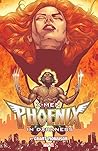
This volume consists of two different story arcs that are thinly tethered by the character of Jean Grey / Phoenix. The first arc features an elaborate plot by Erik Lehnsherr / Magneto to clear the playing field of major opposition so that he can carry out his plans for world domination / the end of homo sapiens. The second arc is set in a futuristic dystopia and its villain is a dark and twisted variant of Hank McCoy / Beast who sets himself up to control the power of the gene. Interestingly, while Jean Grey / Phoenix plays important roles in both arcs, the stories are by no means centered on her. This keeps the stories from just playing out the will of a ridiculously overpowered character, and instead uses the fact that Phoenix is a threat everlasting, one that can never be allowed to get out of one’s sight.
The volume can be a bit chaotic, with the various time jumps and rather large cast of characters, but I felt it wasn’t too hard to follow the story — even given a bit of Grant Morrison trippiness.
If you’re interested in the X-men, this volume is worth looking into.
Amazon.in page
This New 52 spinoff takes the Batman mythos out of Gotham and into the Democratic Republic of Congo. Batman, himself, plays largely a supporting role as mentor and equipment provider to David Zavimbe, a.k.a. Batwing. The book is careful to avoid having Batman play the role of rescuer, but instead, when Batwing and Batman fight together they do so largely as peers.
I’ve got to say that the name had me worried. It’s like a mashup of “Batman” and “Nightwing” and seems lazy and uninspired in a way that I feared might infect the comic. However, character building is a strength in this volume. David Zavimbe is a former child soldier in the Congo, particularly gifted in killing — though tormented by it, torment that reflects itself in PTSD.
While Batwing’s abilities paired with Bruce Wayne’s technology makes the Congolese superhero a force to be reckoned with, Batwing meets his match in a mysterious villain who calls himself “Massacre.” This six-issue volume focuses on the on-going battle between Batwing and Massacre, as the former tries to disrupt the latter’s killing spree.
This arc is stimulating in that it deals heavily in the complex realities of war-torn Africa. There is the issue of redemption, and whether it is even possible for someone who has been a cold-blooded killer. But the story also generates ambiguity about who is right, and even whether “right” is meaningful in a context where everyone has blood on his hands.
I enjoyed reading this book and would recommend it for all comic book readers, especially those who like either Batman, Black Panther, or both.
Amazon.in Page Killing Time is a MacGuffin driven Batman story, though less Batman-centric than most of his eponymous titles. For any readers who might be unfamiliar with the term “MacGuffin,” it’s an object that motivates the characters to heroic and villainous extremes of behavior for reasons about which the reader is largely (or completely) left in the dark. Over the course of the story, the reader is teased information about the MacGuffin, but never with enough certainty or detail that it ever feels like it’s not a MacGuffin. On the other hand, it does feel as though there is self-awareness of the MacGuffin-esque nature of the story, and there are some strengths that I think more than offset what might otherwise be considered the laziest of storytelling.
What are these strengths of which I write? First of all, there is a disjointed, non-linear story presentation that facilitates revelations and maintenance of tension, but it is done artfully enough that one isn’t likely to lose the thread. Second, there are some intriguing characters (and some fascinating character development) in the story. Much of the story revolves around an uneasy alliance between Catwoman and the Riddler, and that is explored in detail. There is also a character known only as “the Help” who is both brought to life in a compelling way, but who also generates tension because he’s every bit a match for Batman in a slug-fest. Thirdly, while the book of epic proportions in some sense, with street criminal melees and the like, it’s quite street-level throughout, not veering into magic or god-tier superpowers. Finally, it is a complete and satisfying story arc. [My biggest pet peeve with comic volumes is that they often don’t feel concluded.]
I enjoyed reading this comic book. It’s fast-paced and isn’t afraid to give supporting characters some space to steal the show. If you’re a Batman fan, it’s definitely worth reading.
Amazon.in Page
It’s the zombie apocalypse in a world brimming with superheroes. Sort of. As is mentioned a couple of times throughout the story, it’s not really zombies as we know them, and there are a few crucial distinctions. But, basically, zombie apocalypse. What matters is that it is a threat that grows to inexorable proportions because it infects efficiently and spreads rapidly, and no one is immune. The threat is increasingly everyone and everywhere. The source is a viral bit of “programming” called the Anti-Life Equation.
This is about as dark as superhero comics get. The heroes that we are used to saving the day experience only victories of a short-lived and pyrrhic nature, while experiencing defeat after defeat. There are no ex machina saviors, at least not that amount to more than a blip in the scheme of things.
I found this story, depressing as it may be, to be intensely suspenseful. Full Disclosure: I also liked the Avengers “Infinity War” movie much more than “Endgame.” It’s not that I necessarily like seeing villains win, but that a story feels more compelling when there is strong and successful opposition and when costs accrue. And credible opposition and true stakes are often missing from superhero comic book stories.
I’d recommend this book for superhero comic book readers.
Amazon.in Page
This volume presents two separate and complete story arcs. The first features the Floronic Man (Jason Woodrue) as the main villain, and it deals heavily in the origins of Swamp Thing and the creature’s struggles to come to grips with who it is and why it experiences the world as it does. The second story makes a shift to a more supernatural threat and shows a Swamp Thing who is more comfortable in its… roots? twigs? foliage? — whatever Swamp Thing has in lieu of skin.
Alan Moore does his usual superb job of creating a clever and satisfying set of tales. Swamp Thing was groundbreaking in its cross-genre mélange of horror, supernatural, eco-fiction, and sci-fi. There is also a certain smartness about the comic. One is led to consider questions of consciousness and humanity’s role in nature through these stories. And solutions are rarely achieved by punching the villain into a stupor. This won’t be for everyone. In some ways, the comic elevates the wise old mentor to the role of hero.
I enjoyed reading this book and would highly recommend it for readers of comic books and graphic novels.
Once upon a midnight dreary, while I pondered, weak and weary,
 Over many a quaint and curious volume of forgotten lore --
 While I nodded, nearly napping, suddenly there came a tapping,
 As of some one gently rapping, rapping at my chamber door.
 "'Tis some visitor," I muttered, "tapping at my chamber door --
  Only this and nothing more."

 Ah, distinctly I remember, it was in the bleak December;
 And each separate dying ember wrought its ghost upon the floor.
 Eagerly I wished the morrow; -- vainly I had sought to borrow
 From my books surcease of sorrow -- sorrow for the lost Lenore --
 For the rare and radiant maiden whom the angels name Lenore --
  Nameless here for evermore.

 And the silken sad uncertain rustling of each purple curtain
 Thrilled me -- filled me with fantastic terrors never felt before;
 So that now, to still the beating of my heart, I stood repeating
 "'Tis some visitor entreating entrance at my chamber door --
 Some late visitor entreating entrance at my chamber door; --
  This it is and nothing more."

 Presently my soul grew stronger; hesitating then no longer,
 "Sir," said I, "or Madam, truly your forgiveness I implore;
 But the fact is I was napping, and so gently you came rapping,
 And so faintly you came tapping, tapping at my chamber door,
 That I scarce was sure I heard you" -- here I opened wide the door; --
  Darkness there and nothing more.

 Deep into that darkness peering, long I stood there wondering, fearing,
 Doubting, dreaming dreams no mortal ever dared to dream before:
 But the silence was unbroken, and the darkness gave no token,
 And the only word there spoken was the whispered word, "Lenore?"
 This I whispered, and an echo murmured back the word, "Lenore!" --
  Merely this and nothing more.

 Back into the chamber turning, all my soul within me burning,
 Soon I heard again a tapping, somewhat louder than before.
 "Surely," said I, "surely that is something at my window lattice;
 Let me see, then, what thereat is, and this mystery explore --
 Let my heart be still a moment, and this mystery explore; --
  'Tis the wind and nothing more."

  Open here I flung the shutter, when, with many a flirt and flutter,
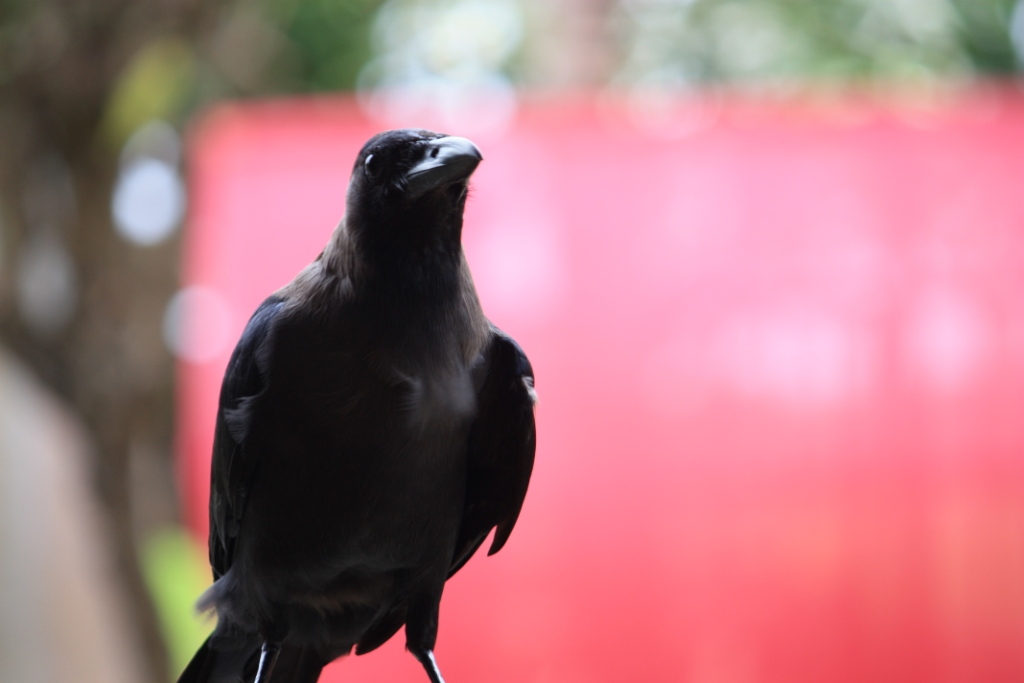
 In there stepped a stately Raven of the saintly days of yore;
 Not the least obeisance made he: not an instant stopped or stayed he;
 But, with mien of lord or lady, perched above my chamber door --
 Perched upon a bust of Pallas just above my chamber door --
  Perched, and sat, and nothing more.

 Then this ebony bird beguiling my sad fancy into smiling,
 By the grave and stern decorum of the countenance it wore,
 "Though thy crest be shorn and shaven, thou," I said, "art sure no craven,
 Ghastly grim and ancient Raven wandering from the Nightly shore --
 Tell me what thy lordly name is on the Night's Plutonian shore!"
  Quoth the Raven, "Nevermore."

 Much I marvelled this ungainly fowl to hear discourse so plainly,
 Though its answer little meaning -- little relevancy bore;
 For we cannot help agreeing that no living human being
 Ever yet was blessed with seeing bird above his chamber door --
 Bird or beast upon the sculptured bust above his chamber door,
  With such name as "Nevermore."

 But the Raven, sitting lonely on that placid bust, spoke only
 That one word, as if his soul in that one word he did outpour.
 Nothing further then he uttered -- not a feather then he fluttered --
 Till I scarcely more than muttered, "Other friends have flown before --
 On the morrow he will leave me, as my hopes have flown before."
  Then the bird said, "Nevermore."

 Startled at the stillness broken by reply so aptly spoken,
 "Doubtless," said I, "what it utters is its only stock and store,
 Caught from some unhappy master whom unmerciful Disaster
 Followed fast and followed faster till his songs one burden bore --
 Till the dirges of this Hope the melancholy burden bore
  Of 'Never -- nevermore."

 But the Raven still beguiling all my sad soul into smiling,
 Straight I wheeled a cushioned seat in front of bird and bust and door;
 Then, upon the velvet sinking, I betook myself to linking
 Fancy unto fancy, thinking what this ominous bird of yore --
 What this grim, ungainly, ghastly, gaunt, and ominous bird of yore
  Meant in croaking "Nevermore."

 This I sat engaged in guessing, but no syllable expressing
 To the fowl whose fiery eyes now burned into my bosom's core;
 This and more I sat divining, with my head at ease reclining
 On the cushion's velvet lining that the lamp-light gloated o'er,
 But whose velvet violet lining with the lamp-light gloating o'er,
  She shall press, ah, nevermore!

 Then, methought, the air grew denser, perfumed from an unseen censer
 Swung by Seraphim whose foot-falls tinkled on the tufted floor.
 "Wretch," I cried, "thy God hath lent thee -- by these angels he hath sent thee
 Respite -- respite and nepenthe from thy memories of Lenore;
 Quaff, oh quaff this kind nepenthe, and forget this lost Lenore!"
  Quoth the Raven "Nevermore."

 "Prophet!" said I, "thing of evil! -- prophet still, if bird or devil! --
 Whether Tempter sent, or whether tempest tossed thee here ashore,
 Desolate yet all undaunted, on this desert land enchanted --
 On this home by Horror haunted -- tell me truly, I implore --
 Is there -- is there balm in Gilead? -- tell me -- tell me, I implore!"
  Quoth the Raven, "Nevermore."

 "Prophet!" said I, "thing of evil! -- prophet still, if bird or devil!
 By that Heaven that bends above us -- by that God we both adore --
 Tell this soul with sorrow laden if, within the distant Aidenn,
 It shall clasp a sainted maiden whom the angels name Lenore --
 Clasp a rare and radiant maiden whom the angels name Lenore."
 Quoth the Raven, "Nevermore."

 "Be that word our sign of parting, bird or fiend!" I shrieked, upstarting --
 "Get thee back into the tempest and the Night's Plutonian shore!
 Leave no black plume as a token of that lie thy soul hath spoken!
 Leave my loneliness unbroken! -- quit the bust above my door!
 Take thy beak from out my heart, and take thy form from off my door!"
  Quoth the Raven, "Nevermore."

 And the Raven, never flitting, still is sitting, still is sitting
 On the pallid bust of Pallas just above my chamber door;
 And his eyes have all the seeming of a demon's that is dreaming,
 And the lamp-light o'er him streaming throws his shadow on the floor;
 And my soul from out that shadow that lies floating on the floor
  Shall be lifted -- nevermore!

 Eternals by Neil Gaiman





 Tiger Riding for Beginners