
5 Untruths Worth Pretending Are True

pretend_play_preschool


William James famously suggested that the path between emotion and expression wasn’t a one-way street. In other words, it’s not just that having an emotion causes us to express it through facial expressions and body language, but also that by assuming a given expressions we create the corresponding emotional state. James might have gone a little far in proposing the emotion can’t exist devoid of its expression, but he came by the belief that you could get to emotion through expression honestly enough.


I read about how James, suffering a bad cases of the blues, asked himself what would happen if he behaved as though he was in a happier state of mind. He decided to carry out this experiment, and he soon found himself in a much better mental state. This got me thinking about what else one might pretend that would yield positive results.


It should be noted, that there’s been a lot of research on this topic, and it’s been dubbed the “as if principle,” though colloquially people talk about it as “faking it till you make it.” Some of you may be familiar with this idea from the study showing that adopting a Wonder Woman stance made subjects feel more confident. If not, Amy Cuddy’s TED Talk can be viewed here.


So, here are five ideas–true or not–that are worth believing:


[Note: You’ve got to pretend as if you were a five-year old. Don’t bring those pathetic and puny adult imaginations.]


5.) I’m happy:  Starting with the self-ruse most widely known and which James brought to our attention. You may have heard the following advice: if you’re ever feeling down, stand up and pump your fists in the air at an upward angle such that one’s body forms a “Y” (or an “X if you want to keep your feet wide.) This is a hardwired victory behavior written into our evolutionary coding, and it’s hard to be depressed while doing it.


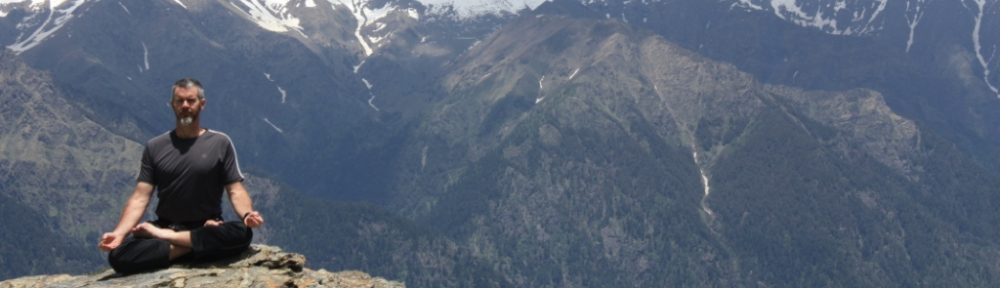
4. Oneness / Unity:  Try pretending that you’re connected to everything in the universe. The experience isn’t uncommon with mystics and meditators, as well as those in the Flow. This is an attempt to work it around from the other direction.

Now, some mystic-scientist out there is going to say that this isn’t an untruth because there’s evidence that we are connected to everything, citing quantum entanglement and such like. Maybe so, but as there’s no reason to believe we have a sensitivity to happenings at that quantum state, the pretending is still necessary. (i.e. Even if such entanglement exists, we can no more sense it than we could recognize if a force of 1-trillionth of a gram touched our skin.) Evolution doesn’t grant us capabilities beyond what are needed to survive to procreate, and so I’m doubtful that we have some untapped power to sense quantum entanglement lurking within us.) The oneness we feel has to do with the part of the brain that tracks the “I v.) not-I” divide fading out of operation–rather than an awareness of some web of subatomic entanglement.

This self-subterfuge is a way to simultaneously put one’s worries in perspective while not becoming demoralized about being an insignificant speck in a vast universe. One is an infinitesimal speck in an infinite universe, but one is tied into the universe such that one is simultaneously an infinite universe.


3.) Chi / Prana: I don’t think there’s any reason to believe that the immaterial energies of Eastern traditions (Taoism and Yoga, respectively) exist. However, I wouldn’t argue that there’s no benefit from imagining them to exist.  There seems to be little doubt that visualizing the flow of these energies can have benefits–regardless of whether they’re the traditionally advertised benefits or not. Even if you don’t succeed in pulling energy into one’s body directly, sans the middlemen of food and oxygen (so one can live off the dew on a single ginko leaf–ala “Kung Fu Panda”), visualization is good for the brain and the invigorated feeling one creates in pretending chi exists can’t hurt.


matrix

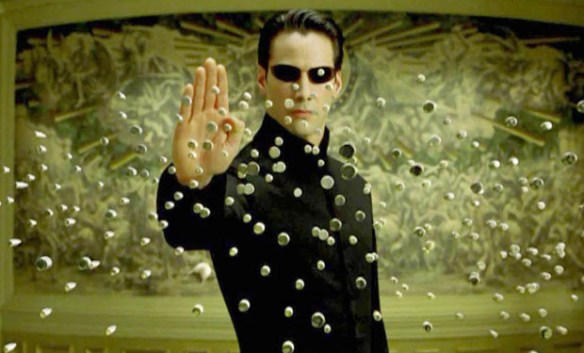
2.) “There is no spoon:”  This, of course, comes from the movie “The Matrix” in which a young sage / savant attempts to teach the protagonist, Neo, how he can bend a spoon with his mind. The upshot is that one doesn’t try to bend the spoon, one realizes that the spoon is a figment of the imagination.

The idea that we are part of a simulation may turn out to be less far-fetched than it seems. I cite, for example, the TED Talk by physics Nobel Laureate George Smoot.

At any rate, the virtue of the thought exercise of pretending this is true is two-fold. First, one can ask whether one would lead the same life and give events the same weight if one was to discover that one was living out a simulation designed to advance the understanding of some entity (e.g. an alien race, a colossal supercomputer, etc.) Second–and more importantly–one may become more attuned to the fact that one’s own mental / emotional world is full of dream-like simulations. One’s brain is designed to anticipate worst-case scenarios, and it’s exceedingly good at fabricating scenarios that taint our perception of the world with anticipated negative possibilities–most of which will never come to fruition. There are many variants, attributed to various speakers, of the following Mark Twain quote:

“I’ve had a lot of worries in my life, most of which never happened.”


1.) There is no I:  A core tenet of Buddhism is that there is no self. Depending what a self has to be to exist as an independent entity, science may yet converge on a similar conclusion. The self seems, at best, to be an emergent property. In the Anil Ananthaswamy book I recently reviewed, it’s compared to a center of gravity. There’s no molecule that can be called the center of gravity, it’s a property that moves around as the body does. It’s definable, but not in terms of a specific location or physical existence.

Pretending there is no self may help put many worries into perspective. Like #4, it may also help one feel more connected to a larger world. But most importantly, it may help one to turn off those parts of one’s mind that are prone to self-loathing, self-denigration, or just self-consciousness.


Happy pretending.

nightsky

POEM: Mind Gravity: or, The Heft of Mental Putrefaction

depression-in-bed

Gravity pulls her head down into the pillow.

Like tar through a garden hose, thoughts flow.

Thoughts weighty, not freed of mass and matter.

As stuck in time and lost to reason as the Hatter.

Thoughts arise because they’re lighter than air.

Hers fell sodden, a lead balloon in the state fair.

The infection arose from a single putrid notion.

One drop floating free to fester across an ocean.

That she wasn’t enough. Enough for whom? Enough for what?

Unanswerable questions that congealed into a sluggish pus.

They say truth has weight, but truth lifts one to fly free.

What pulled her head to pillow was the mass of negativity.

As her thoughts hardened into a slag, devoid of truth or reason.

She summoned the strength for a search in her final season.

She scoured the four corners of the Earth for a fabled cure.

But it lie in a place close at hand, but vastly more obscure.

5 Courage Building Yoga Practices

Learning to manage and moderate one’s fears and anxieties needn’t involve strapping on a parachute, cold quitting a job, or bare-knuckle boxing in a back alley. In fact, it may be best to begin by quietly watching those anxieties at the other end of the spectrum, the one’s so subtle that conscious awareness of them can be blotted out by the noise of living–but which nevertheless have a physiological impact.


The ability to quietly and non-judgmentally witness one’s emotional state–as is taught in yoga and related practices such as Buddhist meditation–is crucial (and, in my opinion, is one of the most valuable lessons that these systems have to teach.) Crushing or repressing emotions is a demonstrably losing strategy. At best these feelings are tamped into one’s subconscious mind, still adversely affecting one’s outlook and, therefore, indirectly casting a pall over one’s life.


You’ll note that I’ve mentioned courage and moderating fear, but have not mentioned defeating emotions or quelling fear. Wrongly, our archetypes of fearlessness are characters like John McClane (i.e. the “Die Hard” movies), Katniss Everdeen (i.e.”The Hunger Games” trilogy),  or Yoda (i.e. the “Star Wars” movies.)  But neurologists who study patients whose brains have been damaged such that they are literally fearless tell us that the defining characteristic of such individuals is “paralysis by analysis.” In other words, Sheldon Cooper (i.e. “Big-Bang Theory”) is a more apt model. Also, the fearless tend to live short lives because they eventually do something fatally inadvisable.


We need our fear. However, while fear can keep us from doing stupid things, it can also turn us into the worst version of ourselves. Therefore, our fear needs to be moderated with courage and reason (to these, some would add “faith.”)


You may note that I tend toward the intermediate / advanced with the practices I mention. This is, in part, because that’s probably more likely the point at which one is ready to take this on. In beginning a practice, one may have one’s hands full to grasp the basics of alignment and breath.


Without further ado, here are a few yoga practices that I’ve used to help me witness my anxieties and learn to moderate them:


1.) Nauli (and other external breath retention [i.e. bāhya kumbhaka] techniques.): Breath retention can produce a subtle anxiety, even when one has full control of the timing of release and the next breath. In fact, subtle anxiety may cause one to have a less robust retention than one might otherwise. Truth be told, this practice has probably been more fundamental than any of the āsana practices that will follow, for me personally.  

Note: external retentions are relatively advanced practice and should only be added to one’s sadhana after one has been taught by an experienced teacher and is somewhat experienced with pranayama.

practicing nauli

practicing nauli


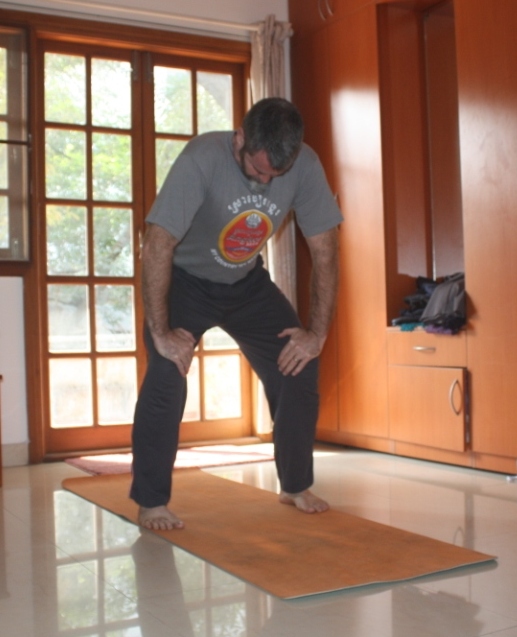
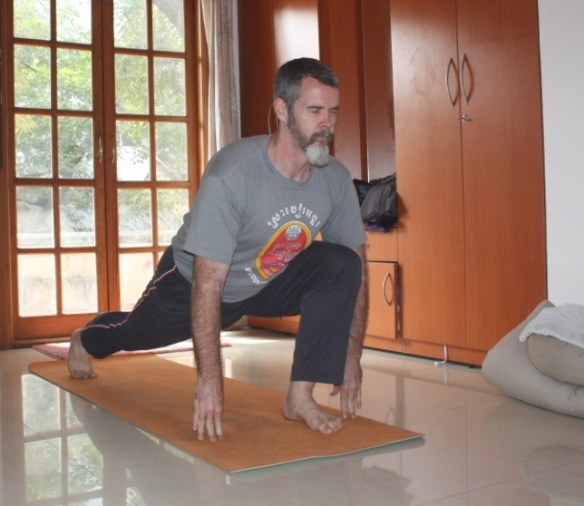
2.) Eyes closed: This is particularly effective with Surya Namaskara (Sun salutations), standing poses, and–at an advanced level–balancing poses. One should make sure that ones balance is solid throughout before attempting with one’s eyes closed. We have redundant systems to help achieve balance (i.e. inner ear, proprioceptive, and visual), but–for the sighted–going without vision can be nerve wracking.

ashwa sanchalanasana in Surya Namaskara

ashwa sanchalanasana in Surya Namaskara


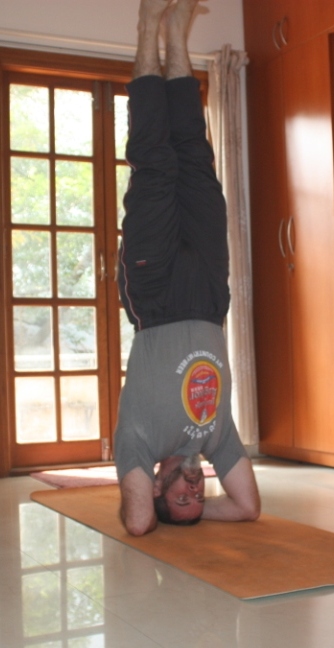
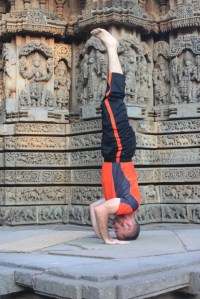
3.) Inversions: Inversions are meant to be calming because when the blood pressure to the head increases, it triggers reactions in the body to reduce it. However, it may take some time before that promised is reached. I’ve done a more extensive post on inversions that can be read here.

shirshasana (headstand)

shirshasana (headstand)


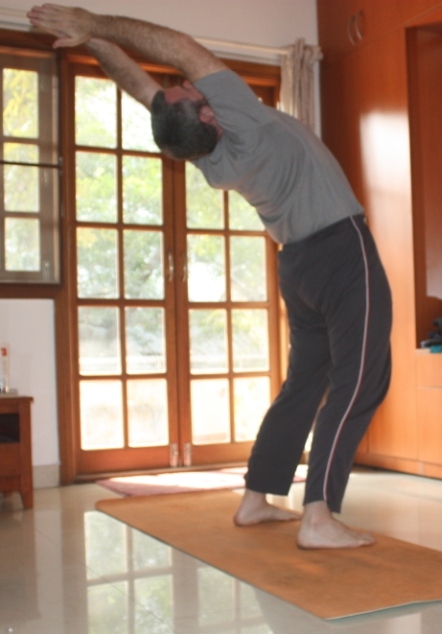
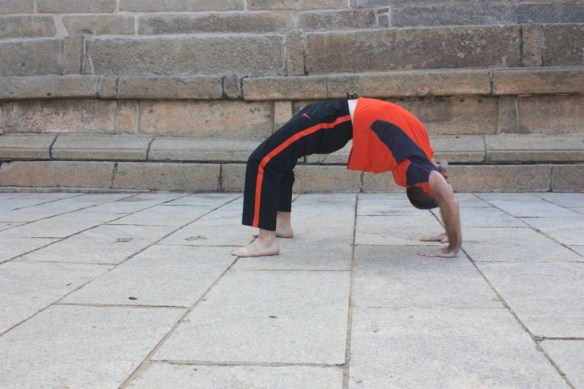
4.) Standing Back-bends: (Ardha Chakrasana / Urdhva Triangmuktasana / full Urdhva Dhanurasana) Simple back-bending can create the feeling that one is about to fall back onto one’s head. One may want to begin with a simple back-bend as one might do in Surya Namaskara before advancing to the complete Urdhva Dhanurasana in which one moves into a wheel pose (Chakrasana) from a standing position. (Urdhva Triangmuktasana is an intermediary in which one’s knees are more deeply bent, and one reaches back towards one’s Achilles tendon.)

ardha chakrasana

ardha chakrasana


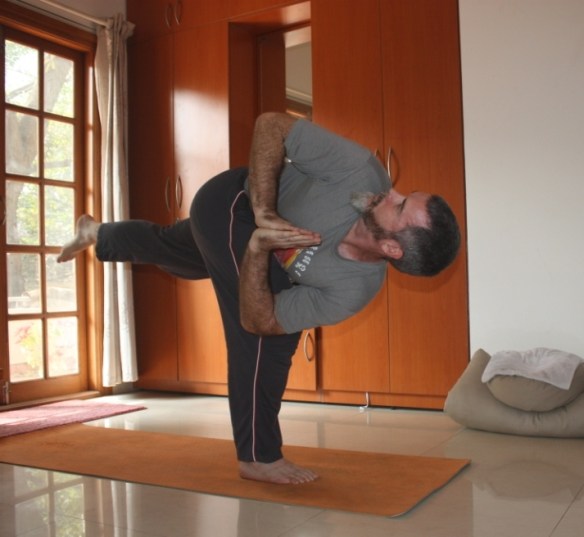
5.) Standing Balances: Depending on one’s level, anything from tree pose (vrksasana) to bound twisted half-moon pose (baddha parivrtta ardha chandrasana) may be applicable. I’ve shown the unbound version of the latter (parivrtta ardha chandrasana.) Twisting and balancing at the same time provides a great challenge, if one is already confident with balances generally.

parivrtta ardha chandrasana

parivrtta ardha chandrasana


Happy practice.

POEM: Angry Infusion

a slow kick

flipped it over

jiggling

not yet rigid

soon to be brick block

unyielding and unmoving

but dissolving

as sugar cubes in hot coffee

and when no trace remained

ubiquity

POEM: Too Happy

IMG_3368

I’m too happy to be crazy,

but the happy makes me lazy

Not lazy, but lacking focus.

Madness is a creative locus.


A sad gravity weighs one down,

as lip corners into a frown,

but in the pit resides a muse.

People pay to hear the blues.


If you could peer inside my mind,

you’d see stacks of rotting rinds.

The rinds pile up and they ferment.

Maybe to a soulful lament?


Or maybe they just start to  sour,

becoming fouler by the hour.

Until you can’t believe the stink,

and every word is wasted ink.


Even imaginary monsters get bigger if you feed them

Public domain image sourced from Wikipedia

Public domain image of Epictetus, sourced from Wikipedia

There’s a story about Epictetus infuriating a member of the Roman gentry by asking, “Are you free?”


(Background for those not into Greek and Roman philosophy. Epictetus was a Roman slave who gained his freedom to become one of the preeminent teachers of stoicism. Stoicism is a philosophy that tells us that it’s worthless to get tied up in emotional knots over what will, won’t, or has happened in life. For Stoics, there are two kinds of events. Those one can do something about and those that one can’t. If an event is of the former variety, one should put all of one’s energy into doing what one can to achieve a preferable (and virtuous) outcome. If an event is of the latter variety, it’s still a waste of energy to get caught up in emotional turbulence. Take what comes and accept the fact that you had no ability to make events happen otherwise.)


To the man insulted by Epictetus, his freedom was self-evident. He owned land. He could cast a vote. He gave orders to slaves and laborers, and not the other way around. What more could one offer as proof of one’s freedom? Of course, he missed Epictetus’s point. The question wasn’t whether the man was free from external oppressors, but whether he was free from his own fears? Was he locked into behavior because he didn’t have the courage to do otherwise?


I recently picked up a book on dream yoga by a Tibetan Lama, Tenzin Wangyal Rinpoche. Lucid dreaming has been one of my goals as of late. I wasn’t expecting to learn anything new about practices to facilitate lucid dreaming because I’ve been reading quite a bit about the science, recently. I just thought that it would be interesting to see how the Tibetan approach to lucid dreaming maps to that of modern-day psychology. Tibetan Buddhists are–after all–the acknowledged masters of dream yoga, and have a long history of it. Furthermore, I’ve been doing research about the science behind “old school” approaches to mind-body development, lately. At any rate, it turns out that there were several new preparatory practices that I picked up and have begun to experiment with, and one of them is relevant to this discussion.


This will sound a little new-agey at first, but when you think it out it makes sense. The exercise is to acknowledge the dream-like quality of one’s emotionally charged thoughts during waking life. Consider an example: You’re driving to an important meeting. You hit a couple long red lights. You begin to think about how, if you keep hitting only red lights, you’re going to be late and it’s going to look bad to your boss or client. As you think about this you begin to get anxious.  But there is no more reality in the source of your fear than there is when you see a monster in your dreams. There’s a potentiality, not a reality. Both the inevitability of being late and the monster are projections of your mind, and yet tangible physiological responses are triggered (i.e. heart rate up, digestion interfered with, etc.) It should be noted the anxiety isn’t without purpose. It’s designed to kick you into planning mode, to plan for the worst-case scenario. Cumulatively, one can get caught up in a web of stress that has a negative impact on one’s health and quality of life.  For most people, when they arrive on time, they forget all about their anxiety and their bodily systems will return to the status quo, until the next time (which might be almost immediately.) Some few will obsess about the “close call” and how they should have planned better, going full-tilt into a stress spiral.


Mind states have consequences, whether or not they’re based in reality. I’ve always been befuddled by something I read about Ernest Hemingway. He’d won a Nobel Prize for Literature and was universally regarded as one of the masters of American literature, but he committed suicide because he feared he’d never be able to produce works on the level that he’d written as a younger man. There seems to be more to it than that. Many others managed to comfortably rest on their laurels when writing became hard[er]–including writers with much less distinguished careers.  The monster may be imaginary, but if you feed it, it still gets bigger.


As you go about your day, try to notice your day-dreams, mental wanderings, and the emotional states they suggest. You might be surprised to find how many of them have little basis in reality. They are waking dreams.

An Unusual International Yoga Day Post: or, Dream Yoga and Fear Management

"The Sleep of Reason Produces Monsters" by Francisco Goya

“The Sleep of Reason Produces Monsters” by Francisco Goya

I awoke exuberant that I’d achieved lucidity in my dream and that I’d apparently slain a nasty character (picture Hans Gruber on a bad day)–a task that had seemed impossible before my eureka of “I’m lucid!” Only my exuberance was short-lived when I realized that Hans was also me. Do you have the courage to talk it out with your dream world nemesis instead of reacting from fear?

I was thinking that I should do a post on yoga for International Yoga Day (June 21st), but what to write about? My answer came in the wee hours of the morning when I had a minor breakthrough in lucid dreaming–also known as, dream yoga. I know this seems like a stretch because, despite “yoga” being right there in the name, this practice is much more firmly associated with Tibetan Buddhism than Hatha Yoga. But my last couple yoga posts (which were a while back on my experience with RYT300 teacher’s training and teaching a Yoga Kid’s Camp) were fairly conventional, so I’m due one that’s out there. Furthermore, I promise to try to make clear the relevance of dream yoga to my hatha yoga practice. (If you read the aforementioned posts, you’ll see that the theme of freeing oneself by managing one’s fears and anxieties is a recurring theme across all these posts. And that is the crux of the relevance of lucid dreaming to unifying mind, body, and breath [i.e. yoga.])


What is lucid dreaming? It’s becoming aware that one is in a dream as one is dreaming. One can then exert influence over the course of the dream. Maybe half of you have had this experience at some point in your lives, and so what I’m saying will not seem far-fetched. For those who don’t actively practice lucid dreaming, it’s much more common among the young, so maybe you had such dreams as an adolescent but don’t have them anymore.

For the other half, the whole idea may seem like poppy-cock. I could easily have been such a doubter. Without following a practice, I almost never remember dreams–let alone dreaming lucidly. At best, I get disappearing fragments of dreams that are ephemeral and hazy. I’m one of those people who might claim that he virtually never dreams, except that I read the science, which suggests that each of us dreams every night that we sleep long enough to cycle through REM (rapid eye movement) mode (and commonly 4 or 5 times a night.) We just don’t recollect these dreams. [However, I have had lucid dreams on rare occasions, and so my skepticism on the subject was curbed.]


Why do I practice dream yoga? While it wasn’t part of my formal hatha yoga training, dream yoga isn’t as far removed as one might think. I have been trained in yoga nidra (yoga sleep), which is an exercise that takes place in a hypnagogic state (on the edge between waking and falling asleep.) Commonly, yoga nidra is used as a deep relaxation exercise, but it can also help one to access the subconscious (as is reflected in repeating a sankalpa [a resolution] in the yoga nidra state.) Lucid dreaming is another approach to assessing the subconscious in order to see what’s going on in there and to try to make changes as necessary. Curiosity about the subconscious mind and its–largely unseen–influence on my daily life is what drew me to dream yoga. It’s just another aspect of knowing oneself and trying to expand one’s capacities of mind and body.


How does one practice dream yoga? Hardcore practitioners set alarms to wake themselves up when they think they’ll be in REM sleep. This, as I understand it, helps them reconnect with the dream when they drift back and greatly speeds the process. As I sleep with a wife who would clobber me with a brick if I set alarms for random times in the middle of the night, I’m not among those hardcore. My practice consists of three main aspects. First, I make resolutions to remember my dreams and to dream lucidly as I’m drifting off to sleep. Second, when I’m not making said resolutions, I try to just observe the subconsciously generated imagery that pops up as a witness–rather than letting my conscious mind go into its preferred mode of planning for an uncertain future. [One can tell the difference because the subconscious images don’t make a lick of sense, and–for me–are devoid of any verbal/language element–i.e. it’s all imagery.]  Finally, I keep a journal in which I record any dreams or fragments that I can recall–sometimes with drawings to supplement the text (though my artisticness is lacking, to say the least.) The first and last of these are among the most common recommendations one will hear from experts.

I should point out that there are a number of books on the subject by individuals much more qualified than I. Said books give detailed guidance into how one can begin one’s own practice. One that I recently finished reading and would recommend is Charlie Morley’s “Lucid Dreaming: A Beginner’s Guide to Becoming Conscious in Your Dreams.”  At some point, I’ll post a review of that book. Also, there is “Dreaming: A Very Short Introduction” by J. Allan Hobson, which I have reviewed.


As I wrote up the entry in my dream journal, I made a resolution to stop attacking the “bad guys” in my dreams and to try to understand them. Note: I don’t recommend this approach for dealing with real world axe-wielding maniacs, but I highly recommend giving it a try in one’s dreams.


Sweet dreams.

What RYT300 Taught Me About Fear

IMG_2752

I recently completed the RYT300 course at Amrutha Bindu Yoga to obtain my RYT500 yoga teacher certification. (i.e. The 200 hour course–which I completed a couple years ago–plus the 300 hour course are the primary requirements for the 500 hour certification.) The essay below is about one of the key lessons I learned in this phase of training.


I walked through the streets of Bengaluru barefoot and with not so much as a 5 rupee coin in my pocket. [If your response to that is “big whoop,” you probably live somewhere like Singapore, Helsinki, Kobe, or Calgary where the streets are immaculate and the rats aren’t so bold. If you’re familiar with what goes on in and near the streets in India, you may be wondering what the hell is wrong with me.]  It was an unconventional teaching tactic to be sure, but it ranks among the most valuable lessons of the training—surpassing no small revelations about postural alignment, pranayama methods, bandha technique, physiology, and yogic philosophy. It was even up there with the experience of advanced shatkarma (cleansing practices) that were completely new to me.


What’s the lesson?  If you’re going to teach yoga–particularly at the intermediate / advanced level that RYT500 is intended to prepare you for–you need to work on not being ruled by fear. That isn’t to say one must be fearless. We imagine fearlessness to equate to courageousness, but courage is action under fear. Neuroscience tells us what a fearless person is like. We know from individuals who’ve had the parts of their brains damaged that are responsible for the emotion—they are paralyzed by indecision. Our emotions provide a basis for choosing–at least as a tie-breaker when no clearly superior path exists. We need our fear, just like our other emotions, but if you can’t move forward because of it you may have a hard time keeping learning.


Not being ruled by fear isn’t just—or primarily—about being able to keep practicing advanced techniques until you can get a grasp on them.  Yes, mastering a handstand requires a fair amount of falling down (hopefully, in a controlled fashion), and that’s a lot of potential for anxiety, but there’s more at stake.  What precisely? One might start, as many do, with what Patanjali has to say on the subject, and one can start from square one. “Chitta Vrtta Nirodhah.” (Quieting the fluctuations of the mind.) Many of the fluctuations of the mind result from anxieties and our obsession with solving them. Our brains are wired to try to anticipate worst case scenarios so we can develop ready-made solutions for them. This can result in excessive pessimism, extended stress, and all the problems that go along with that stress.

IMG_2642

There’s a popular saying that goes, “money is the root of all evil.” But, I think it’s wrong. Fear is at the heart of all evil—not to mention a fair amount of run-of-the-mill pettiness.


So what is the path to anxiety management? Start small, and dispassionately observe your discomfort. Don’t try to squelch the emotion, just watch it while trying to avoid putting good or bad labels on it. Of course, sources of anxiety are personal. As far as prescriptive yoga practices, that depends upon one’s personal anxieties. For some inversions might do the trick, for others extreme back bends, for some external breath retention, for others it may be balancing. Then, of course, there are the advanced shatkarma practices I mentioned earlier–such as vaman dhauti (cleansing by vomiting) or poorna shankhaprakshalana (i.e. clearing out one’s digestive tract via massive ingestion of salt water.)


I recently finished teaching a Kid’s Camp (a post about that to come.) At the beginning of the camp, I was telling someone that the kids were fearless, but what I came to discover was that kids just allow their enthusiasm to swamp their anxieties. I had seven-year-olds doing pinchamayurasana (forearm stand) and vrschikasana (scorpion) within the first few days. That would be a hard sell for adults. [I don’t think I’ve ever taught those postures to adults.]  It’s not just that kids are bendy, they’re also ready to get up after they fall down. (And since they’re not stressed about the possibility of falling they don’t tense up and get badly injured.) Someone posted a great meme on Facebook recently. It said, “A child who falls down 50 times learning to walk, doesn’t go, ‘I don’t think this is for me.’”

BOOK REVIEW: Extreme Fear by Jeff Wise

Extreme Fear: The Science of Your Mind in DangerExtreme Fear: The Science of Your Mind in Danger by Jeff Wise
My rating: 4 of 5 stars

Amazon page

Extreme Fear examines the science behind fear—particularly the fear of life and death situations. In doing so, the author presents findings from scientific research as well as cases that demonstrate the concepts behind those findings. People are often so close to their fears that they take them for granted, and feel that there’s nothing to be done about them. However, there’s a great deal to be learned about how fear operates and how one can improve one’s performance in fearful situations. By replacing the lens of shame with one of science, one can see what fear is objectively, and make the emotion more of a help and less of a hindrance.

A central idea in the book is that fear evolved to maximize one’s chance of survival against the age-old threats facing mankind. These pre-historic threats were relatively straightforward: saber-tooth tiger attacks, clubbing by members of warring tribes, fire, famine, flood, etc. Ancient threats often called for hauling ass, freezing in place, or getting stabby. The problem is that our present-day threats often call less for gross motor skills (run, kick, or throw) and more for creative or nuanced solutions to technological problems (i.e. sliding cars, falling planes, or malfunctioning assault rifles.)

Motor learning is one means by which this mismatch between what our brain tells our body to do in a stressful situation and what is called for in our modern world. Take the case of the infantryman with the jammed rifle. Without training, he might pick up the rifle like a club, intending to use it to unleash blunt force trauma. That is, if he’s still alive then the enemy gets into cudgeling range. Alternatively, the soldier may drop the rifle and run for his life. However, because he had a drill sergeant who made him practice clearing his weapon over and over, his body can go to that behavior while his conscious mind is blinking out.

Still, motor learning only takes us so far. Sometimes creativity is called for, and that’s a tall order in the face of where our body / brain want to put limited resources. In fact, Wise begins the book with the story of a pilot who was flying an old plane when the wing support broke and the wing flipped up, threatening to rip off. Somehow the pilot figured out—based on a vague memory and lots of experience—that he could flip the plane over and fly it upside-down and the wing would snap back into place. Then he had to figure out how to land: a.) upside-down crash, or b.) try to flip the plane over at the last second. The brain systems that this pilot smoothly accessed are among those that one doesn’t expect to be operating in life or death situations—e.g. those involved with long-term conscious memory and abstract problem solving.

The question of how some people can keep their wits about them, as the above pilot did, while others crash and die is the one that Wise really wants to answer. It turns out that it’s not such and easy question. During World War II, the military conducted studies to try to determine which soldiers could be counted on under life and death stress. The answer didn’t readily present itself. Among the problems in finding an answer is that courage and fearfulness aren’t as unitary or straightforward characteristics as one might think. Wise presents the case of Audie Murphy as a prime example. Murphy was at once one of the most decorated American soldiers in World War II—a man who’d taken on a company of Germans single-handedly—and a man of great social anxiety.

The book’s 13 chapters are divided into three parts. The first part presents fear and its effects. The middle section deals with various forms, aspects, and facets of fear, including: social v. life-and-death fear, choking behavior in sports, and fear of fear v. fear of an outcome. In the last part of the book, Wise suggests how one might achieve better performance in the face of fear.

I found this book to be informative and interesting. Wise did a good job of picking cases to illustrate the concepts discussed in the scientific literature. I’d recommend this book for individuals who are interested in the science of the brain and the ways to achieve ultimate human performance.

View all my reviews

TODAY’S RANDOM THOUGHT: “That” Doesn’t Make You So Mad

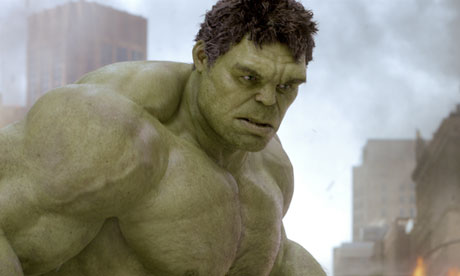
Source: Avengers Movie

Source: Avengers movie

“That makes me so mad!” One hears it all the time. It has to be among the most commonly uttered phrases in the realm of emotional experience. And, of course, it’s completely and utterly wrong. Your anger is a wholly contained neurochemical response. To credit something external with your anger is to grant that person or thing power over you–to enslave yourself. (Stoic philosopher, and former slave, Epictetus was known to piss off gentlemen citizens by asking them if they were “really free.”)


This isn’t to say there isn’t just anger.  However, think about what emotions are. Our emotions are a system evolutionarily evolved to allow us to make decisions with limited or no information. Without emotions our species, if we ever came to be, would have likely become extinct by way of “paralysis by analysis.” We know that happens to people who have neurological damage that keeps them from experiencing emotion. You might think they would become cold and rational Mr. Spocks, but the defining characteristic of such people is that they become paralyzed by indecision. It turns out that we make a lot of decisions with limited information or from an inability to determine a clear winner by way of facts and reason. Emotion plays and important role in those cases.


Chances are that if your immediate gut reaction to something is anger, you probably haven’t worked out a rational argument for your preference. If one has a clear line of reasoning rooted in fact, anger isn’t necessary to justify a position or decision. If your gut reaction to something is emotional, see whether you can  noodle out a rational reason before you swing into too rash an action…. unless the crosstown bus is careening at you.