This Kindle Single is written in the form of advice by a Madam to the newest member of her brothel. It’s historical fiction, and is set ambiguously in the past. It is presumably set in China, but I don’t recall that that is ever explicitly determined.
The Madam shows a mix of maternal protectiveness for the girl and straightforward, harsh candor. She tells the young girl how to game the men, and how to get the most out of them. She instructs the girl in how to defend her virginity until such time as it is sold to someone who can afford to richly compensate them for it.
There is nothing in the way of a plot in the book. It does read just like rambling advice, so there is also not a lot by way of setting. We do get character development of the Madam, but not so much of the title character.
It’s well-written and seems to be well-researched as well. While I don’t know a great deal about the subject, it rings authentic. Despite the subject, the book isn’t gratuitous in its talk of sex. However, don’t be surprised that the entire work revolves “around” the intertwined subjects of sex and money.
When one sees lists of must-read books, if there is a graphic novel on the list, it’s probably this one. Watchmen represents both the graphic novel and the super-hero tale at their best. It forgoes the unrealistic and hackneyed dialogue and internal monologue that usually plague this genre. While the “tough” style (see: Tough Sweet Stuffy by Walker Gibson)is used liberally–particularly for the voice of Rorschach–it has a natural ring to it.
At its heart, Watchmen is a morality tale that pits absolutist morality against the utilitarian approach. Rorschach (a.k.a. Walter Kovacs) represents the absolutist extreme. For Rorschach, the lesser of two evils is nothing more than an evil to be punished. On the other hand, Ozymandias (a.k.a. Adrian Veidt) represents the utilitarian view that to save the many one may have to sacrifice the few. The rest of the cast is in between, showing varying degrees of comfort with utilitarianism, but none willing to accept the absolutist extreme.
While my preceding paragraph may have made this sound dreadfully boring, in fact it’s anything but. The morality tale plays out inside a well-developed mystery plot. It begins with an inciting incident best described by a quote from Rorschach’s journal, “Tonight, a comedian died in New York.” That comedian was “The Comedian” one of the book’s cast of costumed heroes. As other heroes begin to be eliminated–not all by death, some by imprisonment or apparently self-imposed exile–the intrigue builds. Events pull individuals–such as Nite Owl and Silk Spectre–back into the game after many years out.
For those who have seen the movie, I will say that it follows the book far more than do most film adaptations. The movie borrows many of the exact words of dialogue. It even borrows a lot of the imagery almost exactly (e.g. the Comedian flying out the window enveloped by glass shards.) However, if you’re wondering whether it’s still worth reading, I’ll say two things. First, the book does cover a lot more detail than the movie. Besides the usual comic book style graphic panels, there are excerpts from fictitious novels, correspondence, magazine interviews, and another graphic novels that support the story line. Second, the biggest deviation between the book and the film is in the details of the devious plan that is revealed at the book’s end. In other words, there are a few surprises.
I would agree with the widespread notion that if you only read one graphic novel, make it this one.
The other haiku anthology I reviewed is Classic Haiku, located here.
This is the second haiku anthology that I’ve reviewed on my site. While they’re both thin volumes of traditional haiku, each has its distinct flavor. The previous volume was organized by season. This one is organized by author. The two books share several authors (e.g. the greats Bashō, Issa, and Buson), but diverge on many of the lesser known poets.
One nice feature of this book is that it offers multiple translations of many of the haiku. Poetry is notoriously tricky to translate as literal translations can be meaningless. Multiple translations can give one a better opportunity to hone in on what the author meant to convey. This volume does give the original Japanese poem in romanized transcription (for those who enjoy the sound the author conveyed as well as meaning), but–unlike the other volume–it does not include the kanji. (This doesn’t matter for me, as I don’t read Japanese, but I’m sure the kanji is a nice feature for readers of Japanese.)
Some favorites are:
clouds occasionally
make a fellow relax
moon-viewing
Matsuo Bashō
islands
shattered into a thousand pieces
in the summer sea
Matsuo Bashō
you’re the butterfly
and I the dreaming heart
of Sōshi
Matsuo Bashō
[Note: Sōshi is the Japanese name of the Taoist thinker Chuang Tze, and this references his famous statement about having dreamt he was a butterfly.]
that dream I had
of being stabbed–was true
bitten by a flea
Takarai Kikaku
oh, won’t some orphaned sparrow
come
and play with me
Kobayashi Issa
As I prepare to move to India, I’ve begun to read up on this subcontinent about which I know too little. For example, I’d never heard of Paul Brunton before a week ago, but now I am immersed in his book A Search in Secret India. Brunton was a Brit who, like a number of his contemporaries living in the first half of the 20th century, struck out to experience the mysteries locked in the heart of India. Like many, he wanted to gain access to the country’s treasure, but the treasure he sought had nothing to do with material wealth or ancient artifacts. He sought living sages, and the lessons they could teach him. The book I’m reading tells the story of this search.
Something about India drives internal reflection and the spirituality that often accompanies it. It’s the home of Hinduism, Buddhism, Sikhism, and Jainism, as well as many non-denominational wisemen (and wisewomen) who at once can be seen as followers of no religion and believers in many religions. Value for the unity of mind and body can be seen in the popular national practice of Yoga, which is the antithesis of mindless exercise in which one jumps on a treadmill with an i-Pod and zones out for an hour as one’s body churns through its paces. Yoga, like Tai Chi, requires one’s full attention, and that one’s movement, one’s breath, and one’s awareness are all working toward the same purpose.
So far, Brunton’s work has appealed to me not only because he is in search of wisdom, but because he goes about this pursuit as a skeptic. In the introduction he tells how he edited out the many meetings with charlatans and frauds. Charlatans always abound in the presence of sages because it’s quite lucrative to convince people that they can achieve self-improvement effortlessly through some patented approach. (I’m here to tell you that self-improvement is a struggle that requires your physical and mental energy all the way–what I cannot yet tell you is whether it is worth it or not.) If one cannot see the cloud-enshrouded destination, it’s easy to sell maps–whether one knows the route oneself or not–and many are all too ecstatic to buy a map that shows a secret route that takes them to the pinnacle by way exclusively downhill paths. The fact that Brunton enters his quest with a degree of skepticism suggests he didn’t fall for such traps; traps that should be obvious but that appeal to those for whom the force of wanting to believe is stronger than the force of truth. [As I am only a few chapters in, I reserve the right to change this prognosis. At some point, I’ll put up a review with my final thoughts.]
I look forward to discovering whether wisdom is alive and well on the subcontinent. Hopefully, the hucksters haven’t won the war for the mind’s of seekers.
Karen Armstrong’s book is a biography of Siddhatta Gotama (a.k.a. Siddhartha Gautama), the man who became the Buddha. However, in the process of telling this man’s life story, she introduces the reader to the basic tenets of the religion he inspired.
Siddhatta’s story is an interesting one that many non-Buddhists know the gist of from the Herman Hesse novel entitled Siddhartha. As a boy, the Buddha-to-be was the son of a wealthy, high-caste man who attempted to shelter his child from all the ugliness of the world, e.g. poverty, disease, and death. Despite these attempts, the young man eventually sees the true world and realizes that he has been living an illusory life. Ultimately, the young man abandons his comfortable life in search of an enlightened view-point.
The Buddha’s life is what one might call “novel-shaped.” That is, the arc of Siddhatta’s life as we know it is ideally suited to being conveyed as a story. It’s a warrior’s quest tale, but one of the mind rather than physical adventure. Armstrong’s book takes advantage of this arc and is arranged accordingly. The six chapters of the book are:1.) Renunciation; 2.) Quest; 3.) Enlightenment; 4.) Dhamma (the doctrines or teachings); 5.) Mission; 6.) Parinibbana (the final rest.)
Renunciation refers to Siddhatta’s abandonment of the world he knew. The quest describes his life as he strikes out in an attempt to become enlightened. The third chapter outlines how he came upon enlightenment. This might have been the conclusion of the story of the man, but that’s when the story of the Buddhist religion becomes entwined with the story of the Buddha. Chapters 4 and 5 deal largely with how the religion spread.
If one is looking for a good overview of Buddhism, Armstrong’s book is a good place to start. It’s readable, and, by tying teaching into the Buddha’s life story, interesting as well.
Philip K. Dick was one of the most imaginative writers and skilled storytellers of the 20th century. There’s a reason that so many of his stories and novels have been made into movies (e.g. Minority Report, Total Recall, Scanner Darkly, and–most famously–Do Androids Dream of Electric Sheep? [which was adapted into a less quirky and darker film called Blade Runner.])Dick’s works lend themselves to the screen because they lay out novel plots in engaging stories.
Ubik isn’t among the Dick works that have been made into movies, but it’s not for lack of trying. Dick wrote his own screenplay for a film adaptation of the novel, but the project fell through. Over the years, a few directors have talked of Ubik: the Movie, so don’t be surprised if you see it someday.
Ubik deals with the afterlife. It’s set in 1992 (Dick’s future–our past.) (You can’t blame a man who lived from 1928 to 1982 for over anticipating the futuristicness of the 90’s. In the year of his birth Amelia Earhart was making the first solo transatlantic flight by a woman–only a year after Lindbergh became the first ever to do it. The year Ubik was published (1969) the Concorde was making its first supersonic transatlantic flight.)
In the world of Ubik, the moon is being developed for human use, and there are many people with psychic abilities. The protagonist, Glen Runciter, runs a business offering services blocking psychic activity to prevent industrial espionage. He is working for a company that’s building a moon base.
Runciter’s wife is deceased; however, he often consults with her as the dividing line between life and death isn’t so clear in Runciter’s world as our own. There exists a state of “half-life” between life and being fully dead.
The inciting incident is a nefarious explosion on the moon base of which Runciter and his team are victims. At first it appears that Runciter is dead and that his team is alive and trying to rush him back to Earth to get him into a state of half-life (just like his wife.)However, as the novel goes on it becomes less clear who is alive and who is dead. All that is clear is that Runciter exists in a different world from his team members. As the story proceeds there are clues–most notably coins with faces on them that aren’t dead Presidents. Joe Chip (a team member) sees coins with Runciter’s face on them, and later Runciter sees coins with Chip’s face on them.
Ubik is a product that Chip and the others begin to see advertised in their world–which they have come to believe is the afterlife. (Some versions of the book have a spray can on the cover that represents this mysterious product that comes in many forms.) They begin to believe that Ubik is their only hope. There has been a great deal of discussion about the symbolism of Ubik. Its name comes from the word for “everywhere”– as in “ubiquitous”– but what (or who)it’s supposed to be is never clearly revealed. Some have said that Ubik is meant to be God. If so, Dick made an interesting statement because the product is always marketed like some cheesy consumer good.
One test for whether you’ll like this book is whether you enjoy ambiguity in endings. Some readers really enjoy the thought-provocation of an ambiguous ending and the process of thinking out their own conclusions. (I am among this type of reader.) However, there are other readers who feel ripped off if the writer doesn’t tie all the answers up with a neat little ribbon at the end of the book. If you are this type of reader, you will likely hate this book. In other words, if you felt good leaving the theater when you saw Inception you’ll like this book, but if you left shaking your head and saying, “WTF, Chris Nolan?” then don’t bother.
I got this as the Kindle “Daily Deal” about a week ago. It’s really a bundling of six comic book editions: Wolverine No. 1 through 4, and Uncanny X-Men No. 172 & 173.
The story begins as Wolverine travels to Japan to check on his beloved Mariko only to discover she is married to another man. Her abusive husband is a man owed a debt by Shingen Yashida, Mariko’s father, and a Yakuza crime lord. Mariko is the repayment of debt. Over the course of the six books, Wolverine battles Shingen Yashida and–having defeated him–must take on Mariko’s half-brother, the Silver Samurai. In the process, while Wolverine loves Mariko, Yukio (Shingen’s assassin sent to kill Wolverine) falls for Wolverine’s animal charm. The final two editions involve the X-men coming to Wolverine’s wedding to Mariko, but only Storm plays a significant role in the action.
I will admit that comic books are not my bag. As a writer, I generally find the dialogue and internal monologues contrived and filled with jarring “as you know, Bob” style references. This is nails-on-chalkboard grating to me, and it was no less true for this book than others. However, I accept that some of this is an inevitable result of the serialized nature of story lines (often across different series), the space limitations, and the fact that boys are a targeted audience. The Watchmen is one of the few exceptions to this problem.
Having said that, I thought the story line was intriguing and it obviously kept my interest through to the end (albeit without much of a significant time investment.) There are lots of battles with ninja, so how cool is that?
It’s the first graphic-intensive book that I’ve read on my Kindle–which is the basic model, and I was surprised how well it worked. Each page contained several frames, usually in mice type that was hard on the eyes, but one could double-tap the screen to call up a single frame in very legible type.
I think this is worth a read if you’re interested in the Wolverine story. The upcoming Wolverine movie seems to share many of the same characters, but apparently with a different story line. Of course, as I understand it, the X-men series of movies are legendary for scrambling the mythology and timelines of the comics without much concern for being internally consistent, let alone consistent with the comics.
This thin volume packs a great deal of knowledge about the Zen approach to the mind. It’s divided into three parts: right practice, right attitude, and right understanding. The first section is technical (e.g. posture, breathing, etc.); the second section is inspirational; and the third section is philosophical. This is consistent with the Zen priority of putting practice first and being cautious about philosophizing.
The core concept is captured by the book’s topic sentence, “In the beginner’s mind there are many possibilities, but in the expert’s there are few.” This sentence contains a valuable truth, but I can’t help but think that the related title probably hurt the book’s sales. Sadly, many people would rather read a book entitled “How to be a Zen Master in 90 Days.” Everybody wants to be an expert, and few are open to the lesson that they must look at the world through the eyes of a novice. I’ve noticed this in the martial arts. Most individuals seem to be much happier as mediocre black belts with only a few years of practice than they would be as a highly competent white belt. This, of course, is the lure of external validation, which is a weak salve for one’s private demons.
At any rate, the value of cultivating shoshin (i.e. beginner’s mind)is to avoid have one’s experience jaded or tarnished by one’s past. It’s about avoiding attachment to what one believes one knows, such that one is incapable of learning something new. It’s like that old, but popular, tale that is told in both the Zen Buddhist and Taoist traditions about a cocky, young student who comes to learn from a master and proceeds to tell the master all he has already learned. The master pours tea for the youth, and when the cup is full he continues to pour until the scalding liquid spills over into the kid’s lap. When the student angrily asks why the teacher did that, he is told, “Your cup is already full. In order to take in more you must first empty your cup.”
I enjoyed this book. It’s very readable. The chapters are concise and not the least bit arcane. The bits on practice are not bogged down in minutiae. As I indicated, this book covers a lot of ground. I would dare say that if you are only going to read one book on Zen in your lifetime, this is a suitable candidate.
This, the fourth book in the H2G2 trilogy, feels different from the others. First, it’s not so much about the ensemble cast featured in the other books. This is a book about Arthur, plain and simple. Arthur is reunited with Ford Prefect only in chapter 36 of 40, though there are Ford chapters interspersed preceding that reunion. Marvin the depressive robot makes it into the final chapter, but his appearance seems random and purposeless (except that it interjects a Marvin’s typical humor to nice effect.) Zaphod and Trillian are only mentioned in passing.
Second, romance plays a significant part in the story line, answering the previously perennial question, “Will Arthur ever get laid?”
It will be no surprise to readers of the earlier books that the title, So Long, and Thanks for All the Fish, was the final message of the dolphins before they jetted from the Earth–they being the only ones on the planet who knew the Vogons were about to destroy Earth to make way for a hyperspace bypass.
The story begins with Arthur being dropped on a planet that looks suspiciously like the Earth that he knows was destroyed. He hitches a ride with a young man and his delirious sister, Fenchurch. He develops an inexplicable connection with Fenchurch, and their burgeoning romance makes up a considerable part of the story. Fenchurch had had an epiphany right before what she can’t help feeling was the destruction of the world, and she is traumatized by her inability to remember.
The only difference between this planet and the one Arthur knows is that–he later finds out–this one is entirely devoid of dolphins. His house is even where he left it with a couple of months of dust and dirt accumulated. The only thing out-of-place is a new fishbowl engraved with “So long, and thanks for all the fish.”
The couple, once united, go to meet an eccentric scientist who claims to know what happened to the dolphins. The eccentric, who goes by the name Wonko the Sane, has a house built inside-out to symbolize that he is outside the asylum–the asylum being the rest of the world. Wonko shows the couple his engraved fishbowl, and they then realize that all three of them (including Fenchurch) received such bowls. Wonko tells them that they should have put their ear to the bowl’s mouth. They do so, and hear a message from the “Save the Humans” organization, which is a dolphin charity group whose name says it all.
Fenchurch wants to see the universe, and so when Ford lands back on Earth–having come to investigate why the Hitchhiker’s Guide entry for Earth has been expanded from “mostly harmless”–they go off together. Their first stop is to read God’s final message to His created. I’ll not tell you the message. So ends the book–well there’s a little epilogue which is nearly meaningless in isolation.
While it’s off-kilter from the other books, this one shares Adams’ usual absurdist humor. However, in keeping with the different feel, one of the best laughs I had in this book was not absurdist humor at all. That laugh resulted from a story told by Arthur to Fenchurch as an icebreaker. He had once bought a packet of crisps and a beverage and sat down at a table to work the crossword at a train station. The station cafe was crowded and so a stranger ended up sitting across the table from him. The man opened the package of crisps and ate one. Taken aback, Arthur didn’t know what to do. Being non-confrontational in a reserved British fashion, all he could manage to do was to ignore the man’s encroachment and take his own crisp to eat. The man, not to be out done, took another. They proceeded like this until the entire pack had been consumed. To Arthur’s mortification, when he got up to go to his train, he found that his packet of crisps was under his newspaper, untouched. Something about that struck me as hilarious.
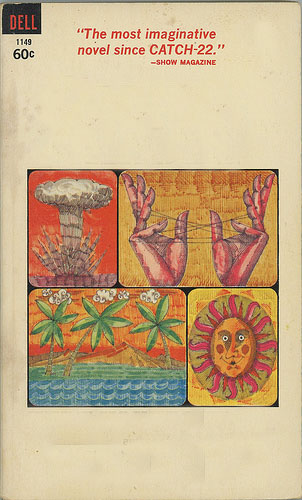
I’m on a Publisher’s Weekly listserv, and today they had the fifth installment of a challenging game on their website. They posted original book cover art for classic works of literature with the title and author removed. I had a fun time with it, and if you are a literature junky, you may too.
I’ll provide links if you are interested in checking it out.
Can You Guess These Classic Books From Their Phantom Covers [Installment 1]
Can You Guess These Classic Books From Their Phantom Covers (Round 2)
Can You Guess These Classic Books From Their Phantom Covers (Round 3)
Can You Guess These Classic Books From Their Phantom Covers (Round 4)
Can You Guess These Classic Books From Their Phantom Covers (Round 5)
Here is an easy one so you can get a feel for what I’m talking about. Most are much harder.






 Tiger Riding for Beginners