BOOK REVIEW: You Only Live Twice by Ian Fleming

You Only Live Twice (James Bond, #12)You Only Live Twice by Ian Fleming

My rating: 3 of 5 stars

When the film Casino Royale came out, it was panned by Roger Ebert, but not because it was a bad film. What Ebert didn’t like about that movie was that it looked and felt a lot more like the lead should have been named Jason Bourne rather than James Bond. In other words, Daniel Craig portrayed the super-suave secret agent with a license-to-kill as a gritty brawler and not the superman who could take on a swarm of SPECTRE henchmen without getting dust on the labels of his impeccable Armani. The latter is the archetypal James Bond.

The problem for film-makers is that the old Bond hasn’t aged well and seems a more suitable basis for Austin Powers’ style parodies than gripping thrillers.

You Only Live Twice is an entertaining read, but it’s best described as delightfully campy. However, it wasn’t meant to be camp when it came out. That being said, the film–which bears only a superficial resemblance to the novel–made changes specifically to make the storyline make more sense (that’s an odd twist for Hollywood.)Specifically, the arch-villain’s motivation doesn’t seem to make much sense in the novel. We are supposed to accept that the fact that the man is mad and evil to the core is sufficient for him to do something randomly quasi-evil, even if it offers him no benefit.

The synopsis is as follows: At the beginning, we find James Bond in turmoil. His wife died in the last book (within 24 hours of their marriage), and Bond has taken it hard. Since then he’s botched a couple of missions. He’s called into M’s office and thinks he is about to be canned. (He’s almost right.) Instead, M sends him on an assignment to Japan. It’s a challenging mission, but–theoretically–one of a diplomatic nature. Bond is to get Japan to turn over information from a code breaking technology they’ve developed. The Japanese only give this information to the U.S., and America is spotty at passing on relevant information to Britain.

Bond strikes up a friendship with “Tiger” Tanaka, who has no use for the bargaining chip which Bond has to offer. However, Tanaka agrees to hand over the information if Bond will take care of a delicate situation for Japan. In the country’s remote south, a European has set up a “toxic garden” of poisonous plants, animals, and insects. This garden has become a Venus flytrap for (the apparently infinite waves of)suicidal Japanese people.

Bond agrees to the proposal, and latter finds out that the European horticulturist is actually none other than the arch-nemesis who killed his wife, one Ernst Stavro Blofeld. Bond spends a couple of days in a fishing village reconnoitering and establishing the book’s romantic interest in the form of Kissy Suzuki–a pearl diver who was for a brief time a Hollywood starlet.

Bond makes his ninja-like infiltration of the Blofeld castle. I won’t get into how the climax of the book unfolds, but needless to say our hero wins the day.

The most thought-provoking part of the book may just be what happens after Bond finishes his mission. At the mission’s end, he develops amnesia as a result of a head injury. This amnesia makes the book’s title apropos.

There are some interesting themes addressed in the book. For example, there is considerable discussion of the difference of perspective on suicide between the West and Japan. Japan retains some of the samurai era notion that suicide can be used to restore honor, while Bond defends the Western view that suicide is a cowardly out. Still, while the Japanese attitude toward killing oneself when added to the stresses of a Japanese lifestyle (e.g. salaryman living) has resulted in a somewhat heightened suicide rate, the issue is greatly exaggerated to make the premise of Blofeld’s “Death Garden” seem remotely credible.

There’s also a great deal of discussion of Britain’s decline and America’s rise. Great emphasis is put on the fact that the Pacific is “America’s domain” and that the Brits have to be sneaky to operate there–lest they be at the mercy of their former colony.

This novel (and its film) introduced many exotic elements of Japanese culture to an audience beyond the Japanophiles for whom they were no surprise. This exotica includes ninja (spies of medieval Japan), fugu (poison blowfish–a potentially lethal delicacy), and Geisha (female entertainers and escorts.) It’s clear Fleming put some research into these matters. However, it also seems like he picks every element of Japanese history and culture that Westerners would find odd and unusual. At some points, one wonders what stereotype Fleming will next exploit.

There are a lot of patently ridiculous happenings in the book. At one point while Bond is hiding out on the grounds of the garden in a manner reminiscent of the ninja of old, biding his time, he decides that he simply must have a cigarette. Now, I’m not going to get into the plausibility of someone with that bad of an addiction having been able to swim a mile through waters with treacherous currents after having spent a few days rowing out to pearl dive. However, the notion that a special operative would light up in the middle of a covert operation is pretty far-fetched. It’s like saying, “I don’t care if this mission succeeds or even if you kill me, I’m going to have my Marlboro moment.” Some readers may think I’m engaging in hyperbole, but not those of you who’ve been in the military. The scent of cigarette smoke is extremely potent, and then there’s the glow. You don’t get out of boot camp without learning that you don’t smoke on LP/OP (Listening Post / Observation Post,) let alone into Her Majesty’s Secret Service.

Bond’s transformation through makeup into a person who looks passably Japanese is another point at which credulity is strained. This make up survives ocean swims, fights, and even after the mission when Bond has amnesia, he can’t recognize that he, himself, looks nothing like the villagers of his hometown hamlet. (Tiger Tanaka has a card printed that says that Bond is deaf and dumb to get around his inability to speak the local language. [Props to Fleming for not going the Hollywood route and making his spy fluent in every imaginable language.])

The most ridiculous piece of the book involves an elaborate machine works that Blofeld uses to make the volcano let off liquid hot magma every 15 minutes like clockwork. He has this ready in anticipation of a need to test whether a victim can understand his instructions to get up and walk out to avoid being burned with hot lava. If Bond understands, he must not be deaf and dumb like the card says, and if he stays put–oh, well, he’s just a deaf and dumb coal miner who went sleepwalking in his ninja suit and ended up inside the heavily guarded castle retreat of the SPECTRE leader. What’s more, he puts the control for this Rube Goldberg contraption where the interrogated can see it (a fact that Bond later puts to use), and even though it’s inside a box, Bond knows exactly what it must be (he’s just that good.)

And, of course, in the most mocked device in this genre, Blofeld gives a long speech when he should be killing Bond.

You’ve got to read this with a certain mindset, and if you want a realistic, gritty thriller you’re not in the right mindset.

View all my reviews

As I said, the movie doesn’t have a whole lot to do with the book besides borrowing some character names and a few scenes. However, below is the trailer for the movie.

BOOK REVIEW: Detective Story by Imre Kertész

Detective StoryDetective Story by Imre Kertész

My rating: 5 of 5 stars

Amazon page

Hungarians have won their fair share of Nobel Prizes–more than most for a country of Hungary’s size. However, these awards are overwhelmingly in the hard sciences, and so you’ll be forgiven for not being familiar with the country’s sole Nobel Prize winner in Literature to date. If you’ve read Imre Kertész, you probably read Fateless (Sorstalanság.) Fateless (aka Fatelessness) is his semi-autobiographical novel about a boy in Auschwitz.

Detective Story is a short novel (some might call it a novella) whose protagonist is a rookie torturer for the secret police of an unnamed Latin American dictatorship. As the novel begins, we find that the protagonist, Antonio Martens, is on death row. The novel is written as his death row journal of how he came to be in this predicament. It tells how Martens came to have his despicable job, but mostly it describes the one case that was his undoing. That case involved the arrest of the son(Enrique Salinas)of a powerful, wealthy, and well-connected merchant, and the subsequent arrest of the merchant himself (Federigo Salinas.)

Being a Holocaust survivor, Kertész is intimately acquainted with the mixed bag that resides within all of us. It’s hard to imagine a more detestable person than one who would torture confessions out of people who are either political dissenters or who are altogether innocent. Kertész subverts our expectations by showing us a perfectly ordinary and likable chap who has a distaste for his work, but thinks that he is defending his country. As they say, Hitler was probably a likable enough fellow in his own mind. So we see Martens’ rationalizations that allow him to do what he does. We also see how he is trapped by the system. He wants to be reasonable, but, once inside, the system won’t let him be.

This theme of being trapped is not applied to the main character alone. The idea that underlies the entire story-line is that an authoritarian regime’s secret police has one shot to get it right, and that’s before the arrest is made. Once they made the arrest, the men involved (the protagonist’s boss and his boss’s boss)felt compelled to move in one direction, even once they realized that they were wrong and that each additional step was only digging their grave deeper. At one point Martens’ boss’s boss, the Colonel, asks what they should do, and the rookie interrogator unwisely suggests that they should let both the father and son go–even given their tortured appearance. However, a dictatorship is built on a fiction of infallibility, and to admit being mistaken is to become vulnerable.It’s like Machiavelli’s advice to the prince that while it would be nice to be both loved and feared, if one has to make a choice, it’s safer to be feared.

There is another character into which we gain insight, and that is Enrique Salinas. Most of this insight comes from excerpts of Enrique’s journal that Martens presents us. We see that Enrique is badly depressed and is questioning whether there is even a point to living. We find out from the interrogation of Federigo that Enrique’s “suspicious activities” are really just wild-goose chases designed to satiate Enrique’s need for adventure and purpose in a safe manner. We also find out that Enrique longs for the authorities to put him to death–suicide by authoritarian regime, if you will. So the idea that the secret police will be punishing the young heir by putting him to death is just another way in which expectations are turned on their head in this novel.

If you only read one book by Imre Kertész, perhaps it should be Fateless, but I’ll contend you have room for this short work as well.

View all my reviews

CLASSIC WORKS: Bushidō by Inazo Nitobe

Bushido: The Soul of JapanBushido: The Soul of Japan by Inazo Nitobe

My rating: 4 of 5 stars

Amazon page 

On the whole, people are ambivalent about feudal times. On the one hand, it was a horrible time to be alive for 99.5% of the population. Chances are that if you’d lived during that time you’d be toiling ceaselessly on the land with no hope of improving your lot in life. Everything was determined by heredity, with merit having little to do with anything. This added insult to injury because that person you’d have had to suck up to was as likely to be putz as not.

On the other hand, there is widespread nostalgia for those times because one can’t help but feel that they were the golden days of virtue. As Ralph Waldo Emerson said, we think that society is ever advancing, but, in reality, we advance like a wave–losing as much on the backside as we gain on the front.

Inazo Nitobe’s book gives us an accounting of the chivalric virtue practiced by the samurai, the warrior class of feudal Japan. Bushidō means the way of the warrior. Nitobe lived after Japan’s feudal era, in the late 19th and early 20th centuries. Nitobe was an educator, and the book has a feel of erudition. Interestingly, the author was a Quaker and received education in the West, and, therefore, is able to contrast the Japanese worldview with that of Westerners.

The book is built around discussion of the seven virtues of bushido: justice, courage, benevolence, politeness, sincerity, honor, and loyalty. Each of these virtues has a chapter devoted to it (Ch. 3 through 9.) But first the book introduces bushido as an ethical system, and then it explains the effect that Buddhism, Shintoism, and Confucianism played in the development of this system.

Later chapters outline the education and training of a samurai, the importance of stoicism, the institution of suicide (seppuku), the symbolism of the sword in Japanese society, the role of women, the role of bushido as an ethical system in the present-day (his present), and its proposed role in the future. It is interesting that the book begins by discussing those things that influenced the development of bushidō, and it ends with discussion of how bushidō influences the larger world.

Our views of virtue have changed, but at some level remain consistent. The seven virtues are all still considered virtuous, but we don’t regard them in the same way today. In some cases we are undoubtedly better off with today’s views, but that’s not always the case.

Consider the seventh precept, loyalty. We still value loyalty, but in today’s world the rule of loyalty has an ever-present Shakespearean addenda: “to thine own self be true.” In other words, we no longer believe in loyalty that is blind as was valued in the days of old.

Sincerity, by which Nitobe generally means honesty, is also seen in a different light today. As depicted in the Jim Carey movie, Liar Liar, there’s a widespread view that it’s better to fib and make someone feel better than it is to tell the truth and hurt that person’s feelings.

One of the most intriguing chapters is the one that deals with seppuku. This is a concept that has never been well-understood in the West, and it’s a major point of cultural disconnect. While the Japanese have tended to see suicide as a means to restore honor that was lost in failure, in the West we tend to see it as a more pathetic and cowardly affair. I’ve recently been reading Ian Fleming’s You Only Live Twice, and this is one of many points of diverging attitudes between “Tiger” Tanaka and James Bond.

Bushidō is definitely worth a read. It’s thought-provoking, and is one of those books to be read slowly and conscientiously.

View all my reviews

BOOK REVIEW: Einstein’s Dreams by Alan Lightman

Einstein's DreamsEinstein’s Dreams by Alan Lightman

My rating: 4 of 5 stars

Amazon page

One might think that a novel written by a physicist would make for dreadful reading–and most of the time one would probably be correct. However, Lightman’s Einstein’s Dreams is a fascinating read. The arc of the book–what makes it a novel rather than a series of short scenes–is conveyed by a prologue, a few interludes, and an epilogue. These brief sections show an Albert Einstein as he went about life trying to work out his special theory of relativity.

In between the interludes are a series of written sketches that depict dreams that might have been had by Albert Einstein between April 14th and June 28th of 1905. Each of these dreams depicts an alternative universe in which time is not experienced as we experience it: that is, as an inexorably flowing river with a clearly defined arrow. In one dream, time is circular. In another, a lifetime is compressed into a day. In another, there is no flow of time; the world is a snapshot. In another, immortality is the norm. In the latter dreams of the book, we see a convergence on time as we know it–though in dream-like abstraction.

This short book is both creative and well-written. Lightman excels at creating scene through vivid description. His approach to structure is unique.

One thing that might have improved the book is if the author had been a little bolder. Lightman feels the need to explicitly state what is going on in each dream world. However, his description is strong enough that such discussion is generally anti-climactic–one already knows how time is working (or not working) in a given universe before the author states it explicitly. Thus, these explicit descriptions succeed only in taking one out of the dream.

View all my reviews

CLASSIC WORKS: Slaughterhouse-Five by Kurt Vonnegut

Slaughterhouse-FiveSlaughterhouse-Five by Kurt Vonnegut

My rating: 4 of 5 stars

Amazon page

If you’re like me, you had to read this in high school. I reread it as an adult because the first time its awesomeness was tarnished by the fact that it was mandatory. Being a pessimistic youth, my thought was, “How good could it be if they are making me read it?” They don’t make you read Batman; they make you read Moby Dick. I’m glad I reread it as an adult. Little did I realize, my knee-jerk rejection of the book as something forced upon me, beyond my control, was mirrored by the theme of the book.

Slaughterhouse-Five tells the story of Billy Pilgrim, an optometrist who survived the Dresden fire-bombings was abducted by an alien race and became “unstuck in time.” If you didn’t get this impression, the book is strange. As the term “unstuck in time” suggests, there isn’t a chronological sequencing of events. Instead, the story leaps around from Pilgrim’s adult life as an optometrist to his time as a young soldier in the military to his time as an exhibit in a Tralfamadorian Zoo.

While the novel covers a lot of life, many of the important themes are seen in protagonist’s war experience. It should be noted that there is an autobiographical component to this book. Vonnegut was a prisoner of war who was ordered to help dig for survivors in the wake of the fire-bombing of Dresden. This gave Vonnegut a unique perspective of war and how similarly it is experienced by the enemy. An important line of tension in the book is between Pilgrim’s character and that of the jingoistic Roland Weary.

The Tralfamadorian subplot has a lot to do with being out of control, and learning that perceptions of control are illusory. This is exemplified by the time jumps, which leave Pilgrim completely unable to predict what will happen next. Then there is Pilgrim’s experience being exhibited in an alien zoo, what  could be less in control than that.

Like most of Vonnegut’s work, Slaughterhouse-Five is a dark comedy. There is humor throughout, but humor wrapped in the macabre. For example, whenever anyone dies there is a chorus of “So it goes.”

Everyone should read this, and reread it if necessary.

View all my reviews

MASTER WORKS: Apology by Plato

ApologyApology by Plato

My rating: 5 of 5 stars

Amazon page

Apology is Plato’s account of the trial of Socrates. This brief work presents Socrates’ defense of himself as well as his reaction to the death sentence verdict against him. Of course, it is all through the lens of Plato, as Socrates left us no written works.

Socrates was charged with impiety and corruption of the youth. He acknowledged both that he was eloquent and that he was a gadfly of Athens (the latter being a role for which Socrates believes he should be valued.) However, he denied both of the formal charges.

Socrates refuted the charge of corrupting the youth first by denying that he had taken money in exchange for teaching. Taking money was a component of this charge. Socrates’ claim is supported later when Socrates tells the court that he can only afford a very small fine, even in the face of the alternative–a death sentence.

Socrates says that he sees nothing wrong with taking money for teaching–if one has wisdom to share. Socrates says that he has no such wisdom, and suggests the philosopher/teachers that are taking money aren’t in error for taking money, but rather because they really don’t have wisdom themselves.

This is summed up nicely by this pair of sentences, “Well, although I do not suppose either of us knows anything really beautiful and good, I am better off than he is–for he knows nothing and thinks he knows. I neither know nor think I know.”

While Socrates raised the ire of the Athenian leaders with what they no doubt believed to be his arrogance, in fact it wasn’t that he thought himself wiser than they, but that he thought they were deluded in thinking themselves wise.

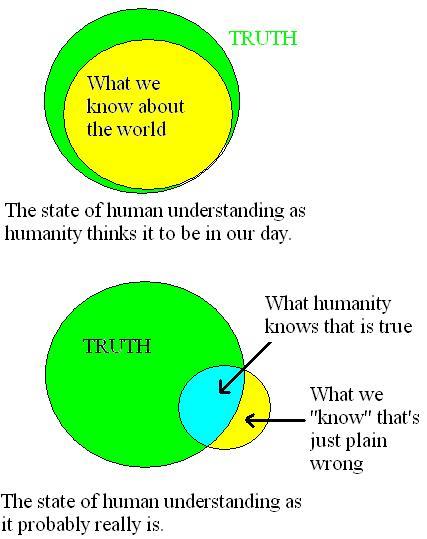
Socrates’ lesson remains valid today. It is the scourge of all ages to think that have finally attained true understanding of the world. Our posterity may know more, but we know all of the essentials and are rapidly converging on a complete picture of our world. We think our generation to be humanity’s sage elders, when, in fact, we are the impetuous teen whose growth spurt has made him cocky. I would propose to you that in all likelihood, even today, the sets of “that which is true” and “that which humanity ‘knows'” form a classic interlinking Venn Diagram. That is, some of the body of knowledge that we take to be proven true is, in fact, false. This occurs because we cannot accept that there are things we are not yet prepared to know, so we use sloppy methodology to “prove” or “disprove.” This one reason we have all these conflicting reports. E.g. coffee is good for you one week, and carcinogenic the next.

VennDiagram_WhatWeKnow

Socrates uses the method that today bears his name, i.e. the Socratic method, to challenge the arguments of Meletus, the prosecutor. The Socratic method uses questions as a device to lead the opposition to a conclusion based on premises they themselves state in the form of their answers. Socrates proposes that if it is he alone who is intentionally corrupting the youth, they would not come around–for no one prefers to be subjected to evil rather than good.

Socrates denies the suggestion that he does not believe in the gods, and in fact indicates that the very suggestion by virtue of the charges against him is a contradiction. What Socrates is guilty of is encouraging those who come around him to develop their own thoughts on god, and not to subordinate their thought to anyone–an idea the leaders found disconcerting.

Socrates goes on to say why he is unmoved by the death sentence. He wonders why it is thought he should beg and wail, when he doesn’t know for sure that an evil is being done against him.

The moral of the story is that those in power fear and will attempt to destroy advocates of free thinking.

This book should be read in conjunction with a couple other Platonic Dialogues, Crito and Phaedo.

View all my reviews

MASTER WORKS: The Taming of the Shrew by William Shakespeare

The Taming of the ShrewThe Taming of the Shrew by William Shakespeare

My rating: 5 of 5 stars

Amazon page

This is one of Shakespeare’s most controversial works, and debates still rage about whether its misogyny was written tongue-in-cheek, was a product of the times, or was indicative of a dark side of The Bard.

The plot revolves around two sisters, Katharina and Bianca, and their suitors. The younger sister, Bianca, is a catch and has many suitors vying for her affection. However, Katharina is, in the terms of Shakespeare’s day, shrewish. She is out-spoken, strong-willed, and on occasion downright bitchy; characteristics that weren’t particularly marriageable back in the day.

The father of the two girls will not allow Bianca to be wed until Katharina, his elder daughter, is also engaged. However, no man is willing to take that bullet so that one of his buddies can marry the much beloved Bianca. That is until Petruchio enters the scene with his friend Lucentio. Petruchio could use the lucrative dowry and believes himself equal to the task of taming the shrewish Katharina. Petruchio’s decision makes Lucentio (not to mention Gremio and Hortensio, i.e. the other suitors) extremely happy.

Petruchio’s approach to taming is to be hyper-sensitive to Katharina’s complaints. She gets no food to avoid her inevitable gripes about the food’s quality. Since no gown would be good enough, she gets no new clothes. These actions are designed to train Katharina to bide her tongue.

Like all Shakespeare, the language is phenomenal.

Like all Shakespeare, everyone should read this work.

I’m curious about people’s feelings regarding this play.

View all my reviews

BOOK REVIEW: A Dead Hand by Paul Theroux

A Dead Hand: A Crime in CalcuttaA Dead Hand: A Crime in Calcutta by Paul Theroux

My rating: 4 of 5 stars

Amazon page

A Dead Hand opens with the protagonist, Jerry Delfont, receiving an unexpected and unusual letter. Delfont is a traveling writer who is temporarily in Calcutta. The letter is from an American businesswoman and philanthropist who seems to have gone native in India. The woman, Merrill “Ma” Unger, asks Delfont to investigate a mysterious event involving her son’s boyfriend, a young Indian man named Rajat.

Rajat claims to have woken up one night in his cheap hotel room to find the dead body of a boy on the floor. Rajat panicked and left, and is living in fear that he will be picked by the police.

The book in part traces Delfont’s investigation of this mysterious body, and in part describes his burgeoning relationship with “Ma” Unger. The former is slow going through the first 2/3 of the book, and at some points one wonders if Delfont has forgotten about the investigation altogether.

The title has a dual meaning. It describes both the writer’s block Delfont is suffering at the beginning of the book and the actual physical hand that turns up as the sole remaining trace of the dead boy who turns out really was in Rajat’s room.

Coming from famed traveling writer Paul Theroux, it’s no surprise that the development of setting is phenomenal. Theroux not only gives one a sense of the sights, sounds, and scents of Calcutta, he also gives the reader insight into the human dimension of India through a number of supporting characters. There is a passionate young woman who writes poetry and practices the Indian martial art of Kalaripayattu. She is a strong, bright, and independent woman but is stuck in a world of arranged marriages and sexual repression. Despite the official end of the caste system, we see completely subservient Indians as well as others who think they are beyond talking to a lowly writer.

The plotting is solid. It’s neither exceptional nor so flat or formulaic as to be boring. I, who am not particularly good at foreseeing plot twists, did anticipate the ending–at least in broad brush stroke terms. However, the book kept me interested and reading. There was a clear narrative arc and the main character definitely undergoes a change over the course of the book (more on that below.)

In my opinion, the book’s weakness is in character development, and specifically Delfont’s character. We are introduced to a Delfont who is having a tough time, but is essentially a likable guy with his head on straight. However, as he begins to fall for “Ma” Unger, he seems increasingly pathetic. Specifically, he falls into this weird relationship in which he seems to see her both sexually and maternally, and–like a schoolboy with a crush–he wants to do anything he can to please her and to gain her attention. Now, being pathetic is a little like being crazy. If the character knows or suspects they are crazy, then how crazy can they really be? Because Delfont recognizes he’s being pathetic, he remains a sympathetic character. However, I think Theroux over hammers the degree to which Delfont is smitten until we begin to think he is obsessed. The problem is that it makes his transformation and that of his relationship with “Ma”, which happens like the flip of a switch, less credible.

All and all, I would recommend this book. I think it’s particularly interesting for one who wants greater insight into India and, specifically, Calcutta.

View all my reviews

BOOK REVIEW: Smile When You’re Lying by Chuck Thompson

Smile When You're Lying: Confessions of a Rogue Travel WriterSmile When You’re Lying: Confessions of a Rogue Travel Writer by Chuck Thompson

My rating: 4 of 5 stars

Amazon page

Smile When You’re Lying gives the reader an insider’s view of the deceit rife in travel writing. In the process, Chuck Thompson tells a story of life on the vagabonding circuit. Instead of being a story of idyllic and pristine white sand beaches, it’s the story of drug- and booze-riddled expats and the prostitutes they frequent.

Thompson lived a colorful life. He tells of how his interest in Thailand began when he heard stories while in a jail in Alaska. He introduces cast of characters, such as Shanghai Bob, many of who are even more colorful than he. It’s this wild living that makes the book an interesting read, but, ironically, it also makes such stories impossible to sell to any of the travels magazines–all of which make money off of advertiser dollars, advertisers who have an interest in making travel seem safe, clean, and family-friendly.

Thompson tells of how he began teaching English in Japan, a common point of origin for expats taking to Asia. Japan has a large and well-developed program, called JET, that brings native English speakers to Japan to teach language or work in government offices as translators.

In addition to the intro on Thailand, a chapter on his Alaskan youth,and one on his JET days, there are chapters on Latin America, the Caribbean, the Philippines, and Eastern Europe. Furthermore, there is a chapter that lends travel advice for aspiring travel writers and one about what travel mags don’t want readers to know. It should be noted that besides having written for such magazines, Thompson did a stint as an editor as well.

Thompson also devotes a chapter to countering the myth that Americans are–on the whole–bigger travel bastards than the people of other Western nations.

If you are interested in travel writing or vagabonding, this is a worthwhile read.

View all my reviews

BOOK REVIEW: 101 Great American Poems ed. The American Poetry and Literacy Project

101 Great American Poems101 Great American Poems by The American Poetry and Literacy Project

My rating: 5 of 5 stars

Amazon page

This is a collection of 101 poems by 39 different American poets. It begins with a poem by Anne Bradstreet in the 17th century and proceeds through to a work by W.H. Auden of the 20th century. In between are many poets that one would expect, such as Poe, Whitman, Dickinson, Sandburg, and Cummings. There are others that might be unexpected such as Abraham Lincoln, Herman Melville, and Stephen Crane. While the poems aren’t all jingoistic in nature, there is a recurring theme of celebration of America.

Most of the poems in this tiny anthology will be familiar to poetry readers. This is a $1 Kindle e-book of a Dover Thrift Edition, and so one won’t find living poets represented, or poems that tap into the zeitgeist du jour— at the risk of mixing loan words. However, most of these poems deserve to be read and reread.

A few of my favorites are below with title, author, and a fragment.

The Builders by Henry Wadsworth Longfellow
Nothing useless is, or low;
Each thing in its place is best;
And what seems but idle show
Strengthens and supports the rest.

The Raven by Edgar Allen Poe
Once upon a midnight dreary, while I pondered, weak and weary,

O Captain! My Captain! by Walt Whitman
O Captain! my captain! our fearful trip is done,
the ship has weather’d every rack, the prize we sought is won,

I’m nobody! Who are you? by Emily Dickenson
I’m nobody! Who are you?
Are you nobody, too?
Then there’s a pair of us–don’t tell!
They’d banish us, you know

The New Colossus by Emma Lazarus
“Give my your tired, your poor,
Your huddled masses yearning to breathe free,…

Solitude by Ella Wheeler Wilcox
Laugh, and the world laughs with you;
Weep, and you weep alone

War is Kind by Stephen Crane
Do no weep, maiden, for war is kind

Sence You Wend Away by James Weldon Johnson
Seems lak to me de stars don’t shine so bright,

Sympathy by Paul Laurence Dunbar
I know what the caged bird feels, alas!
When the sun is bright on the upland slopes;

Fire and Ice by Robert Frost
Some say the world will end in fire,
Some say in ice.
From what I’ve tasted of desire
I hold with those who favor fire

The Road Not Taken by Robert Frost
Two roads diverged in a wood, and I–
I took the one less traveled by,
And that has made all the difference.

Chicago by Carl Sandburg
They tell me you are wicked and I believe them, for I have seen your painted women under the gas lamps luring the farm boys.

Fog by Carl Sandburg
The fog comes
on little cat feet.

Thirteen Ways of Looking at a Blackbird by Wallace Stevens
Among twenty snowy mountains,
The only moving thing
Was the eye of the blackbird;

The Red Wheelbarrow by William Carlos Williams
so much depends
upon

a red wheel
barrow

The Love Songs of J. Alfred Prufrock by T.S. Eliot
The yellow fog that rubs its back upon the window-panes,

First Fig by Edna St. Vincent Millay
My candle burns at both ends;
It will not last the night;
But ah, my foes, and oh, my friends–
it gives a lovely light.

Ars Poetica by Archibald Macleish
A poem should not mean
But be

I, Too by Langston Hughes
I am the darker brother.
They send me to eat in the kitchen
When company comes,

Little Old Letter by Langston Hughes
You don’t need no gun nor knife–
A little old letter
Can take a person’s life.

Nothing struck me as conspicuously absent from this collection, but I’d be curious what poems people feel should (or shouldn’t) be in such a collection.

View all my reviews