Taken in December of 2015 in Hoi An





Taken in March of 2014 at Namdroling Monastery

Taken in September of 2015 in Bangkok

Taken in January of 2016 at Chennakesava Temple in Somanathapura
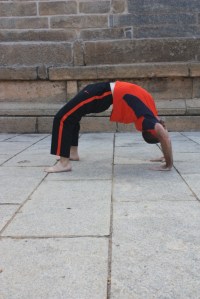 The good news is that yoga can help one lose weight. The bad news is that the mechanism by which this occurs isn’t what most people expect, and it involves the mind a great deal more than the muscles.
While many people hope for a secret to weight loss, there’s no secret. Weight loss is a function of calories eaten being less than calories burned. This simple formula means that one can either eat less or exercise more. Both the diet and exercise matter for good health, but the eating part is more important to cutting weight. This statement may be controversial and seemingly gratuitous—particularly for people who think exercise is going to single-handedly shed excess pounds–and so I’ll take some time to try to make my point.
The first thing one should know is that our voluntary activity only accounts for about one-third of calories consumed. The other two-thirds are used whether we move a muscle or not. Between 20 and 25% of our energy consumption is devoted to our brain, and much of the rest is used to keep us at 37°C (98.6°F) because we are, after all, mammals. This means that increasing the intensity or amount of exercise—while it has tremendous health benefits—will achieve only a marginal increase in calories burned. From the Mayo Clinic website, I learned that a 109kg (240lb) individual will burn about 273 calories doing a typical hata yoga class or about 436 calories with Power Yoga. (Compare this to about 327 calories / hr. for tai chi or 654 calories / hr. for hiking.) So your hour of yoga has maybe knocked off a 32oz soft drink or one medium size French fries. Most people have trouble finding more than one hour of time and energy for exercise per day. And as someone who sometimes spends more than an hour a day exercising, I can attest that there is a point of diminishing marginal returns. So while exercise is an important part of weight loss, one can’t go hog-wild in eating just because one exercises.
[One should also note that many yoga practitioners experience a reduced basal metabolic rate (BMR) because of the calming aspect of the practice. A lower BMR means that you burn fewer calories just living and maintaining your metabolism. All things being equal, this makes cutting weight all the more challenging—though the effect is certainly counterweighted by the stress reduction aspect of the practice that will be discussed below.]
To summarize: unless you’re an elite athlete in training for something like the Olympics, the idea that you can eat whatever you please and cut / maintain a healthy weight is likely to result in disappointment. A common piece of dietary advice for elite athletes is to daily eat one gram of protein for every pound of ideal bodyweight and eight fist-sized servings of vegetables. Beyond that, they can pretty much eat what they want. But with that much slowly digesting material, they’re probably not going to go overboard—even if they weren’t already, almost by definition, very disciplined people.
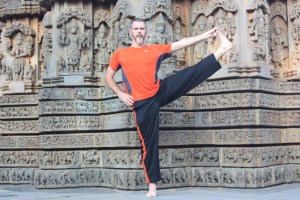 So if an hour of yoga a day doesn’t even make up for having a Mars bar, what good is it? For one thing, the yoga student has the opportunity to become more attuned to his or her body and, in doing so, to learn to differentiate physiological hunger from the many other permutations of hunger that overtime merge into a multi-headed hydra of craving. What are these other hungers? First and foremost, there’s psychological hunger, or the use of food as therapy. People use food to reward themselves, to medicate themselves, to take their minds off of their woes. Secondly, there’s sensory hunger in which we have no real need to eat but the food looks or smells too good to avoid.
One of the forms of hunger that often remains hidden is social hunger. That is, one eats to be part of the in-group and to bond. For example, imagine you’ve just eaten, are not hungry, and someone offers you food. Depending upon who it is and what your relationship is that person, you may feel compelled to eat even if you don’t need it. The double whammy is that eating as socializing is so deeply engrained and that we humans—contrary to popular belief—are dismal at multitasking. We can’t converse and be aware of what we are eating, and thus one may overeat because one is so engrossed in the distraction of socializing. This isn’t to say that there is anything inherently wrong with social eating. We all have to do it to some degree or another. One just needs to recognize that if it becomes a habit to be distracted from one’s food, one may have problems.
Relating back to the idea of psychological hunger, yoga helps one destress. Stress can be a perfectly healthy phenomenon, but when it’s prolonged it can have many adverse consequences. One such consequence is having cortisol levels remain too high, and this has the effect of ramping up the appetite. Your body has been pressed into fight or flight mode, it expects that you’re hauling ass away from a sabretooth tiger or an angry woolly mammoth mamma, and that you’ll soon need to replenish depleted energy stores. Your endocrine system doesn’t know that you’re curled up on the couch with a pint of ice cream… yeah, let’s call it a “pint.” As a form of exercise, yoga helps reduce this problem. However, beyond exercise, yoga offers many relaxation techniques such as yoga nidra, kaya sthairyam, restorative postures, and some forms of pranayama(breathing exercises) that can help you turn off the “fight or flight” and turn on the “rest and digest”—what Herbert Benson called the “relaxation response.” Sometimes you might delve into an intense practice like Ashtanga Vinyasa or Power Yoga, and other times restorative yoga might be just what the doctor ordered. [Disclaimer: “What the doctor ordered” is a figure of speech. I’m not a doctor, and I haven’t even played one on TV.]
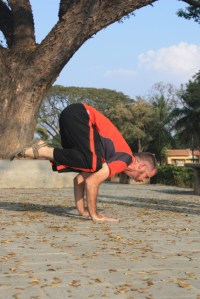 There is yet another way in which yoga can help. Yoga helps one dispassionately observe one’s drives and this way one can slowly, over time, rewire one’s attitudes toward food. One can begin to think of hunger pangs as a sensation, rather than projecting a negative connotation onto them. In this way, one can learn to begin to watch the sensation and learn from it rather than running for the food.
Finally, an important benefit of yoga is in teaching one to be contented with oneself, even if one isn’t content to live with one’s present health or physical capability. Santosa is one of the niyama, and it teaches one to be content with who one is–perhaps even while one is simultaneously practicing the austerities of tapas (another niyama) in pursuit of personal development. If one isn’t contented with oneself, one can fall into a shame spiral that may create the kind of persistent stress that I warned about above. Also, if one is at a healthy weight, but has some deep-seated drive toward “perfection,” the lessons of santosa can inform you as well.
Best of luck in the pursuit of good health.
 The Tell-Tale Brain by V.S. Ramachandran
My rating: 5 of 5 stars
A brain injury patient simultaneously becomes demented and develops a previously unwitnessed artistic talent. Another patient’s brain lights up identically when seeing another person being poked as it does when he, himself, is prodded. An amputee brushed on a specific area of the cheek has a sensation in a specific area of the lost limb—i.e. phantom limb sensations can be mapped to points on the face. A stroke victim develops “metaphor blindness,” and suddenly “the 800 pound gorilla” becomes an actual gorilla. A test subject’s right angular gyrus has an electrical charge delivered to it through an electrode and the person has an instantaneous out-of-body experience. There are temporal lobe epilepsy patients who literally feel one with other people—or, in some cases, the natural world in general. These are just a few of the fascinating cases that Dr. Ramachandran presents in “The Tell-Tale Brain.” Many of these phenomena would have once been attributed to purely psychological or spiritual causes, but now their biological origins in the brain are being revealed.
Dr. Ramachandran is a neuroscientist whose claim to fame is making a noteworthy contribution to our understanding of the brain using mostly low-tech and non-invasive experiments with subjects who have brain abnormalities or injuries. Before there was EEG (electroencephalogram) and fMRI (functional Magnetic Resonance Imaging) machines, much of what scientists learned about the brain came from determining what capabilities were lost (or, occasionally, gained) by patients who had specific brain damage. In this way, we gained a great deal of insight into what areas of the brain are responsible for what tasks and we’ve learned that many aspects of the mind that were largely thought to be beyond biology are—in fact–not. It’s fascinating to see what bizarre effects can result from brain damage or abnormalities, from people who think they are dead to others who want to have a limb amputated because it doesn’t feel like it belongs to them to yet others who think their loved ones are imposters.
The central question addressed by this book is best summarized by a quote from the book’s introduction: “Are we merely chimps with a software upgrade?” Ramachandran proposes that any answer to this question that can be scientifically investigated must reside in the brain. Most of our organs and our general structure are not that different from those of our primate brethren. But our brains are infinitely more capable than those of other species. In responding to the question, Ramachandran considers the brain’s role in topics like language, aesthetics, and belief that are the sole domain of Homo sapiens. One of the most interesting discussions is how our brains fill in the blanks and a give meaning to what we see, such that we sometimes find signs in random data streams. The final chapter deals with introspection and how we come to define ourselves by what we think and what we feel and here Ramachandran gets into some of the most fascinating conditions mentioned in the book, such as Cotard Syndrome in which subjects firmly believe that they don’t exist.
There are a few topics that he delves into in particularly deep detail. One of these topics is that of mirror neurons. These neurons are integral to our relationships with others and are essential to our ability to learn. They fire in mimicry of movement (e.g. facial expressions) we see others perform. The author also uses his work with phantom limbs and synesthesia to illuminate the workings of the brain. Phantom limbs occur when an amputee can still feel sensations in the amputated limb. While phantom limbs were at one time believed to be residue of the soul or the like, studies have offered insights into its origins in the brain. Synesthesia is when the brain is mis-wired such that there is a blending of the senses. As an example, a person might see a different color associated with each musical note or with each number. Synesthesia was once considered a delusion and people were institutionalized for this cross-wiring of the brain. Autism is also addressed in a chapter, and-in particular—the theory that this affliction may be linked to the mirror neurons.
I found this book to be fascinating and insightful. While it delves into our tremendously complex brains, it does so in a readable and comprehensible manner. The fact that Ramachandran’s focus is largely on low-tech and relatively simple experiments means that one can readily understand them in a manner that one might not with studies based on fMRIs or EEGs.
I’d recommend this book for anyone interested in the magnificent human brain.

Taken in December of 2015 at the War Remnants Museum in Ho Chi Minh City

Life vests are a requirement for jewelry buying here.


Taken in December of 2015 in Bai Tu Long Bay

Of course, they give you a little mini-class on culturing pearls.
In Bai Tu Long Bay there’s floating Pearl Farm with a built-in jewelry store. It’s a little strange browsing jeweler’s cases with a bunch of people in life-jackets. On the way into the store they show you how pearls are cultured and harvested, presumably in an attempt to engender a sense of gratitude / reciprocity from those who are really psyched about it.