Unknown's avatar

About B Gourley

Bernie Gourley is a writer living in Bangalore, India. His poetry collection, Poems of the Introverted Yogi is now available on Amazon. He teaches yoga, with a specialization in pranayama, and holds a RYT500 certification. For most of his adult life, he practiced martial arts, including: Kobudo, Muay Thai, Kalaripayattu, and Taiji. He is a world traveler, having visited more than 40 countries around the globe.

BOOK REVIEW: The Devil’s Dictionary by Ambrose Bierce

The Devil's DictionaryThe Devil’s Dictionary by Ambrose Bierce
My rating: 5 of 5 stars

Amazon page


Like all dictionaries, it’s a collection of words and meanings, but this one is much more fun to read. Before it was compiled into a book, these entries were serialized in newspapers from 1881 to 1906. As might be expected, some of the definitions / jokes didn’t age well. However, a great many of them are as amusing as ever. In fact, because so many of the definitions revolve around people’s narcissism and self-serving biases, they may be more accurate and apropos than ever. (And lawyers and politicians continue to be fair game as the butt of a joke.)


Let me give a few examples of the aforementioned narcissism:

ABSURDITY, n. A statement or belief manifestly inconsistent with one’s own opinion.

ACQUAINTANCE, n. A person whom one knows well enough to borrow from , but not well enough to lend to…

ADMIRATION, n. Our polite recognition of another’s resemblance to ourselves.


Not all of the definitions revolve around humanity’s narcissistic worldview. While subjects like politics, economics, and religion are widespread, the entries cover the wide range of subjects one might see in your regular dictionary. e.g.:

CLARIONET, n. An instrument of torture operated by a person with cotton in his ears. There are two instruments that are worse than a clarionet—two clarionets.

CORPORATION, n. An ingenious device for obtaining individual profit without individual responsibility.

ECONOMY, n. Purchasing the barrel of whiskey that you do not need for the price of the cow that you cannot afford.

EDUCATION, n. That which discloses to the wise and disguises from the foolish their lack of understanding.

LOVE, n. A temporary insanity curable by marriage…

TELEPHONE, n. An invention of the devil which abrogates some of the advantages of making a disagreeable person keep his distance.


Despite being a work of the 19th century, Bierce held a more rational and scientific outlook than typical, and this can be seen in many definitions–some of which were probably considered outlandishly irreverent in the day. This helps to keep “The Devil’s Dictionary” relevant. e.g.:

FAITH, n. Belief without evidence in what is told by one who speaks without knowledge, of things without parallel.

FEAST, n. A festival. A religious celebration usually signalized by gluttony and drunkenness, frequently in honor of some holy person distinguished for abstemiousness.

GHOST, n. The outward and visible sign of an inward fear.

MIND, n. A mysterious form of matter secreted by the brain. Its chief activity consists in the endeavor to ascertain its own nature…

MONKEY, n. An arboreal animal which makes itself at home in genealogical trees.

MULATTO, n. A child of two races, ashamed of both.

OCEAN, n. A body of water occupying two-thirds of a world made for man—who has no gills.

PRAY, n. To ask that the laws of the universe be annulled in behalf of a single petitioner confessedly unworthy.


In addition to the definitions, there are many segments of verse or prose used to elaborate on the definitions. These excerpts are usually clever, humorous, or both. There are no graphics and so these snippets are the only use of examples and clarification provided. e.g.:

re: EPIGRAM: “In each human are a tiger, a pig, an ass, and a nightingale. Diversity of character is due to their unequal activity.”

I would highly recommend this book for those who like humor with language.

View all my reviews

BOOK REVIEW: How to Live on 24 Hours a Day by Arnold Bennett

How to Live on 24 Hours a DayHow to Live on 24 Hours a Day by Arnold Bennett
My rating: 3 of 5 stars

Amazon page


This is a book about free time management. Bennett proposes that one use one’s non-working hours for self-betterment, and offers advice on how to go about it. It’s a single volume from a larger tract entitled, “How to Live.”

The book was written in 1908, and it’s at once archaic and ahead of its time. How is it archaic? While the book is slim–less than 40 pages–it’s verbose by present-day standards. However, the prose isn’t so purple as to be unreadable. Also, some passages won’t be relatable to modern-day readers. (e.g. Bennett counters the argument—apparently common in early 20th century Britain—that one can’t start one’s day before one’s servants have awoken, and asking them to get up an hour or two earlier is so 18th century.)

More importantly, one must exercise caution because some of the advice isn’t sound in light of recent scientific research. The best example of this is the idea that one should summarily cut an hour and a half or two out of one’s sleep time. This can work for some, but as blanket advice it won’t produce wholly positive results. To be fair, there are still people giving this advice, e.g. Arnold Schwarzenegger. In my view, two incorrect principles inform this belief—one is wrong in my opinion, and the other is being gradually killed by science. The first is the Western attitude that rest is a form of weakness that we—unfortunately—are forced to put up with, but which we should try to minimize (and even be vaguely ashamed of.) Rest is an essential part of the productivity formula. (Bennett both recognizes and denigrates the value of downtime.) The second notion is that sleep is just rest for the mind. There’s substantial evidence that sleep plays a major role in memory consolidation as well as ramping up healing actions into full gear.

How is the book ahead of its time? Let me say that I mean ahead of it’s time for early 20th century Britain. In some parts of the world, the ideas I mention have been around for thousands of years. First, Bennett describes the importance of training the mind to not be in a constant state of flux, so that one can be less reactive and subject to petty impulses. Bennett doesn’t use the terms “meditation” or “mindfulness” (he talks about “concentration”), but what he describes is meditative practice. What he describes is a bit more cerebral than one would recommend for a beginning practitioners of meditation in light of what we know from the people who do this stuff really well (e.g. Buddhists and Yogis.) While Bennett says that the one can use any object of concentration, he recommends passages from Epictetus or Marcus Aurelius. (Two stoic philosophers.) Note: I’m not disregarding the virtue of reading and actively thinking about the ideas of the Stoics. I’m just saying that it may take some preliminary concentration work on breath or a mantra to get to a place where one can get what one wants out of it.

Second, the book suggests that one rethink one’s notion of happiness. Then, as now, it was common to think that—or at least behave as–if one accumulated enough wealth / stuff, one would achieve a state of happiness. Of course, there’s no evidence that that’s the case, and building evidence that it isn’t. Third, Bennett recognizes the folly of trying to make a massive change all at once. He suggests that one start with an hour-and-a-half a few times a week, and build from there as is manageable as long as time is available.

This volume consists of twelve chapters of a few pages each. The chapters start by introducing the premise—that one has 24 hours a day and roughly 16 of those are ones that one can use as one wishes. Bennett discusses why one would want to do more with this time, what the challenges are, and how one can structure a program of self-development. There are a couple of chapters that discuss the mind and concentration, as mentioned above. However, the program goes beyond mere concentration. There are chapters on the arts, serious reading, and dangers to avoid when starting such a program–as well as my favorite chapter entitled, “Nothing in Life is Humdrum.”

Perhaps the most controversial suggestion in the latter part of the book is that one shouldn’t include novels in one’s “serious reading” time. It should be noted that Bennett isn’t telling one not to read novels, he’s just saying that they shouldn’t be part of one’s mental development regime. Instead, he recommends poetry and non-fiction. His point is that novels don’t challenge the mind. One can certainly see how this is true of today’s sweatshop commercial fiction or the YA novels that dominate the best seller lists, but harder to understand why it’s true of “Ulysses” or “Moby-Dick.”

Given the proviso that one should take what is useful and discard the rest, I’d recommend one give this a read. It’s particularly ripe for consideration if one feels that one has surrendered one’s free time to social media, TV, and brain candy books.

View all my reviews

DAILY PHOTO: Our Lady of the Rosary

Taken in October of 2016 in Old Goa

Taken in October of 2016 in Old Goa


img_3382 img_3358

DAILY PHOTO: City Elephant

Taken in April of 2016 in Amritsar

Taken in April of 2016 in Amritsar

BOOK REVIEW: Sikhism: A Very Short Introduction by Eleanor Nesbitt

Sikhism: A Very Short IntroductionSikhism: A Very Short Introduction by Eleanor Nesbitt
My rating: 4 of 5 stars

Amazon page


I picked up this book before a trip to Amritsar. While Sikhs are arguably the most visually distinct religious adherents, it’s one of the least understood world religions with respect to internal aspects like beliefs and practices. And a major religion, it is. With 23 million followers, it’s between the fifth and eighth most widely practiced religion in the world (depending upon whether one aggregates traditional religions in China or Africa.)

This book offers a 150 page overview of what it means to be Sikh, and it explains it not only in religious, but also in cultural, political, and historical, terms. If one needs deep insight and great detail about Sikhism, this may not be the book for you. But it gives one the big picture quite nicely, and with a scholar’s balanced view (as opposed to that of a theologian.)

There are eight chapters in the book. The first chapter introduces one to Sikhism. Besides the basics, this chapter discusses what makes Sikhism a distinct religion, and how it has been influenced by other religions—most significantly Hindu and Islam, in that order. It also discusses what it means to be Punjabi, in contrast to what it means to be Sikh. To understand the subject of the second and third chapters, one has to know how the leadership of this religion unfolded. There were ten human teachers (Guru), and then a book of scriptures assumed the mantle of Guru. The second chapter is about the human Gurus (and mostly about the first one—Guru Nanak, with a little about the next four, and almost nothing about the last five.) The third chapter is about the Guru Granth Sahib, which is the book of scriptures that has served as the religion’s guide since the early 18th century.

Chapter four discusses Sikh religious practices–including the five K’s that serve to give Sikhs such a distinct physical appearance. The 5 K’s are: kesh (uncut hair), kanga (comb), kirpan (sword), kachh (cotton breeches), and kara (steel braclet.) While only the Khalsa (i.e. the community of initiated) necessarily practice all of these, it’s common to see at least some of these features among the community at-large. The wearing of turbans, beards (though often not completely uncut), and steel bangles are ubiquitous in Punjab. The chapter also delves into turbans, ethics, symbols, and the controversial question of vegetarianism (some Sikhs are and some aren’t.)

The fifth chapter offers a history of Sikhism over the past few centuries from the era of the Maharaja Ranjit Singh in the early 19th century to the dire events of early 1980’s (there was a massacre of Sikhs by government forces in 1982 and in 1984 Indira Gandhi was assassinated by Sikh bodyguards, leading to yet more violence.) Chapter 6 discusses the topic of Sikhs abroad. While Punjab is consider the Sikh homeland, there are Sikhs around the world—but particularly in a few areas where there numbers are sufficient to constitute a community—e.g. in the United Kingdom. Chapter 7 investigates the theory and practice of Sikhism with regards to a few key issues of life on the Indian subcontinent including: the caste system, gender, and attitudes toward other religions. (In many regards, Sikhism is comparatively progressive, but practice hasn’t always followed the scripture—e.g. high girl child infanticide rates.) The last chapter considers the future of Sikhism moving forward.

There are graphics of several types throughout the book—most notably black-&-white photographs. There are a few helpful ancillary features including a “Further Reading” section, a timeline, and a glossary of terms.

I found this book useful, and would recommend it for anyone seeking background on Sikhism.

View all my reviews

BOOK REVIEW: The Discourse Summaries by S.N. Goenka

Discourse SummariesDiscourse Summaries by S.N. Goenka
My rating: 4 of 5 stars

Amazon page


I began reading the summaries before I attended the Vipassana meditation 10-day course. While most of one’s days are spent in meditation, each evening they play video-taped discourses by S.N. Goenka, with each running for an hour to an hour-and-a-half. As the title suggests, this book consists of edited transcripts of those talks. As the course is known for being challenging (approximately 10 hours/day in meditation, noble silence [no talking–or even acknowledging–anyone but the teacher and staff], and no distractions [no phones, no books, no journals, no i-Pods, etc.]), reading the discourses was a way to mentally prepare for the course. (Though I’d already read a book call “Equanimous Mind” by an individual who’d completed the course.)

Let me provide background for those unfamiliar with Vipassana meditation. It’s nominally a Theravadan Buddhist practice, but its religiosity is stripped to a minimum and it’s presented in a largely secular manner. That doesn’t mean that a scientifically-minded skeptic such as myself isn’t occasionally left scratching his head and thinking “that’s not right.” However, it’s repeatedly emphasized that one should take what is of value to oneself and leave the rest behind, and so while there are a few notions mentioned during the discourses that aren’t supported by evidence, one needn’t believe anything controversial to benefit from the practice. (e.g. Karma and reincarnation are mentioned, but if one doesn’t believe those are likely realities, it doesn’t change the effectiveness of the meditation.)

Moving on, Theravadan Buddhism is the branch that is most commonly practiced in Southeast Asia. (It’s sometimes called Hinayana, but—as I learned during a discourse—that’s considered a derogatory term by many Theravadans. “Hinayana” means “lesser vehicle” in contrast to Mahayana’s “greater vehicle,” and the implication is that it’s a path by which only a more select group can achieve enlightenment. One can readily see why this would be objectionable to Vipassana practitioners as they emphasize that the practice is available to everybody [one need not even identify as Buddhist] and that the practice is the heart of the path to enlightenment.) Vipassana meditation involves systematically scanning one’s body for sensations and acknowledging them without attaching positive or negative thoughts and labels to them. The idea is to train oneself to not mindlessly react to sensations, nor to mindlessly attach values to them.

There are eleven discourses, corresponding to the days over which one is at meditation center. However, the new information is mostly in the discourses from days one through nine. The last two discourses consist of a review and a discussion of to how to keep one’s practice going—should one choose to do so.

The discourses present two types of information. On one hand, they provide a primer on Buddhist philosophy regarding the path to enlightenment. For example, Goenka explains the Four Noble Truths and the Eight-fold Path. The Four Noble Truths describe human suffering, its causes, and the path to moving beyond this suffering. That path brings one to the Eight-fold Path which describes eight areas in which one must properly align one’s approach in order to eliminate said suffering.

On the other hand, the discourses provide information about the meditational practices and the logic that informs them. During the first few days of the course, one focuses on respiration and related sensations over a progressively smaller area around and on the nose. Then, on the fourth day, one gets into the Vipassana practice as mentioned above (scanning the body for sensation), but one practices several variations of this over the last few days of the course. It seems that one practices these different ways both because one becomes capable of more challenging approaches and because not everybody experiences the same types of sensations, and so some methods work better for some types of sensations than others. To give an example, on day one might scan one arm at a time, but then one shifts to scanning both arms simultaneously.

There are no graphics and the only ancillary matter consists of a list of Pali quotations as well as a Pali term glossary. (Pali is the language in which the Buddhist scriptures were originally written.) However, there was really no need for either graphics or notations.

I found these summaries were worth reading even having gone through the course and heard the discourses at the center. For one thing, there’s a good amount of information packed into the lectures. While it’s not hard to understand, there’s a high density of information content. For another, Goenka was a charming and humorous individual, so it’s not boring to watch the taped discourses even if one has previously read them.

I would definitely recommend reading the Discourse Summaries if one is considering taking the Vipassana course.

View all my reviews

DAILY PHOTO: MG Road Station Mural, Bangalore

Taken on December 4, 2016 in Bengaluru

Taken on December 4, 2016 in Bengaluru


img_4675

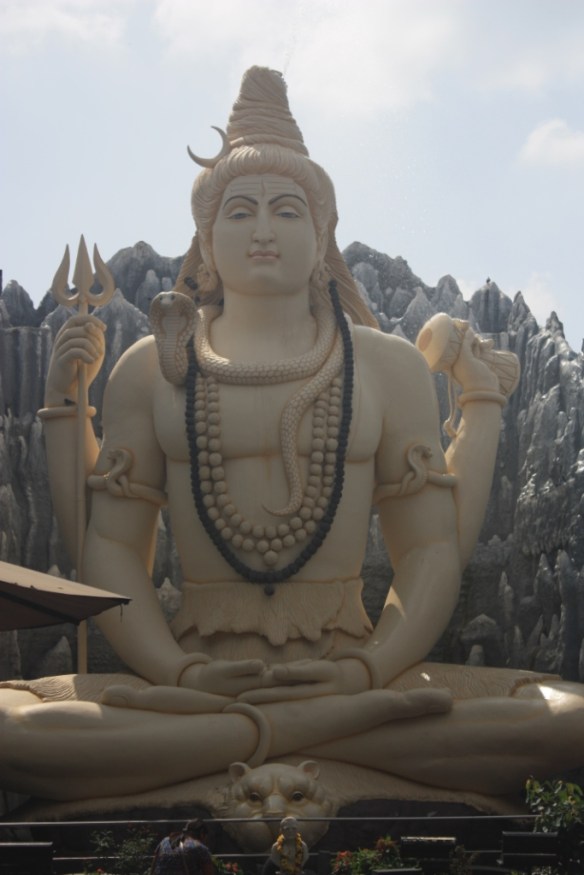
DAILY PHOTO: Shivoham Shiva Temple

Taken on December 4, 2016 in Bengaluru

Taken on December 4, 2016 in Bengaluru


img_4635

DAILY PHOTO: Mountain & Sky

Taken in July of 2015 in Kullu District of Himachal Pradesh

Taken in July of 2015 in Kullu District of Himachal Pradesh


img_1815 img_1341

POEM: Always Fastest Before the Dawn

img_1929

A million turns of the wheel.

I’m still stuck in a devil’s deal.

Running these roads in the deep of night.

Two ellipses lend my only light.

What monsters lurk within that dark?

Beasts cut from the manifest of Noah’s Ark,

but who tread the waters through the flood.

Too mean to die, tougher than mud.

If I should slow before the dawn,

They’ll give this job to the next poor pawn.