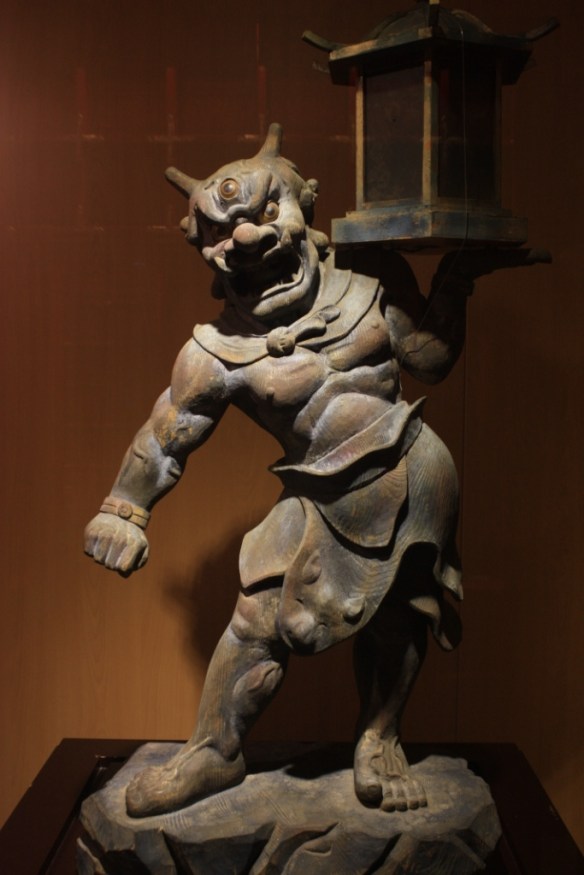




Taken in Singapore in October of 2016.

 In ancient days, the monsters spoke,
but were no less scary.
We’ve made pitiful things of the
unicorn and fairy.
No proud, strong beast of horn and hoof —
No spinner of magic.
Our monsters turned into creatures
cute, feeble, and tragic.
Our monsters are now neat, orderly
and oh-so obvious —
in swank suits and epaulets with
delusions of godliness.
 People die from skin cancer —
freaking out about nuclear power plants —
but not freaked out about the sun
enough to slather on some sunscreen.
A plane crashes,
and many decide it’s safer to drive —
clearly, they must be among the 93%
who are better than average drivers.
Mosquitos kill five orders of magnitude
more people than sharks,
and yet “PROBOSCIS” is not a movie
that will give “JAWS” a run for its money.
People pride themselves on living in the real world,
and yet…

old bamboo
creaks, claps, and rattles
new bamboo…
once bats hung
on swaying bamboo
now cut down
clustered bamboo,
a dark hiding spot
on sunny days
flex like bamboo
and grow like bamboo —
be bamboo
 Don’t bother to bury or burn my body —
just let my bones bleach white.
Throw me in a hole in the jungle —
food for wild dogs, worms, and germs.
Nature’s truth —
a truth painful only to humans —
is that in life we are all consumers,
and in death we are all food.
In nature’s view,
big brains put us no closer to the feet of gods
than does the ancient memory of trees,
the octa-ambidexterity of an octopus,
or the network optimization of fungal mycelia.
We are all both consumer & food.
 Doom Patrol, Vol. 1: Crawling from the Wreckage by Grant Morrison
My rating: 5 of 5 stars
I’d never heard of Doom Patrol until I recently saw a teaser for the television show (which have not seen.) That lack of familiarity made for a nice surprise. I was aware from said trailer that the team consisted of “broken” individuals, and that mental illness featured prominently in these characters’ makeup. What I didn’t know is the degree to which the Doom Patrol dealt in the strange and weird – and I do love tales of the weird. So, it’s a bizarre / dysfunctional team mashup (like “Guardians of the Galaxy” but less heroic and more mentally ill) that takes on the kind of psychedelic villains one might find in “Doctor Strange.” [I realize I’m crossing the DC – Marvel divide with my comparisons, but – owing to the movies – Marvel is much more broadly known at this point.]
I was familiar with Grant Morrison from one of my favorite Batman stories, “Batman: Arkham Asylum – Serious House on Serious Earth.” And this collection of seven “Doom Patrol” comics – while a little more brightly drawn and lighthearted – share the mind-bending surreality of that book. Though in this book the trippiness is supernatural.
The seven comics included in this volume include the four parts of the “Crawling from the Wreckage” story, plus: “The Butterfly Collector,” “The House Jack Built,” and “Imaginary Friends.” Robotman (Cliff,) Crazy Jane, and Rebis (an amalgam of Larry Trainor / Negative Man and Dr. Eleanor Poole) are the principal heroes of the “Crawling from the Wreckage story, though Joshua Clay (Tempest) and Dr. Niles Caulder play supporting roles. (Caulder is this team’s wheelchair-bound, genius leader. Yes, like in the X-men. While this team is less well known, it does go back to the early 60’s so I don’t know who copied who, but I know both sides seem to have snatched ideas on occasion – or maybe great minds do think alike.) The “…Wreckage” story involves the threat of an imaginary universe (Orqwith) spilling into the world as we know it. The team is established in the first two books, and we are introduced to the opposition in the form of “The Scissormen” (faceless villains that – literally – cut people out of this reality.) Then in the third and fourth installments Orqwith is introduced, and the heroes much go there to bring an end to the threat.
“The Butterfly Collector” and “The House that Jack Built” together present a story of Rhea Jone’s disappearance from the hospital. (Jone’s character is at times a member of the Doom Patrol known as Lodestone, but in this comic book she is mostly unconscious.) One of Crazy Janes’ personalities figures out how to open the portal that the kidnapper must have used. Crazy Jane and Robotman cross over to confront the villain, Red Jack. (Yes, sort of an “Alice in Wonderland” thing going on.)
In “The Butterfly Collector” we are also introduced to Dorothy, a hideous-looking little girl whose imaginings can come to life in the real world with disturbing consequences. The last book in the collection, “Imaginary Friends” imagines Joshua Clay watching Dorothy while everyone else is out. Joshua is a minor character in the other books in this collection, but in this one he is the hero of the hour. The story involves Dorothy’s imaginary friends who’ve come to exact vengeance. We learn that Dorothy developed these friends because she couldn’t make real friends owning to her appearance, but then she had to get rid of them when they got out of hand. Incidentally, tales of woe are a repeated refrain with this team. That’s what creates the team’s uniqueness. There’s an intriguing contradiction. Normally, a reader might envy a superhero, but with the Doom Patrol envy is not where the mind goes.
As I said, I love a good tale of the weird, and this was one strange tale after another. The book is both entertaining and also thought-provoking. If you enjoy comic books and graphic novels, this one is worth reading.
 Romeo and Juliet by William Shakespeare
My rating: 5 of 5 stars
Get Speechify to make any book an audiobook
This is one of Shakespeare’s most famous works, if not the most famous love story in the history of love stories. The central challenge of this couple’s love affair isn’t the usual fare of Shakespeare’s works – e.g. unrequited love, love triangles, or class differences. [There is an issue of unrequited love early in the play between Romeo and Rosaline, but Romeo gets over that girl in a hot minute once he meets Juliet.] The problem is that he meets Juliet by crashing her father’s party while wearing a disguise (a disguise that ultimately doesn’t fool the right people,) and the reason Romeo needs a disguise is because Romeo’s father and Juliet’s father are archenemies. Otherwise, the couple meets all requirements for wooing to commence: they each have feelings for the other, and they are of similar class status. In short, they would be a marriageable couple if their families didn’t hate each other.
[Warning: My Shakespeare reviews are far more spoiler-laden than usual because the stories are well-known to most readers and some find a detailed synopsis useful to make sense of the archaic language.] After an opening that establishes the enmity between the Montagues and Capulets, Romeo and Juliet fall for each other fast and hard, and with lightening speed have wed and consummated the marriage. However, no one other than the priest who married them, Friar Laurence, knows of the wedding. They have to keep the marriage secret because it would get back to the heads of the feuding households immediately.
Soon after the wedding, Tybalt (Juliet’s hot-headed kinsman) goes out looking for Romeo. Tybalt had recognized Romeo at the party, and wanted to fight him then, but Mr. Capulet (Juliet’s father) made him chill out because he didn’t want blood spilled during his party. But the next day Tybalt goes out intent on fighting. Tybalt finds Romeo’s friend (Mercutio) and his kinsman (Benvolio,) and Mercutio ends up crossing blades Tybalt. When Romeo comes on the scene, he steps into the middle of the fray to separate the men, and Tybalt finds an opening to thrust into Mercutio. As Mercutio dies, he famously wishes a “plague on both houses” (meaning Tybalt’s Capulets and Romeo’s Montagues.) Mercutio is but one of many who are completely fed up with the feud between these two families. The Prince of Verona has had it up to his neck with the bickering.
While Romeo is generally more a lover than a fighter, he duels and kills Tybalt immediately after Mercutio’s death. After killing Tybalt, Romeo flees the scene, later to find out he’s been banished from Verona upon threat of death. (Lady Capulet petitions the Prince for Romeo to be executed but the Prince won’t go for it, figuring Tybalt got what was coming to him for picking a fight and stabbing Mercutio. Then Lady Capulet plots to have a hit put out on Romeo, but events outpace her plot.) After meeting with Friar Laurence, Romeo flees to Mantua.
When her family informs Juliet that Tybalt has been slain by Romeo, they think she is broken up about her kinsman’s death. However, she’s really worried about her husband Romeo (who, of course, none of the family knows she’s married to.) When it seems like Juliet’s sadness for Tybalt has gone on long enough, her father sets a post-haste wedding date between Juliet and County Paris (the young man that Capulet favors for his daughter.) This is a problem for Juliet because: a.) she’s already married; and, b.) she deeply loves Romeo and finds Paris sort of Meh! She gets into a tiff with her father who thinks she’s an ungrateful whelp. [In Shakespeare’s day, the debate was whether a girl’s feelings about to whom she should be wed should be empathized with or ignored altogether. The idea that her feelings should be a major consideration was deemed laughable. Her mother comes down on the former side, but Lady Capulet accepts her husband’s conclusion of the alternative.]
Juliet goes to see Friar Laurence, who is a botanical mad scientist on the side. The Friar develops an elaborate scheme. Juliet is to go home, apologize to her father for not jumping on board the marriage train with the boy that her father so dearly loves (but to do so without sarcasm,) and then before going to sleep she will take a potion. This potion, not uncommon in Shakespearean works, will make her appear dead for a time, and then she’ll wake up perfectly fine. The family will take her to their crypt, pending the funeral. Friar Laurence sends a note to Romeo explaining the plan. Romeo is to meet Juliet when she wakes up, and they can then flee to Mantua — their families none the wiser.
Up to this point, this play could be a comedy just as easily as it is a tragedy. Sure, there have been a couple stabbing fatalities, but that’s actually pretty calm stuff compared to some of the comedies. (The dead are secondary characters.) What makes it a tragedy, is that Friar Laurence’s messenger can’t get through to deliver the memo in time because of some Black Death scare. Instead, Romeo’s (the Montague family’s) servant gets there first, and, because he’s not in on the Friar’s plot, tells Romeo the truth as he understands it – i.e. that Juliet is dead. Romeo sneaks back to the Verona cemetery with some poison he got at a shady apothecary on the way. Friar Laurence doesn’t know Romeo didn’t get the priest’s message until Romeo is already rolling up on the crypt, intent on dying with is beloved and so Laurence is late arriving to the scene.
To add to the tragedy, Paris is visiting Juliet’s grave and thinks Romeo is a villain. Romeo and Paris battle it out, and Romeo kills Paris. Romeo – knowing that Paris was betrothed to Juliet but without knowledge of Romeo and Juliet’s marriage – places Paris in the crypt near Juliet. But then he takes up position immediately beside her, and drinks the poison. As soon as Romeo dies, Juliet regains consciousness. She finds Romeo dead, and discovers that there’s not enough of the poison left for her. She tries kissing some poison off him, but when that doesn’t work, she plunges a dagger into her own chest.
After Juliet dies, authorities arrive on the scene having been summoned by a person who heard the duel between Romeo and Paris. The Prince arrives and calls for the heads of the Montague and Capulet households so that they can see what tragedy their feud has caused. The sight of the two dead star-crossed lovers (plus Paris, whom Capulet seemed to love) moves Montague and Capulet to end hostilities.
This is a must read for all readers.







 Tiger Riding for Beginners