
Taken in October of 2013 in Delhi.
Gurudwara Sis Ganj Sahib is the Sikh temple that sits on Chandni Chowk, down the road from the Red Fort.

Taken in October of 2013 in Delhi.
Gurudwara Sis Ganj Sahib is the Sikh temple that sits on Chandni Chowk, down the road from the Red Fort.
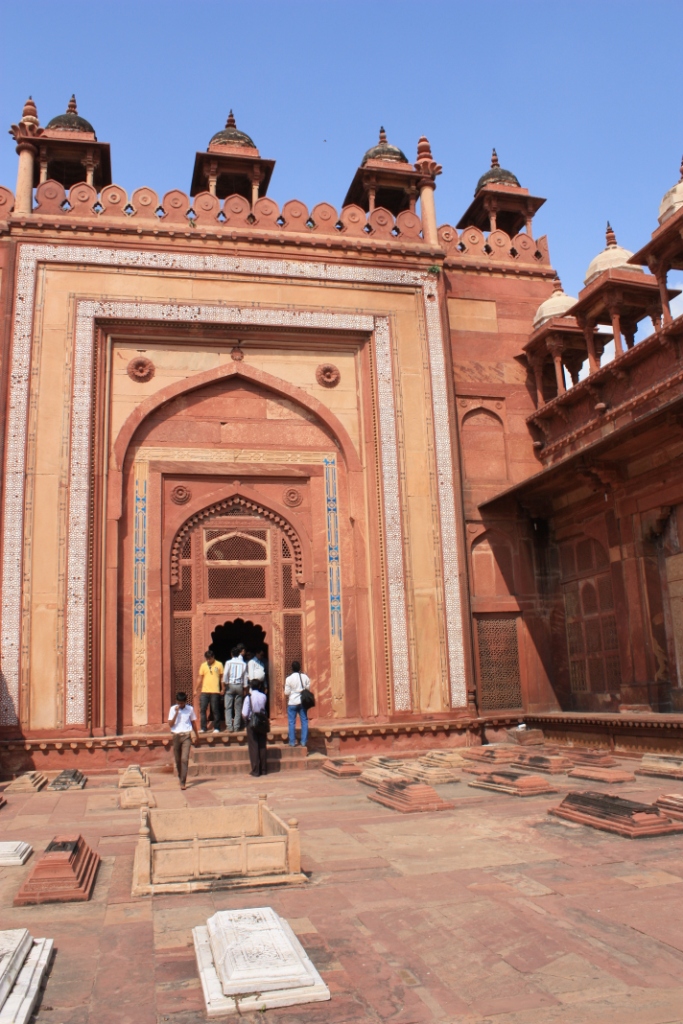
Taken in October of 2013 at Fatehpur Sikri.

Taken in March of 2014 at Namdroling Monastery.

Taken in the summer of 2011.
Taken from the Margit bridge in Budapest. Parliament is on the left (east) bank and the palace in the distance overlooking the right (west) bank.
 The Simpsons and Their Mathematical Secrets by Simon Singh
My rating: 4 of 5 stars
It will come as no surprise that television comedy writers are disproportionately Ivy League educated individuals. What may come as a surprise is that a number of comedies—particularly animated series—have a large number of technically and mathematically educated individuals on their writing staffs. Mathematicians, computer scientists, engineers, and physicists regularly work in hidden humor that only a math geek could love—or get—into episodes of The Simpsons and Futurama. Singh’s book explores the subtle mathematical references and humor that swoosh over the heads of most viewers.
While the title doesn’t mention Futurama, it should be noted that there are four chapters devoted to that series. (This in contrast to the 14 chapters dedicated to the much older show, The Simpsons.)
Let’s assume that nerds can be categorized into three sets: nerds, super-nerds, and mega-nerds. This book takes as its core demographic the largest of these groups, run-of-the-mill nerds. How does one define these three apparently arbitrary designations? A mega-nerd would see the humor in the equation scrawled on a blackboard in the background as he (or she) watched an episode of The Simpsons. (All Hail, King of the Nerds!) A super-nerd wouldn’t get many of these jokes as he (or she) watched, but he would freeze-frame the scene, and would have enough mathematical skill to decipher the cryptic jokes. A regular nerd misses the joke altogether, but is interested enough to take the time to read an explanation of these obscure references. (These categories are contrasted with the typical TV viewer, who doesn’t get the joke, but is blissful in his ignorance.)
While much of the book is devoted to these series’ mathematical gags—which range from the elementary to the arcane—Singh offers interesting insight into the writing process on shows with a team that mixes traditional writers (English and Literature majors) with mathematical types. One of the most interesting behind-the-scenes questions is why mathematical writers work so well for the The Simpsons? Futurama, being a science fiction series–and thus aimed at the geek/nerd nexus, isn’t so much a surprise, but Homer and his family don’t have any motive to be particularly mathematical—with the possible exception of the occasional reference by brainy Lisa. The chapters are arranged by various mathematical themes, such as prime numbers, pi, statistics, topology, etc.
There are some ancillary sections that deserve mention. First, there are a series of “quizzes” that consist of jokes with the set ups written as the question and the punchline serving as the answer. These jokes get progressively more complicated—starting with crude elementary school jokes (e.g. “Why did 5 eat 6?”) and ranging to the truly obscure (e.g. “What’s big, grey, and proves the uncountability of the decimal numbers?” The answer, if you’re wondering, is “Cantor’s Diagonal Elephant.”) Second, there are five appendices that are used to go into more mathematical depth on some of the topics under discussion. This is written as a book for the masses, and so attempts are made to minimize and simplify equations. There are equations and graphic representations, but they’re kept at a relatively elementary level of mathematics.
I enjoyed reading this book and would recommend it for anyone who—like me–kind of likes mathematics, but finds it more palatable with a spoonful of sugar. In this case, the sugar is the discussion of the humorous scenes of these two comedies.

Taken in November of 2013 in Hampi
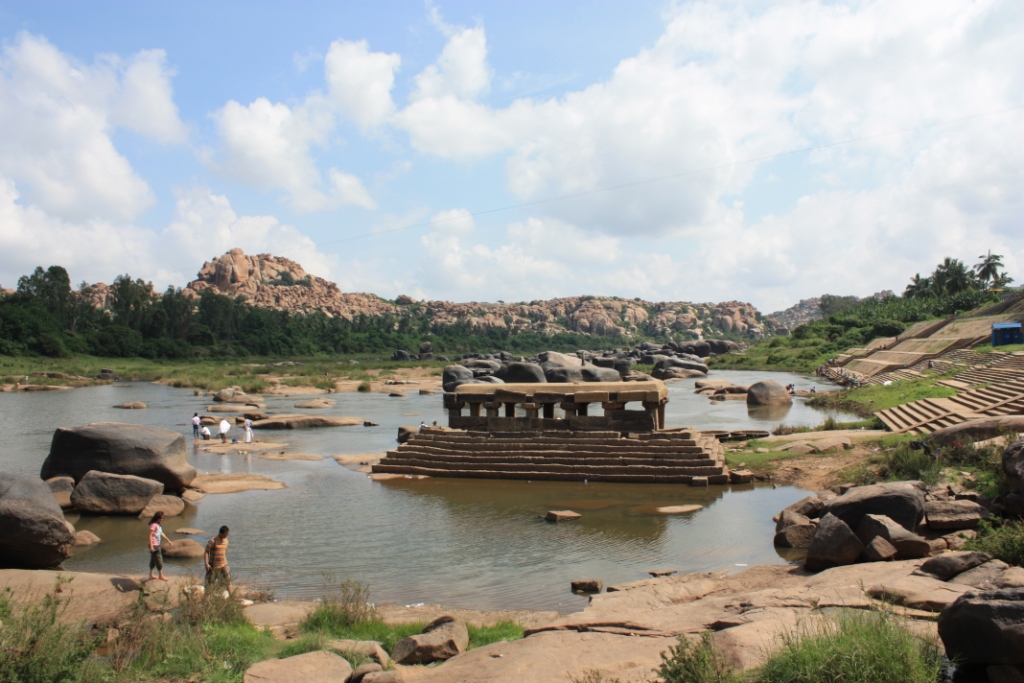
Taken in November of 2013 at Hampi
This is the Tungabhadra River adjacent to Hampi village.
 Warrior Pose: How Yoga (Literally) Saved My Life by Brad Willis
My rating: 5 of 5 stars
It may strike one as hokey that this book has one author, but two names on the byline. But, it’s apropos of an autobiography describing the fundamental transformation of a man.
Part I is the story of Brad Willis, a journalist on the rise. Willis goes from stumbling into a reporter job at one of the smallest markets in the country to being the Asia bureau foreign correspondent for NBC (National Broadcasting Corporation, one of the largest American television networks.) There’s no mention of yoga in this part of the book. It’s the story of a driven journalist covering major world events. Willis made a name for himself reporting from Soviet occupied Afghanistan in the 80’s. He tells harrowing tales of covering the drug war in Latin America, the Desert Storm Gulf War, and human trafficking in Thailand. He was also one of the few American journalists to visit North Korea. There was nowhere he wouldn’t go for the story, and he took serious risks along the way. His highly driven nature is the one point of consistency throughout the book. Willis is not a man to do anything half-assed, be it following a story or pursuing the yogic path.
Then Willis’s world was torn asunder by health problems, and this is the subject of the second part of the autobiography. First, a fall caused a hairline fracture in one his vertebrae that became crippling when Willis refused to take time off from work or to do anything for it. He couldn’t be diverted from his on-the-go foreign correspondent’s pace. Considering the dangerous places Willis traveled, it’s ironic that he initially broke his back on vacation at a Caribbean resort while closing a window during a storm. When the deterioration of his vertebrae made work untenable, he underwent a surgery that failed and left him “permanently disabled.”
Then Willis was diagnosed with a cancer in his throat that spread from his tonsils into lymph nodes. On top of the ailments themselves, Willis’s health rapidly declined because he became dependent on painkillers and other prescribed medications, and—against advisement—he began to drink alcohol in conjunction with these meds. Not only did he become hooked on the medications and alcohol, he became dependent on a back brace, a cane, and a lethargic lifestyle that kept the body from healing itself. Yoga is only briefly mentioned in passing in this part of the autobiography.
The third part is about Willis’s transformation into the yogi Bhava Ram, and his successful battle against cancer. After an intervention that resulted in drug rehab, he was referred to a pain center at Scripps that employed alternative therapies. (As an aside, the book is in part an indictment of a healthcare system in which this Pain Center both helped many people and was completely unsustainable because insurance companies could reject claims on the basis of the treatments being unconventional—but because it was staffed by medical professionals it was too expensive for most people to afford without insurance. Willis points out that there was never a rejection of any claim for any of the expensive medications or surgery that failed to helped him, but the Pain Center that put him on the road to good health went under due to failure to pay.) The Pain Center was the key to his turn around. After progressing with physical therapy, biofeedback, and—most uninsurable of all—Jin Shin Jyutsu, Willis is introduced to Yoga.
The final part charts Willis’s pursuit of yoga both through a series of teachers as well as any books that he can get his hands on. He voraciously reads up on the subject, and begins a sadhana (personal practice) that is marked by all the drive he had earlier given to his journalism career. The practice starts out rough. His muscles have atrophied, his spine curved, and he gained a tremendous amount of weight on a steak, potato, and beer diet mixed with a sedentary lifestyle. However, over the period of a couple of years, well beyond when he had been told he would be dead, he transforms his body and his mind through an intense daily practice and an adjustment of his world view.
I’d recommend this book for anyone. It will definitely be of interest to yoga practitioners—though don’t be surprised that yoga doesn’t come into play until the final quarter of the book. It could also benefit individuals with serious health problems as a way to reconsider how they approach health and treatment. Willis points out that falling into the role of victim was one of the main killers. He inherited a bad situation through an accidental fall and a case of cancer that he believed was attributable to his experience in Iraq (i.e. related to depleted uranium shells.) However, it was only when he stopped gorging on food, alcohol, and self-pity that he made a turnaround.
Even if I wasn’t interested in yoga and alternative approaches to healing, I would’ve found this to be an intensely engaging read. Willis’s journalism career gave him a unique insight into some of the major world events of the 1980s and 90’s. Willis builds lines of tension and sustains them. One wonders what will happen to his marriage to a woman who married one man (a confident and successful foreign correspondent in Hong Kong) and found herself in a marriage with another—first a lethargic addict and then a man who sunk himself hook-line-and-sinker into to the yogic lifestyle. One wonders whether his cancer remission will hold. One wonders whether he can keep clear of the pain meds and stick to the life of a yogi. I haven’t read a book that caught me this much by surprise in some time. I hadn’t heard of this book before I bought it, and didn’t have particularly high expectations (it was on sale on Kindle or I probably never would have picked it up), but I quickly became hooked.
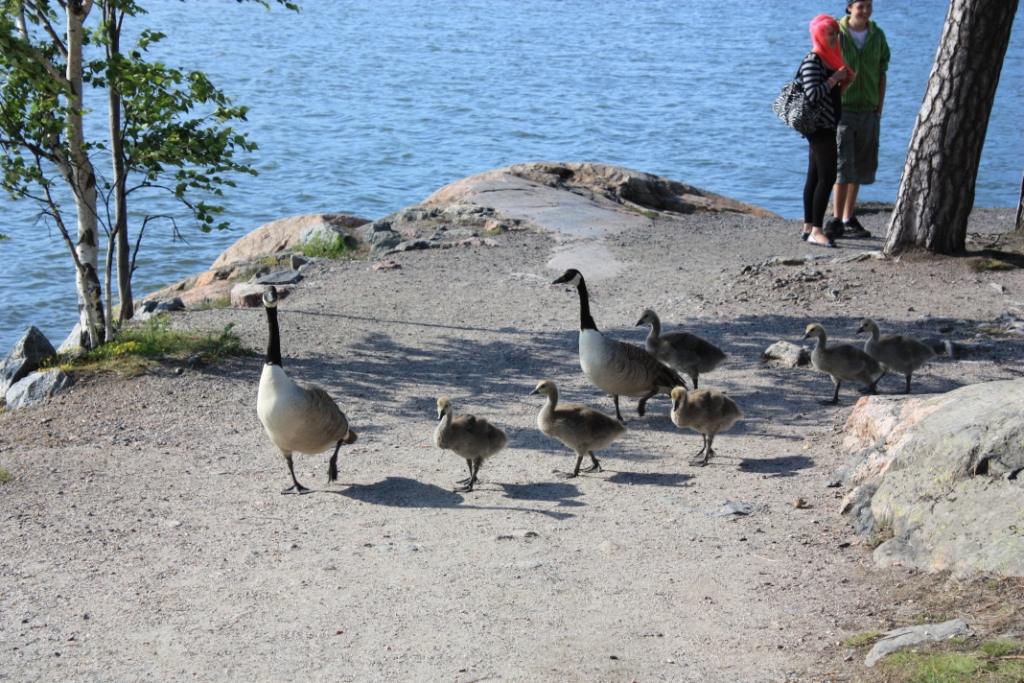
Taken in the summer of 2011 in Helsinki.
This is on Seurasaari, near Helsinki.
 This morning a yoga teacher I’ve studied with posted this article on her Facebook feed. It’s by an Indian yogini who moved to the U.S., and it offers five differences between the practice of yoga in India and in America.
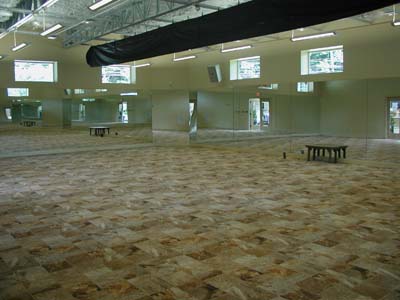
It occurred to me that one additional difference that’s frequently commented upon is that mirrors are ubiquitous in American yoga studios, but a rarity in Indian studios.
There are many possible explanations of this point of divergence. Among the more cynical interpretations is that when yoga spread internationally it was never explained that there are no asana (postures) whose drishti (focal point of gaze) is the reflected “bootilicious”, yoga-panted backside of other students.
The explanation one is likely to hear, however, is that a student needs mirrors to be able to see whether his or her alignment is correct. Sounds logical? Actually, it’s lazy in the same way as saying, “I wanted to know what Lord of the Flies is about, so I rented the movie.” (Read the damn book.)
Yes, looking in the mirror will give one instantaneous feedback, but it won’t help one develop the bodily awareness that’s a huge part of the value of yoga. One should be seeking to enhance one’s proprioception. That’s a fancy way of saying, “know where your parts are.” Proprioception is defined as: “the ability to sense the position, location, orientation, and movement of the body and its parts.” The body has a built-in ability to determine where one’s various parts are in space and whether said parts are straight or crooked. One may not realize this because one may have poor proprioception… because one looks in the mirror instead of closing one’s eyes and listening to what one’s body has to say.


 Tiger Riding for Beginners