DAILY PHOTO: Cambodian National Museum in Phnom Penh

In the courtyard of the National Museum of Cambodia

In the courtyard of the National Museum of Cambodia

The National Museum of Cambodia is picturesque. The collection is small and simple, but impressive in quality. For those of us who run out of “ooh” and “ahh” stamina after a few hundred artifacts, it’s just the right size.  It’s also not stuffy in the usual way of museums– large barred windows are unshuttered while the museum is open. (This is probably less than ideal from both the perspective of security and artifact preservation, but it gives the place a certain ambiance, and maybe helped the exodus of the bats that took up residence during the museum’s dormant period)

It’s great to see what they’ve done with the place considering the state of disrepair it was said to be in after the Khmer Rouge period. With respect to my comment about it not being a large collection, it’s a wonder that any collection exists at all after the wave of lootings from the French through Vietnamese soldiers that took place in the country.

Be forewarned, once one is inside, one will be confronted by Buddhists from a monument preservation society seeking donations at about half a dozen different Buddhas around the museum. If you aren’t a Buddhist, this can be a bit of an annoyance. If you are a Buddhist, you may find their approach disconcertingly unBuddhist. They will try to press incense into one’s palm in order to corner one into paying homage to the Buddha so they can make some dough for their cause. However, they don’t follow one around once refused (as similar individuals have been known to do at Angkor.) It may be a great cause, but they’d probably do better if they restricted it to one per museum and not one per gallery, and just let people drop cash rather than insisting on the idol worship first. I’m nondenominationally happy-go-lucky myself, but I can imagine this being troublesome for some visitors. At any rate, it’s symptomatic of the country’s  poverty and their inability to support their deity at the level to which he has apparently become accustomed.

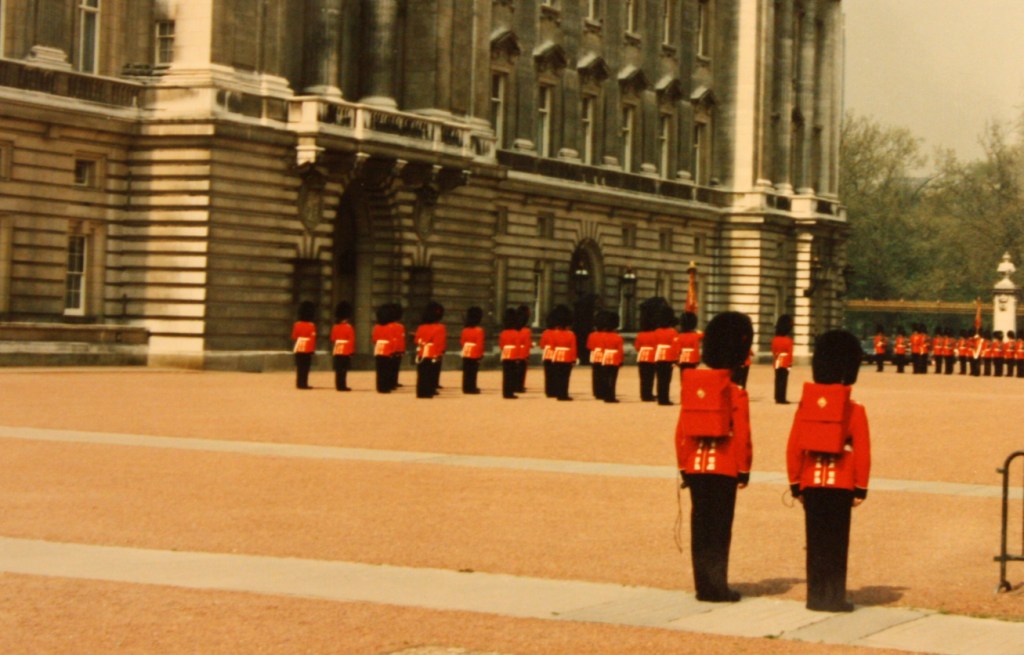
DAILY PHOTO: Buckingham Palace in London, England

Palace Guard

Palace Guard

I took this in 1989 or thereabouts. I think I just stumbled upon the changing of the guard (thankfully this has nothing to do with diapers) ceremony that day. How about those snazzy backpacks?

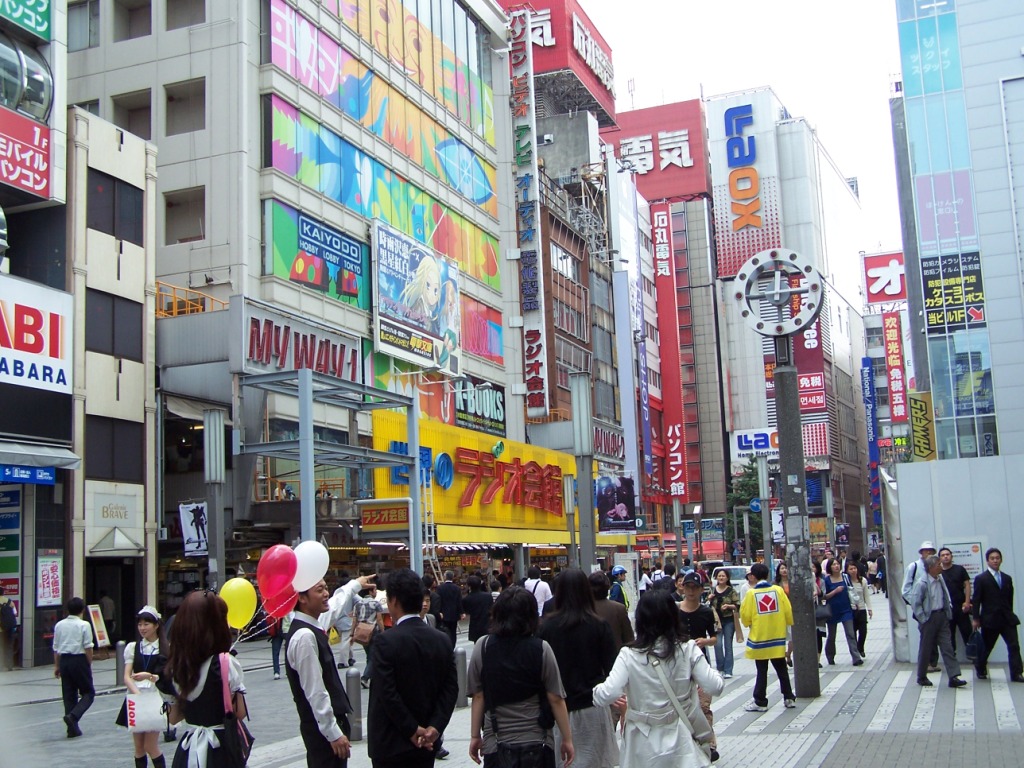
DAILY PHOTO: Akihabara in Tokyo, Japan

Tokyo's Electronics District

Tokyo’s Electronics District

Akihabara is where one goes to find the latest in high-tech gadgets. I was there in 2008, about exactly 48 hours before the multiple-fatality stabbing spree that darkened the doorstep of this lively consumer district.

If you’re wondering about the girls in the French maid costumes, they weren’t kinky prostitutes. They were giving out free tissue packets with advertising  on them. Why wear such costumes? I have no idea– except that I imagine they sell a lot of what they’re selling to sarariman.

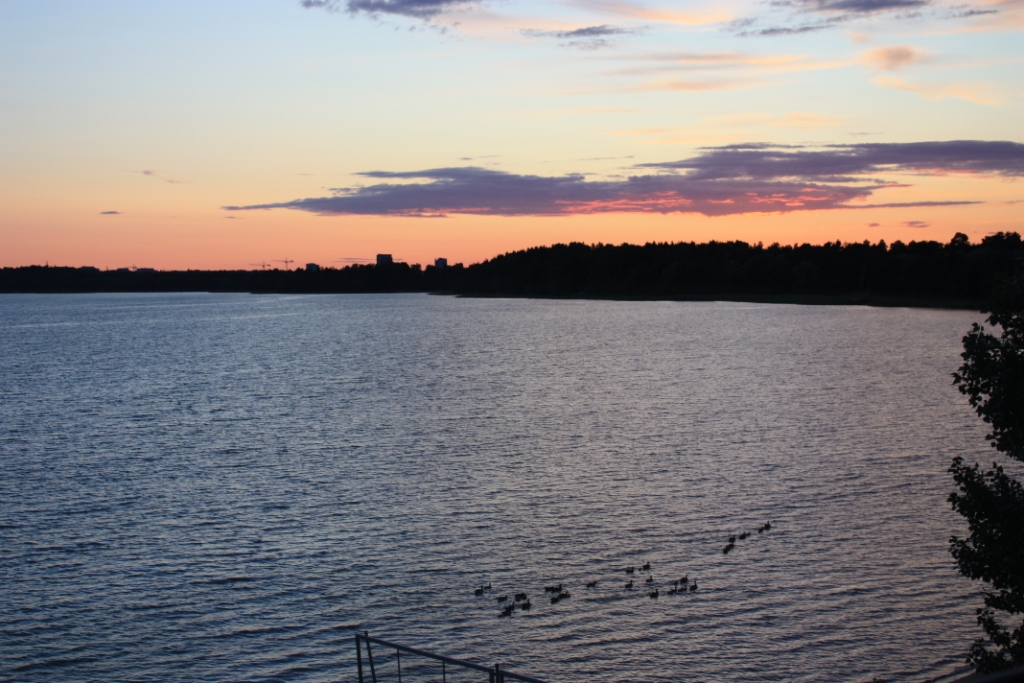
DAILY PHOTO: Gulf of Finland Inlet

Taken from the Hilton Helsinki Kalastajatorppa

Taken from the Hilton Helsinki Kalastajatorppa

In 2011, we made a mid-summer trip to Helsinki. We stayed at the Hilton Helsinki Kalastajatorppa. It’s located northwest of Helsinki proper up the inlet to the city’s west side (not far from Seurasaari Island.)

This photo was taken at probably 1:30am. Vampires beware: I don’t think it ever got fully dark. There was always light on the horizon. Those little black specks on the water are birds whose circadian rhythms were as confused as was mine.

BTW, that hotel has an awesome breakfast buffet that’s included in the room price.  It’ s a little out-of-the-way though.

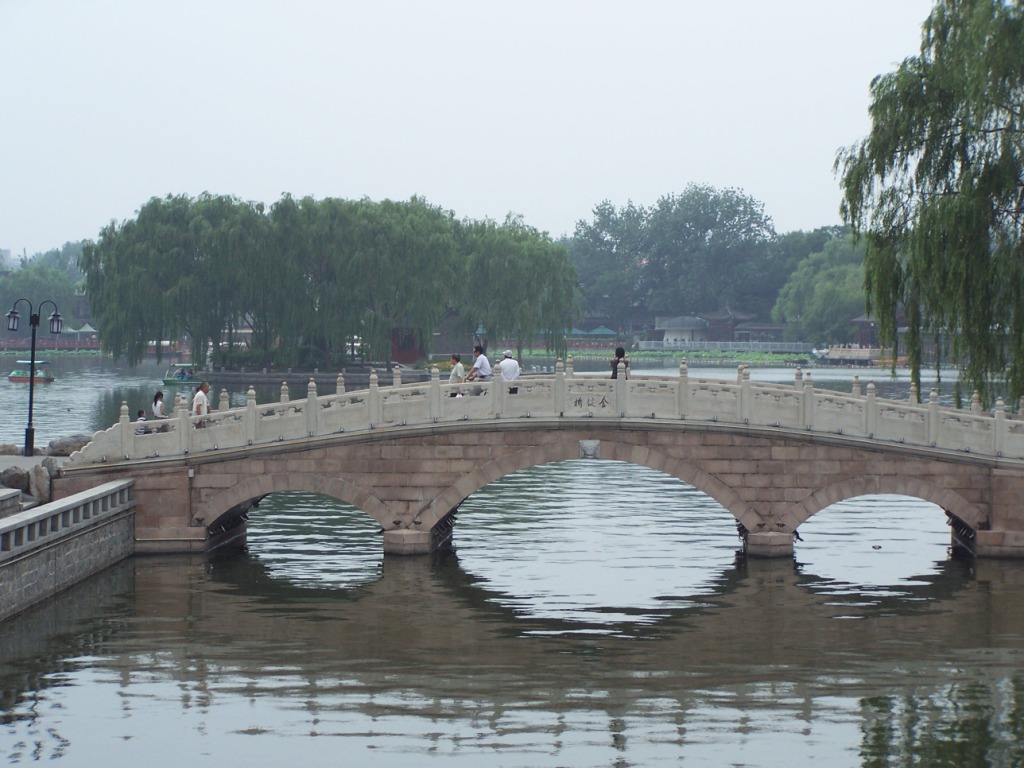
DAILY PHOTO: Back Lake Bridge in Beijing, China

Back Lake in Beijing

Back Lake in Beijing

This was taken in 2008. Beijing is such a pretty city… when the smog lifts and one can see it.

DAILY PHOTO: Grand Plaza, Tikal, Guatemala

Taken from Temple II

Taken from Temple II

The Grand Plaza comprises two temples towers that face each other, Temples I and II, the manicured courtyard between them, and these buildings off to the side. This photo is taken from atop Temple II.

I like to visit Mayan sites. As with Angkor, I feel that this is a good way to mentally prepare myself for the day our own civilization collapses.

Tikal was one of my favorite Mayan sites, mostly because it was the only large-scale site we could visit in peace. When we were at Chichen Itza, the hawkers were ubiquitous and weren’t above following one around. I don’t recall being bothered at Tikal at all.  Of course, it’s been a many years since I visited.

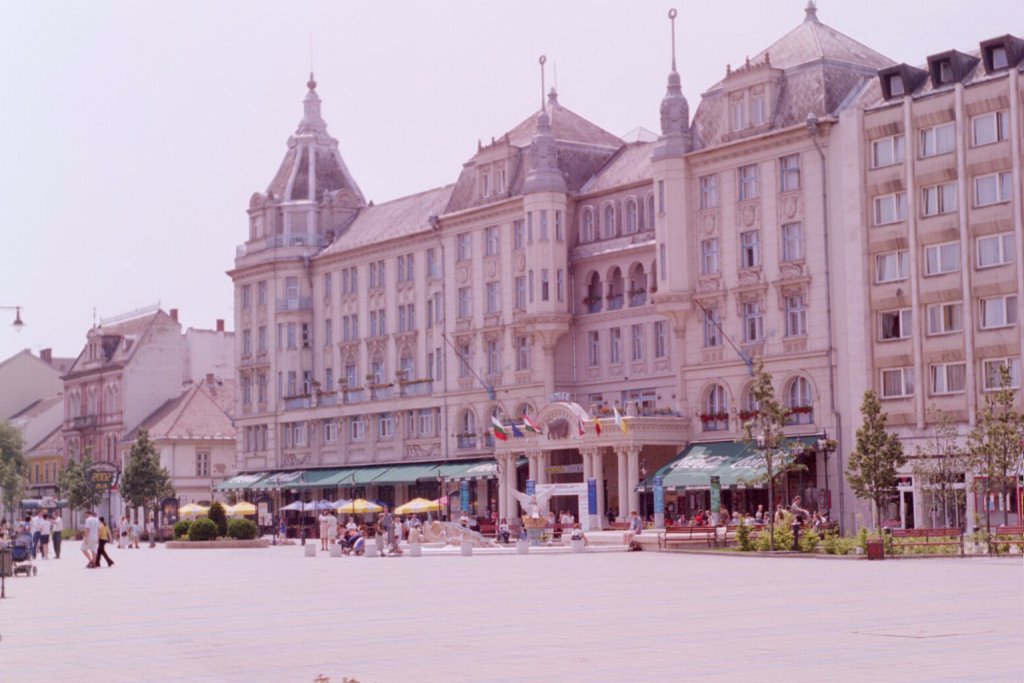
DAILY PHOTO: Downtown Debrecen

Aranybika Hotel

The Aranybika (Golden Bull) Hotel is one of the most prominent landmarks of Debrecen, Hungary. The Golden Bull is alternatively an important edict of 1222 or a soccer team. The hotel was built in 1915 in the secessionist style.

Debrecen is the second largest Hungarian city at 200,000+ residents. In 2002, I attended an intensive language course affiliated with the University of Debrecen. The building in which I was taught was  near this square, across and down the street.

If you are interested in learning Hungarian, I’d highly recommend the school I attended, the Debreceni Nyári Egyetemen.

A Dude’s Attempt to Master Pad Thai

On a trip to Thailand last fall, my wife and I did a one-day cooking class in Chiang Mai. That day I made the perfect batch of pad thai. (For the uninitiated, Pad Thai is “noodles Thai-style.” It’s one of the more popular dishes at your local Thai restaurant. If you don’t believe me, go check. I’ll wait.)

Anyway, I preceded at home to make 35 batches of pad thai that bore little resemblance to food. That’s not true. Only the first five dishes were fundamentally inedible, the next thirty were tasty enough– they just didn’t taste like pad Thai. A poor cook might blame the difference on the variation in ingredients between Thailand and home. However, I have a sneaking suspicion the cooking school staff was slipping good cooking into my dish while I wasn’t looking. They’d say, “Godzilla” and point, and I’d turn (because one can’t take a chance that close to the Pacific), and when I turned back around the contents of my wok would look and/or smell better.

If making mac-n-cheese from a box, microwaving a HotPocket, or grilling a burger aren’t counted as cooking, then you might say that my experience with cooking was nothing. However through an extensive process of error and error, I arrived at delectable pad thai.

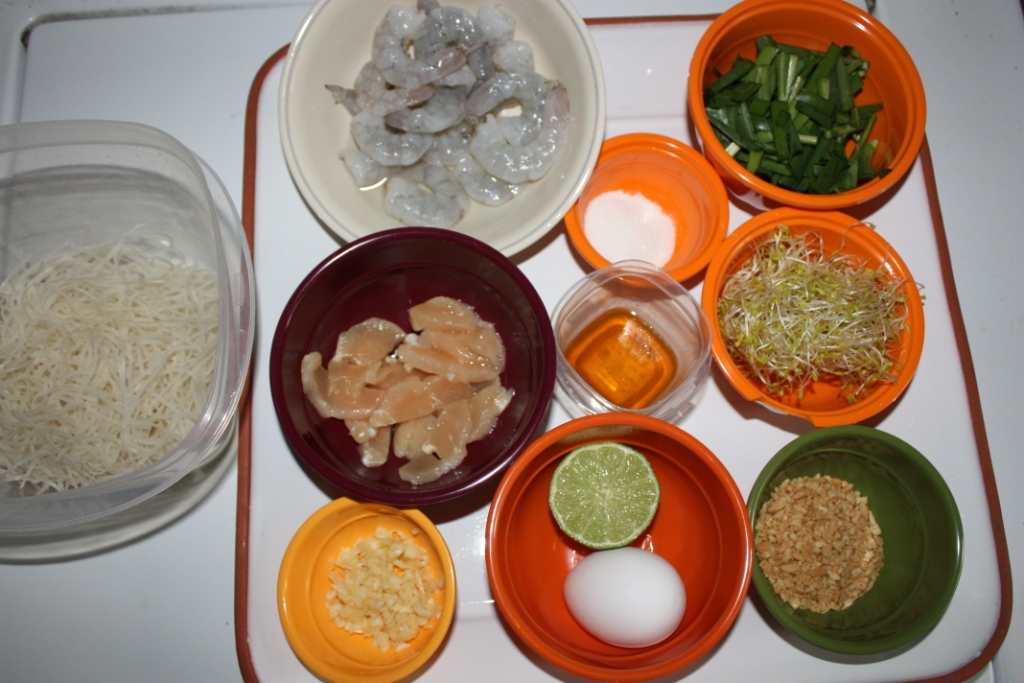
Below is what you’ll need.

Ingredients

Ingredients

First, for the anal retentive types who’ve noticed that I took this picture on top of the washing machine, that was solely for lighting purposes. This process in no way involves use of the washing machine. It’s not one of those clever recipes like cooking fish in the dishwasher. I’m serious, under no circumstances are you to attempt to use your washer in the making of pad thai.

In list form, what you’ll need is:
– 2 Tablespoons of oil (anything but olive)
– 4-ish cloves of garlic (more if you have a vampire-infestation problem)
– shrimp (several to many)
– chicken (one to two tenders’s worth; like the size of tender they give you at Applebees or Chilis– NOT McDonalds, i.e. a swanky tender)
(substitute tofu if you’re one of those quasi-vegetarians who count chicken as animal but don’t count shrimp/fish.)
– egg (1)
– 2 Tablespoons fish sauce
– 1-1/2 teaspoons sugar
– rice noodles (about 2 ramen packets worth, not that you should buy it that way)
– crushed peanuts (3 heaping Tablespoons)
– spouts (1 cup-ish. Normally this is soy or mung bean sprouts, but I’ve substituted Alfalfa sprouts because they work fine and last longer in the fridge.)
– spring onions or chives or something green and oniony (1-cup-ish)
– 1/2 a lime

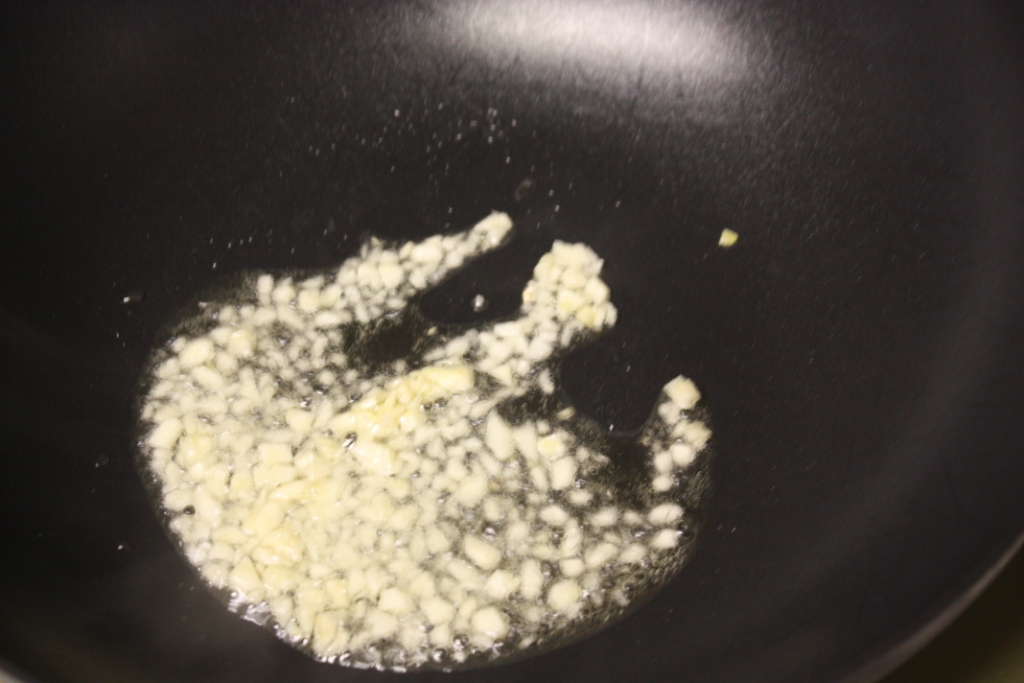
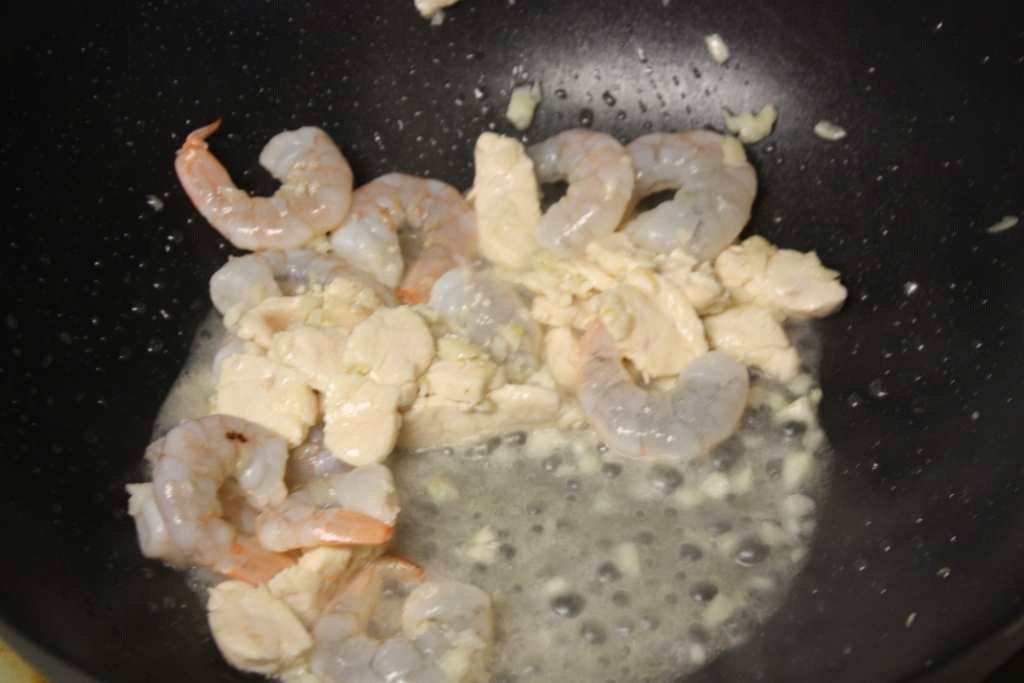
Step 1: Heat your oil in a wok. Get it hot enough so that when you throw the garlic in, it’ll sizzle. This will make you feel more chef-like.
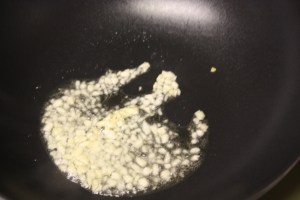
Sizzling garlic

sizzling garlic

Step 2: Add the animal stuff. Put the chicken in first, it takes longer than the prawns.  If you’re using tofu, put it in after the shrimp (tofu won’t cause you severe debilitating diarrhea if it’s under-cooked. [I don’t think, but I have no idea what I’m talking about. Although I do suspect one shouldn’t refer to diarrhea at any point in a food blog post.])
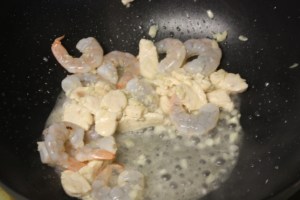
chicken and shrimp (lamest superhero duo ever.)

chicken and shrimp (lamest superhero duo ever.)

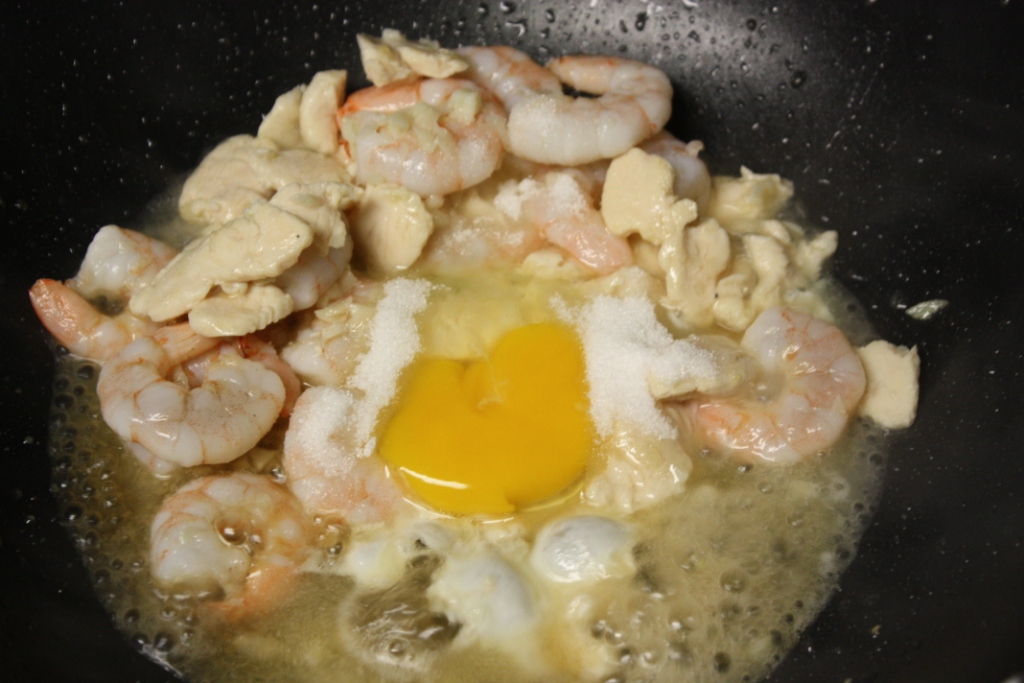
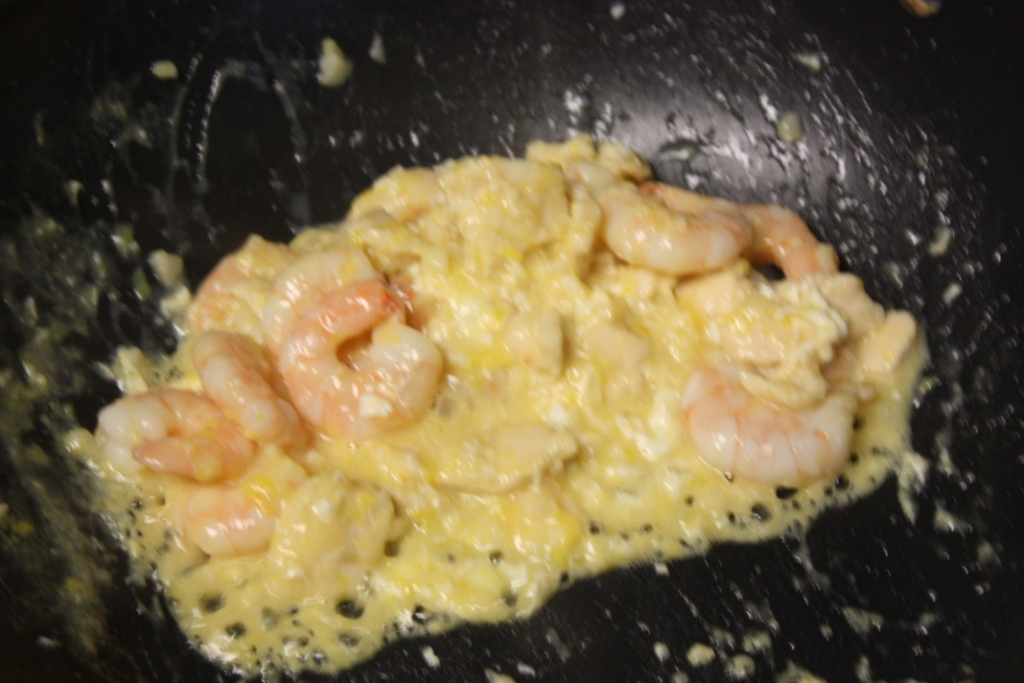
Step 3: Add the egg, fish sauce, and sugar. Scramble the egg up good, and mix everything together.
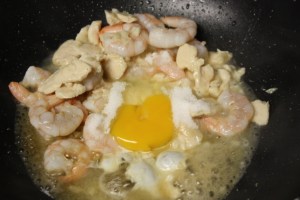
Egg, fish sauce, and sugar

egg, fish sauce, and sugar

prawn scramble

prawn scramble

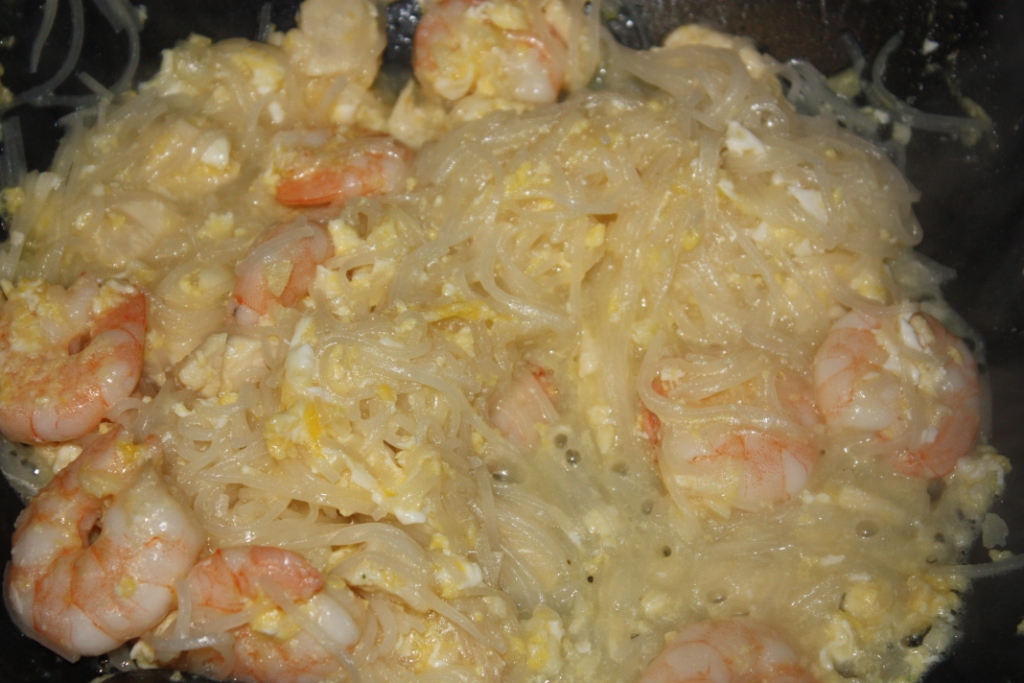
Step 4: Add the noodles. This is the trickiest part of all. First, they make a lot of different types of rice noodles in different dimensions and colors, and they all cook differently. I prefer thin noodles. I must admit the noodles are the weak part of my game. In the batch I’m showing, the noodles are overcooked, but I have done them just right. (You’ll have to take my word.) It’s preferable to have them slightly under-cooked when they’re mixed with the prawn scramble (There’s usually enough moisture that they’ll continue cooking.)

At the cooking school, we put pushed the prawn scramble up to the top of the wok and tilted the wok over and put dry noodles and a cup of water in the bottom of the wok. We then cooked the noodles, and then mixed them with the prawn scramble.  If you’re an octopus or a ninja, that method works great. I, however, pour boiling water over bowled noodles when I’m putting the chicken in the wok, then I tong them into the wok and mix them right together with the prawn scramble.
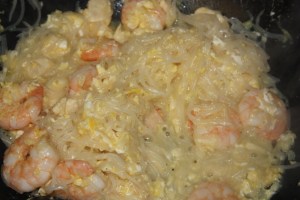
overcooked noodles this time

overcooked noodles this time, so sad

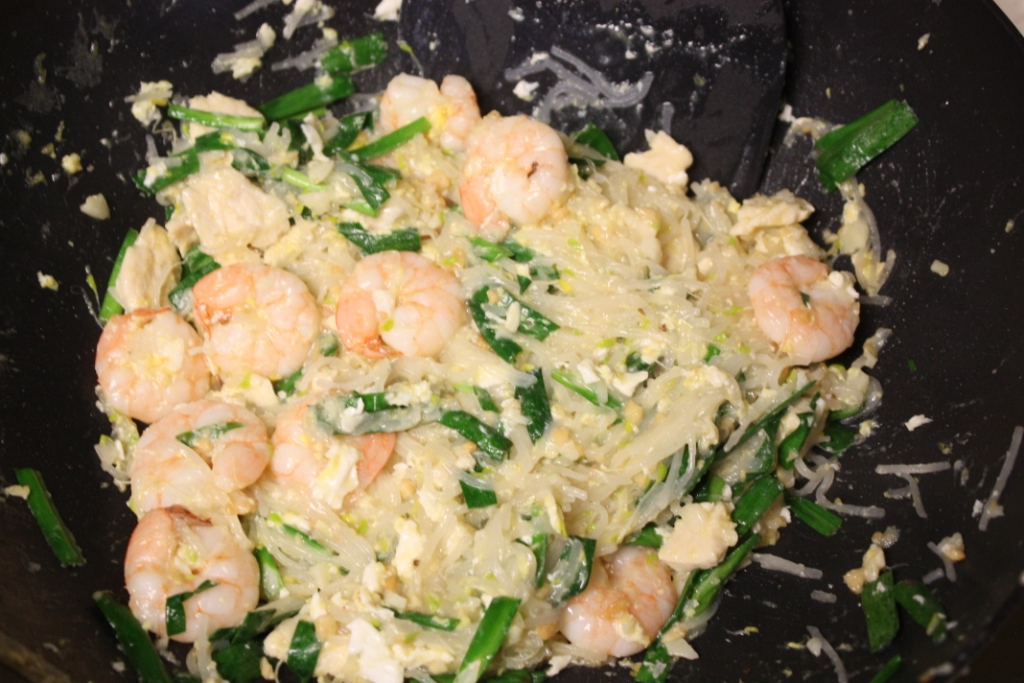
Step 5: Add the vegetable stuff. First, throw in the crushed peanuts. Then stir in the sprouts and the spring onion. (These are all done last, because you want them to provide a bit of crunch. i.e. You don’t want them thoroughly cooked.)
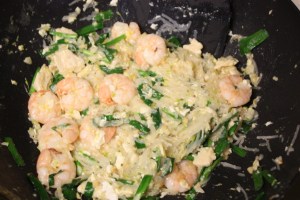
with the veges in

with the veges in

The penultimate step is to squeeze on the lime. This can be done into the wok after it’s removed from the heat or directly on top of one’s bowl.

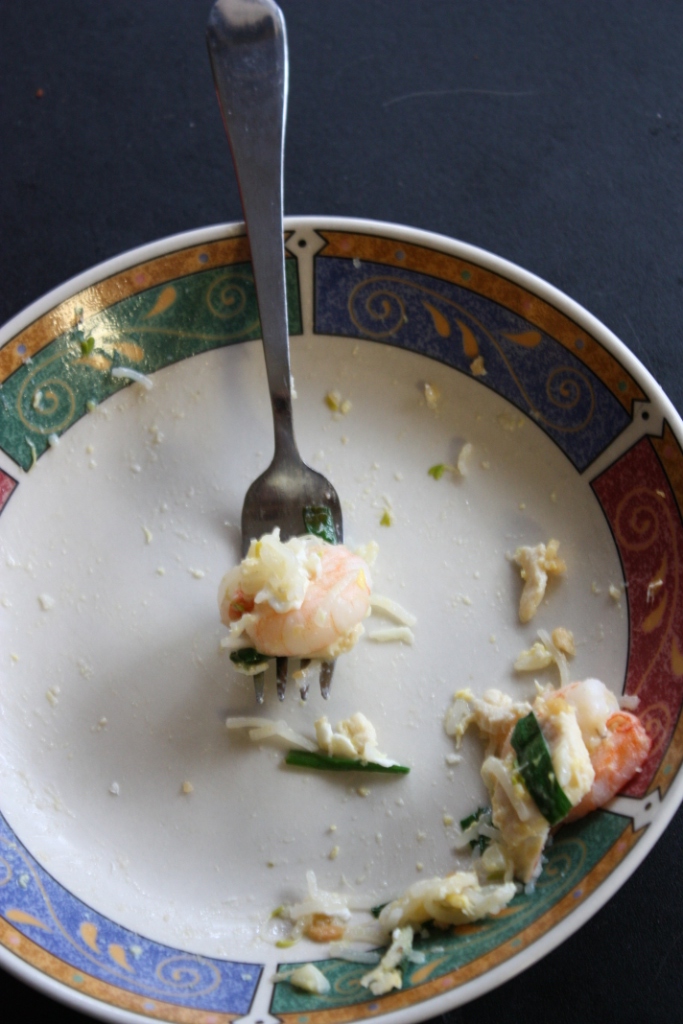
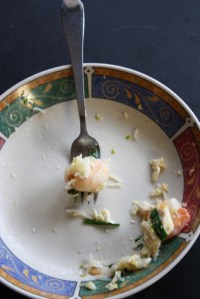
Step 6: Eat. I’ve included the following picture as proof that this was, in fact, edible.
last few bites

last few bites

BOOK REVIEW: Vagabonding by Rolf Potts

Vagabonding: An Uncommon Guide to the Art of Long-Term World TravelVagabonding: An Uncommon Guide to the Art of Long-Term World Travel by Rolf Potts

My rating: 5 of 5 stars

Vagabonding is a book about how to make the leap from a cubicle-dwelling company-man (or woman) to a wandering free-spirit.

This book serves two functions. The first is to answer questions about how one goes about seeing the world if one is not independently wealthy or a recent lotto winner. In this role it provides information such as how one can fund one’s travel time, and, perhaps more importantly, how one can get a job after one has an 18 month void in one’s resume.

The second function is to psyche one up to take the leap. In this role it is more persuasive than informative. In both roles it succeeds, but it is in this second role that it is most useful. The Introduction title is “How to Win and Influence Yourself” and Chapter 1 is entitled “Declare your Independence.”

Each chapter has a list of tips and/or references, quotes from those who have done it, and a profile of a famous person associated with the lifestyle, including: Thoreau, Whitman, Muir, and Annie Dillard. The quotes show you that mere mortals have made this leap. The profiles show that you that you will be in excellent company if you do it.

One of the most important themes in this book is simplified living. If one isn’t independently wealthy, one will have to make “sacrifices” to adopt this lifestyle. However, if one learns to live lean, one will be able to make do with much less. One must also live lean during one’s travels. Potts’s advice is to travel light, and leave the electronics at home. (The latter may seem impossible these days, but as a person who recently lost a laptop in a travel accident, I respect the logic.)

I highly recommend this book for anyone who is ready to take the leap, but only if you’re serious.

View all my reviews

DAILY PHOTO: Sacsayhuamán in the Peruvian Andes

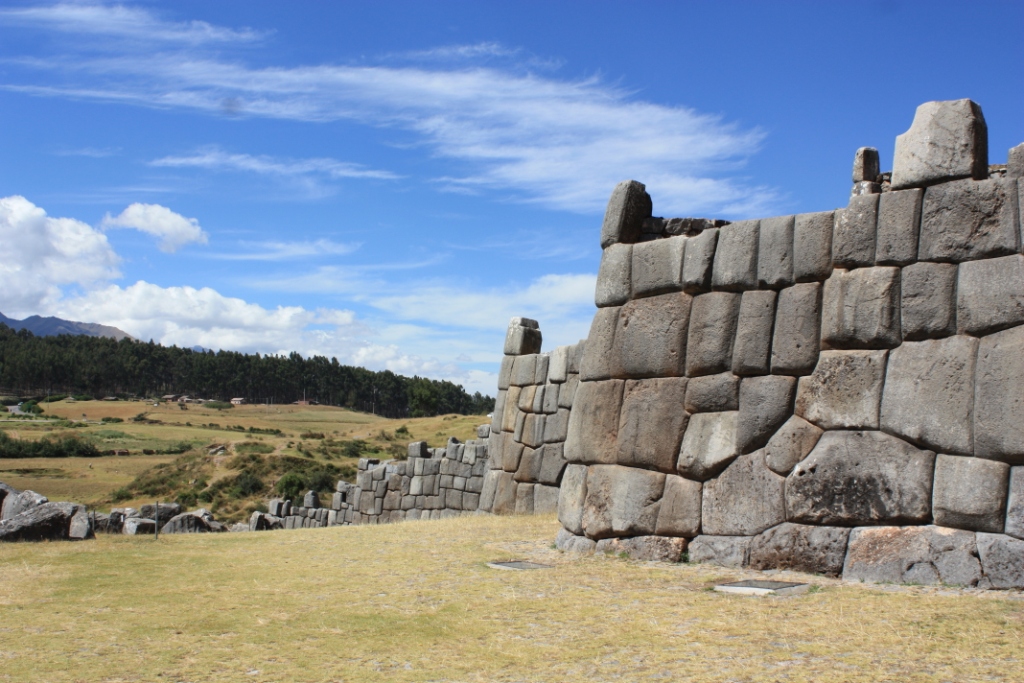
This Incan site overlooks Cusco, Peru.

This Incan site overlooks Cusco, Peru.

Sacsayhuamán may well be the first Incan site you see, if you fly into Cusco. It sits on a hill overlooking Cusco. If you’re in the mood to stretch your legs and aren’t too queasy from the elevation (Cusco, 11,200ft), it’s  not too difficult a walk from the city center.  You can use the Cristo Blanco (huge white Jesus), which shares the same hill, as a navigational reference.

The Incans were the master masons. These stone walls were made without mortar. Yes, those irregularly shaped blocks sit perfectly on each other and have for hundreds of years.  The one thing that Sacsayhuamán has that other sites don’t is a naturally occurring fun park of slides. One can also traverse a pitch black cave, and get spectacular overview shots of the city.

Naturally occurring slides

Naturally occurring slides