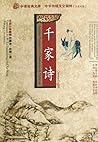
BOOK: “Golden Treasury of Quatrains and Octaves” [i.e. 千家诗] Trans. by Xu Yuanchong and Xu Ming

Golden Treasury of Quatrains & OctavesGolden Treasury of Quatrains & Octaves by Xu. Yuanchong (translator)
My rating: 5 of 5 stars

Publisher Site — China Translation Corp

This is the bilingual (Chinese-English) edition of an anthology of Tang and Song Dynasty poems commonly known in Chinese as 千家诗 (it has a much longer formal title,) which was jointly translated by Xu Yuanchong and Xu Ming (no relation.) The book is organized into four parts by the form of poem: 7-character line quatrains, 7-character line octaves, 5-character line quatrains, and 5-character line octaves. The anthology includes poems by Li Bai, Du Fu, Wang Wei, Meng Haoran, Jia Dao, Ouyang Xiu, Yang Wanli, Su Shi, and many other important Tang and Song poets — from Emperors to Hermits. That said, while the aforementioned Chinese title suggests there are works of a thousand poets involved, that’s an exaggeration. (And that’s probably all the better. While this was the golden age of Chinese poetry, going that wide into surviving poetry might involve hitting the dregs.)

Each entry has a title, byline, the poem in Simplified Chinese script and pinyin (Romanized phonetic script,) an English language translation, notes in Chinese, and a line or two of commentary in English. All but the seven-character line octaves take up just one page per poem. (Seven-character line octaves take two pages per poem.)

This is a great anthology. There’s an introduction to give insight into what approach the translators took. They stuck to rhyming verse to emulate the originals in form, but more can be learned from the introduction.

I’d highly recommend this anthology for poetry readers.

View all my reviews

“To a Taoist Hermit on Mt. Quanjiao” [寄全椒山中道士] by Wei Yingwu [韦应物]

Today, my office is chilly.
At once, I miss my mountain chum,
Who bound firewood in the valley,
Bringing it back to boil white stones.
I wish I could ladle some wine
To comfort on this stormy night.
But fallen leaves fill mountain hollows,
How could I find a track to follow?

This is poem #29 from the 300 Tang Poems [唐诗三百首], entitled 寄全椒山中道士. The original poem in Simplified Chinese is:

今朝郡斋冷, 忽念山中客; 
涧底束荆薪, 归来煮白石。
欲持一瓢酒, 远慰风雨夕。
落叶满空山, 何处寻行迹?

“Parting” [送别] by Wang Wei [王维] [w/ Audio]

I dismount to share some booze, 
And ask the wayfarer where he goes.
Begrudgingly, and with discontent,
He says, "I'll rest up near South Mount."
He asks me to just leave him be.
White clouds cross vast skies - endlessly.

This is poem 13 in the 300 Tang Poems [唐诗三百首.] The original poem in Simplified Chinese is:

下马饮君酒, 问君何所之?
君言不得意, 归卧南山陲。
但去莫复问,白云无尽时。

“Bad Government” by Guan Xiu [贯休] [w/ Audio]

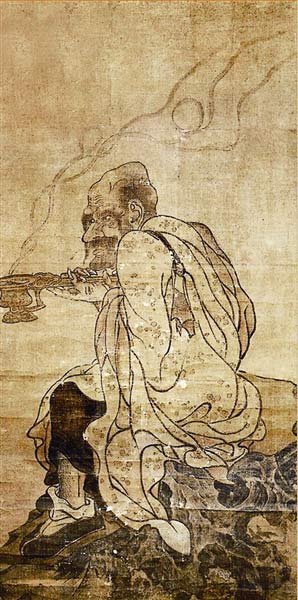
“Venerable Ingatha” by Guan Xiu [One of his 16 Arahat paintings]
Sleet and rain, as if the pot were boiling.
Winds whack like the crack of an axe.
An old man, an old man,
At sunset, crept into my hut.
He sighed. He sighed as if to himself,
"These rulers, so cruel. Why, tell me
Why they must steal till we starve,
Then slice the skin from our bones?

For a song from some beauty,
They'll go back on sworn words;
For a song from some tart,
They'll tear down our huts;
For a sweet song or two,
They'll slaughter ten thousand like me,
Like you. Weep as you will,
Let your hair turn white,
Let your whole clan go hungry...
No good wind will blow,
No gentle breeze
Begin again.

Lord Locust Plague and Baron Bandit Bug,
One east, one west, one north, one south.
We're surrounded.

NOTE: This the J.P. Seaton translation found in The Poetry of Zen (2004); Shambhala Publications: Boston, MA, pp. 67-68. For the author’s name, Seaton uses “Kuan Hsiu,” the Wade-Giles romanization of the name.

“Weichuan Farmers” [渭川田家] by Wang Wei [王维] [w/ Audio]

Low, warm light lands on the village.
Cattle and sheep trapsing farmward.
Farmer mulls a missing shepherd,
Leaning on his staff, still on guard.
Pheasants cluck, wheat heads are heavy,
Silkworms dormant, mulberry leaves few.
Farmers stand, hoes on their shoulders,
Telling old tales, as if they were new.
How I envy the idle time --
To chat about mankind's decline.

This is poem #16 of the 300 Tang Poems [唐诗三百首.] The original poem in Simplified Chinese is:

斜光照墟落, 穷巷牛羊归。 
野老念牧童, 倚杖候荆扉。
雉雊麦苗秀, 蚕眠桑叶稀。
田夫荷锄立, 相见语依依。
即此羡闲逸, 怅然吟式微。

“In Search of the Taoist, Chang” [寻南溪常道士] by Liu Changqing 刘长卿

I walk the narrow path,
Clogs divoting the moss.
White clouds over the shore;
Gate obscured by Spring grass.
Post-rain, I see the pines,
Follow stream to its source.
Flower-mind, then Zen Mind --
Arrived! Words have no force.

This is poem #136 of the 300 Tang Poems [唐诗三百首.] The original in Simplified Chinese goes:

一路经行处, 莓苔见屐痕。
白云依静渚, 春草闭闲门。
过雨看松色, 随山到水源。
溪花与禅意, 相对亦忘言。

“The Taoist Temple Revisited” [再游玄都观] by Liu Yuxi [刘禹锡]

In half of the wide courtyard only mosses grow;
Peach blossoms all fallen, only rape flowers blow.
Where is the Taoist planting peach trees in this place?
Only I come again after my new disgrace.

Note: This is the joint translation of Xu Yuanchong and Xu Ming found in the edition of <em>Golden Treasury of Quatrains and Octaves</em> on which they collaborated (i.e. China Publishing Group: Beijing (2008.))

The “new disgrace” referenced was Liu Yuxi’s second exile.

Mount Zhongnan [终南山] by Wang Wei [王维] [w/ Audio]

Taiyi stretches toward heaven;
Linked mountains reach into the sea.
Looking back, white clouds coalesce;
In the mist, the mist can't be seen.
A ridge is a boundary of worlds:
Cloudy or clear; with - or sans - tree.
In need of lodging for the night,
I ask the woodsman cross river from me.

This is poem #118 of the 300 Tang Poems [唐诗三百首.] The original in Simplified Chinese is:

太乙近天都, 连山接海隅。
白云回望合, 青霭入看无。
分野中峰变, 阴晴众壑殊。
欲投人处宿, 隔水问樵夫。

Lament 4 [感遇四] by Zhang Jiuling [张九龄] [w/ Audio]

South of Yangtze, stands of red tangerine
Can endure winter while remaining green.
Is it that the weather there is so warm?
No. Their nature 's to bear a winter storm.
What might well serve the joyful traveler
Will be loathsome peril to passengers.
Fate factors in chance and situation --
Not playing around in cyclic rotation.
You may cultivate crops however you please,
But should heed shade thrown by mountains & trees.

This is the fourth poem in 300 Tang Poems [唐诗三百首] and the final poem of a quartet that opens that collection. The original in Simplified Chinese is:

江南有丹橘, 经冬犹绿林;
岂伊地气暖? 自有岁寒心。
可以荐嘉客, 奈何阻重深!
运命惟所遇, 循环不可寻。
徒言树桃李, 此木岂无阴?

Lament 3 [感遇三] by Zhang Jiuling [张九龄] [w/ Audio]

Alone, the hermit returns home to sleep.
He's cleansed of cares by way of solitude.
He gives thanks and praise to the geese on high
For lifting feelings to grand altitude.
Day or night, his mind holds no intentions,
Who can sense his energy, so subdued?
His flight and submergence self-limited,
Where can he find calm, and still be renewed?

This is the third poem in 300 Tang Poems [唐诗三百首] as well as the third of a quartet of poems entitled Gǎn Yù [感遇] that open the collection. The original in Simplified Chinese is:

幽人归独卧, 滞虑洗孤清。
持此谢高鸟, 因之传远情。
日夕怀空意, 人谁感至精?
飞沉理自隔, 何所慰吾诚?