BOOK: “Mastering the Art of War” by Zhuge Liang & Liu Ji [Trans. & Ed. by Thomas Cleary

Mastering the Art of War: Commentaries on Sun Tzu's Classic (Shambhala Dragon Editions)Mastering the Art of War: Commentaries on Sun Tzu’s Classic by Zhuge Liang
My rating: 5 of 5 stars

Publisher Site — Shambhala

This book combines the writings of two prominent Chinese strategists, Zhuge Liang and Liu Ji. Both men came after Sunzi, author of The Art of War, and Cleary describes these two works as commentaries on the work of Sunzi.

Zhuge Liang’s piece is called The Way of the General and it collects short essays from Records of the Loyal Lord of Warriors. Like many, I first became acquainted with Zhuge Liang from his novelized personage in the Chinese classic, Romance of the Three Kingdoms, in which he is called “Kongming” and is a force to be reckoned with in service to Liu Bei of the Shu Kingdom. Zhuge Liang’s ideas are conveyed as short topical discussions, not unlike Sunzi’s work.

Liu Ji’s manual, Lessons of War, is a bit different in that the explanation of the strategy is briefer than in the works of Sunzi or Zhuge Liang, but Liu Ji always includes an exemplary story from history. This makes Liu Ji’s work a little more narrative. It is interesting to see the varied approach to conveyance of the concepts under consideration.

Because the works of Zhuge Liang and Liu Ji are thin, the book has a fair amount of padding in the form of Translator’s Introductions, both an overall Introduction and one per included work. I was happy with how these were done. They do not drone on but rather give some background that will be useful to the average reader without getting lost in the weeds.

If you’re interested in strategy, be it applicable to war or otherwise, I’d highly recommend this book.

View all my reviews

BOOK: “Ma” ed. by Ken Rodgers & John Einarsen

Ma: The Japanese Secret to Contemplation and Calm: An Invitation to AwarenessMa: The Japanese Secret to Contemplation and Calm: An Invitation to Awareness by Ken Rodgers
My rating: 5 of 5 stars

Publisher Site – Tuttle

Release date: October 27, 2025

My introduction to the concept of ma came as a young martial arts student, where it was thought of as distancing, but not distancing in a static sense — rather in a way that incorporated timing as well [so, more of an interval in space-time.] I would later hear the term applied to domains such as joke telling in which perfection of pause could be as critical to a laugh as the words that comprised the joke. This book expanded my understanding to numerous realms I’d never much considered before such as architecture, photography, and gardening. (Incidentally, this book does contain a chapter addressing the martial arts aspect of ma, though not the comedic ramifications of the concept.)

I haven’t seen any other books that focus entirely on this concept. Ma is often mentioned in books on Japanese philosophy and aesthetics but rarely with such depth and singular attention. If there are other books that drill down into the concept in this way, I doubt they are as readable as this one (that is, I suspect such a book would be intensely philosophic and scholarly.) So, this book seems to have a solid niche.

There were a couple chapters that took my thinking on the subject to entirely new places. One was on ma in the domain of virtual reality. This raised interesting metaphysical considerations. Another was about the Heart Sutra and how the translations used have led to longstanding misunderstandings of that work.

If you are interested in art and or philosophy, I’d highly recommend this book.

View all my reviews

BOOKS: 孙子兵法 [Sunzi’s Art of War] by Sunzi

孙子兵法白话全译孙子兵法白话全译 by 史哲 文
My rating: 5 of 5 stars

Available online – YellowBridge

In thirteen short chapters, Sunzi lays out a masterclass in strategy. One sees in Sunzi’s work the mark of a Taoist mindset, seeing it in the book’s emphasis on engaging in warfare only when necessary, doing things the easy way whenever possible, and never letting one’s ego write checks one isn’t able to cash in lives.

There is good reason that this is one of the world’s most well-known (if not the most well-known) treatise on warfare. Far from being complicated and technical, this guide is full of pithy teachings such as: “War is the way of deception.” “No country ever benefited from a long war.” “Defeating the enemy without fighting is supreme excellence.” “To be undefeated lies in oneself, to be victorious lies in the enemy.” “Know the enemy and yourself and victory is assured; know heaven and earth and victory is complete.” (And these teachings are even more concise in the original Chinese.)

In addition to basics like leadership, maneuver, and terrain, the book devotes chapters to both the use of fire and spies in warfare. (One’s level of understanding is central to strategic victory throughout Sunzi’s teachings.)

I’d highly recommend this book for anyone interested in strategy, martial arts, or other strategic pursuits. The book may be ancient, but it’s not obsolete by any means.

View all my reviews

BOOKS: “The Book of Five Rings” by Miyamoto Musashi [trans. by Thomas Cleary] [w/ Yagyu Munenori’s “Book of Family Traditions”]

The Book of Five Rings: A Classic Text on the Japanese Way of the Sword (Shambhala Pocket Library)The Book of Five Rings: A Classic Text on the Japanese Way of the Sword by Miyamoto Musashi
My rating: 5 of 5 stars

Publisher Site – Shambhala Publications

This edition, i.e. The Shambhala Pocket Library edition, contains two guides to strategy, tactics, and philosophy of combat by famous early Edo Period swordsmen. The titular work is Miyamoto Musashi’s The Book of Five Rings, but the volume also contains Yagyu Munenori’s The Book of Family Traditions. The naming of the book is meant to capitalize on the continuing popularity of Musashi, who remains well-known to this day not only because of his own works and legend, but because of an afterlife in pop culture that ranges from Eiji Yoshikawa’s novel to a recent Netflix animated series. That said, one shouldn’t conclude Yagyu Munenori was some sort of slouch. He was, in fact, a martial arts teacher to the Shogun’s son, and he founded a branch of his family’s martial arts school that continues to this day.

It is interesting to see these two guides back-to-back, being by authors whose lifespans largely overlapped, though – in other ways – their lives were quite different. While there is some conceptual overlap in these guides, the two definitely show two very different minds at work, Musashi the pragmatic eccentric and Yagyu the Zen philosopher of noble standing.

Miyamoto Musashi is probably the most famous swordsman in Japan’s history. Oddly enough, he’s not known for his experience in battle (he lived at the tail end of the Warring States period and was only in a couple battles), but – rather – for his 62 duels. The Book of Five Rings and other works he left behind are certainly important factors in his continuing fame. Musashi was a bit of a renaissance man: painter, poet, and sculptor in addition to a swordsman. He also left behind a school of swordsmanship, Niten Ichi-ryū.

The Book of Five Rings is divided into five parts: earth scroll, water scroll, fire scroll, wind scroll, and void scroll.

The earth scroll provides an overview of martial science and an introduction to Musashi’s school, which is noted for its simultaneous use of both the large and short sword. A section is devoted the rhythm of martial arts, a crucial topic. It also includes what might be considered Musashi’s 9-point budō kun (a list of warrior precepts.)It’s worth mentioning a couple of these:
#7 Become aware of what is not obvious.
#9 Do not do anything useless.

The Water scroll describes Musashi’s approach to swordsmanship. It covers a range of elements of a martial art including footwork, the focus of one’s eyes, physical posture, mental posture, techniques, and approaches to cutting and thrusting.

The Fire scroll deals with the strategic or interactive aspects of the battle.

The Wind scroll explores other martial arts. Musashi discusses martial arts that use an unusually long sword, an atypically short sword, that focus on powerful strikes, and those that focus on many rapid strikes. He contrasts other martial arts with his own on subjects such as their focus with the eyes and their footwork.

The void scroll deals with, well, emptiness. It’s actually a short wrap-up.

Yagyu’s guide is much more philosophical and mind-centric. It’s not that Musashi doesn’t deal with such topics, but he also devotes considerable space to more practical nuts and bolts of swordsmanship and strategy. It’s also true that Yagyu gets into technical considerations such as control of distancing (if in a bit more poetic way than Musashi.) One can get a feel for the nature of Yagyu’s Book of Family Traditions [on the Art of War] by seeing how it is organized into three parts: “The Killing Sword,” “The Life-Giving Sword,” and “No Sword.” The latter two indicating the author’s belief in the importance of not equating warrior and killer (nor winning with killing) as well as not fixating on the sword.

These two men had great insight into strategy and the tactics of swordsmanship, their guides are worth being read and reread. And the two authors do offer two intriguingly different approaches to a similar subject.

View all my reviews

Dueling Mantras: Competing Tactical Tenets in Martial Arts

There are many rules of thumb that are used to convey useful generalizations to martial arts students. One that I’ve heard for years is:

“Use as big a movement as you have time for.”

The idea is that big movements are more powerful and, thus, more likely to be effective in damaging/dissuading the opponent–if they land. Big movements use major joints and muscle groups, and allow one to put one’s body-weight into the target. There is, of course, a trade-off that’s recognized in the latter part of the tenet, and that’s that big movements are slower movements and slower movements are less likely to succeed. (i.e. One needs to streamline one’s big movements.)

Like any generalization, this tenet can be valuable only as long as one recognizes where its truth falters. I think this rule of thumb is great as long as the student does sufficient sparring / randori (after they’ve learned the basics.) If one doesn’t (e.g. if one only practices forms,) one can easily develop a false impression of how much time one has against an opponent who doesn’t practice the same art–and how big a movement one can make work. In other words, one’s enemy may dance about pummeling one about the head and neck as one lunges with big (futile) movements.

The aforementioned tenet isn’t the only way of looking at the question of whether to favor big (long/slow) or small (short/fast) movements.

One might also suggest:

“Use as small a movement as will sufficiently damage the opponent.”

Again, there’s a trade-off. While small movements offer relatively high odds of success–they are hard to see and counter–they aren’t as likely to achieve a much sought-after coup de grace (meaning a fight-ender, not necessarily a killing blow.) The risk one faces if one follows this second tenet too blindly and without sparring is becoming extremely fast while unable to punch one’s way through a wet paper sack. This is kung fu movie style martial arts, very impressive to look at but not so so effective in a combative sense.

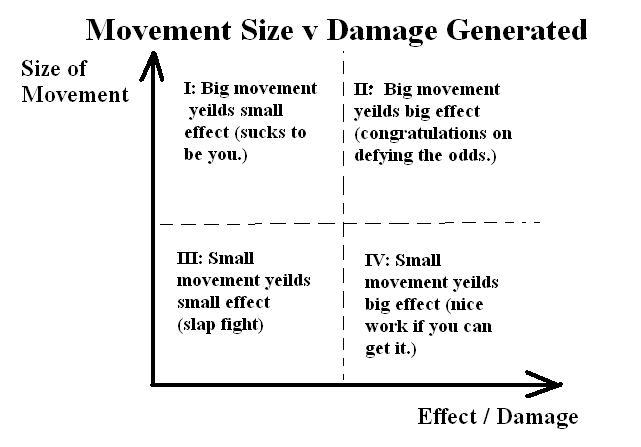
I would argue that one should take advantage of any opportunity to deliver substantial damage with small movements (quadrant IV of the first graph), but be aware that these opportunities don’t grow on trees. How does one defy the trade-off? As an example, I have found that moving an elbow into the line of attack of an incoming limb can destroy said limb’s effectiveness briefly, offering one an exploitable opportunity. This is extremely hard for the opponent to see and respond to once they are committed to an attack.


Size v Damage


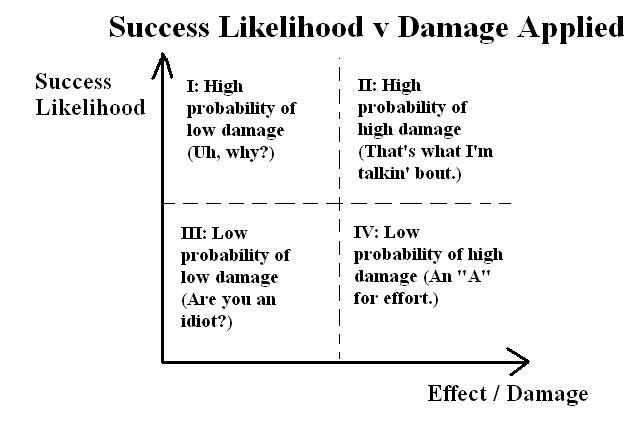
So the ultimate question is whether one favors big/slow/low probability/high consequence movement over small/fast/high probability/low consequence movements. As per my second graph I would suggest one finds a way to employ tactics that are as close to quadrant II as possible, while realizing they’re a tall order in a combative situation.

Likelihood v Damage


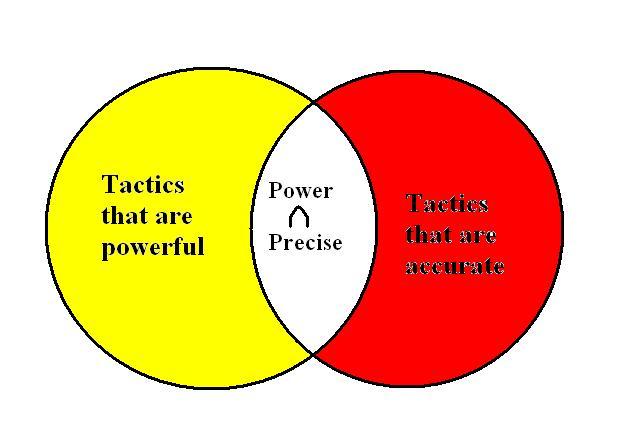
Figuring out how to manage these trade-offs requires a journey to the intersection of accuracy and power.  It’s extremely difficult to be precise in a combative environment, everything is in motion and time isn’t aplenty. However, as one  fine-tunes one’s technique, one should consider what trade-offs are being made and how one can increase power without sacrificing accuracy and vice versa. Ultimately, it all boils down to practicing conscientiously, constantly, and with as much realism as is safe.

power&precise_venn

Now I know what you are thinking, “What kind of nerd puts three graphs in a martial arts blog post?”

This kind [Jutting both thumbs in my own direction simultaneously.]

5 Differences Between Muay Boran and Muay Thai

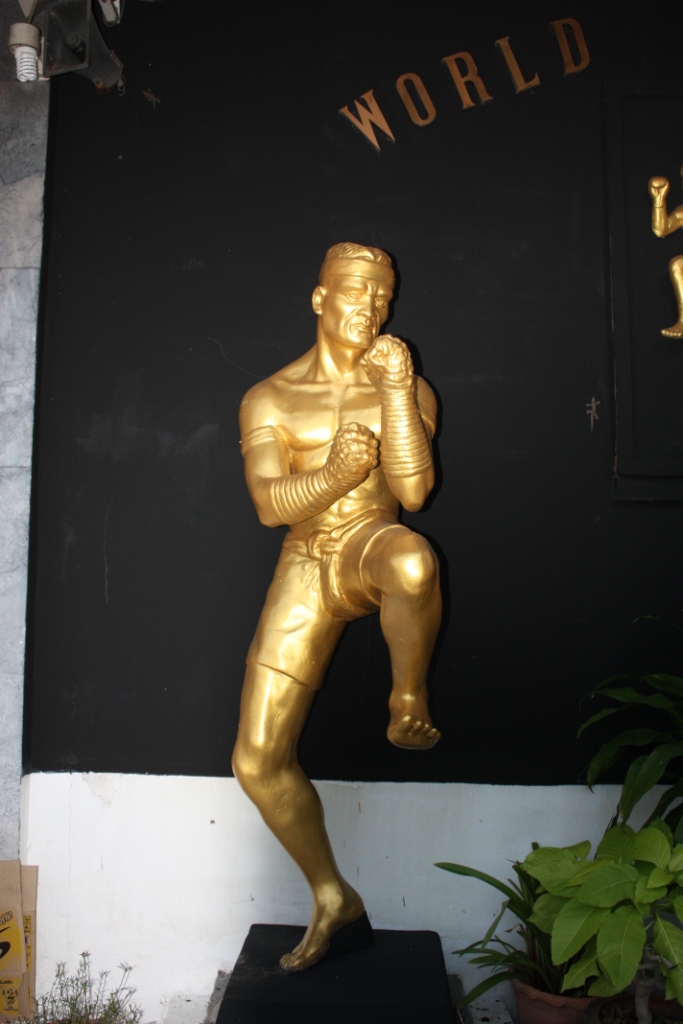
IMG_4014What is Muay Boran? It’s “ancient boxing,” and is considered an ancestor to the more well-known Muay Thai. Muay Boran isn’t a single unified system. Practicing Muay Boran is a bit like practicing “Karate,” which is to say there are a number of different and distinct systems that go by that generic name—some of which bear little resemblance to others. Muay Boran was originally a combat martial art, but came to be practiced as a sport as well. The latter practice included some rules, though relatively few in comparison to Muay Thai. Instead of padded gloves, they fought with their hands and wrists bound with hemp rope.

When I was in Thailand, I had an opportunity to participate in a couple rudimentary Muay Boran classes. I’d just read about this system in the June/July 2013 issue of Black Belt magazine, and was interested in seeing for myself how the discipline was distinct from Muay Thai. I’m fascinated by how martial arts that are more jissen (real combat) oriented differ from systems whose primary objective is something else (e.g. sport, wellness, etc.)  If one looks at a sport martial art such a Muay Thai, one can see how the nature of the rules and equipment subtly shape the nature of the movement. For example, if crotch attacks are illegal and one wears a cup to handle the occasional accidental crotch shot, one won’t worry about that vulnerability and–as one focuses on gaining advantages or minimizing disadvantages–one may end up with a vulnerability that would be disconcerting in jissen martial arts.

Before anyone gets huffy, I should point out that this isn’t a criticism. Sports must have rules so that they can be enjoyably practiced (and watched.)  Given the rules that are in place, one should optimize one’s performance to being as fast, powerful, and effective as possible. In other words, it would be silly to make one’s stance optimized to protecting one’s groin if the opponent can’t attack it (plus one has a little insurance policy against accidents) and if protecting that [non-existent] vulnerability made one any slower, less powerful, or otherwise less effective. I’m also not saying that combative sports are completely ineffective as self-protection. For sports like Muay Thai or MMA there is a huge space of overlap with the no rules combative situation, and—furthermore—the athleticism developed will allow one to adjust to the non-rule environment quickly.

That being said, I’m curious about how Muay Boran is different from Muay Thai and what that might mean in terms of jissen-optimized fighting versus sport-optimized fighting. Here are a few things that I noticed both in the classes that I had at Tiger Muay Thai in Phuket, in the aforementioned Black Belt article, and from a few videos and articles that I could find on the internet from what I believe to be reputable sources. [I should disclaim that I’m far from an authority here. Full Disclosure: I’ve had 3 hours of MB training and done some reading and research.]

1.)    The basic Muay Boran guard covers the centerline. In other words, one’s hands are one fist in front of the other with both fists aligned on one’s centerline. This is as opposed to the boxing or Thai boxing guard in which either hand is to the outside of one’s head. Practitioners of Wing Chun or the system I am most familiar with, Gyokko-ryū will be familiar with what I’m talking about. I have vague theories about why protecting the centerline might be more advantageous in combat than sport. For one thing, it might help one make contact with incoming limbs in a way that supports transition into grappling. For another, it allows one to protect against coup-de-grace attacks more efficiently.

2.)    The basic stance of Muay Boran is lower and wider than in Muay Thai. I suspect this has to do with ranging and protection of vulnerabilities (e.g. the groin is harder to hit.)

3.)    While Muay Thai is considered the style of “8 weapons”: (leg (X2), knee (X2), elbow (X2), and fist (X2), Muay Boran is based on 9 weapons (i.e. it includes the good ole head-butt.) This isn’t a surprise. Without a head-butt prohibiting rule, one would expect people to use this devastating close-range weapon.

4.)    Muay Boran utilizes attacks against the limbs. In sport Muay Thai, there is little to be gained from this, but in a combative art if one can deaden limbs one gains a big advantage.

5.)    One thing that perplexed me at first is the fact that Muay Boran supposedly uses flying knees and flying elbows prolifically. (I should note these are used in Muay Thai occasionally as well, but they’re relatively rare as they are hard to land and to use without having mid-air vulnerabilities exploited.) What I found strange about this is that jissen martial arts tend to be much less flashy and rely on much simpler techniques than do sports. The old motto of KISS (Keep It Simple, Stupid) is often spoken in jissen martial art dōjōs. However, I do have a theory about why the power generated by such tactics might have made them appealing. One mindset difference between sport and jissen martial art practitioners has to do with the role of time. In combat, time is not on your side, and pacing yourself can be a lethal strategy. You want to try to land strikes that have a high probability of putting the enemy out of commission, even if at a risk. That is, of course, just a neophyte’s theory.

I enjoyed learning a few Muay Boran techniques, and I can see how it was an effective combat system.

BOOK REVIEW: The Book of Five Rings by Miyamoto Musashi

A Book of Five Rings: The Classic Guide to StrategyA Book of Five Rings: The Classic Guide to Strategy by Miyamoto Musashi

My rating: 5 of 5 stars

Miyamoto Musashi is probably the most famous swordsman in Japan’s history. Oddly enough,he’s not known for his experience in battle(he lived at the tail end of the Warring States period and was only in a couple of battles), but for his time spent in musha shugyo (warrior’s errantry), during which he engaged in over 60 duels. It is The Book of Five Rings that largely accounts for his continued fame. That being said, Musashi was quite the renaissance man, a painter and sculptor of note. He also left behind a school of swordsmanship, Niten Ichi-ryū.

The Book of Five Rings is divided into five parts: earth scroll, water scroll, fire scroll, wind scroll, and void scroll.

The earth scroll provides an overview of martial science and an introduction to Musashi’s school, which is noted for its simultaneous use of both the large and short sword. A section is devoted the rhythm of martial arts, a crucial topic. It also includes what might be considered Musashi’s 9-point budō kun (a list of warrior precepts.)It’s worth mentioning a couple of these.
#7 Become aware of what is not obvious.
#9 Do not do anything useless.

The Water scroll describes Musashi’s approach to swordsmanship. It covers a range of elements of a martial art including footwork, the focus of one’s eyes, physical posture, mental posture, techniques,kiai (spirit shout), and approaches to cutting and thrusting.

The Fire scroll deals with the strategic or interactive aspects of the battle. Among my favorite quotes from this scroll is, “If your own power of insight is strong, the state of affairs of everything will be clear to you.”

The Wind scroll teaches us about other martial arts. Musashi discusses martial arts that use an unusually long sword, an atypically short sword, that focus on powerful strikes, and those that focus on many rapid strikes. He contrasts other martial arts with his own on subjects such as their focus with the eyes and their footwork.

The void scroll deals with, well, emptiness.

Musashi had great insight into strategy from his career of dueling. His book is worth being read and reread.

View all my reviews