BOOKS: The NEW Comedy Bible by Judy Carter

The NEW Comedy Bible: The Ultimate Guide to Writing and Performing Stand-Up ComedyThe NEW Comedy Bible: The Ultimate Guide to Writing and Performing Stand-Up Comedy by Judy Carter
My rating: 5 of 5 stars

Amazon.in Page

As the title suggests, this is a soup-to-nuts exploration of building a standup comedy act. While the bulk of the book discusses how to build jokes that work in a comedy club setting, it also gives helpful tips on relevant issues such as stage fright, hecklers, bombing and bomb recovery, set arrangement, and editing material. It offers many insights that may seem counterintuitive to a neophyte reader.

In writing, there is a common distinction made between “plotters” and “pantsers” (as in “by the seat of one’s pants.”) Plotters do a lot of research and outline everything thoroughly before beginning to write (as most people understand the writing process.) Pantsers like to get right into the typing and are willing to have a much messier process in exchange for greater feelings of spontaneity and surprise. A similar distinction seems to exist in standup comedy. Jerry Seinfeld might be the posterchild for the comedic plotter, writing and rewriting jokes on paper and having an already finely honed collection of jokes when he goes into the comedy club to revise through audience feedback. Other comedians seem to like to work by riffing and editing material on the fly. My point is: this book will definitely appeal most to plotters. That said, I think it has a lot of useful information that will save pantsers a great deal of trouble, but I suspect those with intense pantser proclivities will be skeptical of such a step-by-step approach.

The book is set up as a workbook woven into an instructional guide. That is, it has exercises throughout. It also presents a lot of jokes and partial bits by headlining comics to help the reader see how successful comics apply the principles in question.

I enjoyed reading this book and found it helpful. I thought that many of the exercises were quite helpful in triggering joke ideas. If you are looking for a book that deals in both joke writing and comedic delivery, I’d highly recommend this book.

View all my reviews

BOOK REVIEW: TED Talks Storytelling by Akash Karia

TED Talks Storytelling: 23 Storytelling Techniques from the Best TED TalksTED Talks Storytelling: 23 Storytelling Techniques from the Best TED Talks by Akash Karia
My rating: 4 of 5 stars

Amazon page


This is a brief guide to storytelling and story building, particularly as it pertains to public speaking. Its emphasis on TED Talks is just to capitalize on the popularity of that forum as well as to draw widely known examples. There are no novel insights offered in this book. It’s the same information one could find from many other sources. However, it’s concise, well-organized, and uses examples pulled from popular TED Talks, and so readers may get some synergies from familiarity with a given speaker’s delivery.

The book is organized into nine chapters. The first introduces the topic by explaining why stories are so much more effective than other approaches to public speaking. The second chapter is about hooks and conflict. The third chapter is about the twist or element that makes the story interesting—as opposed to a straightforward accounting of events. Chapters four through six are all related in that they deal with providing the sensory and other details necessary to make the story come alive for the audience member. Chapter seven is about the effectiveness of stories with a positive message. Chapter eight steps back and examines the overall flow of the story with key way-points of consideration. Chapter 9 is a summation of key points. It’s mostly a list of the 23 bullet points that were made throughout the book, each of which is also located at the end of its respective chapter.

I’d recommend this book for anyone preparing for a public speaking engagement. However, I should point out that the price seems to be higher at the moment than when I bought it. I wouldn’t recommend spending a lot on the book because the information is so widely available.

View all my reviews

TODAY’S RANT: Pronunciation Police

Pronunciation is tricky.

Pronunciation is tricky.

If you’ve ever had someone tell you that any water can be put in a pot (for pronouncing drinking water pot-table rather that po-table), then you may be with me here. If you frequently exercise your perogative, rather than your prerogative, you may agree. Have you had sherbert, or only sherbet? Do both your eggs and oxen have yokes?

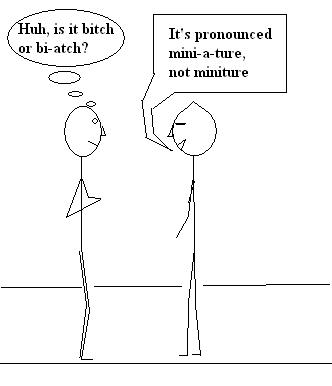
If you’re not with me, you –my friend– might be the person on the right in my little stick cartoon.

I’m as anal about language as the next writer, but let’s try to dial down the pretentiousness. The big question I have for pronunciation police is this: What in your experience with the English language has led you to believe it is a phonetic language?

For those who think English is phonetic because they learned it via “Phonics,” let me expose you to a poem that says it more eloquently than I ever could. (I would attribute the poem, but it is to my knowledge owed to that most prolific “Anonymous” chap.)

Hints on Pronunciation for Foreigners

I take it you already know
of tough and bough and cough and dough.
Others may stumble, but not you,
On hiccough, thorough, laugh and through.
Well done! And now you wish, perhaps,
To learn of less familiar traps.

Beware of heard, a dreadful word
That looks like beard and sounds like bird.
And dead-it’s said like bed, not bead.
For goodness sake, don’t call it deed!
Watch out for meat and great and threat.
They rhyme with suite and straight and debt.

A moth is not a moth in mother,
Nor both in bother, broth in brother,
And here is not a match for there,
Nor dear and fear for pear and bear.
And then there’s dose and rose and lose
Just look them up–and goose and choose.
And cork and work and card and ward.
And font and front and word and sword.
And do and go, then thwart and cart.
Come, come I’ve hardly made a start.

A dreadful language? Man alive,
I’d mastered it when I was five!

If you still don’t believe that the language can handle multiple pronunciations, check out what the experts say.