BOOK REVIEW: The Philosopher at the End of the Universe by Mark Rowlands

The Philosopher at the End of the Universe: Philosophy Explained Through Science Fiction FilmsThe Philosopher at the End of the Universe: Philosophy Explained Through Science Fiction Films by Mark Rowlands

My rating: 4 of 5 stars

Amazon page

This is one of those books that’s designed to make tedious material palatable. Rowlands achieves this by conveying the concepts of erudite philosophers such as Plato, Nietzsche, Sartre, Laplace, Kant, Heraclitus, Wittgenstein, Hume, and Heidegger through the lens of popular speculative fiction movies (almost all Sci-fi.)

The book uses thirteen films as case studies to consider ten critical philosophical concepts (over ten chapters.) Virtually all sci-fi fans are likely to have seen most—if not all—of these films. They include: Frankenstein, The Matrix, the first two Terminator films, Total Recall (1990), The Sixth Day, Minority Report, Hollow Man, Independence Day, Aliens, Star Wars, Blade Runner, and The Lord of the Rings. I am not a film fanatic (though I do like Sci-fi) and I’d seen all but two of these movies (i.e. Hollow Man and The Lord of the Rings.) I can say that the book is understandable without having seen the movies, but it’s much more enjoyable when you have seen them. Although, as far as the two movies that I’d missed went, Hollow Man was easy because it’s a relatively straight-forward invisible man story, and—therefore—the link to that chapter’s question “Why Be Moral?” was simple. However, for The Lord of The Rings book I had to rely more on the synopsis the author provides to follow the chain of thought.

The philosophical issues that are addressed include: the meaning of life, what can we really know (if anything), what am I (or you or any other individual), what makes me (you, etc.) different from everyone else, is there free will, why behave morally, how broadly does morality apply (in other words, is it applicable outside humanity), do good and evil exist and (if so) what differentiates them, what does it mean to be mortal, and what’s wrong with moral relativism. If you’ve seen the movies, and give it some thought, you can probably match the movies to the questions easily.

I enjoyed this book. First of all, I will admit that it’s easier to follow the concepts and for them to stick with one when one puts them in terms of movies one has seen (in some cases, several times.) Second, the author has a good sense of humor. While Rowlands is a Professor of Philosophy, this book doesn’t read in the humorless and dry tone of academic writing. On the contrary, it’s meant for a popular audience and it reads for a popular audience. It should be noted that the humor and the exclusive focus on movies (versus literature or films) set this book aside from a number of others that are superficially quite the same. I have another book in storage back home called Science Fiction and Philosophy that is by an academic publisher, maintains the scholarly tone, goes into a bit more depth, but covers many of the same ideas (e.g. Brain-in-a-vat, etc.) using similar examples. I didn’t finish the more scholarly book, but if you’re looking for great depth but not reading ease you might pick it up for comparison.

Rowlands does overplay the “these-movies-are-so-bad-they’re-good” card, and when he does he sounds a tad professorial / pretentious. However, the book often reads like it was written by a colorful football coach rather than a Philosophy Professor. And, to be fair, in some cases it’s true that the films are delightfully bad. However, these are not B-movies like Attack of the Killer Tomatoes as one might think from the commentary.

If you’re interested in philosophy, but can’t get through two pages of Kant without falling asleep, I’d recommend this book.

View all my reviews

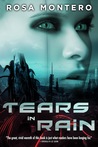
BOOK REVIEW: Tears in Rain by Rosa Montero

Tears in RainTears in Rain by Rosa Montero

My rating: 3 of 5 stars

Amazon page

The title of this book, Tears in Rain will be instantly recognizable to sci-fi fans as a reference to the Roy Batty (played by Rutger Hauer) monologue at the end of the movie Blade Runner. For those who aren’t familiar, Roy Batty is an android who is about to die as the result of a preset lifespan established in his programming, and he’s reflecting on all those unique experiences that he’s had that will be forever lost with his demise—as tears in rain.

When I picked up this book, I thought it would exist in the Blade Runner universe. It does not. However, it exists in a universe that shares several common features with the world of Blade Runner, and—in fact—it gives a nod to the film as a prescient historic work of fiction. What Montero’s novel has in common with the Ridley Scott film is a world in which there are both humans and androids that have surpassed the uncanny valley—i.e. they are generally indistinguishable from humans (if they want to be.) Furthermore, these androids (also called replicants) have a short and predictable lifespan–though it’s presented as a mysterious flaw rather than intentional programming. Further, there is a degree of tension between humans and replicants (reps.) The book also shares the movie’s film noir feel. The book’s lead character, Bruna Husky is a private dick–if you will—and a replicatant, and she is investigating a series of murders by replicants gone haywire.

The focal point of the book is something not extensively addressed in Blade Runner or that film’s point of origin, the Philip K. Dick novel Do Androids Dream of Electric Sheep, and that is the need to build memories into these androids so that they can function like humans. Reps discover at some point that all their childhood memories—good and bad—are fake, and this is a point of consternation for Husky. It is the corruption of the memories that leads the replicants to kill. That fact is established almost from the novel’s beginning. What isn’t clear is who is doing it and why, and book follows Husky through her investigation of these questions.

For the most part, I found the book to be readable. It’s a translation from the original, which was written in Spanish. It didn’t have that rare page-turning aura that made me have to find out what would happen next, but it was a good, solid science fiction work. The characters are—as one might expect from my “film noir” comment—overwhelmingly gruff and terse and / or broken people. Not that the unlikable nature of the characters is responsible for the lack of intensity of interest in what will happen to them. I recently read an article about unlikable characters, and it pointed out (correctly in my view) that Nick and Amy Dunne of Gillian Flynn’s Gone Girl are among the most detestable characters of recent literature, and yet that is a book one can’t put down. It’s difficult but not impossible to build intense interest with such characters.

Interspersed throughout the book are a few multi-page information dumps in the form of reports to an archivist who is a secondary character in the book–and who probably only exists to justify these info dumps. While the dumps aren’t excessive, neither do I think they are necessary. I don’t think there was much information in them that was necessary to the storyline, and what was could have been communicated more smoothly.

Part of Montero’s problem is that by tying her work’s title and important background details to Blade Runner, it becomes almost impossible to not compare her novel to either Blade Runner or Do Androids Dream of Electric Sheep. I might have given this work another star if I wasn’t thinking about how it was less visceral than the movie and less clever than Dick’s book. (Without the info dumps or the comparison it would have been a 4-star for me.)

This is a worthwhile read for sci-fi fans.

View all my reviews

Robot Karateka Threat Underwhelming

Worried that Terminator-like robots may kick humanity out its pole position among sentient beings? You can sleep well tonight. A news report today suggests that the Karate Kid’s kicking dominance is not yet under threat by Robo-karateka.  In other words, Ralph Macchio can still out kick the state of the art karate robot. The Cobra Kai’s plans to achieve world dominance via a fleet of Karate androids have been thwarted for the time being.


BOOK REVIEW: The Strain, Vol. 1 by David Lapham et. al.

The Strain Volume 1The Strain Volume 1 by David Lapham

My rating: 3 of 5 stars

Amazon page

I sometimes wonder what Bram Stoker would think about the fact that his work spurred an entire industry of copy-cats. Everybody thinks that they can make an interesting and novel contribution to this vampiric genre. In very few cases, see: Richard Matheson’s I am Legend, they are correct. However, even though most of these works don’t take us into uncharted territory, they can still be entertaining. In fact, some of the versions that stay true to the concept seem more entertaining than others that moved into new territory but are patently stupid. I’m speaking, of course, of Twilight and other vampire-as-romance books that feed a widespread malady of the age afflicting teenage girls and, sadly, middle-aged women. I think The Strain, Volume 1 makes for an interesting and entertaining modern-day vampire story, without being particularly brilliant or groundbreaking.

The Strain, Volume 1 is the first installment of a graphic novel adaptation of the novel written by Guillermo del Toro and Chuck Hogan. The Introduction states that the graphic novel isn’t meant to precisely mirror del Toro and Hogan’s prose novel. I haven’t read the del Toro / Hogan book, but the synopsis indicates that at least the beginning and the characters are largely the same. I can’t comment as to how much the two works differ in detail, and whether the authors of the first book emphasized the difference so as to encourage readers to pick up both books (instead of cannibalizing each other), versus because the works are truly substantively different.

The inciting incident, apparently for the novel as well as the comic, occurs when a commercial jet liner lands in New York, coming to a stop and going out of contact with the tower. It turns out that all but three of the individuals on the plane are dead.

The graphic novel weaves together the story from two perspectives. First, the lead in the story is Dr. Ephraim Goodweather, a Center for Disease Control (CDC) employee who heads a rapid response team. As circumstances somehow indicate that this event involves a biological or toxic substance—though they have no ability to see into the plane, Goodweather’s team is called to investigate. (How they concluded with such high certainty that it was a substance in CDC’s bailiwick and not smoke inhalation or a terrorist hijacking is beyond me. But the CDC team enters on the heels of SWAT, and with operational control.) However, it’s a graphic novel with limited page constraints, so I didn’t grade too harshly on this particular type of credulity stretcher.

Second, the graphic novel begins with a vignette from the point of view of Abraham Setrakian who is a holocaust survivor and former Vampire hunter. Setrakian knows what is going on from his experience in the old world. It’s this odd couple pairing of an old man who knows an unbelievable truth and a scientist who doesn’t believe in the supernatural that makes this work interesting. The latter anchors the work in the world as we know it, but the former adds an element of mystery and charm. These mixed atmospherics are where this work really excels. The two men end up teaming up to fight a threat that will spread with unchecked fury unless they do something about it.

Unlike the hunky Vampires of Twilight fame, the vampires in Lapham’s work are meant to be as repulsive as possible. They have six-foot tongues with stingers by which they take their blood meals, and the giant slobbery maws necessary to accommodate such an appendage. Instead of having a new twist on the Vampire story, this work attempts to create value added in part by putting the horror back into Vampires in a big way (also, through skillful atmospherics.)

It should also be noted that this isn’t a work for young kids. That should go without saying, I know. Freak-show parents who reason that it’s only violence, and who have no problem with their child seeing someone take a shotgun blast to the chest, but who’ll write a death threat to networks, publishers, or congressmen if said shotgun blast exposes a nipple should be forewarned that the work has a short but sexually graphic section in it—in addition to all the stakings and proboscis stabbings.

This was an entertaining enough horror-genre take on the Vampire. Scientists may find it a bit ridiculous that their comic book counterparts go about their jobs sticking their hands in unknown substances found at the site of the mysterious deaths of almost 200 people. However, despite some credulity challenges, the book creates an interesting atmosphere for a vampire story.

View all my reviews

BOOK REVIEW: VALIS by Philip K. Dick

VALIS (VALIS Trilogy, #1)VALIS by Philip K. Dick

My rating: 4 of 5 stars

Amazon page

VALIS is the first book in a final—unfinished–trilogy of Philip K. Dick. The other two books of the trilogy were to be The Divine Invasion (finished) and an unfinished book that would have been entitled The Owl in Daylight. Some (notably people who want to sell books at any cost) will claim that The Transmigration of Timothy Archer is the last novel of this trilogy. It’s true that “Transmigration” was Dick’s last complete book and that it shares a domain at the nexus of religion and science fiction with the VALIS trilogy, but it wasn’t intended to be part of the trilogy.

“Trippy” might be the best word to describe VALIS. The narrator is a writer named Phil, who we know from details like the mention of past titles is really the book’s author, Philip K. Dick. The lead character is a man named Horselover Fat. If one is reading carefully, one learns early that Horselover Fat and Phil are one in the same—although we don’t learn until late in the novel that Philip means “fond of horses” in Greek and Dick means “fat” in German. For most of the novel Phil speaks of Horselover Fat as though he was an entirely separate person, and even describes times when the two were said to be in two different places (Horselover goes on a global search for the new messiah, while Phil seemingly stays home.) There’s a point late in the novel in which Phil is “cured,” and his multi-personality delusion disappears.

It’s hard to concisely describe what the book is about because it’s so strange and ranging. One can easily vacillate between thinking it’s brilliant and that it’s gobbledygook. Horselover Fat is in search of a messiah, and he thinks he can simultaneously see the world as it is and as it was in Roman times. He has visions that he comes to believe were laser transmitted into his brain. He is writing a rambling exegesis that features throughout the book in random order as seems “relevant.”

Horselover has friends that are in their own ways both less and more crazy than he—not including Phil who is actually one in the same and, therefore, is equally insane. His big break comes when one of these friends, Kevin, introduces him to a surrealist film that seems completely incomprehensible, but—given their laser beamed “inside knowledge”—they’re able to discern clues in what seems like nonsense. This leads them to rock star and actress, respectively, Eric and Linda Lampton. (While I was under the impression that this was a thinly veiled pseudonym for Eric Clapton, it was apparently a more sophisticated pseudonym for David Bowie.) It turns out that the Lamptons are even crazier than Horselover / Phil, but—nonetheless–they do have the messiah with them in the form of an immaculately conceived two-year old girl named Sophia. I won’t get into what happens next as I don’t want to give away too much.

The ending is not strong, but that’s the nature of writing in trilogies (or multi-book sequences more generally.)

If you are wondering about the title, VALIS is the name of the surrealist film that leads Horselover and his folks to the Lamptons (who were involved with the film along with an electronic musician who is supposedly supposed to represent Brian Eno.) In said fictional film the acronym stands for “Vast Active Living Intelligence System” and it’s an artificial intelligence and / or god.

If you like Philip K. Dick for his clever and clear science fiction story arcs, you may like this work but you probably won’t find it to be Dick at his best. If you like Philip K. Dick for taking you on a walk inside the mind of a drug-addled and bat-shit crazy genius, you’ll find this to be one of his best works.

I found it to be an intriguing read and would recommend it for lovers of the strange.

View all my reviews

BOOK REVIEW: Make Room! Make Room! by Harry Harrison

Make Room! Make Room!Make Room! Make Room! by Harry Harrison

My rating: 4 of 5 stars

Amazon page

Knowing that this book was the basis of the movie Soylent Green, I expected a very different book. While I haven’t seen the movie Soylent Green, I–like everybody not living under a rock–knew that the movie’s big twist was that “Soylent green is people!” Meaning, society has unwittingly been led into cannibalism.

I wouldn’t so much categorize Make Room! Make Room! as dystopian science fiction as I would a detective story that happens to take place in a Malthusian dystopia. (For those unfamiliar with the work of Thomas Malthus, he predicted a massive crash resulting from the fact that human population in his day [18-19th century] was growing much faster than food production and resource discovery. Some dismiss Malthus as a doom-and-gloomer who was unable to foresee that great technological breakthroughs would make it possible for humanity to support its growing numbers. Others, like Harry Harrison, have maintained that it’s merely a matter of time before humanity outstrips its resources and Malthus’s prediction is vindicated.)

While the story is about a detective investigating the death of a wealthy businessman/criminal and said officer’s love affair with the deceased man’s girl, Malthus’s idea sets the tone of this novel. Written in 1966, Make Room! Make Room! describes the world of 1999 as one in which food and drinking water are in scarce supply. Harrison predicted the population would then be 7 billion. He was off a bit. The population in 1999 was closer to 6 billion. While we have presently reached 7+billion, we aren’t surviving off SOYbeans and LENTils (SOY-LENT, get it) for protein.

It’s probably good that the story is about crime and romance, because when it becomes too focused on the Malthusian dystopia—rather than letting it play in the background and give the story a visceral edge—the book can be a bit preachy. This is best exemplified by the brief diatribes of Sol, the protagonist’s roommate and the character that occasionally drags us out of this fictional story and into a lecture on the dangers of unchecked population growth. Such brief lectures might have been well worthwhile if the author (and Malthus) had been correct, but they read a bit alarmist in the wake of both men’s overreaction (or incorrect timelines?) Readers with strong feelings on the subject of birth control may find that issue positively or negatively impacts one’s perception of the book depending upon one’s stance on the issue, but most will find it to be just an another issue that dates the work.

If this had just been about the 1999 Malthusian dystopia, it might be so dated as to be unreadable today. However, the story is more timeless than that—if with an inescapable retro feel.

View all my reviews

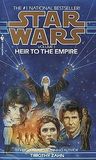
BOOK REVIEW: Heir to the Empire by Timothy Zahn

Heir to the Empire (Star Wars: The Thrawn Trilogy, #1)Heir to the Empire by Timothy Zahn

My rating: 4 of 5 stars

Amazon page

Heir to the Empire is set about five years after the first movie trilogy (by release date, i.e. after Return of the Jedi.) It features many of the principal heroes of the first trilogy including: Luke, Leia, Han Solo, Chewbacca, Lando Calrissian, R2-D2, and C-3PO. Obviously, gone are most of the bad guys from the movies, but in their place has risen Grand Admiral Thrawn—a master strategist who seeks to revive the Empire. Thrawn is portrayed more as a brilliant military man than a dastardly villain. This doesn’t mean he can’t be cold and villainous, but he also brings in a measure of intellect and rationality not seen in the movie universe. While it would appear that Luke is the last of the Jedi Knights, or the first of a new line if one prefers, that turns out to be not entirely true.

I enjoyed this book. I bought it during a Kindle sale on what Amazon considered to be the best Star Wars books. While I’d seen the movies, I hadn’t read any of ancillary works, and so I Googled to find out which of the books on Amazon’s list were considered by fans to be the best. Zahn’s Thrawn trilogy, and particularly this first installment, seemed to be on every fan’s list.

One of the great plot devices used in this book is a creature whose mere presence can nullify the force. This strips Luke’s powers away through a critical piece of the book. Yes, the introduction of this creature is deus ex machina, but it’s deus ex machina that challenges the protagonist–rather than making life easier for him–so it’s alright by me. Because Luke is the last of the known Jedi, he’s essentially a Superman among mere mortals, and so the book might have become tedious if Luke weren’t stripped to his native intellect and courage devoid of superpowers. Instead, he has to escape from the planet on which these creatures reside and help rescue Han and Lando in the process without any supernatural abilities.

As mentioned, this is the first book of a trilogy, and, therefore, it leaves many major issues unresolved. Multi-part series usually have less satisfying endings than a stand-alone book, and I can’t say it’s not true of this work. However, this first book of the Thrawn trilogy does contain a clear climax and a definitive tactical (battle-level) resolution.

The book intersperses chapters from the hero’s point of view (PoV) with those from the Thrawn’s ship. This book begins with a chapter from the enemy’s PoV, and so for Star Wars neophytes—such as myself—one enters into a whole new territory in which it’s not quite certain when or where one is in the Star Wars universe. However, in subsequent chapters Luke, Leia, and Han are introduced and we learn that Han and Leia are married and that Leia is pregnant, and this gives one insight into the timeline of the book. We also learn that while the Empire seems to have been destroyed, the Republic is on weak footing and is having trouble reestablishing itself.

The book introduces us to a couple of new characters that I understand will become established in the expanded Star Wars universe. The most intriguing and important of these is Mara Jade, the right hand woman of the most powerful smuggler in the known universe. We soon learn that Mara despises Luke Skywalker and wants nothing more than to dance on his grave. However, we don’t learn until much later why it is that she hates him, and we learn after a time during which the two are forced together by circumstances. Mara Jade is a force to be reckoned with. While she might not be a match for Luke the Jedi, she is more than a match for Luke stripped of his powers. It seems clear that Zahn is building a relationship between Luke and Mara with their interaction in this book. Luke is oblivious to why Mara dislikes him, or even who she is until he is explicitly told, but events force them to spend time together under trying circumstances.

All in all, I liked this book. I found it readable, and thought that it did a good job of maintaining tension throughout.

View all my reviews

BOOK REVIEW: Batman: Arkham Asylum by Grant Morrison

Batman: Arkham Asylum - A Serious House on Serious EarthBatman: Arkham Asylum – A Serious House on Serious Earth by Grant Morrison

My rating: 4 of 5 stars

Amazon page

This is the third, and probably last, installment in my “Happy 75th Anniversary, Batman” series of reviews. Batman: Arkham Asylum is an attempt to convey a nightmare on the page, and it succeeds both graphically and narratively. It’s quite different from other Batman comics in style and content. It takes the dark nature of the Dark Knight’s mythology to the extreme.

There are two story-lines woven together in Batman: Arkham Asylum. The main line involves Batman entering an Arkham Asylum being run by the inmates. There he finds himself pitted against his foes: the Joker, Two-Face, Scarecrow, and others. The other is the 19th century tale of Amadeus Arkham’s descent into madness.

As is common in the Batman mythology, psychiatrists are portrayed as walking the razor’s edge between sanity and insanity. For those who don’t read comic books, this is most readily exemplified by the character of Dr. Crane / Scarecrow in the first film of the Nolan trilogy, Batman Begins. I’m not sure whether the point is to create enemies that are so strong they can bend doctors to their will, or if there is a general disdain for psychiatrists—as one might see a dislike of lawyers in other stories.

Among the nightmarish elements of this work is the fact that Batman’s face is never seen clearly. The Dark Knight is always a vaguely and/or surrealistically silhouetted. There’s a mix of sharpness and haziness in the graphics. The Joker gets his own crazy scrawl font. The graphics are as creepy and strange as can be. On my low-end Kindle, the work was in black and white, which worked well. I did look at the sample pages, and the color version uses a lot of sepia and crimson.

Batman: Arkham Asylum asks us to consider whether Bruce Wayne / Batman is sane or just a lunatic with a moral code.

View all my reviews

BOOK REVIEW: Batman: The Dark Knight Returns by Frank Miller

Batman: The Dark Knight ReturnsBatman: The Dark Knight Returns by Frank Miller

My rating: 4 of 5 stars

Amazon page

A couple of reviews ago, I covered Frank Miller’s Batman: Year One, which imagined the first year of the Dark Knight’s venture into crime fighting. The Dark Knight Returns is Miller’s take on the other end of the Caped Crusader’s career. It begins ten years after the last sighting of the Batman. Commissioner Gordon is on the verge of retirement, and there’s a mix of new and old threats rising.

There are four parts to this work. The first, also entitled The Dark Knight Returns shows the rise of a powerful gang of thugs called “The Mutants.” The way this gang’s leader is drawn makes him look like he truly is an altogether different species, but it’s his filed teeth and his bulky physique that account for his appearance. The main battle is with the “rehabilitated” Harvey Dent (a.k.a. “Two-Face,” an inappropriate moniker as his face has been fixed and his flighty psychiatrist ensures the community that Dent’s mind is fixed as well.) We see Bruce Wayne’s concern about the deteriorating state of Gotham and his eventual return to crime fighting, which is instigated by a freakish bat flying through his [closed] window. Wayne takes the bat as a sign from the universe that the Batman is indeed needed. Dent engages in a terroristic plot which the Dark Knight must try to foil.

As was the case in Batman: Year One, the story of Commissioner Gordon plays out in parallel with that of Bruce Wayne / Batman. However, in the third book, Gordon has retired and it’s the new Commissioner, Ellen Yendel, who shares the spotlight. Yendel, unlike Gordon, promptly issues an arrest warrant for Batman.

Book Two is called, The Dark Knight Triumphant, and it’s in this episode that Batman comes up against the leader of the Mutants. As in Batman: Year One, Batman arrives to the fight as an underdog. However, as would be expected, the nature of his underdog status is completely different. In Year One, Batman is a supreme physical specimen, but is green to crime fighting. In The Dark Knight Returns we see a battle-hardened veteran Batman who is a spry geriatric, not up to fighting young, mutant thugs. However, as with the former comic, the Dark Knight does redeem himself. Many of the Mutants, being fair-weather friends to their leader, form a cult of Batman in the wake of the Dark Knight’s victory over their former boss.

Besides broadening the readership demographic to retirement community dwellers, another new demographic is appealed to with Carrie Kelley, the new Robin. There are references early in the book to the profound effect that the death of Jason Todd had on Bruce Wayne. Be that as it may, Batman seems quick to bring this young girl into harm’s way given the lingering wound of Jason Todd.

Book Three, Hunt the Dark Knight, pits Batman against his ultimate nemesis, the Joker—who like Dent—has been sprung in no small part due to his lunatic psychiatrist. Miller continues the popular Batman comic disdain for psychiatrists, who are portrayed as a small nudge away from becoming bat-shit crazy (pun intended.) While the battle against the Joker provides this chapter’s crime fight, Commissioner Yendel’s war on Batman is a major part of the storyline. We also discover that time has not been as kind to Selina Kyle as it was to the men of this series. (i.e. Gordon is old but distinguished, and Batman has pretty much the same preternatural physique that he did as the young batman.)

The Dark Knight Falls is the last section, and it’s the most famous for the battle between Batman and Superman. Earlier in the book there’s a foreshadowing call from Clark Kent to let Batman know that the Superman will be out-of-town for a while. Appropriate to the 1986 issue date of this comic, a Cold War crisis is the event consuming Superman’s time. These Cold War tensions result in a nuclear missile launch that Superman diverts, but the Man of Steel hasn’t read up on the Electro-Magnetic Pulse (EMP) effect. [Incidentally, Miller didn’t read up on the use of nuclear weapons as an EMP either, or—at least—he gets it completely wrong. Perhaps, he just figured that his readers wouldn’t know the difference–and he’s probably right. At any rate, I’m not deducting stars for bad science.] The power outage caused by the EMP results in looting and societal chaos. Batman quells this with the help of the cult of Batman mentioned previously. However, this doesn’t go over smoothly with some, which results in Superman’s invasion of Batman’s Gotham turf, and the ultimate battle.

I enjoyed this work more than Batman: Year One in part owing to the serious enemies that the Dark Knight must vanquish. I’d agree with the common view that this is a must-read for those interested in the canon of the Caped Crusader.

Also, if you aren’t a comics fan but are wondering how Batman and Superman could end up fighting–as per the upcoming Batman v Superman: Dawn of Justice movie–this might give you some insight. [Though I wouldn’t expect that movie to follow this work in any of the vaguest ways.] Also, there are other Caped Crusader versus Man of Steel interpretations out there, though this is probably the most famous.

View all my reviews

BOOK REVIEW: Batman: Year One by Frank Miller, et. al.

Batman: Year OneBatman: Year One by Frank Miller

My rating: 3 of 5 stars

Amazon page

Amazon recently had a sale on classic Batman collections in celebration of the Caped Crusader’s 75th anniversary. I bought a few titles, including this one.

Batman: Year One is Frank Miller’s vision of the hero’s first year of crime fighting. Unlike the first movie in the Nolan trilogy, Batman Begins, there’s no backstory about Bruce Wayne’s training. The comic begins with Bruce Wayne beginning to go on the equivalent of self-sanctioned “neighborhood watch” rounds in Gotham’s seedy underbelly. He’s in his planning and research phase, and only quasi-reluctantly gets into brawls with street thugs. His goal is, ostensibly, intelligence gathering.

Miller’s work isn’t aimed at a boyish market. From the intimation of underage prostitution to themes of marital infidelity to the unsubtle homage to Edward Hopper’s famous painting Nighthawks, this book is directed at a more mature reader. It’s grittier, but Batman hasn’t yet become so sophisticated as to abandon wearing his underwear outside his pants.

The four chapters that make up this graphic novel parallel and twist together the stories of Jim Gordon and Bruce Wayne as they each begin their Gotham crime fighting careers. In many versions of the Batman mythology, Gordon is a young cop who helps boyhood Bruce Wayne on the night his parents are killed. This is one of the ways in which the Miller version differs. In Batman: Year One Gordon is a detective who moves to Gotham from Chicago at about the same time Bruce Wayne is sticking his toe in the waters of Gotham crime. This comes in handy for Miller later in works like Batman: The Dark Knight Returns in which he is able to have a geriatric Bruce Wayne and Jim Gordon coexisting.

The interests of Gordon and Batman only align at the very end of the last chapter. Until then, Gordon is trying to find and apprehend Batman like all the other cops. In fact, Gordon is leading the crusade against the Dark Knight when his bosses still have little interest in it—until Batman crashes their ball.

There are no supervillains yet—only corrupt cops and organized crime. Bruce Wayne, who adopts the guise of Batman only after a bat flies through his window (never heard of that happening), gets off to a rough start. He isn’t yet the phantom nightmare that he will later become, and is still learning his lessons. In his early encounters with criminals, he prevails mostly by being able to take a punch.

Besides Bruce Wayne’s inner monologue being a bit ham-handed, I enjoyed this work. The ham-handed inner monologue is—no doubt–intended to convey that Wayne is a man of thought as well as a man of action, but it’s hard to believe that someone who could transform himself into the Batman would be that riddled with doubt. That said, the dialogue is better written than the typical comic. There’s not a lot of the “As-you-know-Bob” dialogue that often plagues this genre.

If you’re a fan of the Dark Knight, this is worth reading.

View all my reviews