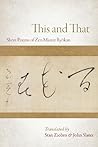
BOOK: “This and That” by Ryōkan [trans. by Stan Ziobro and John Slater]

This and That: Selected Short Poems of Zen Master RyokanThis and That: Selected Short Poems of Zen Master Ryokan by Ryōkan
My rating: 5 of 5 stars

Publisher Site — Monkfish Books

Release Date: March 24, 2026

This is a new selection of Ryōkan’s short poetry (haiku, tanka, and Chinese-Style poems) as translated by Stan Ziobro and John Slater. Ryōkan was a Buddhist monk who lived across the late 18th / early 19th century. These translations are evocative and present the sometimes whimsical and sometimes haunting work of Ryōkan well. While the forms are just three, i.e. haiku, tanka, and kanshi [Japanese Poetry in the Chinese Style,] the style varies, some being imagist and some being more philosophical. Being a monk, Ryōkan’s work is heavily influenced by a Buddhist worldview, as well as by philosophies that interacted with Buddhism — e.g. Taoism.

While I usually have no basis to judge a translation as translation and am left to reflect on it purely as stand-alone verse, in this case, I have enough experience reading translations of Ryōkan to have a feel for his work. I immediately recognized some of Ryōkan’s more famous poems: e.g. the one’s translated in this book as, “Poems? no way // when you see that my // poems aren’t poems // then we can talk poetry” or “Left behind by thief // bright moon // in my window” Yet, at the same time, I felt the translators left some of their own imprint on the poems, and their influence / voice resonated with me.

The book does have front matter to set the stage for readers, and there is a “Notes” section that includes useful background on the poems. I found this ancillary matter useful, but not excessively verbose or intrusive.

If you enjoy Japanese poetry or Buddhist influenced poetry, I’d highly recommend this selection.

View all my reviews

“Who says my poems are poems” by Ryōkan [w/ Audio]

Who says my poems are poems?
They aren't poems at all.

Only when you understand my poems aren't poems
Can we talk poetry.

This translation by Sam Hamill in The Poetry of Zen (2004) Boston: Shambhala, p. 159

“Without desire everything is sufficient” by Ryōkan Taigu

Without desire everything is sufficient.
With seeking myriad things are impoverished.
Plain vegetables can soothe hunger.
A patched robe is enough to cover this bent old body.
Alone I hike with a deer.
Cheerfully I sing with village children.
The stream under the cliff cleanses my ears.
The pine on the mountain top fits my heart.

Translation by Kazuaki Tanahashi and Daniel Leighton in Essential Zen (1994) HarperSanFrancisco.

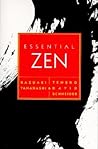
BOOKS: “Essential Zen” ed. by Kazuaki Tanahashi & David Schneider

Essential ZenEssential Zen by Kazuaki Tanahashi
My rating: 5 of 5 stars

Google Books Page

This is a collection of short writings (poems, koans, and prose excerpts) on Zen Buddhism arranged into loosely themed sections. The writings tend toward the artistic, creative, and metaphorical, with relatively few straightforward descriptions of technique or philosophy. The writings range from those of Chinese and Japanese monks who lived hundreds of years ago to present-day poets and Zen practitioners. Among the more frequently drawn from sources are: Hanshan, Ikkyu, Dogen, Ryokan, Hakuin, Gary Snyder, Robert Aitken, Seung Sahn, John Daido Loori, Thich Nhat Hanh, and Peter Levitt. But there are many others, including some who have only a single piece included.

There’s a substantial “Notes” section that gives source, translation, and — in some cases — background information. Most of the translations (both Japanese and Chinese) are by the editors, Kazuaki Tanahashi and David Schneider. There are illustrations, but they are all ensō (circular brush paintings) and related forms.

This is a highly readable and insightful collection of short writings, and I’d highly recommend it for individuals interested in Zen or Eastern Philosophy more generally.

View all my reviews

Four Seasonal Haiku of Ryōkan [w/ Audio]

Spring

rainy days
make the monk Ryōkan
feel sad.

Summer

the moon in my window
is all the thief left behind.

Autumn

an autumn wind
chills the dangling persimmons,
and my testicles.

Winter

little birds have
gathered in the brushwood
on a snowy morn.