Evangelists Meet Max Their Match

BING-BONG.

Without even looking up from his computer, Max knew it was church people. They came around trying to sell him a religion now and again. No one sold aluminum siding, encyclopedias, or ice cream door-to-door anymore. Evangelic proselytizers were the last bastion of door-to-door salesmanship. The sect varied; the approach did not. They were the only ones who ever disturbed his peace.  Well, the only ones who didn’t use the phone.

He went to the door. It was a zaftig woman and a clean-cut young man–both dressed in funeral-like attire.

“Hello!” the pair said with practiced exuberance.

“Hello,” Max parroted with a decided lack of exuberance. Then he added, “May I help you?”

Max didn’t feel like being helpful, but there was the off-chance that it was  a couple of his neighbors who were just looking to borrow a cup of sugar so they could bake cookies for whatever wake they were attending. If so, he’d help them out, but as far as he knew such a request hadn’t happened since 1955. Then he saw their name tags, and not the paper kind. These were black plastic bordered in gold with white letters.

“We’d like to talk to ya ‘bout the Bible,” the woman said.

“Unless it’s the racy bits, I don’t think you’ll hold my interest,” Max said.

“Excuse me?”

“Never mind.”

“Have you ‘cepted Jesus as your personal Lord and Savior?” the woman asked. The young man was silent, apparently just there in case the woman knocked on the door of a Jeffery Dahmer-type.

Max was distracted by the words “personal lord”, and how odd the phrase seemed. Can I get my Messiah in Mocha with a burgundy robe?

After an awkward pause, he said,  “No, I’m an atheologist.”

They gave a coordinated grimace as if he’d dropped a deuce at their feet. “You’re an atheist?”

“No. I said atheologist. An atheist is one who does not believe in God. I believe in God. I just don’t believe in religion.”

“You cain’t have Gawd without religion.” The woman said.

“I beg to differ.”

“How’d ya know Gawd, elsewise?” The woman continued.

Max swept his hand outward in a gesture meant to draw the pair’s attention to the flowering dogwood in his front yard and the sky beyond. Their forehead creases indicated that they were both perplexed. The meaning of his gesture was lost on them.

“You cain’t know Gawd without religion,” the woman repeated, as if Max just hadn’t heard her the first time and if she said it more emphatically he would get it.

“You can repeat a gratuitous assertion ad infinitum, and it will remain an assertion,” Max said.

Neither evangelist gave any indication that they understood what Max was saying.

He sighed, stepped out onto the porch with them, and said, “Look. First, let’s ask what God gives us.” He leaned out under the eaves to look at an azure sky feathered by white wisps of cirrus clouds. This time they followed his gesturing arm and looked out with him at the bounty of nature. “Now, let’s consider what religion offers us. May I?”  He said as he reached for the thin little magazine that they had prepared to leave with him.

Max was taking a risk. He couldn’t know exactly what it the magazine would contain, but he’d seen enough of them to make an educated guess. There it was, right on the cover. He didn’t even have to flip through in search of it. The cover artwork was a dark sketch of a treeless city with brooding clouds drifting at the tops of buildings. The buildings were in ruins, and there were human-shaped lumps on the ground –meant to be either corpses or homeless people. It was a story about the fall of man or the coming apocalypse or some doom upon whose cusp humanity sits.

“Here we have it. Religion doesn’t show us beauty. It wants me to be afraid. It wants to scare me. It wants carnage and chaos to be my lodestar. It shows me horrors so that it can be my life-preserver. It wants to be my life-preserver so that I’ll substitute its will and wisdom for my own. It wants me to believe its leaders are infallible so that I’ll feel good about giving up control. It wants me to behave as its people behave. Most insidiously, it wants me to hate the people who it hates… This is why I don’t believe in religion. Thank you for your time,” Max said as he handed the Doomsday Gazette back to the woman and walked back into his house, leaving the two slack-jawed proselytizers in his wake.

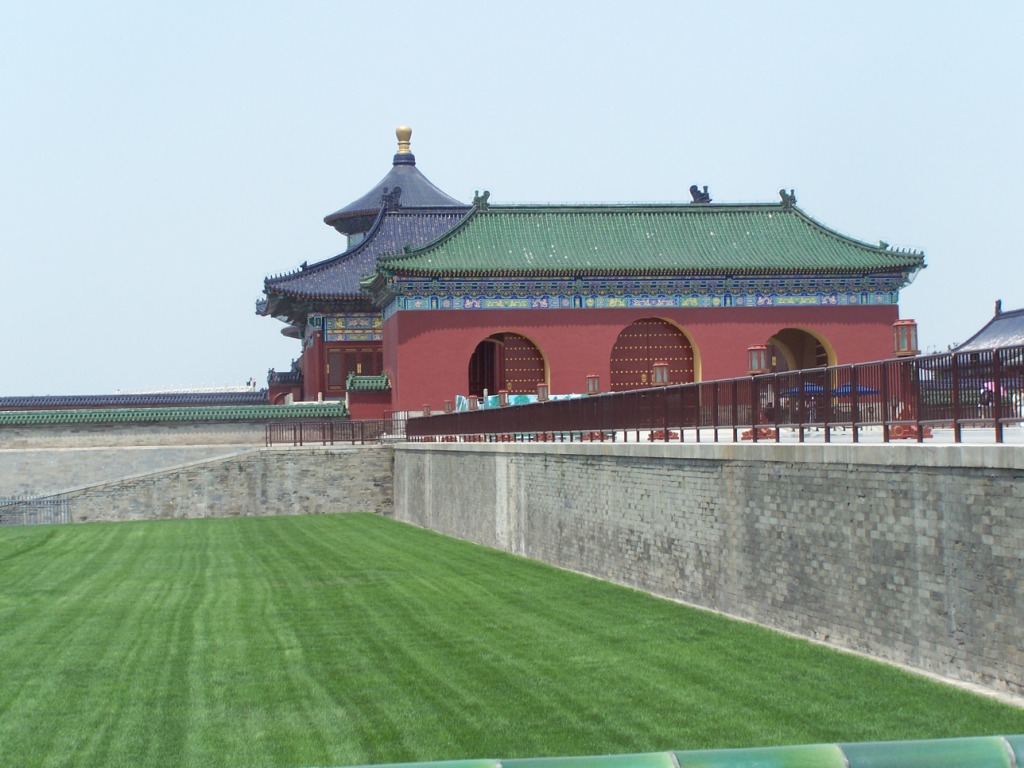
DAILY PHOTO: Temple of Heaven Grounds in Beijing

The pointy-topped building is the Hall of Prayer for Good Harvests

The pointy-topped building is the Hall of Prayer for Good Harvests

The Temple of Heaven is a complex of buildings used for Heaven worship.  It was built in the 15th century, and is a Taoist temple  (Heaven worship predates Taoism–though the Temple doesn’t.) The most distinctive building, the Hall of Prayer for Good Harvests–shown only partially in the picture–was built without any nails or spikes.

It’s  located in a beautiful park south of central Beijing. The park has a rose garden and is a popular hangout for people doing tai chi, playing instruments, and dancing.

BOOK REVIEW: How to be God by George Mikes

How to Be GodHow to Be God by George Mikes

My rating: 3 of 5 stars

Amazon page

Humorist George Mikes’ main premise in this book is that humans created God in their image. The book is a series of essays designed to instruct God, if he or she exists, in being a more reasonable facsimile of the ideal human–dear old mom.

Actually, the micro-essays that make up the chapters of this book cover a wide range of subjects. Some of them stay on topic more closely than others. A few of the chapters seem to be stories that the author found interesting (and they are), but which didn’t have a lot to do with supporting his argument. For example, he discusses the two good deeds he has done in life, and he has a chapter on episodes of coincidence. The former may be a tongue-in-cheek support for the argument that even the worst of us are good sometimes. The latter may have been an attempt to bolster a more general argument for atheism by stating that coincidences are not miracles. However, if that is his point, while true, he doesn’t explicitly close that loop in any but the most gratuitous way. At barely over 100 pages, it felt like some of the material, while entertaining, was in the book not to address the topic but to hit the lower bound on a page range.

Mikes weaves together amusing anecdotes with shock-essayist statements that are not so much humorous as gratuitously provocative. With respect to the latter, I’m thinking of his discussion of Hitler and Stalin as basically good guys–if at least in their own minds.

The book is a mixed bag. It’s sometimes though-provoking and humorous, but other times it drifts into shock and awe gratuitous assertions. I suspect he could have hit his page mark by supporting his arguments better and still maintained the humor (realizing that exposition can be death in humor writing.)

A prime example of the book at its best is a story about a woman meeting with her doctor [paraphrased herein.] This is in a section about mini-gods, i.e. those people that we quasi-deify–such as judges and medical doctors. The doctor is trying to convince the woman to have surgery, but the woman refuses.

The doctor asked, “how did you get here today?”

The lady replied, “I took the bus.”

“And you trusted the driver, a complete stranger, with your life. But you won’t trust me–an expert in my field?”

“Yes, of course, the difference is vast.”

“How so?”

“The driver was on the same bus.”

If you find a copy, this book is worth a read. It’s not much of a time investment. It’s an illustrated 105 page book.  If your attitude is, “Sacred cow? it’s what’s for dinner,” you’ll probably like it overall. If you are pious, you’ll probably hate it. If you are neither, you’ll probably find that it has its moments.

View all my reviews

Book Review: Breakfast with Buddha

Breakfast with BuddhaBreakfast with Buddha by Roland Merullo

My rating: 4 of 5 stars


Merullo’s “Breakfast with Buddha” is a classic road-trip / odd couple tale. I found it to be engrossing and engaging. It is a book that attempts to convey life lessons as it entertains. In my opinion, this type of book succeeds best when the lessons do not draw too much attention to themselves, but rather subtly plant a seed. In some cases Roland Merullo’s book succeeds on this regard, and in other cases his middle-of-the-road protagonist comes across as a bit preachy and holier-than-thou.

The set up is a road-trip from New Jersey to North Dakota in which a spiritual but only vaguely religious skeptic is joined by a Tibetan Buddhist Rinpoche. The Rinpoche conveys life lessons, largely of a Buddhist nature but somewhat non-denominational, to the protagonist — often at breakfast (hence the title.)

Merullo does a great job creating a character who considers himself spiritual, but who is not so comfortable with spiritualism that is out of line with western rationalism or which expresses religiosity in the doctrinaire Western tradition.

The protagonist, Otto Ringling, undergoes a sort of transformation that is satisfying –though some may find it to have gone a skosh too far.

Those who my Religious Studies professor called Homo religiosis will likely find the book objectionable, but atheologists (not atheists, but those not believing in religion, though believing in god / God / gods) will probably relate to it quite nicely.

I recommend it.

View all my reviews