BOOKS: “Mother Tongue” by Bill Bryson

The Mother Tongue: English and How It Got That WayThe Mother Tongue: English and How It Got That Way by Bill Bryson
My rating: 5 of 5 stars

Publisher’s site

This is a humorous and readable overview of the English language. It examines the language’s history and evolution, as well as exploring some niche areas of interest such as swearing, wordplay, and naming conventions. Bryson takes on such questions as how a language that’s a train wreck of non-phonetic spelling and logical inconsistencies that made a career for comedian, Steven Wright (e.g. Why do we park in the driveway and drive on the parkway?) becomes the world’s most broadly spoken language. (At this time, it’s even the most spoken in absolute terms, but the book is fairly old now.)

Part of what one learns is that English isn’t so bad. Yes, our spelling is random and nonsensical (despite many failed attempts to improve it,) but in some ways English is grammatically simpler than many languages. English also has a history of embracing loan words and so there’s something familiar for all comers. Bryson does provide a number of fascinating points about other languages, largely by way of comparing and contrasting them with English.

Bryson was born in America, worked much of his life in Britain, and moved back to America. This bi-nationalism gives him unique insight into some of the book’s central questions — e.g. whether the language of these two hubs of English language will diverge or converge. There has been a concern that the English language would become so fractured that it would no longer be mutually intelligible to those on opposite sides of the Atlantic. However, increasingly, there is greater concern that people who watch both British and American versions of “The Office” may homogenize the language into one in which regional differences vanish.

I found this book to be both interesting and entertaining and would highly recommend it for anyone who wants more insight into the English language presented in an approachable manner.

View all my reviews

“Untitled” [Pronunciation Poem] by Anonymous* [w/ Audio]

I take it you already know
Of tough and bough and cough and dough.
Others may stumble, but not you,
On hiccough, thorough, lough and through.
Well done! And now you wish, perhaps,
To learn of less familiar traps.

Beware of heard, a dreadful word
That looks like beard and sounds like bird.
And dead -- it's said like bed, not bead.
For goodness sake, don't call it deed!
Watch out for meat and great and threat.
They rhyme with suite and straight and debt.

A moth is not a moth in mother,
Nor both in bother, broth in brother,
And here is not a match for there,
Nor dear and fear for pear and bear.
And then there's dose and rose and lose
Just look them up -- and goose and choose.

And cork and work and card and ward.
And font and front and word and sword.
And do and go, then thwart and cart.
Come, come I've hardly made a start.

A dreadful language? Man alive,
I'd mastered it when I was five!

* This poem has come to be attributed to a T.S. Watt with a date of 1954. However, the broad divergence of titles and lack of other publication information suggest the alternate possibility that attribution was invented after the fact and has just been mindlessly copied across the internet. I don’t wish to cheat T.S. Watt, if he or she was an actual person who wrote this clever poem, but I also don’t wish to contribute to the spread of false information that happens regularly across the internet. Hence, this note.

TODAY’S RANT: Pronunciation Police

Pronunciation is tricky.

Pronunciation is tricky.

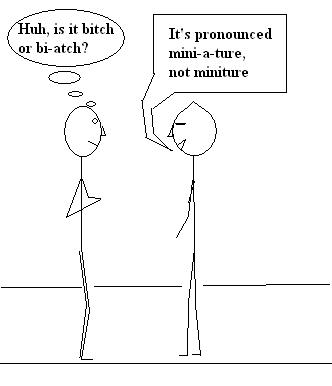
If you’ve ever had someone tell you that any water can be put in a pot (for pronouncing drinking water pot-table rather that po-table), then you may be with me here. If you frequently exercise your perogative, rather than your prerogative, you may agree. Have you had sherbert, or only sherbet? Do both your eggs and oxen have yokes?

If you’re not with me, you –my friend– might be the person on the right in my little stick cartoon.

I’m as anal about language as the next writer, but let’s try to dial down the pretentiousness. The big question I have for pronunciation police is this: What in your experience with the English language has led you to believe it is a phonetic language?

For those who think English is phonetic because they learned it via “Phonics,” let me expose you to a poem that says it more eloquently than I ever could. (I would attribute the poem, but it is to my knowledge owed to that most prolific “Anonymous” chap.)

Hints on Pronunciation for Foreigners

I take it you already know
of tough and bough and cough and dough.
Others may stumble, but not you,
On hiccough, thorough, laugh and through.
Well done! And now you wish, perhaps,
To learn of less familiar traps.

Beware of heard, a dreadful word
That looks like beard and sounds like bird.
And dead-it’s said like bed, not bead.
For goodness sake, don’t call it deed!
Watch out for meat and great and threat.
They rhyme with suite and straight and debt.

A moth is not a moth in mother,
Nor both in bother, broth in brother,
And here is not a match for there,
Nor dear and fear for pear and bear.
And then there’s dose and rose and lose
Just look them up–and goose and choose.
And cork and work and card and ward.
And font and front and word and sword.
And do and go, then thwart and cart.
Come, come I’ve hardly made a start.

A dreadful language? Man alive,
I’d mastered it when I was five!

If you still don’t believe that the language can handle multiple pronunciations, check out what the experts say.