A trick of the light
Turns leaves pallid and frosty
Under dusky skies
[National Poetry Month: Poem 3]

A trick of the light
Turns leaves pallid and frosty
Under dusky skies
[National Poetry Month: Poem 3]
 I read you like a person reads
his blender manual.
It’s a necessity–legally obligatory.
But meaningless because if a word falls
in a blender manual, does anyone read it?
No one cares until someone loses a thumb.
Words are nudged and danced
into perfect clarity in seven languages.
But it’s 100 pages for a three button machine.
“Frappe” must have a long and convoluted definition.
[Poem #2: National Poetry Month]

I stress that eustress
is the best stress.
From time to time,
I must confess
I’ve made a mess
doing more
succeeding less.
In a mad dash to impress,
badgered by self-duress,
taking matters to excess,
brewing up toxic distress.
Assess,
progress,
but don’t obsess.
[Poem 1: National Poetry Month]
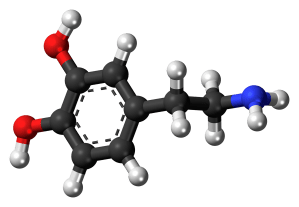
Dopamine Model; Source: Wikipedia
I’m grateful for the ability to be grateful.
For gratefulness causes dopamine and serotonin levels to rise.
I’m grateful for the fine people in my life.
For delightful company causes oxytocin and vasopressin spikes.
I’m grateful for my health.
[Or am I healthy because I’m grateful?]
For gratitude correlates to superior health across several indicators.*
I’m grateful for my food,
which is well-balanced to provide the brain glucose,
while offering all the
vitamins, minerals, and amino acids
my neurochemistry needs.**
*Sansone, R.A. and Sansone, L.A.2010. Gratitude and Well Being. Psychiatry. 7(11): 18-22.
**Gibson, G.E. and Blass, J.P.1999. “Nutritional and Functional Neurochemistry.” Basic Neurochemistry: Molecular, Cellular, and Medical Aspects, 6th ed. NCBI: Bathesda, MD.

dusk descends
&
bats wing away
abandoning bamboo stanchions
that flex, creak, and groan
during their daily hang
flying like waves of B-52’s
on a doomsday run–
buggy Armageddon
but bugs are too numerous
and
small-brained
to be decimated
it takes giant ganglia
to produce a proper doomsday
 Modern British Poetry by Louis Untermeyer
My rating: 4 of 5 stars
Amazon page (not the same edition)
This is an anthology of 183 poems written by 77 British authors. Given the title, “Modern British Poetry,” the first thing that should be stated is that the original work came out around 1920, and so the bulk of these poems are from the 19th century. That may fit perfectly with your classification of modern poetry, but if you’re looking for present-day poets, this isn’t the book you’re after.
However, the good news is that you might still find some unexpected treasures. Often collections of public domain poetry like this gather poems that are ubiquitous and which are probably already on the shelves of most poetry readers in various collections and anthologies. But of the almost 80 poets included, only a handful will be household names for a general reader—particularly if you aren’t from the UK and thus didn’t get exposed to the more obscure British poets. Of course, there are a number who have stood the test of time: Thomas Hardy, Robert Louis Stevenson, Oscar Wilde, A.E. Housman, William Butler Yeats, Rudyard Kipling, G.K. Chesterton, Alfred Noyes, D.H. Lawrence, Edith Sitwell, and Robert Graves spring to mind. Furthermore, the poems chosen aren’t a straightforward “greatest hits” list. (e.g. “If” isn’t among the four Rudyard Kipling entries.)
As one might expect of a 230 page anthology that contains 183 poems (plus author bios and the occasional footnote), the poems selected are brief. In a few cases, excerpts from longer works are included, but for the most part these are poems that fit comfortably on a single page. This is great for someone trying to get a feel for the various poets and for those who enjoy more compact works over epic poems—which, if we’re being honest, is most of us.
The anthologist, Louis Untermeyer, includes brief bios for each of the poets in front of their entries in the anthology. Generally, each included poet has between one and four poems. While the poems are organized by poet, the poets seem to be organized chronologically (at least as near as I can tell; it begins with Thomas Hardy [1840 – 1928] and ends with Robert Graves [1895 – 1985.])
I read a Kindle version of this work and found it to be far better organized than most of these public domain compilations. It not only had an index that would take one to individual poems or poet bios, but it also contained a hyperlinked index. Unfortunately, I obtained the book some time ago and I couldn’t find the same edition when I looked for it while doing the review. Most of the Kindle editions now seem to bundle Untermeyer’s “Modern American Poetry” with his “Modern British Poetry” but the edition I had was just the British poets.
I recommend this book for poetry readers. In addition to having some exemplary short form poetry from both well-known and forgotten poets, it happens to contain the first poem I ever memorized in it—a powerful little poem by John McCrae entitled “In Flanders Fields” (if you don’t know it, read it; it’s war poetry at its finest.)

A worn wooden knob
Shiny here, pitted there
Rotates loosely on a steel pin
Set in a sinuous cast-iron arm
A horn flares skyward
It’s fed meat and gristle
The spiral augur chews and crushes
with gruesome moist sounds
Carrying meat to the grinder blade
Shredded charnel remnants vomit forth
from a perfectly circular mouth
Tumbling into an old glass bowl
Chipped on the edge but not abandoned
A sweep second-hand betrays your modernity
A glint unrecognizable throughout eternity
Not all slow time dances out the same
Gooey time stretches to a break in the rain
Tom-toms string out in slow motion
Lost before the vastness of an ocean
The massacred were buried shallow
Their murderers never saw the gallows
Legends said that ghosts rose up
Dead partaking of a proffered cup
To magically roll back the killing time
But clocks refuse to yield for crime
Running dumbly down the street
She bows to touch the guru’s feet
But the world is in chaos down
On the burned out side of town
Cashing checks for weekly wages
Stuck in time across the ages
 District and Circle by Seamus Heaney
My rating: 5 of 5 stars
“District and Circle” is a collection of 44 poems by the Nobel Laureate Seamus Heaney that was released in 2006.
One feels the essence of the 20th century across this collection. There are a couple of poems that refer to World War II, not from the perspective of crucial events and violent clashes, but as it was experienced in “the District” (e.g. “Anahorish 1944.”)
There are also a number of poems that make industrialization romantic or—at least, in some way–evocative. Heaney writes of mechanical devices and processes in a way that many great nature poems are composed (e.g. the first poem in the collection “The Turnip-Snedder.”) In fact, it’s almost like industrial haiku. It doesn’t share the brevity of Japanese form, but it removes the extraneous and deals in only what one can experience with the senses. In that way, one can feel the heft of these objects. They aren’t cheap, flimsy plastic, but wood and iron and brass. There are also some lovely nature poems.
Heaney’s use of language is resplendent. It’s not just the description, but the sound. I’ve even found myself thinking, “I don’t know what that word means, but—damn–it sounds gorgeous right there.”
The poems range from several words to a few pages in length, with most fitting on a single page. It’s about 80 pages of beautifully composed poetry.
I’d recommend this book for all poetry readers.
Call me Ishmael.
And if you write me
send it by fish mail,
addressed: high seas.


