POEM: Until You See the Flower Floor

It’s a post-apocalyptic scene.

Until you see the flower floor.


Concrete walls, bare but for paan stains.

Looking like a fresh massacre.

A murderous rampage

written in shotgun spatters.


A pack sits, rhythmically rocking,

hands mindlessly at work.

But with their backs to you,

you can’t see they’re stringing garlands.

Looks like the junky fidgets

of a Zombie horde at rest.

The impulse to tip-toe past, rationally quieted.


Then you peer over the rail to the flower floor.

The flower floor is brightness.

The visual gravity of oranges and yellows

exerts such an aesthetic pull on the eyes

that one can’t see any sign

of dystopian dreariness.


[National Poetry Month: Poem #12]

POEM: Foul

they stole her soul

put it in a hole


&


covered it with steaming shit

from the demon’s latrine pit

but they fouled up

it woke the pup

who knew a soul could vaporize


&


in a steam cloud it would rise


&


that breathed in by Cerberus

it’d make the beast more murderous


[National Poetry Month: Poem #11]

5 Reasons to Write Poetry

We’re a week into National Poetry Month. I’ve posted a few poems with more to come, but here I’ll reflect upon the benefits of writing poetry. Some may point out that this is one-sided because the pantheon of poets is littered with opium addicts and suicidal depressives. I read a BBC article citing research showing poets were 20 times more likely to be institutionalized than the non-poet population. I maintain that those bards were broken from the beginning, and that there’s another side to the story.


5.) Poems are puzzles, and puzzles make you problem-solve. This may be more true of structured poetry than free verse, but a poem wrangles words into a relationship designed to create a desired outcome–often an emotional state. With structured poetry one faces a tight puzzle that’s constrained by syllable counts, the relation of stressed and unstressed beats, or rhyme schemes. But even free verse cuts away everything that dampens a desired resonance. That’s done by a series of strategic choices.


4.) Poetry aids emotional management. A study by UCLA researchers found that poetry writing dampens the activity of the amygdala (the brain’s bringer of fear) and, of course, gives the pre-frontal cortex something to do (besides creating catastrophic scenarios–which is its go-to occupation under stress.)


3.) Poetry helps build better prose. Some writers will be more concise and others will be more graphic, but there’s always a benefit to be had. I found a NaNoWriMo blog post that tackles this topic nicely, so I’ll just link.


2.) Poetry activates attentiveness. This is especially true of a form like haiku, which consists of natural observation unembellished by analysis or sentiment. However, all poetry styles require one examine the world intensely enough to see the old anew. This post may be of interest on the topic.


1.) Poetry can access the unconscious. As a practice, I often just put pencil to paper write whatever comes without intervening or directing my conscious mind. Yes, most of it’s crap.  Or not even crap–more like gibberish. But when I go back through these later on, phrases often jump out at me as interesting or evocative, and these often find their way into the heart of actual poems. This is a particularly beneficial practice when one is stuck.

POEM: Happily Obsolete

You’ll never see a guy

shake his fist at the sky

and let fly the impassioned cry,

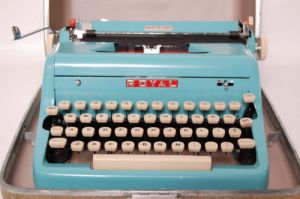
“I just want to fix typewriters.”


Some dream of escaping life in the hoi polloi,

pretending to be a princess, wearing a tiara toy,

but no one applies for the post of “whipping boy.”

[To take the beatings for said mischievous princess.]


And should you flush your ring down the toilet bowl,

you’re on your own, bless your plague-fated soul,

cause you’ll not find a tosher to jump down the sewer hole.

[Unless your time machine is set for London, circa 1850.]


When I look back at the sea of me’s.

I grin with glee and I’m quite pleased,

feeling totally at ease…

Because they’re all happily obsolete.


[National Poetry Month: Poem #10]

POEM: Found on Table

  • 1 revolver, used
  • 5 bullets, loose
  • 1 gas bill, past due
  • 1 electric bill, final notice
  • 1 slice buttered bread, nibbled


[National Poetry Month: Poem #9]

POEM: Ruins

blocks of rubble

corners & edges eroded round

bas reliefs dulled

&

adorned by jagged cracks


once the Earth’s most massive city

in its day London was a hamlet


thriving,

dying,

&

swallowed


infinitely patient arboreal adversaries

claimed the light

drilling down into cracks

making chasms

to set roots


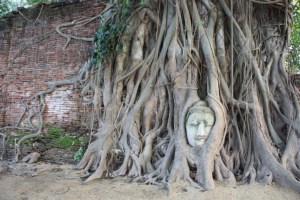
strangler figs, literally,

strangled

figureheads


[National Poetry Month: Poem #8]

POEM: A Monster in Scale and Disposition

Lumbering lunatic slogs

through the moonlit woods.

If it comes upon a farmhouse,

it’ll eat

a chicken or

a goat or

a girl or

a boy.

They’ll find only buttons and belt buckles,

and maybe loose feathers.


It’s a monster in scale and disposition.


[National Poetry Month: Poem #7]

POEM: Edits Awry

“Punch that word into proper position,”

the angry god of grammar cried.

It started surgically.

Teams tapped in pry bars,

popped out words,

and spackled in a space or a substitution.

Then they found rot,

and it’s all wrecking balls and dynamite from here.


[National Poetry Month: Poem #6]

POEM: Brain Burrower

I rue the hearing of that tune

like a sandworm from planet Dune

it burrowed from ear to brain

where its bouncy pop egg was laid

but when the alien overlords arrive

fresh out of intergalactic drive

sitting parked up in our Thermosphere

we’ll offer them a welcome beer

they’ll think us weak in being kind

until we lodge that f@#%ing tune in their hive-mind

watching them gyrate in a spastic dance

their minds melted in a Zombie trance

like lemmings they’ll plummet from the ship

with that infernal tune on all eight lips


[National Poetry Month: Poem #5]