BOOK REVIEW: Death in the Andes by Mario Vargas Llosa

Death in the AndesDeath in the Andes by Mario Vargas Llosa
My rating: 5 of 5 stars

Amazon page


Three men disappear from a small mining village in the Peruvian Andes. The army sends two investigators, Corporal Lituma and his adjutant Tomás, to get to the bottom of the apparent murders. Suspects include Sendero Luminoso (“Shining Path”) guerilla-terrorists and a number of locals. For some of the locals, there’s another possibility, the various demons and deities attributed to each of the mountains in the Andes.

“Death in the Andes” follows the time that the investigators spend in this remote village. There are two major story lines taking place at once. One narrative arc revolves around the investigation and day-to-day living in a tiny town under primitive living conditions. The second story line comes by night as the deputy, Tomás, recounts his love affair with a girl who was out of his league in almost every way—except, perhaps, with respect to virtuous living. The girl was in a relationship with an abusive gangster at the start, a condition that Tomás found untenable. His love-driven reaction creates all manner of drama, and that drama serves as the only entertainment to be had in this remote village.

The book is literary fiction, but it’s not purely about the characters. As suggested, there’s a strong narrative element. While the book is in a realist genre, i.e. nothing in it feels like it couldn’t happen in our universe, the fact that the story takes place in an area of the Andes where the Shining Path is strong and mother nature is harsh means that there’s plenty of tension and suspense.

This is book is translated from Peruvian, and it seemed to me that the translator did a fine job of capturing the feel of the rural Andes. A few Spanish terms are used for terms like terrorists and avalanches to create a feel of a unique character of these concepts relative to this place. However, there are only a couple of these terms and so context is sufficient for the reader to readily keep them straight even if one is not gifted in picking up foreign terminology.

In general, the book is quite readable. The most challenging part of reading it is when Tomás is telling his story because you have a three-way conversation going on over two time periods at once. (i.e. Tomás voices himself and his girl as he tells their story, but then Cpl. Lituma chimes in periodically with questions—or, more commonly, commentary.) However, the author uses dialogue tags throughout to avoid confusion. One just needs to be attentive in one’s reading of these sections.

I enjoyed this story. I picked up this book both because Llosa won the Nobel Prize in Literature in 2010 and I like to read something by winners, but also because I’ve trekked in the Peruvian Andes and translated literature often offers one a unique form of insight into a place. This was no exception.

I’d recommend this book for readers of fiction. If one is looking to broaden one’s horizons into literary fiction and /or translated fiction, this book is a good place to start. It offers humor and intrigue as well as deep characters and an infusion of geography and culture.

View all my reviews

DAILY PHOTO: Andean White Church & Blue Sky

Taken in July of 2011 in the Peruvian Andes

Taken in July of 2011 in the Peruvian Andes

DAILY PHOTO: Sunflower in the Andes: Confused or Distracted?

Taken in Cuzco in July of 2011

Taken near Cuzco, Peru in July of 2011


Sunflowers are supposed to turn to look at the sun, but this one was looking over it’s shoulder. I wonder if it was confused or distracted?

DAILY PHOTO: Cusco Street Scene

Taken in July of 2011 in Cusco, Peru

Taken in July of 2011 in Cusco, Peru

DAILY PHOTO: A Bit of Ruins, a Bit of Mountains

Taken in July of 2011 in the Peruvian Andes

Taken in July of 2011 in the Peruvian Andes

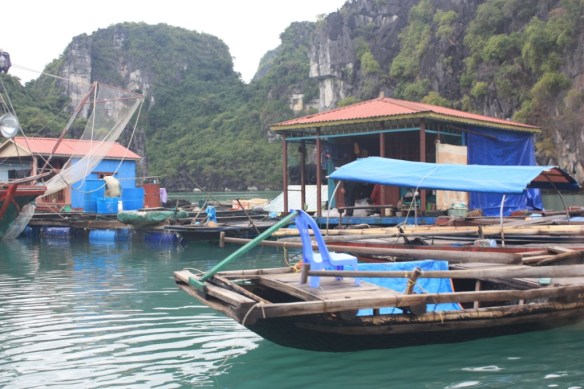
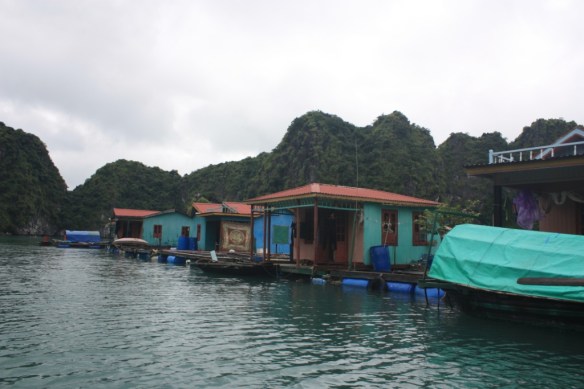
DAILY PHOTO: Vung Vieng Floating Village: or, Why Live Adrift?

Taken on December 31, 2015 in Bai Tu Long Bay

Taken on December 31, 2015 in Bai Tu Long Bay

IMG_2327 IMG_2329 IMG_2379


Vung Vieng sits scattered amid a dense cluster of skerries in Vietnam’s Bai Tu Long Bay.

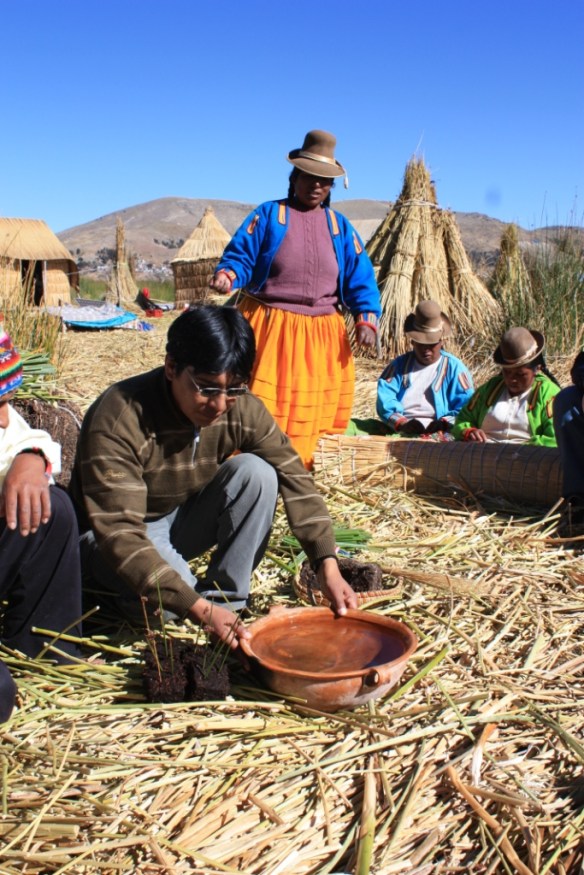
This was the second floating village that my wife and I have visited. The first was located on Lake Titicaca in Peru. The two villages couldn’t be more different.

A Peruvian floating island for comparison purposes

A Peruvian floating island for comparison purposes


There are similarities. Both villages are steadily shrinking (population-wise), and expected to one day disappear. Once upon a time, the villagers lived without daily tourist visits, but now tourists provide much (if not all) of the income earned by most villagers.  (In Vietnam, it seemed like fishing might still be a viable income source for some at least. In Peru, it looked like if tourists disappeared tomorrow the islands would be completely abandoned the day after.)

In many ways the villages were different. On Titicaca, the islands and the structures on them are largely made of bundles of a reed that grows in the lake. In Bai Tu Long, the structures are small houses of modern design that are floating on synthetic materials. (They used to float them on polystyrene, or something similar, but that was an ecological wreck because pieces of it broke off to be consumed by the fish while floating ugly upon the sea in perpetuity. Now, the houses are buoyed with empty plastic barrels.)

The original villagers on Lake Titicaca are said to have been Pre-Incan native people who moved out there to evade the bellicose Incans. Part of why a few Peruvians have stayed is that a loophole makes life on the Lake tax-free. The Vietnamese villagers had a more mercantile motive. It was too expensive and time-consuming to go to and from the mainland each day.

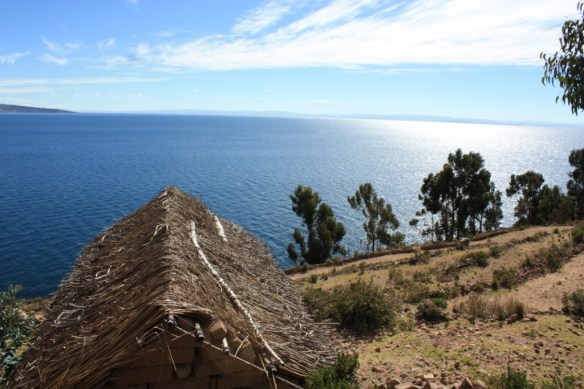
Lake Titicaca is a placid high-altitude lake, and that makes it fairly safe for villagers. Bai Tu Long Bay is part of what much of the world calls the South China Sea, but which the Vietnamese call–simply–the Pacific Ocean. (The Vietnamese aren’t big fans of China’s attempts to make this part of ocean their sole domain–including the building of man-made islands. I suspect nothing has been better for building good relations between the governments of the US and Vietnam in the wake of a horrific war than the counterweight the US Navy provides to China’s ambitions.) Obviously, the Vietnamese villagers are subject to some pretty rough weather. The skerries provide protection up to a point, but historically the villagers used to hide out in caves on the islands when it got too tumultuous.

DAILY PHOTO: A Bad Place to be a Guinea Pig

Taken in Arequipa, Peru in July of 2010

Taken in Arequipa, Peru in July of 2010


If you think this guy is eyeballing the camera suspiciously, it may be because it’s a resident of the Peruvian Andes. If you don’t know what I mean, check out this article from the National Geographic (particularly item #2.)

Anywhere else and he’d be someone’s fluffy little pet… or I guess a lab test animal–given the colloquial meaning of “Guinea Pig.” (So, maybe things could be worse than to be a Guinea Pig in Arequipa. One could be a Guinea Pig in the lab’s at Pfizer.)

DAILY PHOTO: Amantani Island Blue

Taken in June of 2010 on Amatani Island

Taken in June of 2010 on Amatani Island

DAILY PHOTO: Big Sky

Taken in July of 2010 in the Peruvian Andes

Taken in July of 2010 in the Peruvian Andes

DAILY PHOTO: The Cornerstone

Taken in July of 2010 at Saqsaywaman

Taken in July of 2010 at Saqsaywaman