5 Fascinating Mysteries for Skeptical Pessimists

Being a rational skeptic by nature, I’m not the easiest target for those peddling mysteries. Any mystery that can feasibly be a hoax by a single person or a small group of people (e.g. crop circles), I assume was a fake.  Any mystery that  could be accounted for by a person misidentifying his or her mushrooms (e.g. out-of-body experiences and maybe the odd alien abduction), I assume is a case of hallucination. Any innocuous naturally occurring phenomena (e.g. the Taos Hum), I assume is just a matter of the limits of our current understanding. So, most of the time I dismiss “mysteries” as pranks that succeeded or natural phenomena that occur under rare “perfect storm” conditions resulting in phenomena we don’t yet understand.

That said, I’m sucker for intrigue, and there are some astounding mysteries out there.
5.) The Fate of Raoul Wallenberg

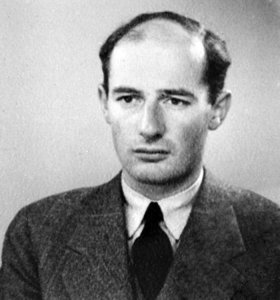
The Facts: Wallenberg was a Swedish diplomat assigned to Budapest, Hungary during the Second World War. He’s credited with saving thousands of lives during the Holocaust by issuing protective passports from his neutral homeland that kept the bearers from being deported to extermination camps. In January of 1945, Wallenberg sought to make contact with the Soviets, who were mopping up the fascist forces in and around Budapest, in order to facilitate a smooth aftermath of the Battle of Budapest. He succeeded, but got more than he bargained for when the Red Army arrested him and he was shipped to Moscow to serve time in the notorious Lubyanka and Lefortovo prisons.

The Soviets claimed that they had no knowledge of Wallenberg. They suggested that he’d probably been killed trying to get to Debrecen to meet with the Red Army General who commanded forces in the area. (Debrecen is a city in Eastern Hungary, near the Ukraine, and was the HQ of Soviet military forces fighting in Hungary at the time.)

Then, when prisoners from various other countries started being released in exchanges, they reported having been in contact with Wallenberg (often through a tap code that has been used the world over to circumvent rules preventing prisoners from talking.)

In the fifties, after Stalin died, the Soviets finally admitted that they’d had Wallenberg but that he died in 1947 of natural causes. (The claim that the young (early to mid 30’s), healthy, and vigorous man having a heart attack strained credulity for people ranging from those who’d conversed with him in prison to Soviet officials during the Gorbachev Era (i.e. the late 1980’s) who’d began to come clean about the matter. The Soviets had been lying through their teeth for decades and so “we don’t know any more than that” wasn’t a convincing answer even though it’s possible that it was true by that time.) At any rate, even up into the early 1960’s there were credible claims of prisoners who stated that they’d been in the Gulag with Wallenberg, and into the 1970’s there were less credible claims.

The Questions:  1.) Why’d they take Wallenberg in the first place? He wasn’t particularly high up in the diplomatic corps, nor had he had a career that would have exposed him to a treasure trove of government secrets. Furthermore, while one wouldn’t think of him as a high value target, he was a public relations nightmare waiting to happen because he’d saved so many lives (eventually the United States and a number of other countries made him an honorary citizen and he came to be considered one of the great heroes of the Holocaust.) In short, on the face of it, he seems like a high risk / low reward prisoner. 2.) When did he die? Was it 1947, as the Soviets claimed? Was it 1962, or thereabouts, as prisoners had claimed? Or might it have been even later? 3.) How’d he die? Was it really natural causes? (It would have been hard to believe in the late 40’s when he was a 35 year old man who’d been imprisoned only a couple years and not in a labor gulag, but: a.) it can’t be ruled out, and b.) it’s quite possible if he died many years or decades later under forced labor camp conditions.) Was he poisoned at Lubyanka, or simply shot dead?

The Most Credible Solution: As for why the Soviets took him, Wallenberg was in contact with people from many varied countries and segments of society, including Americans and even moderate / sympathetic members of the Arrow Cross Party (Hungary’s fascist party that was installed into power by the Nazis,) anyone who could be of help in saving lives was worth building relations with. Furthermore, Wallenberg was from a prominent Swedish family with its hands in many commercial pies internationally. All one really has to understand is that to Stalin and his henchmen, anybody who talked with Soviet enemies was an enemy spy.

So why did they “disappear” him? This is a case in which wishful thinking and naivete was probably fatal. The Swedish diplomat, Staffan Söderblom, became convinced that Wallenberg had been killed inside Hungary while moving through the dangerous war zone, and, crucially, he told his Soviet counterpart as much. What evidence made him think this — besides Soviet disinformation — probably just that it would make his life much easier. I don’t mean to suggest Söderblom wished Wallenberg dead, but as a diplomat concerned with high level issues like trade agreements and security assurances, having relations hung up on the fate of one man was a pain in the diplomat’s keister. Söderblom did eventually accept the evidence and start doing his job, but by that time the damage was done. The Soviets believed they could keep Wallenberg without the public relations nightmare of being seen imprisoning an international hero because the Swedes didn’t seem to want him back very badly, and Stalin’s regime became invested in a lie that became progressively more costly come clean about.

I recently read Ingrid Carlberg’s biography of Wallenberg, she reports that the consensus view of the investigative group that took up the case during the Glasnost years was that Wallenberg likely did die in the summer of 1947, though no one believes for a moment that it was of natural causes.

 

4.) MH-370

The Facts: In March of 2014 a flight (Malaysian Airlines 370) took off from Kuala Lumpur, heading generally northeast toward its destination of Beijing. At some point over the Gulf of Thailand, near its transition into Vietnamese airspace, the pilot made final contact with air traffic control and then the plane disappeared (transponder turned off — though the plane does periodically appear on military radar it doesn’t induce a response.)

While the search begins  in the Gulf of Thailand and into the South China Sea, a private company that has satellite monitoring of jet engines, says it has data that shows the plane was in the South Indian Ocean. For the geographically-impaired, that means MH-370 was going south way down to the west of Australia. As the system that monitors engines wasn’t designed for locating said craft, the last known location is imprecise. The weather in that part of the Indian Ocean is notoriously rough. The plane still has not been recovered over four years later, though pieces from the wings have turned up in the Indian Ocean, verifying that it was going the wrong direction.

The fact that there wasn’t a huge and readily visible debris field limits the ways that the jet could have gone into the water. Experts are divided into those who think the pilot must have made a controlled landing on the water and then let the plane sink (Note: this wouldn’t be like Capt. Sullenberger landing on the Hudson as the waves would have been as high as a few meters) and those who think the plane may have gone in nearly vertically as it plummeted out of the sky, the fuel tanks having run dry, and the engines powerless.

The Questions: 1.) Was it done on purpose or was it the result of an accident? [Spoiler Alert: While there remain many disagreements among experts on specific details of the crash, all the experts seem to agree that the pilot, Capt. Zaharie Ahmad Shah, had to have been an active participant in creating this tragedy.] If we assume that the overwhelming evidence pointing to the pilot’s participation (presumably in a suicide + mass murder), there remains a gripping mystery. Why go to all that trouble to make the plane disappear? There are a few cases of pilot suicide with mass murder, but in those cases the pilot just flew the plane into the Earth. Shah took hours flying, going to great lengths to make certain the plane would be as hard to find as he could make it. If he actually landed on the water, that would have been six or so hours flying — ostensibly with the crew and passengers incapacitated by depressurization. Angry suicidal psychopaths don’t seem likely to care whether the murder instrument is found or not. If he was the unusual suicidal person who wanted to create a mystery, he must have known that the very activities he took to make the plane hard to find would make him look guilty. (i.e. If he thought that making it look like an accident by not allowing the black box to be found would make his loved ones look fondly upon him, he must have realized the chain of actions needed to achieve that lost flight would look like a willing hand was in control. i.e. catch-22.) 

The Most Credible Solution: The Australian 60 Minutes did a fascinating Special Edition on MH-370 just recently. They layout many of the reasons that the pilot must have been involved. There was an early thought that the pilot might have been making an emergency course correction due to a breakdown when he lost consciousness along with the passengers and crew (due to depressurization) and then the plane just flew until it ran out of gas on that random heading. However, it became clear that the pilot made specific course corrections long after the transponder went silent. Why the pilot made sure the plane would be as hard as possible to find is hard to explain.
 

3.) Frank Olson: Murdered or Psychedelic Trip Gone Wrong?

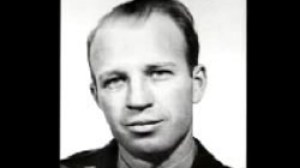
The Facts: Frank Olson was a scientist and biological weapons expert who nominally worked for the Army at Fort Detrick, MD, but who’d been assigned to work for the CIA on a program that would become infamous: MK Ultra. MK Ultra was an umbrella project for many programs involving behavioral modification and mind control. Among the most disturbing element of MK Ultra involved unwittingly dosing people with LSD (a hallucinogenic substance) in order to see how they would behave (and whether such behavior was exploitable for the CIA’s purposes.)  On November 19 of 1953, Frank Olson was surreptitiously dosed with LSD by Sidney Gottlieb — the head of MK Ultra and Olson’s CIA boss. Nine days later, Olson jumped out of a 13th floor hotel window in New York City.

The official claim was that Olson committed suicide while experiencing a severe psychotic breakdown. (“Suicide” may or may not have meant that Olson desired to end his life. It could have been an accident owing to his loss of touch with reality. In other words, the CIA claimed that Olson jumped out the window under his own propulsion, whether he did that because he wanted to die or because he thought he could fly is anyone’s guess.)

Olson’s family, notably his son Eric, claims that Frank Olson was increasingly despondent — presumably unnerved by the amoral world he’d been caught up in since being assigned the CIA job on MK Ultra —  but that he was by no means on the verge of a complete psychotic breakdown. Eric Olson believes his father was physically defenestrated.

The Questions: 1.) Was Frank Olson murdered? 2.) If so, was he physically forced out the window or was he loaded up on hallucinogens and driven to madness via Scarecrow (i.e. the Batman villain) tactics?

The Most Credible Solution: Most of the books and documentaries come down on the side of Olson having been murdered, but that’s not to say that there is an overwhelming case for murder. This is part of what makes this type of mystery interesting to me (this also applies to the Wallenberg case.) Once one strays from the path of virtuous behavior — as both Stalin and Sidney Gottlieb did — no one is going to believe in accidents anymore — even if that’s really what happened.


2.) S.S. Ourang Medan

The Story: In 1947 or 1948 (sources vary), a distress call was received from a merchant vessel, S.S. Ourang Medan, near the Straits of Malacca (between Malaysia and Indonesia.) The radio operator claimed that the Captain and some (possibly all. he couldn’t say) of the crew was dead. The message ended with “I die” and then radio silence. Another vessel responded to find that the entire crew was all dead, stiff as if frozen and littered around the decks as if each man died where he’d stood.  As the assisting craft prepared for an investigation, they were forced to flee because an intense fire flared up at ship’s stern. The Ourang Medan burned and then sank.

The Questions: What killed the crew? Was it an accident, perhaps resulting from the leakage of a hazardous chemical cargo, or was there something more nefarious afoot?

The Most Credible Solution: Fascinatingly, the most credible solution to this mystery may be that S.S. Ourang Medan never existed (the photo above isn’t the Ourang Medan, and, in fact, the ship didn’t appear by that name in the registry.) The whole event may have been some kind of urban legend or sophisticated hoax. This may be a bit of an unsatisfying solution, and it seems to violate my principle of not taking interest in mysteries that could be (and, thus probably are, hoaxes.) However, I still find this one interesting because the story was repeated so many times with the exact same details, and by credible sources. That’s pretty impressive if it was a hoax, and leaves open the possibility that it wasn’t a hoax at all. If it’s not a hoax, the most credible solution would be that the ship carried a lethal and flammable chemical until it experienced  a leak.
 

1.) Dyatlov Pass Incident

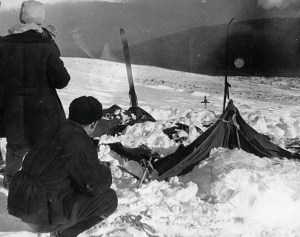
The Facts: In January of 1959, nine experienced hikers set out on a trek in the Ural Mountains. When they didn’t return when they were supposed to in early February, a search party was dispatched. Because these were knowledgeable outdoors-people and they’d left a route-plan, it didn’t take long to find their tent (as shown) and soon thereafter they started to find the first of the trekkers’ corpses. Though it took more than two months of searching to find the last four.

That’s when it got weird. They found the corpses on the order of a  mile down slope, and all of them were without their boots and were inadequately dressed. Their boots and outerwear were all in the tent, along with the makings of the fire that someone had been setting up to keep them warm for the night. The first several bodies they found showed no sign of physical injury and seem clear cases of death by hypothermia. Among the bodies found later there were a some blunt force trauma injuries and a few strange physical anomalies (e.g. one corpse was found missing a tongue.) There were a whole host of  bizarre features that added to the mystery. For example, one of the individuals was found wearing two watches.

As I’ve mentioned, these were experienced hikers. Some were on the hike in part to obtain the highest level grade for outdoors skills available in the Soviet Union. These young people weren’t like Christopher McCandless (subject of Krakauer’s Into the Wild) who went into the wilderness by himself with inadequate knowledge of survival in harsh conditions and got himself killed. They were also, by all accounts, teetotalers, and, therefore, wouldn’t have gotten drunk and stupid.

The Questions: What drove nine experienced campers out of their tent and to their death by hypothermia in the darkness? And, oh yeah, if your theory could explain all the other weird stuff, such as one person wearing two watches, one person missing her tongue, and a couple people looking like they’d been battered with baseball bats, that would be great.

The Most Credible Solution: There are a truly vast range of theories out their from credible sounding avalanches to unlikely assaults by demon dwarfs. Adding to the range of conspiracy theories is that this took place during Soviet times. During Stalin’s days, these kids wouldn’t have been allowed to trek into the wilderness like this at all, but even with the easing of prohibitions under his successors, it remained believable that these college students saw something they weren’t supposed to see and paid for it with their lives.

That said, Donnie Eichar in his book Dead Mountain, paints a compelling and science-based argument that the culprit was naturally occurring infra-sound that resulted from wind blowing around the rounded mountain top. Said sonic phenomena has been known to make people spontaneously nauseous and prone to panic attacks. Incidentally, the curious missing tongue might simply have been due to the fact that the girl’s face ended up partially in flowing water (and it took a couple months to find her so bacteria had time to do its thing.) The blunt force trauma was all found among the latter recovered bodies who took so long to find because they’d fallen down a ravine (hence the bruising.) The watches may have been as simple as someone saying, “Here, hold my watch,” to someone who was getting ready to do some other task, so that person put on the second watch to free up his hands. Or it could have been a mindless action under panic-induced duress.


5 Myths of the Mind


I wrote a post a while back about six persistent brain myths that has some overlapping relevance to this one.

5.) A person is a unitary actor (the spherical cow of social sciences.) When I was a graduate student studying International Relations, a popular theoretical assumption was that nations were “unitary actors.” This meant that no matter how schizophrenic a government (and a nation’s civic institutions) might appear, they ultimately always pursued a national interest via a solitary hand. Like physicists assuming spherical cows, this makes life easier — even if it bears little resemblance to reality.

The full extent of the folly of the rational unitary actor assumption became apparent when I discovered that an individual isn’t even a unitary actor systematically pursuing its best interest. An individual is a collection of impulses, thoughts, feelings, etc. that seems like its under the command of a central authority only because that “central authority” [our conscious mind housed in our Pre-Frontal Cortex (PFC)] is really good at forming post-hoc rationalizations and making up stories that let us feel unitary. The reader may think I’m just talking about some slim segment of the population with a multiple personality disorder, but no. I’m talking about anyone who has ever agonized over whether or not they should have an ice cream treat or take the healthy route. At the end of an internal battle that ends with the levers of action being operated by parts of your nervous system beyond your conscious control, you walk away with your conscious mind building a nice story that explains how it chose to either treat its taste buds or take it easy on its pancreas by keeping insulin production stable.

To consider how the conscious and subconscious mind can be on two entirely different pages on a subject, we’re going to veer into controversial and provocative territory. [So be warned, and if you’re sensitive about sexuality and particularly coercive sexual fantasy, you may want to skip down to the next paragraph.] Across a series of studies, an average of 40% of subjects (generally, or maybe exclusively women) admitted they’d had a fantasy about being raped. Many readers will react with incredulity, perhaps suggesting that there must be something wrong with such a person. However, obviously numbers like that aren’t describing a lunatic fringe. The next response one might here is, “Why doesn’t a person with a rape fantasy know how horrible and decidedly unsexy rape is?” If you’re following my gist, you know the answer is that said person knows very well. Consciously, she is aware that rape is violent and horrific, and moreover she probably even knows that it’s about commanding power rather than sexual desire for the rapist. This knowledge doesn’t undermine the fantasy [unless, perhaps, she really forces herself to think about it intensely] because the arousal is driven by a more visceral part of the mind that FEELS that the act is about the rapist being overwhelmed with sexual attraction even though the person KNOWS that that’s not the case.

[Note: I do realize that it might theoretically be possible that a much more complex collection consisting of many individuals and organizations might behave in a more unitary fashion than an individual. That is, even though a nation his made up of many non-unitary actors, perhaps the nature of the game forces it to behave in a unitary fashion. I don’t buy it. I’ve been reading a great example in a biography by Ingrid Carlberg about Raoul Wallenberg where both the Soviets (who had Wallenberg in custody but wouldn’t admit it) and the Swedes (who didn’t know whether Wallenberg was alive and sent mixed signals) were befuddled by varying actors sending mixed messages and collectively behaving ineffectively. It’s hard to come away thinking that Stalin and his Ministers had a rational and unified decision process. Instead, it seems like a perfect storm of incompetency and incorrect assumptions resulted in an outcome that wasn’t ideal for any of the parties.]

 

4.) Everyone can be hypnotized via instant induction and then commanded to do anything that’s asked of them.  Hypnosis is among the most misunderstood activities around. There are a couple of reasons for this. One is that hypnosis is a favorite device in movies and fiction, and people draw information from these fictitious sources. The “Now You See Me” movies (see above) offer many such displays of a person being instantaneously hypnotized against his will even when the person is an expert himself, and made to do things against his interests. Misconception also flowers when people hear real or fictitious accounts of Cold War programs like America’s MK Ultra or the Soviet’s psychotronics. The lesson to be taken away from those expensive and morally-dubious programs is that it may be possible to break a person’s mind, but you can’t force someone to do something they abhor while programming them to forget all about it afterwards.

Another reason for the misunderstanding, is that there’s a disreputable group of stage hypnotists and others who love to spread these ideas because it’s more intriguing if people think they can do it to anyone at any time than if they understand that their subjects have been carefully selected to be among the more readily prone to achieve trance states and to be responsive to suggestion. It’s true that most people are hypnotizable and will respond to suggestions to do things they wouldn’t otherwise do (as long as it’s not something that they don’t want to do.) But highly hypnotizable individuals are only about 15% of the population, and there’s another 15% at the other end that are virtually impossible to hypnotize. The video below has more detail on the science.


3.) One has no access to one’s subconscious mind. The conscious mind is like the loudmouthed drunk who swears he invented the potato chip bag clip, the envelope-wetting sponge, and Velcro. That is, it’s hard to hear over the din of incessant yapping, and since the conscious mind claims credit for everything, it’s easy to be fooled that there’s nothing else to listen to in the mind. However, if you can knock the drunk out, you start to become aware of what the subconscious has to say. Those who don’t meditate may be aware of subconscious imagery as they are falling to sleep (the hypnogogic state), as they are waking up (the hypnopompic state), or sometimes even during dreams (i.e. so-called lucid dreams or dream yoga.) Those who do meditate will be well aware of images that spontaneously form and fade in the meditative mind, and which can give rise to conscious thoughts if left unchecked.


2.) Memory is a recording of life events.  I’ve been reading Julia Shaw’s “The Memory Illusion” recently. It’s a fascinating look at false memories. There are many famous cases of false memory, but what is most interesting is Shaw’s success in planting false memories of criminal activity. “Planting” isn’t the best term to describe this. It’s more about getting the subject to visualize events such that they create the false memory. While I stand by what I said about the myths of hypnosis, there have been a number of cases of false memories being implanted while an individual was in a hypnotic trance, and so one shouldn’t disregard the power of hypnosis altogether.  The fact of the matter is that what we remember isn’t the occurrence of the event itself, but the last remembrance of said event. This means that there’s a great deal of room for memory degradation over time, and for a false transcript of events to form in the mind.


1.) Emotions get in the way of good decision making. I just posted a review of Antonio Damasio’s book “Decartes’ Error,” which examines this subject in great detail. Damasio found that patients who had damage to parts of the brain responsible for emotion often became victims of paralysis by analysis. That is, without emotion to give them a kick, they can’t make decisions. Reason doesn’t always provide a clear answer because the world is filled with uncertainty. When there’s not enough information, we still need to make decisions, and this is accomplished by emotional “gut instincts.”

Around the World in 5 Works of Poetry

5.) On Love and Barley by Matsuo Basho [Japanese]: One doesn’t get better haiku [and other traditional Japanese poetry forms] than Basho.


4.) The Sun and Her Flowers by Rupi Kaur [Indian-Canadian]: This isn’t the expected fair for an “around the world” post as it’s not blatantly infused with setting / geography, but culture does factor in prominently.


3.) Leaves of Grass by Walt Whitman [American]: Not only does Whitman explore the many dimensions of America, he also references other cultures and locales. [There was a fascination with the East brewing in Whitman’s day.]


2.) Octavio Paz / Selected Poems by Octavio Paz [Mexican]: Paz was a diplomat as well as a Nobel Laureate, and his poems include many references to India (where he was posted) as well as Mexico.


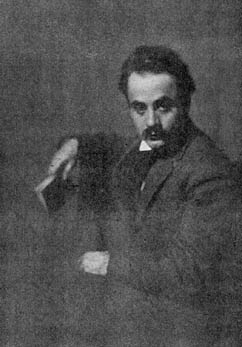
1.) The Prophet by Kahlil Gibran [Lebanese-American]: Featuring an intriguing melange of advice in poetic form.


NOTE: It’s not as global a list as I’d like. I’d love to hear what works others might include in the list. I don’t think poetry gets translated as much as fiction and so it’s a bit of a challenge. It’s much easier to find examples of novels & short story collections from far-flung corners of the world.

5 Beautiful Death Poems


5.) In Flanders Fields by John McCrae

excerpt [2nd stanza]:

We are the dead; short days ago

We lived, felt dawn, saw sunset glow,

Loved and were loved, and now we lie

In Flanders fields.


4.) Do Not Go Gentle Into That Good Night by Dylan Thomas

excerpt [1st stanza]:

Do not go gentle into that good night,

Old age should burn and rave at close of day;

Rage, rage against the dying of the light.


3.) Because I could not stop for Death (479) by Emily Dickinson

excerpt [1st stanza]:

Because I could not stop for Death –

He kindly stopped for me –

The Carriage held but just Ourselves –

And Immortality.


2.) To the Virgins, to Make Much of Time by Robert Herrick

excerpt [2nd stanza]:

The glorious lamp of heaven, the sun,

The higher he’s a getting,

The sooner will his race be run,

The nearer he’s to setting.


1.) Do Not Stand At My Grave and Weep by Mary Elizabeth Frye [authorship disputed]

excerpt [opening lines]:

Do not stand at my grave and weep.

I am not there. I do not sleep.

I am a thousand winds that blow.

I am the diamond glints on snow…

10 Great Quotes from “The Prophet” by Kahlil Gibran

10.) “But let there be spaces in your togetherness.

“And let the winds of the heavens dance between you.”

-on Marriage


9.) “He who wears his morality but as his best garment were better naked.”

-on Religion


8.) “And you would accept the seasons of your heart, even as you have always accepted the seasons that pass over your fields.”
-on Pain


7.) “What of the ox who loves his yoke and deems the elk and deer of the forest stray and vagrant things?

“What of the old serpent who cannot shed his skin and calls all others naked and shameless?”

-on Laws


6.) “If he is indeed wise he does not bid you enter the house of his wisdom, but rather leads you to the threshold of your own mind.”

-on Teaching


5.) “For if you should enter the temple for no other purpose than asking you shall not receive.”

-on Prayer


4.) “And if it is a fear you would dispel, the seat of that fear is in your heart and not in the hand of the feared.”

-on Freedom


3.) “For what are your possessions but things you keep and guard for fear you may need them tomorrow?”

-on Giving


2.) “Only then shall you know that the erect and the fallen are but one man standing in the twilight between the night of his pygmy self and the day of his god self.”

-on Crime and Punishment


1.) “Or have you only comfort, and the lust for comfort, that stealthy thing that enters the house as guest, and then becomes a host, and then a master.”

-on Houses

5 of my Favorite Books on Yoga

5.) Sure Ways to Self-Realization by Swami Satyananda Saraswati: All you need to know about meditation and more. The first half of this book examines various yogic approaches to meditation and offers in-depth explanation of said techniques. The second half puts yogic meditation into a larger context by providing a survey of meditative approaches from around the world. It’s as close to one-stop shopping for the yogic meditator as one is likely to find, and the presentation of material on topics such as Jnana Yoga and Tantra is much more balanced and illuminating than many books.


4.) Your Brain on Yoga by Sat Bir Singh Khalsa: This Harvard Medical School Guide provides an overview of the scientific evidence for the benefits of yoga practice.


3.) A Search in Secret India by Paul Brunton: Brunton traveled India looking for the needles of yogic sagacity amid a haystack of charlatans and posers, and he found a few.


2.) Warrior Pose by Brad Willis: As the sub-title suggests, this book is about how yoga saved the life of a war correspondent who suffered from a severe spinal injury that had repercussions beyond his back — re: his state of mind.


1.) The Heart of Yoga by T.K.V. Desikachar: This book provides one-stop shopping for building one’s yoga practice, and it does so in a very down-to-earth, secular, and non-doctrinaire way. It also includes a translation and brief commentary of Patanjali’s Yoga Sutras — hence, the reason I didn’t need to include that work on this list.

5 Books of 2017 that Influenced Me Greatly

It’s that year-in-review time of year. To clarify: these are the books published in 2017 that most profoundly influenced my thinking. I clarify because I’ll probably do a list of books that I read in 2017 but that were published in previous years.

5.) Norse Mythology by Neil Gaiman: Gaiman’s take on classic tales of Norse Mythology shows that one can bring great value with a fresh look at old art. However, beyond the “steal like an artist” sentiment of not getting locked into building something brand new, these stories show the Norse to be exceptional storytellers. All ancient cultures had a mythology, but not all of them were equal in producing stories that are timeless and work across cultures.


4.) The Lost City of the Monkey God by Douglas Preston: This book taught me two things: First, that there is still much to be discovered right on terra firma. We talk as though the only new vistas of knowledge are to be found in space or places like the Mariana Trench, but the days of terrestrial discovery are not past. Second, there is a lesson of common fates of humanity across time. A lot of this book is about a parasitic disease that infected several of the expeditionary team, as well as speculation about how the same disease might have influenced the civilization that abandoned the titularly referenced city.


3.) The Sun and Her Flowers by Rupi Kaur: Kaur’s books combine poetry and art. Both are crude but heartfelt and evocative. Both of Kaur’s books have struck a chord with readers, and that resonance seems to be about the candid and bold nature of her art.


2.) Behave by Robert Sapolsky: Sapolsky tells readers that one can’t look at something as complex and bewildering as human behavior through the lens of any one academic discipline and get a complete and satisfying picture. Sapolsky considers the best and worst human behaviors through the lenses of biology, neuroscience, endocrinology, human evolution, and more.


1.) Stealing Fire by Steven Kotler & Jamie Wheal: The authors of this book examine the various ways people achieve what they call ecstasis. Ecstasis is a state of mind in which one loses one’s sense of self, and all the muddling factors that go with the self, such as self-criticism, fear of failure, and the feeling of working against everyone and everything else.

5 Books to Introduce You to Your Gut Microbiota

5.) The Wild Life of Our Bodies by Rob Dunn: This book takes a broad look at the role that hangers-on have on  human life.


4.) The Psychobiotic Revolution by Scott C. Anderson et. al.: This book focuses on the role that our gut microbiota have on our mental well-being–which increasingly appears to be substantial.


3.) Missing Microbes by Martin J. Blaser: The focus of this book is on how our love of antibiotics in every form– from pills to antimicrobial soaps–is killing us by denying us microbiotic diversity and robustness.


2.) 10% Human by Alanna Collen: Collen’s book addresses many of the same issues as the other books mentioned, but–as the title suggests–it emphasizes the fact that a human has 10 times as many hangers-on of other species as it does cells that are contiguous to the body. (If you’re wondering how this could be, it’s because the human body has some pretty big cells [some macroscopic, in fact] and the bacteria and other single-celled species tend to be relatively tiny.)


1.) I Contain Multitudes by Ed Young: This is probably the most highly-regarded of the books on this subject. It was considered one of the best science books of 2016.

5 Essential [and Sometimes Hilarious] TED Talks About the Human Body

5.) 3 Clues to Understanding your Brain by VS Ramachandran: Ramachandran discusses three afflictions that offer insight into the working of the brain. Capgras Syndrome occurs when individuals think loved ones have been replaced by impostors. Phantom limbs occur when there is an amputated limb which the brain continues to feel the presence of. Synesthesia is a muddling of sensory inputs /experiences.


4.) Charming Bowels by Giulia Enders: How we poop. How our gut nervous system influences our central nervous system. Why there is such a thing as “too clean for your own good.”


3.) Can We Create New Senses for Humans by David Eagleman: Our senses are narrowly attuned to taking in that information that offered evolutionary advantage to our ancestors. How might technology help us transcend those bounds?


2.) 10 Things You Don’t Know about Orgasm by Mary Roach: Eyebrow orgasm, thought-induced orgasm, orgasm among the deceased, and how orgasm may cure your hiccups.


1.) The Biology of Our Best and Worst Selves by Robert Sapolsky: Sapolsky explains that one can’t look at one biological system to understand violence or cooperation. Instead, genetics, environment, our nervous system, our endocrine system, and even the digestive system come into play. He also considers how we change.

5 Insightful Sentences from Literature


It is sometimes an appropriate response to reality to go insane. 

Philip K. Dick in VALIS


And now that you don’t have to be perfect, you can be good.

John Steinbeck in East of Eden


Anger was washed away in the river along with any obligation.

Ernest Hemingway in A Farewell to Arms


There is a sense in which we are all each other’s consequences.

Wallace Stegner in All the Little Live Things


There are some things that are so unforgivable they make other things easily forgivable. 

Chimamanda Ngozi Adichie in Half a Yellow Sun