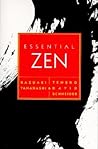
BOOKS: “Essential Zen” ed. by Kazuaki Tanahashi & David Schneider

Essential ZenEssential Zen by Kazuaki Tanahashi
My rating: 5 of 5 stars

Google Books Page

This is a collection of short writings (poems, koans, and prose excerpts) on Zen Buddhism arranged into loosely themed sections. The writings tend toward the artistic, creative, and metaphorical, with relatively few straightforward descriptions of technique or philosophy. The writings range from those of Chinese and Japanese monks who lived hundreds of years ago to present-day poets and Zen practitioners. Among the more frequently drawn from sources are: Hanshan, Ikkyu, Dogen, Ryokan, Hakuin, Gary Snyder, Robert Aitken, Seung Sahn, John Daido Loori, Thich Nhat Hanh, and Peter Levitt. But there are many others, including some who have only a single piece included.

There’s a substantial “Notes” section that gives source, translation, and — in some cases — background information. Most of the translations (both Japanese and Chinese) are by the editors, Kazuaki Tanahashi and David Schneider. There are illustrations, but they are all ensō (circular brush paintings) and related forms.

This is a highly readable and insightful collection of short writings, and I’d highly recommend it for individuals interested in Zen or Eastern Philosophy more generally.

View all my reviews

BOOK REVIEW: Singing and Dancing Are the Voice of the Law by Busshō Lahn

Singing and Dancing Are the Voice of the Law: A Commentary on Hakuin's “Song of Zazen”Singing and Dancing Are the Voice of the Law: A Commentary on Hakuin’s “Song of Zazen” by Bussho Lahn
My rating: 5 of 5 stars

Amazon.in Page

Release Date: December 20, 2022 [In India, may be out in your area.]

This book consists of a collection of essays inspired by the poem, “Song of Zazen,” written by the 18th century Zen master, Hakuin. Hakuin’s poem is brief (about forty lines,) and the essays composed by a present-day Zen priest (Lahn) offer commentary on a stanza-by-stanza basis. The book is divided into fourteen chapters, though the final chapter isn’t a stanza commentary.

I enjoyed reading this book and learned a great deal from it. The book benefits from the fact that the author is not rigidly sectarian. Therefore, the book is not doctrinaire, which warms the reader to the teachings. It’s also useful because it allowed the author to freely draw examples and quotes from a variety of sources, some of which may be more familiar or relatable to neophyte readers.

The last chapter offers a discussion of the fundamentals of zazen (seated meditation) as well as some other ancillary information that may be useful to readers new to Zen Buddhism, its practices, and its sutras. If you’re interested in Zen Buddhist meditation and philosophy, you may want to give it a look.


View all my reviews