


Northern or Southern hemisphere? Landlocked or coastal? Temperate or Equatorial? I need more information.
PROMPT: Favorite Month
1

Northern or Southern hemisphere? Landlocked or coastal? Temperate or Equatorial? I need more information.
 The Meaning of Travel: Philosophers Abroad by Emily Thomas
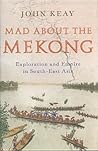 Mad About The Mekong: Exploration and Empire in South East Asia by John Keay
No. I try to see wherever I’m at as being as good as any other place I’ve been. And, of course, it is — only my perceptions change and can drive value judgements. The places and the peoples are just different. If one starts ranking and rating places, one can kill the ability to see what is beautiful and spectacular about a particular place. If a place didn’t have redeeming features, people wouldn’t live there. And, by the way, if people don’t live there, that’s probably my favorite place on earth.
What was your favorite subject in school?
Depends on the year. In twelfth grade, I remember enjoying Physics the most. In Eleventh, Psychology was the best class I attended. There was a year when I got the most out of an English class that focused on Creative Writing. I guess my most longstanding preference was for classes like Geography and Social Studies, wherein we learned about the world outside our world.
That depends on how you define “home.” If by home, one means the place I’ve lived for the past decade [Bangalore, KA, India,] then its antipode is in the eastern Pacific Ocean – off the coast of South America. This would make the farthest I’ve been from home: Lima, Peru. If, however, one means the place I was born and grew up in [i.e. Northwest Indiana in the USA,] its antipode is in the Indian Ocean – west of Australia, and the farthest I’ve been would probably be the southern tip of Bali, Indonesia.
Either way, one could say that I’ve never been far from home (despite having visited 40-some countries over all continents except Australia and Antarctica.)
 Atlas of Improbable Places: A Journey to the World’s Most Unusual Corners by Travis Elborough
 The Ocean of Churn: How the Indian Ocean Shaped Human History by Sanjeev Sanyal
My rating: 4 of 5 stars
This is a geographic and historical overview of the Indian Ocean from the geological processes that created it to the wave of independence movements that took hold in the wake of the Second World War. The author’s approach is to emphasize the interaction between – rather than within – the various nations of this region. [Though, India in particular, gets a great deal of space devoted to internal happenings. However, given its central location (trading to both the east and the west,) its size, and its cultural influence on the region, it’s not necessarily the case that this is an unfair bias.]
I was happy to find a book that seemed to be just what I was looking for. Having lived in India for more than five years, I’ve often been struck by the intriguing evidence of interconnectedness that I didn’t have the historical background to understand. From a discussion with a Nairobi cab driver who had no idea that chapati (a flat bread common in South Asia, but eaten as far afield as the Caribbean) was anything other than an indigenous Kenyan culinary invention to the fact that Tamil is one of the official languages of Singapore, I’ve often found myself curious about how these connections came to be. This book didn’t disappoint. Sanyal delves right into the fascinating fun facts without getting too bogged down in the who married whom and who fought whom that quickly becomes the tediousness contributing to a lack of enthusiasm for the subject of History among school children. (That said, there is – probably necessarily – some of the stuff that students are forced to memorize, here and there.)
The approach of the book, after an introductory chapter that gives the reader a contextual introduction to the region, is to proceed chronologically. This means the book starts out more geology, geography, and anthropology and gradually becomes more of a history. In the later half of the book, this history is particularly an economic history focused on the products whose trade drove interaction in the region – be it for conflict or for cooperation. Trade is important throughout the region’s history, but we also see a lot the spread of culture earlier, especially the spread of religion. From the spice that was much coveted in Europe to the opium that the British East India Company used to balance its trade with China (resulting in the Opium Wars,) this trade has had a profound impact on the world in which we live.
There are many graphics throughout the book, primarily maps. These are extremely beneficial. The book is annotated with end-notes that provide sources and elaborations.
I found this book to be both interesting and entertaining. The author throws in a one-liner joke now and again, but what I really found humorous were the fictions that were widely believed back in the day. Most of these resulted from merchants telling tall tales to make asking prices more palatable. It’s harder to scoff the price of a diamond if one thinks they were guarded over by gigantic snakes and the only way to get them was to throw meat into a canyon so that Eagles (the only things that could out move the snakes) might snatch up a diamond with its steak. It is also fascinating to learn how the same stories were heard from different sources, suggesting that false information behaving like an infection isn’t new to the internet age.
If I had one criticism of the book, it would be that in the final chapters the author leaves behind the historical objectivity that seems prevalent throughout most of the book. Instead of presenting the information and letting the reader make up their own mind about such events as Subhas Chandra Bose’s (Netaji’s) courting of the Nazis during the Second World War, Sanyal shapes the information he feeds to readers to persuade rather than to inform. I didn’t notice this in earlier parts of the book and suspect it was just easier to be dispassionate about the distant past.
All-in-all, I’d recommend this book for anyone wanting to learn more about history and trade across the Indian Ocean. I learned a great deal, and found the book readable and intriguing.
 The Geography of Bliss: One Grump’s Search for the Happiest Places in the World by Eric Weiner
My rating: 5 of 5 stars
This book combines travel writing with pop science discussion of what makes people happy (or unhappy.) Weiner travels to ten countries in pursuit of happiness, and reflects upon the cultural components of bliss.
Some of the countries, like Switzerland and Iceland, rank among the world’s happiest in international surveys. Some of the countries, such as Qatar and America, have every reason to be happy, but aren’t necessarily as blissful as the rest of the world would expect. Some of them, like India and Thailand, have good reason to be unhappy, and yet they manage to be global exemplars of happiness [at least within certain domains.]
Then there are a few nations that have unique relationships to happiness. Bhutan has a national policy on happiness [plus it’s a Buddhist country, and Buddhism probably offers the most skillful explanation of what it takes to be happy of any world religion.] Moldova provides a counterweight as it’s one of the least happy countries in the world. Weiner visits the Netherlands in part because one of the biggest academic centers studying happiness is located in Rotterdam, but it also offers an opportunity to study whether the country’s unbridled hedonism (drugs and prostitution are legal) correlates to happiness. That leaves Great Britain, a country known for wearing the same happy face as its sad, terrified, and enraged faces.
I’ve been to half of the countries on Weiner’s itinerary, and—of the others—I’ve been to countries that share some—though not all—of the cultural constituents of happiness. (e.g. I haven’t been to Qatar, but I’ve been to the UAE. I haven’t been to Moldova, but I’ve seen somewhat less grim Eastern European states. I haven’t been to Switzerland or Iceland but I’ve been to cold countries in Western Europe. I haven’t been to Bhutan, but I’ve been in areas where Tibetan Buddhism was the dominant cultural feature.) This allowed me to compare my experiences with the author’s, as well as to learn about some of the cultural proclivities that I didn’t understand during my travels. And I did find a lot of common ground with the author, as well as learned a lot.
I found this book to be interesting, readable, and funny. Weiner has a wacky sense of humor that contributes to the light-hearted tone of the book—perfect for the subject. That said, some people may be offended because the author doesn’t pull punches in the effort to build a punchline, and this sometimes comes off as mocking cultures. However, in all cases—even that of Moldova—Weiner does try to show the silver lining within each culture.
The paperback edition I read had no graphics or ancillary matter. There are no citations or referred works (except in text), and the chapters are presented as journalistic essays. The chapters largely stand alone, and so one could read just particular countries of interest. He does refer back to events that happened in earlier chapter or research that related to another country’s cultural proclivities, but not often. The first chapter, on the Netherlands, would be a good one to read first because he describes many of the scientific findings on happiness in that one.
I would recommend this book for anyone interested in what makes some places happier (or sadder) than others.
 Maphead: Charting the Wide, Weird World of Geography Wonks by Ken Jennings
My rating: 4 of 5 stars
In a sad commentary TV’s popularity, you may only know Ken Jennings from his record winning streak on Jeopardy, and the books he’s written since then may have escaped your attention. But Jennings isn’t just a fast-handed font of trivia, he writes nonfiction that is approachable, intriguing, and displays a good sense of humor.
Maphead is about maps and the people who love them, and–in some cases–who build their lives around various forms of graphic depiction of our world. In 12 chapters, Jennings not only reflects upon the many forms of map and geography fetish, he also presents insight on the opposite–the often dismaying and sometimes hilarious geographic illiteracy of college students and beauty queens. Besides learning about the million dollar outlays of rare map collectors and the intense rivalry of geocache hunters, Geography Bee contestants, and Traveler’s Century Club members (only those who’ve been to 100+ countries need apply), you’ll hear about a college professor who was fired for letting fly the fact that a majority of his incoming students hadn’t the vaguest idea of the whereabouts of metropoles like London or Chicago.
This book may seem like it’s only for those geeky to an obsessive level, but it’s one intriguing work of geo-geekery. It’s certainly for the intellectually inclined, but Jennings doesn’t bludgeon the reader with his intellect. True, you’ll be introduced to terms like hypsometric maps and cartacacoethes, but never in a manner that suggests a normal person would know such arcane terms. As might be expected from a trivia master, Jennings heavily seasons his book with fascinating tidbits and factoids—particularly in the chapter of the National Geographic “geography bee.” You’ll learn how the borders work between countries that drive on opposite sides of the road (I’ve experienced this myself from Cambodia to Thailand, and that may be the only place in the world where it occurs.) You’ll learn what’s in a name, and why one like “Whorehouse Meadows” was doomed from the start. You’ll learn about why maps that are wrong are often the most prized.
But it’s not all trivia. Jennings takes on serious questions as well. For example, he reflects on the degree to which kids being prohibited from venturing out into the world because of an overblown concern about pedophilic maniacs has contributed to a geographically uninterested and incapable student body. The reader is exposed to a history in which mapmakers were adventurers—the stuff of legends. In doing so, Jennings attempts to reignite a passion for geography that is lacking in a post-frontier world. We’ve become jaded by our planetary proliferation. But the book’s excitement isn’t all in the past. One learns about vintage map thieves and the sometimes wild and wooly world of modern travel (e.g. where one should get passport stamps on a separate sheet of paper to avoid border rectal exams.)
Maybe it’s the maphead in me, but I’d recommend this book for anyone who reads nonfiction. And if you’re not sure whether you’re a maphead or not, there’s a handy quiz in the back of the book.


 Tiger Riding for Beginners