PROMPT: Belongings

Daily writing prompt
What personal belongings do you hold most dear?

I do have a jō (short wooden staff) of which I’m fond. I crave books, but since I could care less whether I read them as paper or on a screen and gladly give any but those with long-term reference value away after reading, I don’t think they count.

Being fonder of ideas than anything material, I like the story about Diogenes the Cynic who, upon seeing a boy drink from cupped hands, threw away his cup in self-anger for being such a hoarder.

Five Wise Lines [April 2024]

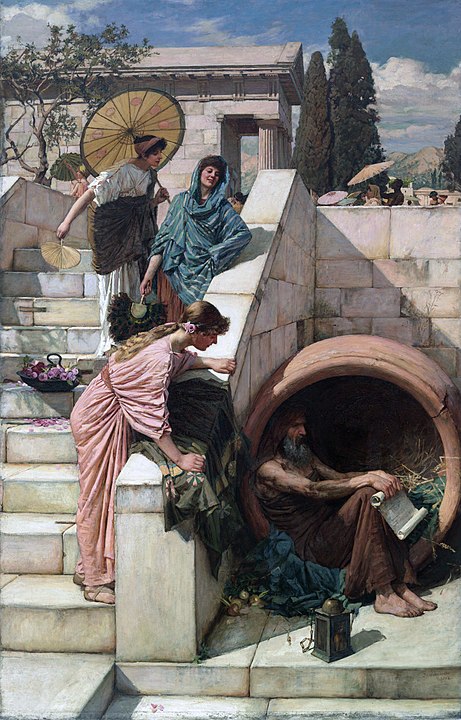
Diogenes Sitting in His Tub by Jean-Leon Gerome (1860)

Of what use for us is a man who, although he has long practiced philosophy, has never upset anyone?

Diogenes of sinope on Plato, according to themistius

The superstition that we must drive from the Earth is that which, making a tyrant of God, invites men to become tyrants.

Voltaire in On Superstition

The progress of an artist is a continual self-sacrifice, a continual extinction of personality.

T.S. Eliot in Tradition and the Individual talent

What’s the difference between a king and a poor man if they would both end the same bundle of white bones.

Zhuangzi

The absence of evidence is not the evidence of absence.

Carl sagan (Note: There are variations on this quote that long predate Sagan’s)

HONORABLE MENTIONS:

You live off the crumbs that fall from the festive table of my genius.

Kurban Said in Ali and Nino [Not so much wisdom as a wicked burn]

To roam Giddily and be everywhere, but at home, Such freedom doth a banishment become.

John donne in a Poetic letter to rowland woodward

Lions are not the slaves of those who feed them, it is the feeders, rather, who are the lion’s slaves. For fear is the mark of a slave, and wild beasts make men fearful.

Diogenes the cynic

BOOKS: “The Dangerous Life and Ideas of Diogenes the Cynic” by Jean-Manuel Roubineau

The Dangerous Life and Ideas of Diogenes the CynicThe Dangerous Life and Ideas of Diogenes the Cynic by Jean-Manuel Roubineau
My rating: 5 of 5 stars

Amazon.in Page

This is a translation of a French book about the life and philosophy of Diogenes the Cynic. It’s a thin volume, as there is much that’s unknown about the life of Diogenes, and the dearth of surviving texts means that some of what is believed about Diogenes and Cynic philosophy maybe corrupted by the reports of detractors. I learned a great deal from reading this book, but not because I learned much new about Diogenes, himself. The colorful anecdotes from his life have been extensively discussed.

With respect to what I did learn, it largely fell into three categories. First, I gained insight into the context and environment in which Diogenes lived. Second, I discovered that many of the stories of Diogenes’ life are far less certain than we have been led to believe through the presentations of them in so many books. For example, we know Diogenes was exiled from his native Sinope in relation to a scheme involving currency debasement. This is often straightforwardly stated as “Diogenes was a counterfeiter,” but Roubineau shows that we don’t know much (if anything) about the degree to which Diogenes was involved (i.e. whether he was mastermind, accomplice, or an unwitting pawn.) Third, I benefited from the comparing and contrasting of Cynic philosophy with that of predecessors (e.g. Socratics) and successors (e.g. Stoics,) and – in a few cases – comparisons between Diogenes and other Cynics.

The book consists of four chapters. The first is a discussion of what is known about Diogenes as a historical figure. The second focuses on the Cynics views on economy, wealth, and related ideas. The third explores the Cynic view of the human body and related topics like sex, pleasure, and pursuit of health and well-being. The last chapter considers Diogenes as a teacher and the Cynic approach to practicing philosophy.

I’d highly recommend this book for readers interested in philosophy.


View all my reviews

PROMPT: Holiday Invention

Invent a holiday! Explain how and why everyone should celebrate.

Mad Saints Day. In honor of all the crazy sages throughout history (e.g. Hanshan, Diogenes the Cynic, Ikkyu, St. Isadora, Drukpa Kunley, Nasreddin, Milarepa, William Blake, etc.)

It’s celebrated by violating some societal convention that doesn’t have direct adverse health and safety consequences (This is not “The Purge.”) Of course, violating even the most absurdly arbitrary societal convention will cause many people to freak out, so the other element of celebrating Mad Saints Day is just getting the f@$& over it.

PROMPT: Successful

Daily writing prompt
When you think of the word “successful,” who’s the first person that comes to mind and why?

Diogenes [of Sinope] and – also – Drukpa Kunley. Each of them spoke his mind, lived by his own rules, never wore a mask, and could not be controlled. They were truly free.

Cynic Limerick

The philosopher named Diogenes
was like a dog... known to have fleas.
-failed to find an honest man.
-didn't let "Greatness" block his tan.
But he lived simply, and as he pleased.

BOOK REVIEW: Anecdotes of the Cynics by Various

Anecdotes of the CynicsAnecdotes of the Cynics by Robert F. Dobbin
My rating: 5 of 5 stars

Amazon.in Page

This is a collection of brief stories and sayings from famous Cynic philosophers – notably, Diogenes of Sinope, Crates of Thebes, Hipparchia, and Bion. It opens with the longest piece, a dialogue [allegedly] by Lucian the Cynic advocating the Cynic’s minimalist approach to life. [Cynics were ascetics who shunned customs and cultural conventions and thus often ran afoul of the conservative societal base / rubbed people the wrong way.] The dialogue uses Socratic method, but also contains prolonged exposition. [Not like the Platonic dialogues in which Socrates tends to ask brief questions and attempts to demand brief answers – granted not always successfully.] However, most of the pieces are just a paragraph or two brief excerpts.

Most of the entries report on what various Cynics said or did, though there are a few that are biased commentaries of non-Cynics about these “dog philosophers” – e.g. there is a Catholic tract denouncing the Cynics while talking up Paul. [It reads as though the early Christian church (which was teaching Jesus’s ideas, including: in part, the virtues of poverty, of simplicity, and of a lack of deference to the world of men) might have been concerned about being outcompeted.]

There’s not a tremendous amount that remains of direct Cynic teachings, and so a book like this is a way to get a taste of the highlights. Just as Buddha found that extreme forms of ascetism didn’t yield the optimal result, Cynicism lost ground to the upstart school Stoicism, which borrowed some Cynic ideas while jettisoning the most extreme aspects of the philosophy.

One can find these stories in old public domain sources such as Diogenes Laertius’ (no relation) “Lives of the Eminent Philosophers,” but this is a good way to get the condensed version without too much extraneous information.

View all my reviews

In Praise of Diogenes the Cynic [Free Verse]

Owning only a cloak, 
staff, and satchel,

he broke his bowl
after seeing a child
drink from cupped hands,

feeling the dunce 
for being out-simplified
by a mere child.

When pirates,
eager to sell him off,
asked what skill he had,

he said, "Governing men.

"If you find someone 
interested in buying 
a master,
I'm your man."

He couldn't be driven
away with a stick,
much as the downright-dog,
Antisthenes, tried.

He was expert
at adulterating the currency -
literally and figuratively.

When Alexander the Great
offered him whatever he wished,
A sunbathing Diogenes replied,
"Stand out of my sunlight."

I fear
they don't make 'em like
that anymore.