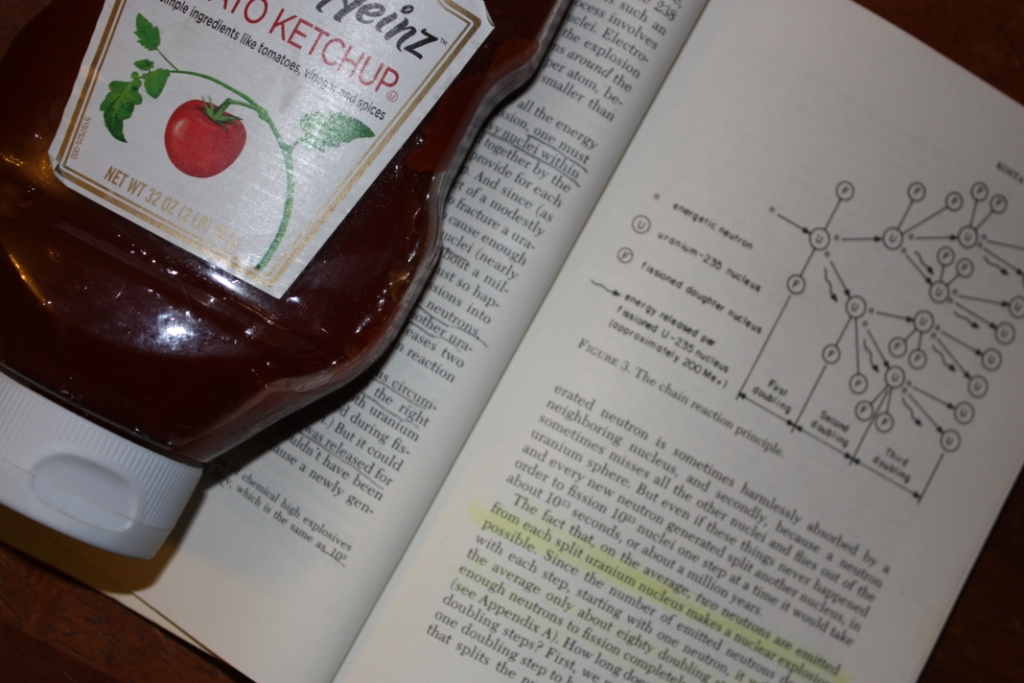
TODAY’S RANT: Nukes and Ketchup

Why was there no Manhattan Project for Ketchup?

Why was there no Manhattan Project for Ketchup?

How come we mastered the thermonuclear warhead decades before we did the ketchup bottle?

Building a nuke took:

– the greatest scientific minds Hungary ever produced (You scoff, but Hungary’s claim to fame is driving out more Nobel Laureates and top-rate scientific minds than most countries will ever hope to produce. [e.g. Teller, Szilard, Wigner, von Neumann, etc.] If they didn’t let jackwagons run their country, they’d probably rule the world by now.)
– $42 billion in current-year US dollars
– the Project Manager who built the Pentagon
– and a whopping two or three years (for the fission weapon)

Building a decent ketchup bottle shouldn’t have even required an Algonquin Round-table  It could have been achieved by two morons sitting around at a barbecue.

Moron one says, “You knows what would be delightful, if this bottle was squeezable plastic, not glass.”

Moron two says, “Dude, you are so right, and what if they turned it upside-down so that all the ketchup stayed near the hole?”

Bob’s your uncle, the ketchup bottle is perfected.

Do you know what kind of Galactic douche-bags this makes humanity look like? It makes it seem like we don’t care about our condiments.
Oh, but we do. I’ve seen it. I’ve seen a man in Boise use no less than 42 packets of ketchup on his fries. I saw a rotund woman in Phoenix use half a jug of mustard on her hot dogs. I saw a canuck slather mayo on his burger (what is up with that, Canada.) From sea to that other sea, amid the prairie dogs, through the alligator-infested swamps, across those bruised mountains, I’ve seen a divinely inspired love of sauces throughout our great nation (and that ancillary nation to the north.)

No wonder aliens haven’t visited us; they probably haven’t received word across the light-years that we’ve mastered ketchup. Or maybe it’s the fact that we haven’t built a plastic fork whose tines could stick up to a sturdy gherkin. (But that outrage is for another day. Yes, manufacturers of disposable flatware, you too will taste my wrath.)

Book Review: JOHN DIES AT THE END by David Wong

John Dies at the End (John Dies at the End, #1)John Dies at the End by David Wong

My rating: 5 of 5 stars

If the movie Alien was “Jaws in space,” then John Dies at the End is “Bill and Ted’s Excellent Adventure in the Nether World.” Except that, unlike Bill and Ted’s, Wong’s book is hilarious.

The gist of this book is that two likable anti-heroes ingest a drug, “soy sauce,” that gives them the ability to pass into an alternate universe. They’re inexorably drawn down the rabbit hole (so to speak, there is no actual rabbit hole in this book.) What they find is not what they expected. It’s not what anyone expected, because it’s so mind-boggling ridiculous and richly complex.

The title character, John, oddly enough is not the main character. The author, David Wong, uses a self-named protagonist as narrator and lead. The book unfolds as Wong (the character, not the author) tells a skeptical journalist about the strange goings-on in his small, Midwestern hometown.

We see John mostly through the lens of the narrating Wong. We know that John is a storyteller. Which may sound a lot like “liar,” but that’s not the case. Have you ever known a person who would never deceive you for personal gain, but will never fail to engage in hyperbole to make a story funnier or more interesting? That is John. He has one of my favorite lines of the book:

“We’re talking about a tentacled flying lamp fucker, Dave. What are you prepared to call unlikely?”

Despite the fact that John is a booze-hound and exaggerator, he remains an endearing character. As Wong gets to know Amy, a classmate who lost her hand after they knew each other in school, we get an insightful testimonial about John:

“Let me tell you something about John. The reason I was surprised by your hand was because John never once described you as, ‘the girl with the missing hand.’”

As for Wong’s character, he is hapless but hilarious. When he gets to know Amy, he is shocked to find that she’s not retarded or crazy. They had vaguely known each other from a “Special Needs” school, but it never occurs to him that she might be at least as sane as he.

The book is a pan-genre mélange. While it’s mostly a combination of horror and humor, there are points at which it feels like action/adventure and towards the end it seems largely like sci-fi. Horror and humor are not easily mixed, but this book does it about as well as one can imagine it being done. John Dies at the End is campy, of that there can be no doubt, but Wong writes descriptions of creatures and murderous events in a way that offers grim clarity. As a lover of humor more than horror, I was obviously not put off by this dark comedy.

Throughout the book, one suspects that the whole surreal bag of events is just a bad hallucinogenic trip, and that the “soy sauce” is just LSD on steroids. Happily this is not the case… or is it?

Don’t worry; John dying is not the intriguing twist at the end of this book. There are a couple such twists though.

If the movie that comes out today (January 25, 2013) is not awesome, it’s not Wong’s fault. The trailer shows us the quirky horror, but not the humor of the book. Much of the humor is in the language – i.e. the word choice. Some of that will likely come out in dialogue and narration, but who knows how much.
View all my reviews

The Maai of Jokes

From my martial arts blog Jissen Budōka.

間合い

A duck walks into the dōjō for his first session. He’s awkward and seems to be getting everything wrong.

The Sensei calls out, “Duck!”

The duck snaps to attention and says, “Yes, Sensei” — boot to the head.

Maai often gets boiled down to “distancing.” Understanding distancing is simple, understanding maai is challenging. First, maai understood in three dimensions is maai misunderstood. The fourth dimension, time, is critical. Second, maai is always interactive. Rules of thumb will only get one so far because the peculiarities of the opponent matters. Third, the interval between recognition and response that occurs in the mind is as important as the physical distance.

It behooves the martial artist to see the maai  existing in exchanges outside the dōjō. Thinking of maai solely in terms of kenjutsu, for example, can encourage one to focus on the physical distance. The distance gap is what we can see, and that is what is most easily analyzed. However, another area in which maai is critical is joke telling, and in jokes one has to optimize for intangibles –timing and audience response to the joke.  Not that this should be an intellectual exercise (that slows everything down); I presume it’s intuitive for people with the skill. 

A joke has a two-part anatomy: 1.) a set up that is straight, plausible, and –perhaps even– factual; 2.) a punch line that must turn expectations on their head with punch. The interval between parts 1 and 2 separates masterful joke tellers from horrible ones. If one runs the punchline into the setup, one risks the joke falling flat. If the recipient doesn’t recognize the transition they may start thinking about what was said (ugh –analysis is the nemesis of humor.) However, if one pauses too long, one risks the recipient anticipating the ending. Some jokes are easier to tell than others. The one that opened this post is easily anticipated. Recognition of the dual-use of “duck” happens quickly.

For a more user-friendly joke consider the one that a scholarly survey suggested was the world’s funniest joke:

A woman gets onto a bus with an infant. The driver vomits in his mouth a little and says, “Lord, that is the ugliest baby I’ve ever seen.”

The woman is appalled and speechless. She scowls, pays the fare, and proceeds to the rear of the bus.

Sitting down, she says to the woman next to her, “I’m outraged; I can’t believe how insulting the bus driver was.”

The woman says, “Well go give him a piece of your mind. Don’t worry. I’ll hold your monkey.”

The elaborate set up makes it difficult to anticipate the ending, and the twist between kindness and cruelty is readily apparent. (“Monkey” is very visual.) The punchline is really a punchword, the very last word.

Other jokes have more balance between set up and punchline, and that increases anticipation risk.

I was in the bookstore the other day and I asked the clerk for the self-help section.

She said that if she told me it would defeat the purpose.

Here one starts getting clues much earlier.

Other joke concepts are so well-known they invite anticipation.

Blonds all want to be like Vanna White, they yearn to know the… alphabet.

As for rushing the punch line, consider the joke:

I’m thoroughly familiar with 25 letters of the alphabet. I don’t know “Y.”

While in writing the joke is clear, this is the type of joke that can easily be missed and fall flat. It’s not just because it’s not exactly hilarious, but because the recipient may have to reconstruct the joke or, worse yet, have it explained to them –both of which are death.

The other thing that one must recognize is that there are always specific exceptions that work. “Interrupting cow” is the perfect example of a rushed punchword that works.