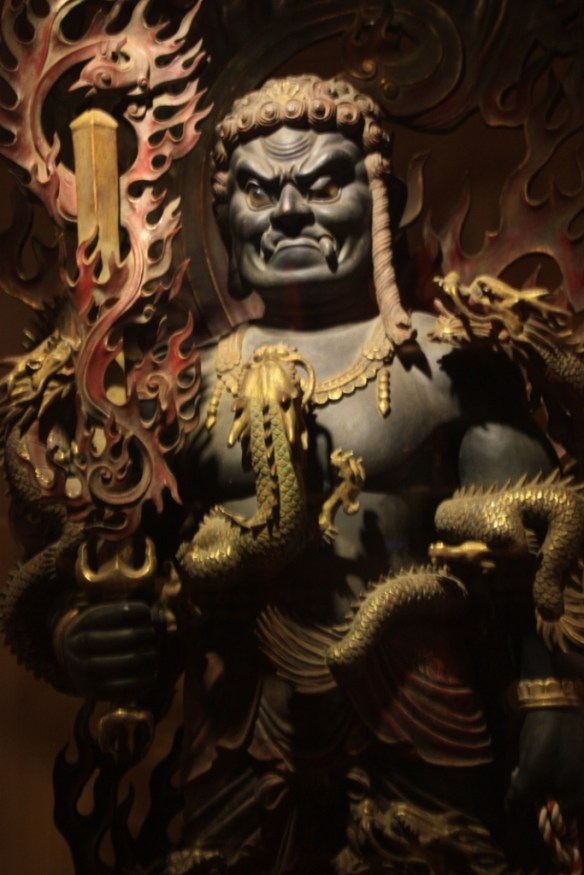
Taken on October 30, 2016 at the Buddha Tooth Relic Temple in Singapore
Fudō-Myōō is the name used by Japanese Vajrayana Buddhists for the wrathful deity otherwise known as Acala [the Wisdom King.]

Taken on October 30, 2016 at the Buddha Tooth Relic Temple in Singapore
Fudō-Myōō is the name used by Japanese Vajrayana Buddhists for the wrathful deity otherwise known as Acala [the Wisdom King.]
 Sleeping, Dreaming, and Dying: An Exploration of Consciousness by Dalai Lama XIV
My rating: 4 of 5 stars
This book is a product of the 4th Mind & Life Institute Conference that took place over five days in October of 1992 in Dharamsala, India. It reads as a narrated description / transcription of the event. The Mind & Life Institute was established as a dialogue between science and Tibetan Buddhism, and is actively supported by His Holiness the Dalai Lama—who is an important figure in the book, both asking questions of the presenters and offering clarification on Tibetan Buddhist thinking on various points. The exact subject of each conference is different, but the mind is a recurring theme. Which makes sense as Tibetan Buddhist practices of the mind are as advanced as any, and it would be of great benefit to understand them better from a scientific perspective.
As the title suggests, this conference (and the book) deal with three topics: sleeping, dreaming, and dying. This may seem like a case of “one of these things doesn’t belong,” but from the Buddhist perspective on consciousness it’s a sensible enough grouping. One can think of it this way, sleeping and dying are points at which consciousness goes bye-bye. [Although, lucid dreamers retain consciousness in REM sleep, and there are unsubstantiated claims of the ability to maintain consciousness in sleep by extremely advanced practitioners.]
There is some front matter (a forward by the Dalai Lama and an editor’s Introduction) and then eight chapters. The first chapter discusses both the Western and Tibetan perspectives on “the self,” what it is, and whether it is [real or illusory.] This topic seems unrelated to the book’s theme, but it’s a way to develop a common understanding for the rest of the discussion. If participants have different views on what a person is, mentally speaking, and what consciousness is, then it’s easy to talk past each other without even realizing it. The second chapter is an overview of what was known about sleep, principally from the perspective of neuroscience (it should be noted that neuroscience was a fairly fledgling term at that time.) The next three chapters (ch. 3, 4, and 5) are about dreaming. The third chapter is a bit unique. The general approach throughout the book is to give the understanding of science and then to compare and contrast that with Buddhist thinking. However, chapter three’s discussion is led by a proponent of psychoanalysis (i.e. the Freudian approach,) which isn’t so scientific, but is a Western philosophical approach. [Chapter one is also heavily philosophical.]
Chapters four and five delve into the subject of lucid dreaming, which is referred to as dream yoga in the Tibetan Buddhist tradition. For me this was the meat of the subject, and it was the reason that I bought the book. Tibetan practices on lucid dreaming are incomparable, and at this point science’s understanding was beginning to blossoming as well.
The last three chapters are on death, and each offers a different character. The first two emphasize Western views, but in different ways. Chapter six outlines the Christian position on death—a theological rather than scientific understanding. Chapter seven explains the medical community’s view of death. This sounds straight forward, but it’s a much more technical subject than one might imagine. What organ has to stop functioning and for how long before one is actually dead. Besides all the coma patient stories, one may be aware of cases historically in which people were discovered to have been buried alive accidentally due to bad calls by doctors. The last chapter is about near-death experiences. This is an area in which there is a great potential for differing views. While science doesn’t deny that people have all sorts of fascinating experiences such as seeing bright lights at the end of “tunnels” and out-of-body experiences, scientists tend to attribute such events to material causes. [Neuroscientists can now induce out-of-body experiences by zapping a specific part of the brain.]
There are graphics in the form of diagrams and tables in the chapters that are most technical (e.g. chapter two and chapter seven,) but they are used sparingly. There’s an appendix that describes the Mind & Life Institute, as well as a glossary that explains both Tibetan and scientific terms. There are also a few pages of end notes that will help one find related material.
The weakness of this book is clearly its age. The Buddhism probably hasn’t changed much, but the science has changed a lot. Since 1992 there has been a revolution in understanding of the brain due to advances in functional Magnetic Resonance Imaging (fMRI) and other technologies.
However, despite the book’s age, there’s a lot of thought-provoking discussion, which offers plenty of room for both scientists and Buddhists to gain a better understanding of the mind and consciousness. I’d recommend this book for anyone interested in dream yoga / lucid dreaming, or—for that matter—death.
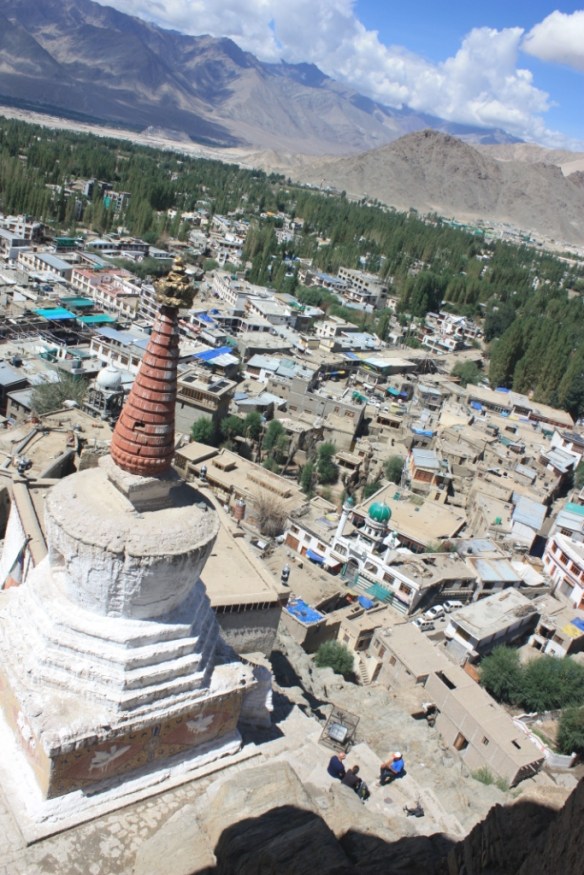
Taken in August of 2016 in Leh
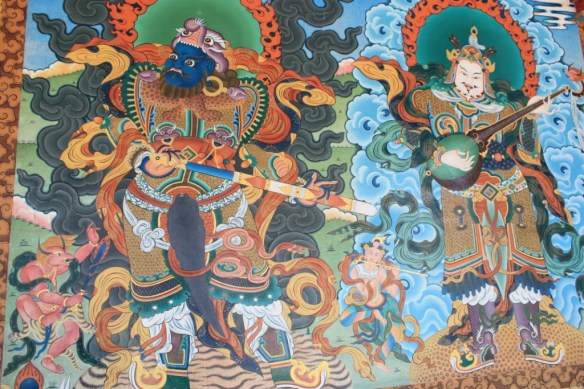
Taken in March of 2014 at the Namdroling Monastery in Bylakuppe (south Karnataka)

 Zen Bow, Zen Arrow: The Life and Teachings of Awa Kenzo, the Archery Master from “Zen in the Art of Archery” by John Stevens
My rating: 4 of 5 stars
Awa Kenzo is variously known as an archer without compare, a Zen master, or as the teacher of Eugene Herrigel. Herrigel was a German philosopher who wrote a thin book entitled, “Zen in the Art of Archery” that gained a global following. Herrigel’s book was about his time as a student of Kenzo and the insight that he gained into both Zen and Kyūdō—Japanese style archery—through his studies. Kenzo lived from 1880 to 1939, a period during which arts like kyūdō were used more for development of character than as fighting arts, and Kenzo was important figure in this transformation.
Stevens’ book is a thin volume (< 100 pages) consisting of three parts. The first is a short biography of Awa Kenzo. One shouldn’t expect a thorough treatment, but that may be for the best (i.e. Kenzo’s life is of interest because of his mastery of archery, but probably only his most ardent fans would want to read a 400 page biography on his life.)
The second part is a set of lessons and aphorisms attributed to the master archer. This section includes a few pages by the author to put Kenzo’s brief statements in context. The lessons themselves are sometimes in prose, sometimes in poetry, and occasionally in the form of lists. These lessons offer insight into archery, mindset, and life in general. Archery is portrayed as a lifestyle.
The third section consists of three short (very short) stories in which archery as a means to develop one’s character is at the forefront.
In addition to the three sections, the book includes front matter, annotations, a bibliography, and a few photos.
I enjoyed this book and would recommend it for those seeking insight into the nexus between Zen and the martial arts.

It’s 4:45 in the morning and I’ve been sitting on my cushion at the Dhamma Setu Vipassana Meditation Center in Chennai, India for a quarter-hour. It’s day one, and I’m observing my breath as it comes in and out through my nostrils—at least for seconds to minutes at a time before I have to coral my mind back from some random tangent. This breath exercise (ānāpāna-sati), I will soon learn, is a preparatory exercise used to reign in the mind enough so that actual Vipassana meditation can be introduced on the middle of the fourth day. In eleven days, I’ll be in the closing session of the course.
There are several approaches to Vipassana meditation taught throughout the balance of the course, but the gist is the same for all of them. One rotates one’s awareness throughout the body systematically observing sensations. As one does this, one works toward equanimity, a calm and quiet state of mind in which one neither covets pleasurable sensations nor shuns unpleasant sensations. The idea is to train the deepest level of the mind to not habitually lunge one toward pleasure or away from displeasure. (FYI: displeasure = pain. At least for a novice, such as myself, there is a fair amount of pain involved in sitting still for such long periods. It’s generally referred to a solidified gross sensation to differentiate it from the uniform and subtle sensations that one may feel in the parts of the body that aren’t in agony. I joke about it here, but there’s good reason to train oneself to not think in terms of pain, and the negative connotation the word evokes.)
At that course’s beginning, I knew a little about Vipassana from research, including reading the book “Equanimous Mind,” one man’s account of his experience in the course. For example, I knew that most people who quit, leave either on day two or day six. At the time, I didn’t know why, but would learn soon enough. It’s nothing about those two days, but rather the days that precede them. Day 1 seems to last forever, and it’s easy enough to discern why it might give students trouble. When one gets through day 1, an optimist says “yeah, I can do this because I’m through the first day” but a pessimist says, “I just barely made it, I can’t do this.” Day 5 is when the strong commitment (adhiţţhāna) is added, which means that one has three one hour sessions during which one is to commit to not changing one’s posture for the whole session. No opening eyes, but—more challengingly—no unfolding /refolding one’s legs. This commitment to not changing posture steps up the difficulty of the course to another level.
It should be noted that one can opt to sit in a chair. However, that introduces an entirely new challenge—drowsiness. During the long sessions, when I’d get up to walk the lymphatic fluid out of my legs, there were usually two people in a straight-spined meditative position and six to eight who looked to be sound asleep. (Drowsiness was one reason that I didn’t sit in a chair. I’m prone to get sleepy enough during meditation, especially in a complete absence of caffeine. The other reason was that I’ve not found chairs to be more comfortable for long-sits of meditation. Once your bony parts start pressing into the chair, one begins to wish one was cross-legged on a cushion. One can make the chair more comfortable by placing padding wherever it’s uncomfortable, but eventually one has a virtual La-Z-boy and the drowsiness factor becomes all the more problematic.)
With respect to these strong commitment (adhiţţhāna) sessions, I didn’t make it the full hour without moving on the fifth day–or any day until day 10, in fact. However, I don’t count this as a failure, because I did give it my all. I say that based on the endorphin-induced euphoria, simple hallucinations, and a proprioceptive form of Alice-in-Wonderland Syndrome that I experienced from toughing it out past mere discomfort. I’ll get to what that all means, but for now suffice it to say these happenings were symptomatic of sitting still through the period in which the pain came, grew, and then started to numb out.
In fact, these trippy experiences may, sadly, have been one reason why it never occurred to me to want to leave around day six. While I tried not to get caught up in them, these experiences were fascinating. I could see why day 2 presents a challenge to so many, but day 6 was a hoot, relatively speaking. The second most challenging day for me was day 8, because I’d reached a plateau but I didn’t yet feel myself in the homestretch. But by day 8, who’s going to leave? You’ve gutted it out that long, and are almost done. For those concerned about whether they can make it to the end, I can honestly say that I never seriously considered quitting. It’s not that hard to get through the 10 days, as long as one isn’t too addicted to comfort and communication. That said, I wouldn’t offer a wholesale recommendation of the course as many do, but rather recommend it on a case-by-case basis. If you’ve done no meditation whatsoever, this is the meditative equivalent of going from couch-sitting to training for an ultra-marathon overnight. If you think you can’t get through nine days of silence–without no phones or books, maybe you can’t, and you should probably reevaluate your life.
I mentioned some of the unusual experiences that I witnessed during the course, and I’ll get into that a bit more. I should preface this by saying that one shouldn’t get caught up in these trippy happenings for reasons I’ll elaborate upon below, but they may happen so it’s worth being ready for them. Here’s a list of the unusual events I experienced:
-Extreme relaxation / lethargy: a little off topic, but between sessions on day 1, I noticed that I couldn’t be bothered to shoo away a fly that kept buzzing around my head with random touch downs. I don’t know how long I walked with the fly buzzing over me before it struck me that this was unusual. This was before Vipassana proper had been introduced, so it didn’t yet seem apropos.
-Olfactory hallucination / vivid scents: on day 2 I witnessed a distinct smell from my elementary school days (i.e. a mix of cleaning solution and milk cartons?) that theoretically could have originated at the Dhamma Setu, but which was quite probably an olfactory hallucination. It was short-lived and I never smelt it again. I did later experience an intense smell of flowers inside the meditation hall. This may well have been an actual scent as there were many blooming flowers there. These vivid scents were also short-lived.
-Endorphin-Induced Euphoria: on days 4 and 5, I experienced this as an almost intoxicated feeling. [Endorphins are the body’s indigenous pain-killers.] As drunks find unfunny things funny, so did I—including the pain in my legs and back. I wondered if anyone would be distracted by my occasional giggle-fits, but I think they were much more subdued than I suspected from my vantage point. Just like I’ve thought I was talking in my sleep in the past, only to be told that it sounded more like faint and indistinct whimpering. On day 6, I experienced a more sophisticated (not drunk-like) form of euphoria that expressed itself as a feeling of “oneness.” I’ve read about feelings of oneness being attributed to a form of transient hypo-frontality—i.e. a shutting down of the parts of the prefrontal cortex (PFC) that track the self / other distinction. There may have been more happening than endorphins (and other neurotransmitters) involved in that happening.
-Lifting sensation: This was the single most awe-inspiring experience that I was party to. For those unfamiliar with seated meditation, one of one’s chief enemies in long meditation sessions is a proclivity to slump. Slumping translates into agonizing back pain and labored breathing. So whenever one catches oneself slumping, one has to straighten one’s back. [If you wonder why a meditator would pretzel up his or her legs in full lotus (padmasana), the alignment of one’s legs helps one maintain a straight spine.] At any rate, on day 6 I experienced the feeling that I was being lifted up straight and it became effortless to maintain a straight back for the rest of that session—as if an outside force were doing the work. This lifting sensation wasn’t like being lifted by a person, but rather like the action of a “tractor beam” from the world of sci-fi. While I have some inkling of the causes of much of what I experienced based on the science of the human body, explanation of this “lift” is harder to come by. I did read an account in Oliver Sacks’ “Hallucinations” by a woman who suffered from migraine-induced hallucinations and Alice-in-Wonderland Syndrome that was a spot-on description of what I experienced as well.
-“Visual” [closed-eye] simple hallucinations: I didn’t experience anything even close to the what people usually think of as a hallucination—that is, there was nothing that could be confused with reality. I wouldn’t have even known to call these images hallucinations if I hadn’t been reading the aforementioned Oliver Sacks’ book. Mine were quite close to what are described as hypnogogic (falling asleep) hallucinations in the Sacks’ book. This makes sense. While I wasn’t drowsy at the time, my brain was probably in a pretty similar state of relaxation. Mostly, these were moving shapes that formed and dissipated in a field of black-fringed purple. On day 7, there were more complete visuals—mostly of partial faces, usually with mouths wide open. I took this as my subconscious mind’s comment on the noble silence. (On the noble silence: from about 6pm on day 0 [orientation afternoon] until the morning of day 10, one isn’t allowed to talk or in any way interact with / acknowledge anyone except to direct questions to the teacher or staff. Whether one has questions or not, one will speak at least a few words to the teacher every day or two when he / she reviews one’s progress. For some, this may be the single biggest challenge of the course, but I’m a hardcore introvert and could do ten days of silence standing on my head.)
-Tactile Alice-in-Wonderland Syndrome: Alice in Wonderland Syndrome usually refers to a visual form of hallucination in which things appear a great deal taller, smaller, closer, or farther than they actually are. What I experienced was a great deal less whacky and traumatic than that. With eyes closed, I felt a distortion of the size and shape of my arms. Sometimes my arms felt like they were six-foot long from deltoid to fingertips, and sometimes the same points seemed to lie a foot and a half apart. Needless to say, those are both distortions of the actual length of my arms.
-Inexplicable Beatles’ Music: On day 8 my mind bombarded me with music from the Beatles for a little while. In particular I heard “Sgt Pepper’s Lonely Hearts Club Band”, “Lucy in the Sky with Diamonds”, and “All You Need is Love,” or parts thereof, in high fidelity. Now, while this is fine music, it’s not music that I’ve listened to recently nor have I listened to that album a great deal. When I was growing up, there was a copy of “Sgt Pepper’s…” at home, but I’ve only periodically heard these songs on the radio since. The experience was monotonous because only the parts that I knew the words to (i.e. the choruses) replayed on a loop, but the music and voices were crystal clear as if I were listening to the album. Given the lack of personal relevance, I can only imagine that my subconscious thought this is the kind of music a person meditating would like to hear.
As I said, by about day 8 I’d hit a plateau. The aforementioned odd experiences were petering out, particularly when I did as I was supposed to do and gently returned my mind to the task at hand. Yet, the practice wasn’t getting any easier or smoother. I still had the same dead spots—areas that I could observe for extended periods without even the subtlest of sensations—and I still had growing pain zones in my back and legs—i.e. starting from isolated pains, the pain would become increasingly diffuse and of ill-defined boundaries—but often no less painful.
Now I’ll explain my comment about not allowing oneself to become captivated by the trippy experiences. If one seeks after these experiences, not only is one missing out on the value of the practice, one is actually moving in the wrong direction by coveting an experience while impulsive craving is what one is training oneself away from through Vipassana meditation. Beyond this, seeking out such experiences is likely to be frustrating because they are products of the subconscious mind and physiological processes that are beyond conscious control. They happen when they happen, on your body’s schedule. (Note: Some people think of these as spiritual phenomena. I don’t, but—for those who do—they still won’t happen on your schedule. Ostensibly, they’ll happen on some deity’s—presumably rather tight–schedule. And—divine as they may be—they are still a distraction from the objective of the practice—and that’s not my opinion, but according to the teachers of the tradition, starting with Gautama Buddha and through to S.N. Goenka.)
So when one experiences such phenomena, one should do the same as one always does in meditation, quietly and non-judgementally return one’s mind to the object of awareness—in this case, systematically witnessing the sensations on one’s body. I won’t say that this isn’t a challenge. It is, because your mind is presenting you with something fascinating and new, and you’re asking it to return to a task that has become rather mundane over hours and days of practice. It should be noted, I would broadly categorize the phenomena that I experienced into two slots, one of which is things the brain does to cope with a lack of external stimulation. (The other being, things the body does to cope with unrelenting pain.) So it takes some discipline, but one should remind oneself—as one is frequently reminded during the discourses—that you are there to give the Vipassana approach a fair trial, and as fascinating as these sideshows are they are a distraction from the practice.
That said, these things will happen and their unusual nature may make them points of concern or confusion, and so I’ll discuss them a bit more. I have a theory about the cause of the euphoric experiences, but it requires a little clarification and background. What makes Vipassana challenging for a new practitioner—at least for me— is that in systematically rotating one’s awareness to observe sensations, one has to ignore areas that are screaming with pain while carefully running one’s attention through areas that seem completely devoid of sensation. This requires quieting the mind and especially not feeding the anxiety about one’s pain and discomfort—hence, developing equanimity (steadiness of mind.) Sitting still for an hour at a time, lymphatic fluid piles up in your lower extremities (no pump in the lymphatic system but the one of movement), over time blood circulation may be inhibited, and this lack of circulation has ramifications for the cells not being adequately nourished. So your body notices this fluid build-up (a relatively minor concern, easily rectifiable, and which will take a while to be a serious problem for most people) and sends you some pain sensations to spur you to get up and move about. When you don’t get up and walk, it turns up the discomfort disproportionate to what’s happening with your body. You still ignore it. Eventually, your body starts to think maybe a boulder fell on your legs and you’re in shock (the conscious and unconscious minds don’t talk as much as you might think, and—even if they do—let’s face it, at least the conscious mind is a big, fat liar.) It’s at this point that your body starts to emit some feel-good chemicals. (I refer to “endorphin-induced euphoria,” but it’s more extensive than natural painkillers. In reading up on the subject, I noted references to serotonin and even melatonin (yes, the skin color chemical) in addition to beta-endorphins. I wouldn’t be surprised if there was some dopamine—a reward / feel good chemical—in the mix as well. Hence, the euphoria.
I don’t think it’s necessary to get into the hallucinations and other effects that the mind creates in order to cope with the lack of sensory input. This is a well-studied area, and there’s been a lot written on how the mind hates the dark and the quiet over extended periods. I would recommend the aforementioned book by Oliver Sacks on hallucinations as a case in point.
Saving the most crucial question for last, was it worth it? In his discourses, S.N. Goenka offers three criteria by which one might evaluate whether Vipassana is worth practicing. While all three are sound criteria, I’ll focus on just one of these, which is really the bottom-line, and that’s whether it makes an improvement in one’s life. That is, does one start to be less prone to impulsively react to craving and aversion and become more equanimous of mind?
On this, I’ll have to say that the jury is still out. Many come out of the 10-day course calling it life-changing. I’d say that it was beneficial because I learned a meditative technique that has a sound internal logic (even if one doesn’t believe every aspect of the mechanism by which it is said to work by Buddhists—which I don’t), an established track record of benefit for many, and the feel that it’s benefiting one. However, I’m still evaluating the approach. I’ve been doing Vipassana meditation twice a day with morning and evening affirmations. Let’s face it, 10-days isn’t a long time to overhaul one’s deeply ingrained modes of operation—even sitting in meditation for 10 hours a day. I’m optimistic, and the practice sure doesn’t hurt—except for those solidified gross sensations, they hurt.
 The Tibetan Yogas Of Dream And Sleep by Tenzin Wangyal
My rating: 5 of 5 stars
I stumbled upon this book in a used bookstore, and didn’t know what to expect–but was intrigued. It’s a book on the Tibetan Bön approach to dream yoga and sleep yoga, written by a Bön lama (monk.) Dream yoga is a term used in Buddhism and other Eastern traditions to refer to what is called lucid dreaming in Western scientific circles. My review will focus on the more than 3/4ths of the book that deals in dream yoga (lucid dreaming.) The 40-ish pages that deal with sleep yoga are outside my wheelhouse. The author suggests that that part is for initiates who are familiar with certain background concepts. I’m not an initiate, and—in fact—I have no idea whether there is any merit to sleep yoga practice. Lucid dreaming is a well-studied and documented phenomena, but, as far as I know, what the author calls sleep yoga remains unstudied. All I can say is that the part on dream yoga is readily comprehensible, despite much of it being couched in spiritual terms, but a lot of the section on sleep yoga is arcane and ethereal.
As it happens, I was pleasantly surprised with the portion of the book about dream yoga. Having read a number of books dealing with the subject recently, I wasn’t sure whether I would learn anything that was both new and useful. But I was exposed to ideas that were new, useful, and mind-blowing. There were a few ideas for helping one to achieve lucid dreaming—mostly through practices carried out during the day—that I’d not seen in other works, at least not put in such clear terms. Also, while there is a lot of reference to the Bön and Buddhist spiritual traditions, this didn’t result in the explanations being needlessly complicated or arcane. There is a lot of information that one doesn’t need if one is a secular practitioner, but many readers will find it interesting, even if it’s not necessary to advance their practice.
The book is organized into six parts: 1.) The Nature of Dream, 2.) Kinds and Uses of Dreams, 3.) The Practice of Dream Yoga, 4.) Sleep, 5.) The Practice of Sleep Yoga, and 6.) Elaborations. The last part has information pertinent to both dream yoga and sleep yoga.
There are some graphics in the book including photos, line drawings, and tables. Most of these aren’t essential, but some make it easier to imagine what the author is describing (e.g. when he discusses sleeping positions.) The book has a glossary and bibliography. The former is useful, and the latter doesn’t hurt (but it’s only one page and offers only a handful of citations.) The glossary is mostly of foreign terms, but includes English terms specific to the religious traditions discussed. It offers both Tibetan and Sanskrit variants of the word if they exist, which is a nice feature. There is also an appendix which summarizes the crucial practices elaborated upon in the book.
I’d recommend this book for those interested in developing a lucid dreaming practice. I will say that it may not be the best first book to read on the subject, unless you are a practitioner of Bön or intend to be. (For that, I would recommend Charlie Morley’s “Lucid Dreaming: A Beginner’s Guide…” which I recently reviewed.) However, this book makes an excellent follow-up once one has read a book that is couched in simpler terms (i.e. not specific to a certain spiritual tradition) and which reports on the science. I found that the book gave me a number of new ideas, and—in fact—offered some insightful ideas.

Taken in August of 2016 in Diskit, India
It’s over 100ft (30m) tall.
A Maitreya is a “future Buddha,” meaning a Buddha who hasn’t yet appeared, but who was prophesied to live in an era to come. For people unfamiliar with Buddhism, this might seem strange. The Buddha we normal think of is Gautama Buddha, or the Shakyamuni Buddha (Siddhartha Gautama.) He was the founder of the religion, but one of many said to have achieved enlightenment. In other words, the Buddha we think of was an awakened one, not the awakened one.
 Running with the Mind of Meditation: Lessons for Training Body and Mind by Sakyong Mipham
My rating: 4 of 5 stars
Tibetan Buddhists believe Sakyong Mipham is the reincarnation of a great teacher from late 19th century Tibet. He’s also completed many marathons—nine at the time of this book’s publication. He’s certainly qualified to comment on meditation, running, and the nexus of the two–if there is such a thing. However, it may not be clear that the topics are particularly connected. Readers may have an intuitive sense that they are closely connected, but without sufficient understanding of both elements to draw sound conclusions.
The author, himself, proposes that one should recognize the points of contrast as well as comparisons between the two activities. A couple quotes make this clear:
“People sometimes say, ‘Running is my meditation’… in reality, running is running and meditation is meditation… It would be just as inaccurate to say, ‘Meditation is my exercise.’”
“The body benefits from movement, and the mind benefits from stillness.”
Later in the book, the author suggests that the apparent clarity after running usually has more to do with the “wild horse” of the mind being tired, rather than it being tamed. (Taming the mind being the objective of meditation.) That said, Mipham Rinpoche clearly believes that there are benefits to be had from an interaction between these two activities.
The book is divided into six parts. The first part gives background on basics like base-building, breath, what meditation is, and the challenge of starting to build a regime (either of running, meditation, or both.) The rest of the book is organized by way of a Tibetan Buddhist conception about how new skills are learned. This schema relies on animal symbolism. The first level is that of the tiger, and this is when one works on attentively and conscientiously building one’s technique. The lion level follows the tiger. The lion phase is a joyful one because a base capacity and fundamentals have been built and the initial struggle is in the past. The next phase is represented by the Garuda (a mythical eagle-like creature that features in Hindu as well as Buddhist mythology), and it’s expressed by challenging oneself to more demanding practice. The final phase is the dragon, and it involves moving beyond doing the activity for oneself to doing it for others. There’s a final part, entitled the windhorse, that is based on the notion of an energy that Tibetan Buddhists believe accumulates when one follows the aforementioned 4 phase path. This last part is a description of events that might be seen as the culmination of the author’s running career.
Within the aforementioned six parts, there are 40 chapters—most of which are only a few pages and deal with a specific aspect (or pitfall) of that phase of training.
I found this book interesting. Learning about the four phases (tiger, lion, garuda, and dragon) of skill development was illuminating, and I found myself thinking about how this idea could be more widely applied. It’s a handy conception with broad utility. The author uses stories from his own experience to add credibility as well as light-heartedness to the philosophy lessons being taught. While the book may seem ethereal, much of the discussion is on down-to-earth subjects like dealing with pain and injury. It should be noted that the introductory and tiger parts make up a little more than half the book—suggesting the importance of fundamentals. There’s a lot of valuable information on fear, confidence, and how to view pain.
I’d recommend this book, especially for runners and meditators—but not exclusively so. Many people who are interested in mind / body interaction will be able to draw useful lessons from the book, even if running isn’t your thing.


 Tiger Riding for Beginners