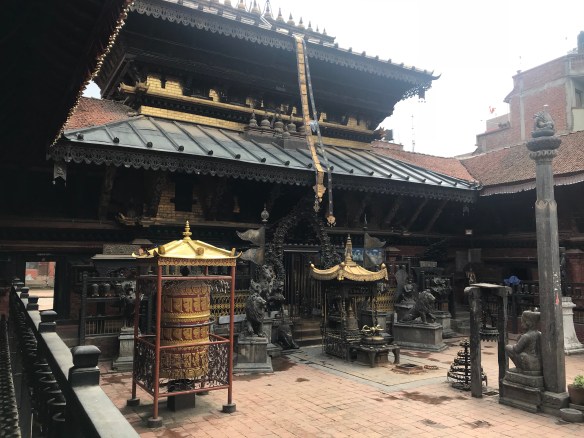
DAILY PHOTO: Acala in Buddha Tooth Relic Temple of Singapore

Taken in October of 2016 in the Buddha Tooth Relic Temple of Singapore

BOOK REVIEW: The Way of the Bodhisattva by Shantideva

The Way of the Bodhisattva: A Translation of the BodhicharyavataraThe Way of the Bodhisattva: A Translation of the Bodhicharyavatara by Śāntideva
My rating: 4 of 5 stars

Amazon page


A bodhisattva is one who achieves enlightenment but sticks around to help others pursue the path. Shantideva was a Buddhist monk who lived [mostly] in the 8th century in the part of India that is today in the state of Bihar. Shantideva’s lesson on how to be a good bodhisattva is delivered via 10 chapters of verse, mostly in four-line stanzas. This instructional poem makes up almost 240 pages of the edition of the book put out by Shambhala as translated by the Padmakara Translation Group, and the rest is front matter, appendices, notes, and a bibliography.

The chapters of Shantideva’s poem are: 1.) The Excellence of Bodhichitta (lit. “enlightened mind”); 2.) Confession (fear is a major theme in this statement of modesty); 3.) Taking Hold of Bodhichitta; 4.) Carefulness (discussion of what to avoid.); 5.) Vigilant Introspection (on the need to keep one’s attention concentrated, and to not let the mind roam.); 6.) Patience (on not being focused on self, but on all those suffering.); 7.) Diligence (on avoiding hedonism and being industrious.); 8.) Meditative Concentration (avoidance of getting caught up in the material / physical world.); 9.) Wisdom (karma, illusion, and, particularly, the illusion of self.); 10.) Dedication.

As mentioned, there’s a lot of ancillary matter in this edition of the book. There’s a forward by the Dalai Lama, an extensive introduction (which is helpful as even a modern translation requires background), three appendices (a brief biography, a discussion of equalizing self and other, and a meditation on exchanging self and other), notes (which are also necessary give the nature of a 21st century global reader spoken to by an 8th century Indian monk), and a bibliography. There are no graphics (except a single line-drawn panel) but none are needed.

I had mixed feelings about this work. There was a great bit of wisdom, and the meditation described in the final appendix (based on Shantideva’s discussion) seems to be tremendously valuable. One the other hand, there was a lot of degradation and abasement of the physical body. Granted, I know that Shantideva is talking to an audience of primarily monks and he’s trying to keep them from being horn-dogs or otherwise being distracted by physicality. However, I’m always turned off by those who fail to recognize the tremendous awesomeness and beauty of the human body. There’s also the pessimism. Buddhists are often accused of being pessimistic. Starting with an opening statement of “life is suffering,” this might not be a surprise. Of course, Buddhists counter by saying that they aren’t pessimistic because they are offering a solution to the fact that life is misery, to which non-Buddhists tend to say, “Yes, but the defining characteristic of life need not be agony in the first place.” I won’t weight in on that debate, but the reader should be prepared for a certain dismal tone here and there.

I found this book to be loaded with food for thought. The introduction and notes are extremely beneficial, and this is one of those few cases in which they don’t just feel like padding to hit a desired page count. The verse is readable, and can be understood by a general audience.

I’d recommend this for those interested in Buddhist philosophy.

View all my reviews

BOOK REVIEW: Modern Buddhism: Vol. 1 (Sutra) by Geshe Kelsang Gyatso

Modern Buddhism: The Path of Compassion and Wisdom - Volume 1 SutraModern Buddhism: The Path of Compassion and Wisdom – Volume 1 Sutra by Geshe Kelsang Gyatso
My rating: 4 of 5 stars

Amazon page


This is the first book in a three-volume overview of Buddhism that is available for free (or for the minimum Kindle book price on Amazon.) The book is written by a Tibetan Buddhist scholar-monk, and, therefore, emphasizes the Mahayana approach and specifically that of the Gelug school. (I’m a neophyte, but I don’t think this book goes into so much detail as to be controversial among Tibetan Mahayana Buddhists, but if you are thinking you’ll learn about, say, Zen or Theravadan Vipassana, not so much.) The theme of this volume is an overview of the Limram, which is a sutra describing the path to enlightenment.

The book is divided into four sections. The first offers a broad overview of Buddhism with particular discussion of the Kadam Lamrim (the specific sutra discussed) and Kadampas (which is the name for an individual who pursues practice of the Kadam Lamrim.) The other three sections describe the information needed by an initiate, middling practitioners, and advanced practitioners, respectively.

The section on persons of initial scope (i.e. initiates) emphasizes the need to recognize the limited scope of a human life, to reflect upon one’s imminent death, and to consider the importance of avoiding lower rebirth.

The section on persons of middling scope echoes the four noble truths. They are discussed by way of the four questions: 1.) What one should know? 2.) What one should abandon? 3.) What one should practice? And 4.) What one should attain? In essence, it suggests one understand suffering, the path to is cessation, and that one follow that path.

The largest section, by far, is the portion on individuals of great scope. It is divided into four parts. The first part describes the need to revise one’s approach to love by taking oneself out of the center and practicing loving-compassion for those that one doesn’t know. The second subsection outlines the six perfections (giving, moral discipline, patience, effort, concentration, and wisdom) and the importance of each. The third section is about emptiness and truth. The final section is a brief description of the Lamrim practice.

There are a small number of line drawn illustrations of important figures in the tradition. There are no notations, citations, or ancillary material.

I found this book to offer a concise overview of the subject of Buddhism—specifically from the perspective of the Gelug tradition of Tibetan Buddhism. While there are some historical stories, such as those drawn from the life of Milarepa, the book is not designed to be entertaining reading. It’s a straightforward transmission of knowledge. In that regard it does a fine job, it’s clear and concise.

I’d recommend this book for one who’s interested Tibetan Buddhism, but one should be aware that it’s not a nonsectarian overview of Buddhism as the title might suggest to a reader.

View all my reviews

BOOK REVIEW: The Life of Milarepa ed. by Lobzang Jivaka

The Life of Milarepa: A New Translation from the TibetanThe Life of Milarepa: A New Translation from the Tibetan by Lobsang P. Lhalungpa
My rating: 5 of 5 stars

Amazon page


Superhero stories can be surprisingly hard to make interesting. The hero’s vast powers make it hard to build obstacles that seriously challenge him. Make no mistake; while this book may be the biography of a Tibetan Buddhist yogi who was born in the eleventh century, it’s a superhero story as well. At various points, the titular character can control the weather, fly, read minds, predict the future, and cover a distance that would take a mere mortal months in just days. Milarepa is basically the entire cast of the X-Men rolled into one monk. [Note: the introduction of 1962 Lobzang Jivaka edition features a series of rants against Westerners that put a bad taste in my mouth early in the reading–basically suggesting the reality of these magic powers should be taken as a given even though the deficient Western mind has trouble wrapping its head around difficult concepts. It made me think I’d probably not like the book, but I’d forgotten it by the time I got around to the end of the book.]

“The Life of Milarepa” is essentially a hero’s journey, which begins with his widowed mother, his sister, and he being taken advantage of by a mean Uncle and Aunt. Milarepa takes up Black Magic to influence the weather so that he can exact revenge. Doing so makes him feel great shame, and puts him on the path of a religious ascetic. After his initial training, he is put through a great series of trials by Marpa, the man who will eventually his guru. Were it not for the encouragement and support from Marpa’s wife, Milarepa would never have made it through the training, and at one point—in fact—he goes away to learn from one of Marpa’s most advanced students because it seems Marpa unwilling to teach him.

Eventually, Milarepa ends up returning to his home and, thereafter, meditating on his own. Here he runs into the aunt and uncle (now separated) who made his family’s life hell after his father died. These elders aren’t the only ones who think Milarepa is a ne’er-do-well. However, most people are too scared of his superpowers to create problems for him, at first. He eventually wanders off and becomes the poorest of ascetics—with not so much as covering for his naked body as he live off nettles.

There are oddities in the book. The Buddhist teachers he studies under both use him as weapon (i.e. his hailstorm magic) as a requirement to taking him on as a student, despite the fact that this will pile onto his Karmic debt (and ostensibly theirs), and it leaves him feeling horrible—as well, it seems, these black magic powers make Marpa hostile to the young man and not take him seriously as a student until the guru receives an omen.

So why does this story turn out to be so satisfying? For one thing, for all his powers, Milarepa is constantly confronting challenges that keep the story tight. (I should again emphasize that this is nominally a work of biography. It just doesn’t read like one because of all the magic and the classic story elements. Few people have such a novel-shaped life. A hagiography is a more apt descriptor but instead of only displaying Milarepa’s good side (boring), this book presumably dances around facts to make a more engrossing product.) While Milarepa could concoct all manner of magic, he mostly doesn’t with the exception of some ESP. After Marpa has taught him, Milarepa deals with people with calm and compassion. (His return home is a little like Alex’s from “A Clockwork Orange” in that people have ill feelings about him because of his past, but at first they are afraid of him. When they discover he can’t defend himself, they start to lay into him.) For another, we can see Milarepa’s growth and we come to respect his intense devotion tremendously as he becomes quite virtuous of the course of the book. While he is a superhero, he’s also an ascetic who denies himself with the utmost of discipline in pursuit of liberation.

I’d highly recommend this book for those who like biographies—especially if you like to learn about Buddhism in the process. In the latter half of the book there are some lessons transmitted through the text as Milarepa interacts with students and other people. Eventually, even his loathsome aunt becomes a student.

View all my reviews

BOOK REVIEW: An Introduction to Indian Philosophy Chatterjee & Datta

An Introduction to Indian PhilosophyAn Introduction to Indian Philosophy by Satischandra Chatterjee
My rating: 4 of 5 stars

Amazon page


India has spawned a number of philosophical systems over the centuries. Chatterjee and Datta provide an overview of Indian philosophy by comparing and contrasting nine major schools of Indian philosophy—the six orthodox schools plus three well-known heterodox schools. The dividing line between orthodox and unorthodox hinges upon whether a philosophy accepts the Vedas as sources of authority.

After an introductory chapter that lays out the concepts that will be needed throughout the remainder of the book as well as providing brief sketches of nine philosophical schools, the remainder of the book is a one chapter per school examination of metaphysics, ethics, theology, epistemology, etc. The authors first consider the heterodox schools: i.e. Carvaka (a materialist /atheist approach), Jain (one of the major Indian religions), and Buddhist. After examining the heterodox approaches, Chatterjee and Datta take on the orthodox schools in the following order: Nyaya, Vaisesika, Sankhya, Yoga (which you may not have realized was a philosophical system), Mimamsa, and Vedanta.

There are a number of questions that recur as the authors compare these schools to each other. A major point of consideration is presence or absence of belief in a god, and—for those systems that believe in a God or gods—what is the role of said deity. It might seem that all the orthodox systems would be theistic, but this isn’t the case (e.g. Sankhya.) Another key question is how one can know something, i.e. what is acceptable authority—can one only trust one’s own senses or can one trust everything but one’s own senses? Then there is the matter of ethics and how each system regards ethical behavior. Of course, there are some elements that are unique to a given system, and so it’s not entirely a matter of comparison and contrast.

There are no graphics in the book and the ancillary material is limited to footnotes, a select bibliography, and prefaces to the various editions of the book. Note: I read the 2007 / 7th Edition of the book.

I won’t say this book isn’t dry. It’s a philosophy textbook, after all. However, it does provide a solid overview of the topic and seems to take great efforts to be unbiased (to the extent of sometimes not challenging philosophical ideas that are patently unsound in favor of reporting what advocates of the tradition propose.)

I’d recommend this book for anyone who’s looking for an overview of Indian philosophy.

View all my reviews

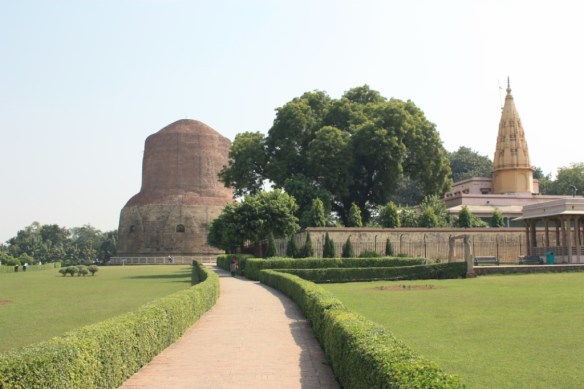
DAILY PHOTO: Buddha Temple, Sarnath

Taken in October of 2015 at Sarnath

DAILY PHOTO: Prayer Flags, Khardung-la

Taken in the Summer of 2016 at Khardung-la


DAILY PHOTO: Wat Traimit

Taken in September of 2015 in Bangkok

Taken in September of 2015 in Bangkok

5 Bits of Ancient Eastern Wisdom to Make Your Modern Western Life Happier

img_12811.) The Dispassionate Witness:  A person’s default setting is to repress emotions and pretend they don’t exist. On the one hand, this seems to work because others rarely notice one’s clenched jaw or downing of Prozac, and it’s true that fist-fights rarely break out in workplaces and classrooms. On the other hand, this approach leads to a lot of passive-aggressive behavior and stress-related illness. I just read in some material on Flow and business that 2/3rds of performance issues in businesses result from strained relationships.

The alternative is to take time to observe one’s emotional state, but to watch it without dumping fuel onto the fire. This process puts one’s feelings in perspective so that one can respond in a careful, but not repressed, manner. It doesn’t mean one won’t still be mad, sad, or scared, but one will be in a position to act in a manner that is neither petty and knee-jerk, nor one that consists of gobbling antacids. This brings us to #2.


2.) The Second Dart: [Siddhartha Gotama] Buddha talked about the mind’s response to an event as the second dart, suggesting that the second dart produces much more prolonged misery than the first. Imagine one is walking along and gets hit by a dart. Ow!  It hurts. But what makes it agonizing is when one’s mind becomes obsessed with the injury. It’s unfair that someone threw a dart at me. What if the wound doesn’t heal right? What if the wound heals up too well, and I don’t have a cool scar at story time?

This point is closely related to #1. One has to observe, but not let mind run wild. The first dart is real. The second dart is immaterial, a figment of the mind.


3.) Relaxation is Part of the Process: Anyone who’s attended a yoga class is familiar with closing in savasana (corpse pose.)  Occasionally, a student wants to get up and walk out at this point. They “aren’t paying __ $’s to lay around on their a##.” For Americans, rest is something begrudgingly accepted between actually doing stuff.

The problem with the “rest as laziness” approach isn’t just that one is likely to suffer a relaxation deficit, but also that the rest one gets isn’t effective. But how can rest be effective? I’m glad you asked. Because when you’re doing savasana or yoga nidra (yogic sleep) you’re not just letting your monkey mind run wild as it does when one is watching television or stuck in afternoon rush hour.


4.) Breath is Anything but Mundane: Since breathing is constantly going on and one can choose not to think about it, people dismiss it as unworthy of consideration. However, breath is the one point at which we can consciously influence our autonomic nervous system. [Well, there’s also blinking, but to my knowledge there’s no evidence that one can adjust one’s energy level or emotional state through blinking–but you can with breath.]  Breath is the key to improved physical performance, but it’s also a powerful tool to train the mind.


5.) Use the Belly: I haven’t studied a large number of martial arts, but I’ve trained in a diverse few that were extremely different in both approach and priorities. It could be said that these arts (budō, tai chi chuan, muaythai, and kalaripayattu) had nothing in common. Except they did. They all valued strength in a point below the navel. Sometimes it was called dan tien; other times tanden. However, regardless of the pronunciation, name, or the precise anatomical location, there was this commonality.

Strength in the belly is tied to both breath and mental concentration.

img_1786

BOOK REVIEW: Siddhartha’s Brain by James Kingsland

Siddhartha's Brain: Unlocking the Ancient Science of EnlightenmentSiddhartha’s Brain: Unlocking the Ancient Science of Enlightenment by James Kingsland
My rating: 5 of 5 stars

Amazon page


Kingsland builds his niche by connecting the dots between the teachings of the Buddha and scientific discoveries about meditation and mindfulness. There are many books that tell the life story of Siddhartha Gautama from various perspectives (e.g. famously the books by Hermann Hesse and Karen Armstrong.) There are also a number of books reporting the science of meditation (e.g. Herbert Benson and Sat Bir Singh Khalsa.) However, it’s not so common for the subjects to be overlapped.

There’s a reason that this middle path hasn’t been more widely studied. While Buddhism is arguably the most science-friendly of the major world religions, there’s always a gulf between spiritual and scientific thinking. The writer has to figure out how to chart a course through rocky waters. Books appealing to spiritual seekers are likely to come across as insubstantial fluff to the scientifically minded reader, and books appealing to skeptics are likely to feel materialistic and cold (and, perhaps, naive) to the spiritualist. The Buddha’s teachings about the need for the practice to be experiential, rather than faith-based, offers a unique opportunity to tread this tightrope. Furthermore, the Dalai Lama’s willingness to facilitate a dialogue between science and Buddhism has been crucial as well. One can easily set aside controversial issues like reincarnation and karmic law as they aren’t essential to the value of mindfulness.

The book consists of twelve chapters. The chapters generally begin with a story or teaching from the life of Buddha, and then go on to investigate the relevant lesson in more detail with particular emphasis on any relevant scientific discoveries that support said teachings.

The story of Buddha begins in a wealthy, high-caste household with young Siddhartha Gautama being kept from seeing the effects of aging, illness, and death. When the young Siddartha, nonetheless, sees these things, it is a powerful introduction to the concepts of impermanence and suffering that will play a central role in his future teachings. Chapter 1 starts this introduction and also offers an overview of the book. Chapter two continues it. In Chapter three, Kingsland describes a little of the known history of meditation, though its origins are lost to time.

Chapter 4 is entitled “The Second Dart” and it discusses the Buddha’s teaching of the same name—the second dart being one’s mental reaction to an event (i.e. the initial dart.) Chapter 5 investigates the question of whether there is a self—and, if so, of what manner. A core idea within Buddhism is that the self is illusory.

Chapter 6 gets to the heart of the matter by explaining the mechanism of mindfulness meditation and what has come to be known as MBCT (Mindfulness Based Cognitive Therapy)—a secular approach to the use of mindfulness to improve well-being. The next chapter tells the story of how a group of fire worshippers came to follow the Buddha after he made clear that everything (their senses, thoughts, and emotions) were aflame with craving, hatred, and delusion, and that springboards into a discussion of how mindfulness is used to reduce craving and addiction.

Chapter 8 tells the story of an attempt to kill the Buddha via an angry, drunk elephant, and the Buddha’s thwarting of the plot by way of calm and compassion. As one might have guessed, the chapter is about moderating emotions, just as the Buddha controlled his fear before the elephant.

Chapter 9 takes a jaunt into evolutionary biology to question how the mismatch between what humans evolved to do and what we do in the modern world causes mental illnesses and how mindfulness can help mitigate the problem. Chapter 10 is about metacognition, or the ability to observe and reflect upon our own mental experience—i.e. thinking about thoughts. Chapter 11 is about cognition and decision-making, and the role that meditation can play in improving our performance in this domain. The last chapter discusses the Buddhist conception of death and enlightenment. It isn’t until this point that there’s a major divergence between the Buddhist and scientific viewpoints. There is a discussion of the Buddha’s teachings emphasizing that belief in ideas from on high is not so important as experience.

Six of the chapters (2, 4, 6, 8, 10, & 11) are concluded with guided meditations to offer the reader an introduction into the basics of mindfulness. These are simple practices that many readers will already be familiar with in some variant or another. (e.g. breath awareness, bodily awareness, and mindful eating.)

There are only a few graphics (e.g. maps and diagrams—mostly of the brain) but there is no need for additional graphics. The book has references annotated.

I found this book interesting and thought-provoking. It uses the stories of Buddha as well as some stories from the present day to make the reading more engaging and approachable. The discussion of scientific research is easy for a neuroscience neophyte to follow.

I’d recommend this book for anyone interested in learning more about the science behind Buddhist practices.

View all my reviews