BOOK REVIEW: An Introduction to Indian Philosophy Chatterjee & Datta

An Introduction to Indian PhilosophyAn Introduction to Indian Philosophy by Satischandra Chatterjee
My rating: 4 of 5 stars

Amazon page


India has spawned a number of philosophical systems over the centuries. Chatterjee and Datta provide an overview of Indian philosophy by comparing and contrasting nine major schools of Indian philosophy—the six orthodox schools plus three well-known heterodox schools. The dividing line between orthodox and unorthodox hinges upon whether a philosophy accepts the Vedas as sources of authority.

After an introductory chapter that lays out the concepts that will be needed throughout the remainder of the book as well as providing brief sketches of nine philosophical schools, the remainder of the book is a one chapter per school examination of metaphysics, ethics, theology, epistemology, etc. The authors first consider the heterodox schools: i.e. Carvaka (a materialist /atheist approach), Jain (one of the major Indian religions), and Buddhist. After examining the heterodox approaches, Chatterjee and Datta take on the orthodox schools in the following order: Nyaya, Vaisesika, Sankhya, Yoga (which you may not have realized was a philosophical system), Mimamsa, and Vedanta.

There are a number of questions that recur as the authors compare these schools to each other. A major point of consideration is presence or absence of belief in a god, and—for those systems that believe in a God or gods—what is the role of said deity. It might seem that all the orthodox systems would be theistic, but this isn’t the case (e.g. Sankhya.) Another key question is how one can know something, i.e. what is acceptable authority—can one only trust one’s own senses or can one trust everything but one’s own senses? Then there is the matter of ethics and how each system regards ethical behavior. Of course, there are some elements that are unique to a given system, and so it’s not entirely a matter of comparison and contrast.

There are no graphics in the book and the ancillary material is limited to footnotes, a select bibliography, and prefaces to the various editions of the book. Note: I read the 2007 / 7th Edition of the book.

I won’t say this book isn’t dry. It’s a philosophy textbook, after all. However, it does provide a solid overview of the topic and seems to take great efforts to be unbiased (to the extent of sometimes not challenging philosophical ideas that are patently unsound in favor of reporting what advocates of the tradition propose.)

I’d recommend this book for anyone who’s looking for an overview of Indian philosophy.

View all my reviews

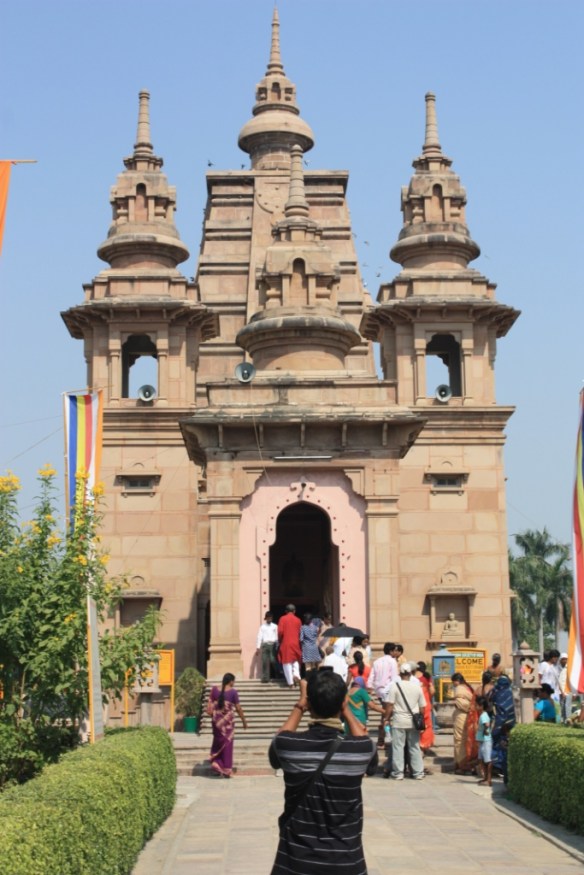
DAILY PHOTO: Buddha Temple, Sarnath

Taken in October of 2015 at Sarnath

DAILY PHOTO: Prayer Flags, Khardung-la

Taken in the Summer of 2016 at Khardung-la


DAILY PHOTO: Wat Traimit

Taken in September of 2015 in Bangkok

Taken in September of 2015 in Bangkok

5 Bits of Ancient Eastern Wisdom to Make Your Modern Western Life Happier

img_12811.) The Dispassionate Witness:  A person’s default setting is to repress emotions and pretend they don’t exist. On the one hand, this seems to work because others rarely notice one’s clenched jaw or downing of Prozac, and it’s true that fist-fights rarely break out in workplaces and classrooms. On the other hand, this approach leads to a lot of passive-aggressive behavior and stress-related illness. I just read in some material on Flow and business that 2/3rds of performance issues in businesses result from strained relationships.

The alternative is to take time to observe one’s emotional state, but to watch it without dumping fuel onto the fire. This process puts one’s feelings in perspective so that one can respond in a careful, but not repressed, manner. It doesn’t mean one won’t still be mad, sad, or scared, but one will be in a position to act in a manner that is neither petty and knee-jerk, nor one that consists of gobbling antacids. This brings us to #2.


2.) The Second Dart: [Siddhartha Gotama] Buddha talked about the mind’s response to an event as the second dart, suggesting that the second dart produces much more prolonged misery than the first. Imagine one is walking along and gets hit by a dart. Ow!  It hurts. But what makes it agonizing is when one’s mind becomes obsessed with the injury. It’s unfair that someone threw a dart at me. What if the wound doesn’t heal right? What if the wound heals up too well, and I don’t have a cool scar at story time?

This point is closely related to #1. One has to observe, but not let mind run wild. The first dart is real. The second dart is immaterial, a figment of the mind.


3.) Relaxation is Part of the Process: Anyone who’s attended a yoga class is familiar with closing in savasana (corpse pose.)  Occasionally, a student wants to get up and walk out at this point. They “aren’t paying __ $’s to lay around on their a##.” For Americans, rest is something begrudgingly accepted between actually doing stuff.

The problem with the “rest as laziness” approach isn’t just that one is likely to suffer a relaxation deficit, but also that the rest one gets isn’t effective. But how can rest be effective? I’m glad you asked. Because when you’re doing savasana or yoga nidra (yogic sleep) you’re not just letting your monkey mind run wild as it does when one is watching television or stuck in afternoon rush hour.


4.) Breath is Anything but Mundane: Since breathing is constantly going on and one can choose not to think about it, people dismiss it as unworthy of consideration. However, breath is the one point at which we can consciously influence our autonomic nervous system. [Well, there’s also blinking, but to my knowledge there’s no evidence that one can adjust one’s energy level or emotional state through blinking–but you can with breath.]  Breath is the key to improved physical performance, but it’s also a powerful tool to train the mind.


5.) Use the Belly: I haven’t studied a large number of martial arts, but I’ve trained in a diverse few that were extremely different in both approach and priorities. It could be said that these arts (budō, tai chi chuan, muaythai, and kalaripayattu) had nothing in common. Except they did. They all valued strength in a point below the navel. Sometimes it was called dan tien; other times tanden. However, regardless of the pronunciation, name, or the precise anatomical location, there was this commonality.

Strength in the belly is tied to both breath and mental concentration.

img_1786

BOOK REVIEW: Siddhartha’s Brain by James Kingsland

Siddhartha's Brain: Unlocking the Ancient Science of EnlightenmentSiddhartha’s Brain: Unlocking the Ancient Science of Enlightenment by James Kingsland
My rating: 5 of 5 stars

Amazon page


Kingsland builds his niche by connecting the dots between the teachings of the Buddha and scientific discoveries about meditation and mindfulness. There are many books that tell the life story of Siddhartha Gautama from various perspectives (e.g. famously the books by Hermann Hesse and Karen Armstrong.) There are also a number of books reporting the science of meditation (e.g. Herbert Benson and Sat Bir Singh Khalsa.) However, it’s not so common for the subjects to be overlapped.

There’s a reason that this middle path hasn’t been more widely studied. While Buddhism is arguably the most science-friendly of the major world religions, there’s always a gulf between spiritual and scientific thinking. The writer has to figure out how to chart a course through rocky waters. Books appealing to spiritual seekers are likely to come across as insubstantial fluff to the scientifically minded reader, and books appealing to skeptics are likely to feel materialistic and cold (and, perhaps, naive) to the spiritualist. The Buddha’s teachings about the need for the practice to be experiential, rather than faith-based, offers a unique opportunity to tread this tightrope. Furthermore, the Dalai Lama’s willingness to facilitate a dialogue between science and Buddhism has been crucial as well. One can easily set aside controversial issues like reincarnation and karmic law as they aren’t essential to the value of mindfulness.

The book consists of twelve chapters. The chapters generally begin with a story or teaching from the life of Buddha, and then go on to investigate the relevant lesson in more detail with particular emphasis on any relevant scientific discoveries that support said teachings.

The story of Buddha begins in a wealthy, high-caste household with young Siddhartha Gautama being kept from seeing the effects of aging, illness, and death. When the young Siddartha, nonetheless, sees these things, it is a powerful introduction to the concepts of impermanence and suffering that will play a central role in his future teachings. Chapter 1 starts this introduction and also offers an overview of the book. Chapter two continues it. In Chapter three, Kingsland describes a little of the known history of meditation, though its origins are lost to time.

Chapter 4 is entitled “The Second Dart” and it discusses the Buddha’s teaching of the same name—the second dart being one’s mental reaction to an event (i.e. the initial dart.) Chapter 5 investigates the question of whether there is a self—and, if so, of what manner. A core idea within Buddhism is that the self is illusory.

Chapter 6 gets to the heart of the matter by explaining the mechanism of mindfulness meditation and what has come to be known as MBCT (Mindfulness Based Cognitive Therapy)—a secular approach to the use of mindfulness to improve well-being. The next chapter tells the story of how a group of fire worshippers came to follow the Buddha after he made clear that everything (their senses, thoughts, and emotions) were aflame with craving, hatred, and delusion, and that springboards into a discussion of how mindfulness is used to reduce craving and addiction.

Chapter 8 tells the story of an attempt to kill the Buddha via an angry, drunk elephant, and the Buddha’s thwarting of the plot by way of calm and compassion. As one might have guessed, the chapter is about moderating emotions, just as the Buddha controlled his fear before the elephant.

Chapter 9 takes a jaunt into evolutionary biology to question how the mismatch between what humans evolved to do and what we do in the modern world causes mental illnesses and how mindfulness can help mitigate the problem. Chapter 10 is about metacognition, or the ability to observe and reflect upon our own mental experience—i.e. thinking about thoughts. Chapter 11 is about cognition and decision-making, and the role that meditation can play in improving our performance in this domain. The last chapter discusses the Buddhist conception of death and enlightenment. It isn’t until this point that there’s a major divergence between the Buddhist and scientific viewpoints. There is a discussion of the Buddha’s teachings emphasizing that belief in ideas from on high is not so important as experience.

Six of the chapters (2, 4, 6, 8, 10, & 11) are concluded with guided meditations to offer the reader an introduction into the basics of mindfulness. These are simple practices that many readers will already be familiar with in some variant or another. (e.g. breath awareness, bodily awareness, and mindful eating.)

There are only a few graphics (e.g. maps and diagrams—mostly of the brain) but there is no need for additional graphics. The book has references annotated.

I found this book interesting and thought-provoking. It uses the stories of Buddha as well as some stories from the present day to make the reading more engaging and approachable. The discussion of scientific research is easy for a neuroscience neophyte to follow.

I’d recommend this book for anyone interested in learning more about the science behind Buddhist practices.

View all my reviews

BOOK REVIEW: The Discourse Summaries by S.N. Goenka

Discourse SummariesDiscourse Summaries by S.N. Goenka
My rating: 4 of 5 stars

Amazon page


I began reading the summaries before I attended the Vipassana meditation 10-day course. While most of one’s days are spent in meditation, each evening they play video-taped discourses by S.N. Goenka, with each running for an hour to an hour-and-a-half. As the title suggests, this book consists of edited transcripts of those talks. As the course is known for being challenging (approximately 10 hours/day in meditation, noble silence [no talking–or even acknowledging–anyone but the teacher and staff], and no distractions [no phones, no books, no journals, no i-Pods, etc.]), reading the discourses was a way to mentally prepare for the course. (Though I’d already read a book call “Equanimous Mind” by an individual who’d completed the course.)

Let me provide background for those unfamiliar with Vipassana meditation. It’s nominally a Theravadan Buddhist practice, but its religiosity is stripped to a minimum and it’s presented in a largely secular manner. That doesn’t mean that a scientifically-minded skeptic such as myself isn’t occasionally left scratching his head and thinking “that’s not right.” However, it’s repeatedly emphasized that one should take what is of value to oneself and leave the rest behind, and so while there are a few notions mentioned during the discourses that aren’t supported by evidence, one needn’t believe anything controversial to benefit from the practice. (e.g. Karma and reincarnation are mentioned, but if one doesn’t believe those are likely realities, it doesn’t change the effectiveness of the meditation.)

Moving on, Theravadan Buddhism is the branch that is most commonly practiced in Southeast Asia. (It’s sometimes called Hinayana, but—as I learned during a discourse—that’s considered a derogatory term by many Theravadans. “Hinayana” means “lesser vehicle” in contrast to Mahayana’s “greater vehicle,” and the implication is that it’s a path by which only a more select group can achieve enlightenment. One can readily see why this would be objectionable to Vipassana practitioners as they emphasize that the practice is available to everybody [one need not even identify as Buddhist] and that the practice is the heart of the path to enlightenment.) Vipassana meditation involves systematically scanning one’s body for sensations and acknowledging them without attaching positive or negative thoughts and labels to them. The idea is to train oneself to not mindlessly react to sensations, nor to mindlessly attach values to them.

There are eleven discourses, corresponding to the days over which one is at meditation center. However, the new information is mostly in the discourses from days one through nine. The last two discourses consist of a review and a discussion of to how to keep one’s practice going—should one choose to do so.

The discourses present two types of information. On one hand, they provide a primer on Buddhist philosophy regarding the path to enlightenment. For example, Goenka explains the Four Noble Truths and the Eight-fold Path. The Four Noble Truths describe human suffering, its causes, and the path to moving beyond this suffering. That path brings one to the Eight-fold Path which describes eight areas in which one must properly align one’s approach in order to eliminate said suffering.

On the other hand, the discourses provide information about the meditational practices and the logic that informs them. During the first few days of the course, one focuses on respiration and related sensations over a progressively smaller area around and on the nose. Then, on the fourth day, one gets into the Vipassana practice as mentioned above (scanning the body for sensation), but one practices several variations of this over the last few days of the course. It seems that one practices these different ways both because one becomes capable of more challenging approaches and because not everybody experiences the same types of sensations, and so some methods work better for some types of sensations than others. To give an example, on day one might scan one arm at a time, but then one shifts to scanning both arms simultaneously.

There are no graphics and the only ancillary matter consists of a list of Pali quotations as well as a Pali term glossary. (Pali is the language in which the Buddhist scriptures were originally written.) However, there was really no need for either graphics or notations.

I found these summaries were worth reading even having gone through the course and heard the discourses at the center. For one thing, there’s a good amount of information packed into the lectures. While it’s not hard to understand, there’s a high density of information content. For another, Goenka was a charming and humorous individual, so it’s not boring to watch the taped discourses even if one has previously read them.

I would definitely recommend reading the Discourse Summaries if one is considering taking the Vipassana course.

View all my reviews

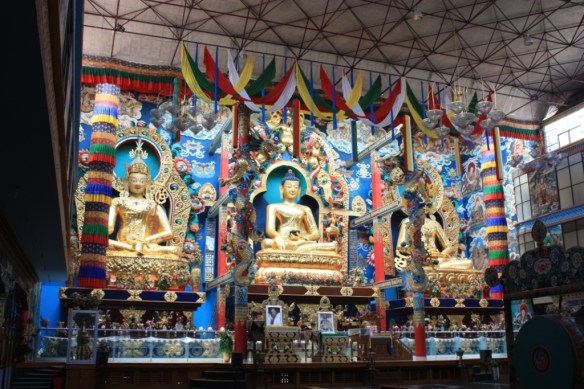
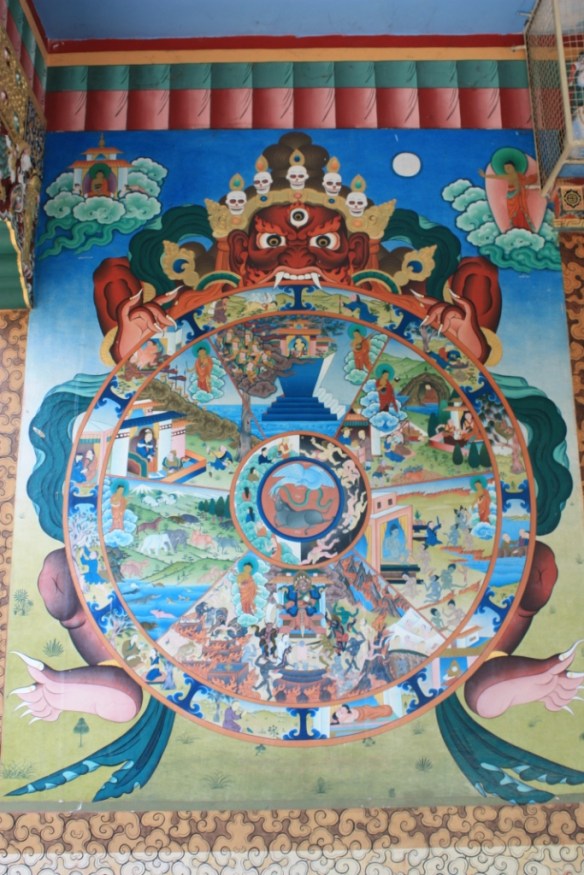
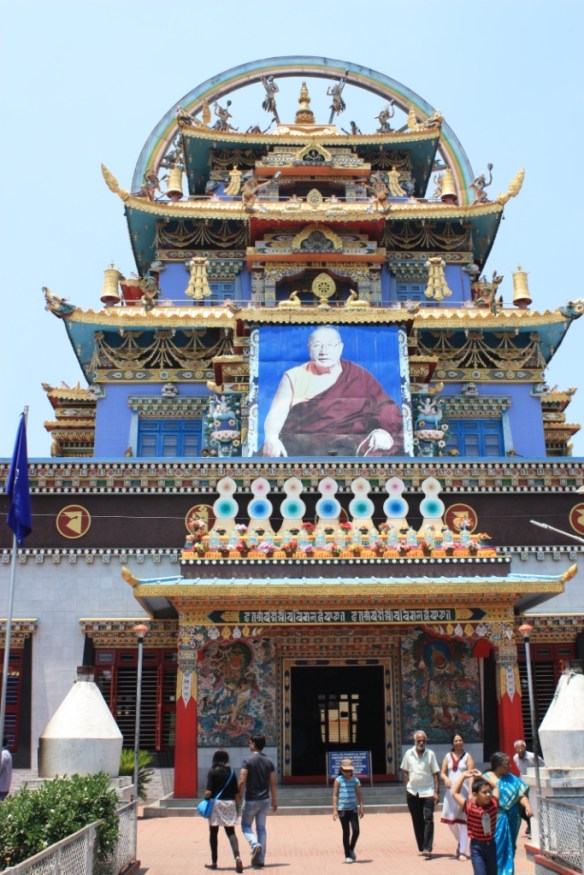
DAILY PHOTO: Namdroling Monastery Inside & Out

Taken in March of 2014 at Namdroling Monastery in Bylakuppe

Taken in March of 2014 at Namdroling Monastery in Bylakuppe

img_1576


img_1598

DAILY PHOTO: Thian Hock Keng

Confucius; Taken on October 29, 2016 in Singapore

Confucius; Taken on October 29, 2016 in Singapore

img_3549img_3548

This Chinese temple sits in the heart of Singapore’s Chinatown. It’s said to be the oldest Hokkien or Hoklo temple (i.e. Han Chinese) in Singapore. It’s a temple related to Han Chinese culture generally, rather than to a particular sect or religion. While the main deity is Mazu (a.k.a. Ma Cho Po,) a maritime goddess from Chinese folklore that is sometimes associated with Taoism, there is also a Confucian shrine as well as homages to several Buddhist Bodhisattvas (a Bodhisattva is one who has achieved enlightenment but sticks around to help others out of compassion.)

DAILY PHOTO: Fudō-Myōō

Taken on October 30, 2016 at the Buddha Tooth Relic Temple in Singapore

Taken on October 30, 2016 at the Buddha Tooth Relic Temple in Singapore


Fudō-Myōō is the name used by Japanese Vajrayana Buddhists for the wrathful deity otherwise known as Acala [the Wisdom King.]