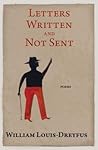
BOOK REVIEW: Letters Written and Not Sent by William Louis-Dreyfus

Letters Written and Not SentLetters Written and Not Sent by William Louis-Dreyfus
My rating: 5 of 5 stars

Amazon page


This collection consists of about 55 poems, mostly of the short-form free verse variety. The author passed away between completion and publication of the volume. He was that rarest of creatures, a rich poet. (Though he was not an impossible creature – i.e. he didn’t become a billionaire by writing poetry. It was his side gig between trading in commodities.)

One of the poems toward the end of the book, “How to keep from being devoured,” changed my attitude toward the book. Up until that poem, I found the collection to be just okay. It was alright, but didn’t feel like anything special. However, that one poem made its mark on me, and I suspect other readers will find their own favorites among the collection. The poems are finely crafted. The fact that this one short volume is billed as the man’s “lifetime work” suggests that he focused on quality rather than quantity of verse.

I found a gem among a body well-composed poetic works, and I’m pleased I took the time to read this collection.

View all my reviews

BOOK REVIEW: Measure for Measure by William Shakespeare

Measure for MeasureMeasure for Measure by William Shakespeare
My rating: 5 of 5 stars

Amazon page


“Measure for Measure” was originally grouped as one of Shakespeare’s comedies (back when there were just three categories: tragedy, comedy, and history,) but more recently it’s been reclassified as one of the three “problem plays” of Shakespeare. Problem plays are neither clearly comedy nor clearly tragedy, but mix elements of both.

Vincentio, the Duke of Vienna, is taking a mysterious trip, and he’s left his deputy, Angelo, in charge. Angelo is a stickler for the law (or, at least, appears to be at first) and one of his first official acts is to sign a death sentence on Claudio. Claudio is a young man who knocked up his girlfriend. While the law calls for death, everyone advises Angelo that the details of the case don’t merit such a sentence. Those details being that the young woman, Juliet, is in love with Claudio, consensually partook of sexual intercourse, and both she and he are eager to marry so that the child will not be born out of wedlock. Angelo is unmoved by petitions from just about everyone to let Claudio live as long as he weds Juliet. When Claudio’s sister, Isabella, who heard the news in the convent where she is a postulant [in training to be a nun, but not yet one,] comes before Angelo seeking leniency for her brother, Angelo’s tune slowly changes, and he betrays himself as the worst form of hypocrite. If Juliet will “consent” [used loosely] to Angelo taking her virginity, he’ll let Claudio go. Obviously, Juliet isn’t at all keen on this arrangement, being a nun wanna-be and having the strict moral values one might expect of one who’s chosen such a life. She goes off preparing to tell her brother that he must die because the only way out is for her to sex up Angelo. Isabella fully expects Claudio will accept this, but Claudio has a moment of weakness in which he shares his terror of death and requests Juliet do the deed with Angelo. However, she won’t do it.

At this point, things look grim for Claudio, but we find out that the Duke is pulling a Henry V, and (far from visiting foreign lands to unknown purpose) is making his way in disguise through Vienna, learning what happens in his absence. The Duke [pretending to be a friar] has various meetings with Isabella, Claudio, the Provost (a warden), and others. The Duke-turned-friar hatches a plot that hinges on a piece of inside information that he holds.

It turns out that the sight of lovely Isabella wasn’t the first cause of Angelo being a jerk, there was a previous incident. Angelo was once betrothed to a woman, but before they could wed the woman’s fortunes changed when a storm sank the boat carrying wealth that included her dowry. Lacking a dowry, Angelo kicked the woman to the curb where she ended up turning tricks in a Viennese brothel because for fortune had sunk — literally.

The Duke / friar’s plan is that Isabella go to Angelo and say that she agrees to his despicable propositions, and that she will do the vile deed on the condition that it be someplace pitch dark so that her lady bits can remain unseen and so she won’t throw up in the lousy face of her rapist. She also insists she be able to bring a servant to the place in question. The plan revolves around getting the wronged ex-fiancé turned prostitute to agree to pull a switch-a-roo, with her engaging in intercourse in the dark with Angelo instead of the virgin Isabella doing so. Angelo having committed the same offense as the man he signed a death warrant for will have to either change his order regarding Claudio or submit himself to the same punishment.

One can see why this play is not easily classified. It contains a lot of dark subject matter. However, it does have numerous lighthearted moments of humor, including Lucio badmouthing the Duke (to the Duke’s friar-disguised face) and the servant of a local brothel’s Madame, Pompey, becoming an assistant to the executioner. As in comedies, everything works out more or less happily for all parties.

I was gripped by this play. It’s among my favorites of the Shakespearean comedies. It has an intense storyline and some fascinating moral conundrums. The Duke works his plot such that more than one character must confront a moral dilemma and choose whether to be a better version of him-, or herself. This is definitely worth reading.

View all my reviews

BOOK REVIEW: Dhammapada trans. by Venerable Acharya Buddharakkhita

Dhammapada: a practical guide to right livingDhammapada: a practical guide to right living by Acharya Buddharakkhita
My rating: 4 of 5 stars

Amazon page


The Dhammapada consists of 423 sayings attributed to the Buddha. There seem to be numerous versions of the Dhammapada as translated by Venerable Acharya Buddharakkhita in circulation, so your results may vary for good or bad from what I report here. (Not to mention there are many other translations which may vary tremendously)

The 423 sutras or maxims included in the book are arranged into twenty-six topical chapters. The version I have presents no analysis, it’s just the text of the verse in Pali (i.e. the Roman / English language alphabet spelling out the phonetic Pali words) with an English translation below.

First, the pros of the edition I read: There are some explanatory notes offered as necessary (38 of them,) there are a few graphics (drawings and photos in B&W,) and there are two indexes. The first of the two indexes wouldn’t be of much use to me, but it would be for the Pali literate because it indexes the Pali verse. The second index is in English and is organized by analogies (i.e. analogies employed in the verses,) and that could be a tremendously useful feature. For the Pali literate, having the original phonetic Pali included must be an excellent feature. (There’s also a page in the front matter that shows how the pronunciation works.)

As for the cons of this edition: First, there were a few typos (mostly of the type that wouldn’t be caught by spellcheck – though this translation was pre-spellcheck — so I’m referring to the kind of typos that aren’t easily caught.) Second, while all the verses are translated, there is some text that remains in Romanized Pali [I suspect prayers, but can’t say for sure.]

This is the second translation of the Dhammapada I’ve read, and I found it worthwhile. It’s easily readable, not too flowery, and not bogged down with needless analysis or exposition. I can’t say how it compares among all translations (either in terms of skill of translation or in accurately capturing the Buddha’s meaning,) but it reads pretty fluidly.

View all my reviews

BOOK REVIEW: Three Tang Dynasty Poets by Wang Wei, Li Po, and Tu Fu

Three Tang Dynasty PoetsThree Tang Dynasty Poets by Wang Wei
My rating: 5 of 5 stars

Amazon page


This book is in a series put out by Penguin Books entitled “Little Black Classics.” As the series name implies, these are booklets featuring classic works (or fragments, thereof.) This book features a combined 33 poems by three Chinese poets who lived in the eight century.

In the 14 poems by Wang Wei (a.k.a. Wang Youcheng) we see his famed mastery of landscape and nature poems, and we feel the effect of his Cha’an (Zen) Buddhist mindset.

Among the ten poems by Li Po (a.k.a. Li Bai) we are introduced from the beginning to the poet’s legendary proclivity for drink. While it’s not all carousing, human characters do play a more central role in Li Po’s work.
There are nine poems by Tu Fu (or, Du Fu), which share Li Po’s inclination to feature humanity at the heart of each poem, if in a more straight-laced way.

I enjoyed the poems in both their imagery and sound quality. I can’t really speak to how skilled the translation was, i.e. how much better or worse they could have been. The translators were G.W. Robinson and Arthur Cooper, who I know nothing of, but who apparently both translated a considerable amount of classic Chinese literature.

The poems are almost all short form works, so – with one exception – the poems are included in their entirety (i.e. not excerpted.)

The booklet has an appendix that features a two-page prose story entitled “The Story of the Peach Blossom Spring” by Tao Yuanming. The reason for including the story is that it’s the inspiration for the Wang Wei poem that opens the volume.

I enjoyed reading this little booklet of poetry. The translations are easy to follow, and the imagery is appealing. The Zen / Taoist feel that is widespread in these works is pleasant.

View all my reviews

BOOK REVIEW: Acid Dreams by Martin A. Lee & Bruce Shlain

Acid Dreams: The CIA, LSD and the Sixties RebellionAcid Dreams: The CIA, LSD and the Sixties Rebellion by Martin A. Lee
My rating: 5 of 5 stars

Amazon page


This is a microhistory of America’s interaction with LSD. LSD, commonly called “acid” from its full name Lysergic acid diethylamide, is a chemical substance that was originally derived from ergot fungus, and which causes distortion of perception, an altered state of consciousness, and – in some cases – hallucinations. When I say it’s American history, that’s an oversimplification because many of the events described happen overseas (e.g. LSD’s own story begins in Switzerland with chemist, Albert Hofmann, after all,) but most of the central players are American and the book’s two primary lines of investigation are both centered on America. One of these lines involves the covert research program designed to discover if acid could be used as a truth serum, a mind-control agent, an incapacitant, or otherwise to the benefit of the Central Intelligence Agency (CIA) and other covert agencies. The other line is about the role that LSD played in the countercultural revolution of the 60’s and early 70’s.

The book’s flow begins more heavily focused on the covert programs, then gets into what was happening with the youth in the 60’s, and toward the end discusses where the proceeding lines seem to run together with individuals like Ronald Stark who was a drug smuggler involved with an organization called the “Brotherhood for Eternal Love” but who many suspected of having ties with (if not direct employment by) the CIA – and not entirely without reason (though not with sufficient evidence that firm conclusions are drawn in the book.) I should mention that this just the general flow. The book has a chronological flow with topical segments within, so it’s not like it deals with these issues entirely independently.

If the covert research program had been carried out by competent scientists using accepted methodologies, then the discussion of these programs would probably be at best moderately interesting. (To be fair, some competent science may have occurred, but it’s so unnoteworthy compared to the wild and pranksterish that it draws no attention.) What the reader learns, however, is fascinating because it involves clean-cut and seemingly respectable g-men spiking unwitting subjects with acid like a teenage prankster-idiot might do – but without the “excuse” of being immature, stoned, and having not yet learned to behave responsibly. Perhaps the most bizarre program was Operation Midnight Climax, in which CIA agents hired prostitutes in San Francisco to spike the drinks of their johns so they could find out if the customers got loose-lipped. A CIA agent would watch on, dutifully making pipe-cleaner twists of the various sexual positions performed by the sex-worker and her customer.

The civilian history follows a path from Hofmann’s discovery at Sandoz Laboratories (now owned by Novartis) through the early years of Al Hubbard (the so-called “Johnny Appleseed of LSD”) through the trials of Timothy Leary to others who figured in the heyday of LSD such as Ken Kesey and his Merry Pranksters, and, finally, to the crackdown on psychedelics and the illicit smuggling rings that resulted. There is fascinating coverage of how Federal law enforcement tried to stifle production and smuggling of LSD, particularly with respect to training agents to infiltrate hippie organizations.

This book originally came out in the 80’s (though I read the 2007 edition) and while it has a post-script that discuss a bit of a resurgence that occurred beyond the 70’s, it doesn’t touch upon a more recent thaw in attitudes toward psychedelics as they’ve begun to be legalized (or sought out where they are legal) or the surge in popularity of “micro-dosing.” As of this book’s end all psychedelics remained Schedule I – a label which states that they have no legitimate medicinal value (which cooler heads have realized is blatantly wrong given substantial evidence that psychedelics can be of benefit in conquering addiction, in managing depression, and otherwise.)

I found this book intriguing. It’s a must-read if you are interested in any of the following topics: the 60’s counter-culture revolution, mind-control programs, or how public policy gets hijacked by history.

View all my reviews

BOOK REVIEW: Catching the Big Fish by David Lynch

Catching the Big Fish: Meditation, Consciousness, and CreativityCatching the Big Fish: Meditation, Consciousness, and Creativity by David Lynch
My rating: 4 of 5 stars

Amazon page

This book consists of a series of topical micro-essays – the shortest being a simple sentence and the longest being a few pages, with the average being about a page. Lynch is most well-known as the director who created such works as “Eraserhead,” “Mulholland Drive,” “Blue Velvet,” and “Twin Peaks.” As the subtitle suggests, the overarching theme of the book is the nexus of meditation and creativity. While many of the essays explicitly touch on how meditation influences consciousness, which in turn influences the creative process, not all of them do. Some of them are more biographical or about the filmmaking process – including discussion of technical considerations (what is the optimal type of camera and how high definition can be too much definition for its own good) and what a neophyte such as myself might call the managerial considerations of movie direction (how to best get one’s vision across through the actors.) Along the way, one glimpses how Lynch shifted from his first artistic love, painting, into the world of cinema.

Lynch is a long-time practitioner of Transcendental Meditation (TM,) which is a mantra-based meditation in which the meditator silently repeats a mantra given to him or her by a teacher. The central analogy posed by Lynch is that meditation expands the consciousness and this allows one to catch bigger fish (more profound and creative ideas) through one’s art. He’s not suggesting that the ideas come directly within the process of meditation, but rather that meditation facilitates one’s ability to deepen the pool and pull up bigger creative fish.

He does engage in a fallacious form of thinking that I’ve critiqued in other books, and so I figure I should mention it here as well – even though I found it a little less troubling because of his free flowing “artsy” approach to presenting ideas. But this fallacious bit of reasoning goes something like this: “See how science is talking about this confusing issue and admitting that no one fully understands it yet? And see here how these scriptures are describing this nebulous idea with a few kernels that sound vaguely similar to what the scientists are talking about? From this we can conclude that they are – in fact — talking about the same thing, and that the ancients actually understood this all in much greater detail than we do today.” He does this mostly with reference to the unified field theory (which still hasn’t unified gravity into its ranks, let alone establishing some kind of oneness of all things.) It’s what dear old Dr. Sherrill used to call the “firstest-is-bestest” fallacy, which is thinking that back in the day they knew everything any we are presently just stumbling around in the dark trying to get back on track. [One should note, there is an equally fallacious counterpart that he called the “outhouse fallacy,” which assumes that because people in the past didn’t have indoor plumbing that they were complete idiots.]

For cinephiles, the book provides a lot of interesting tidbits about Lynch’s filmography. [For non-cinephiles such as myself, some of this will make sense, and some of it won’t. I occasionally had to make a Google run while reading the book to figure out some obscure reference about one of his movies.] For those interested in meditation, there is a great deal of fascinating thought about how creativity happens and how it’s advanced by having a meditative practice.

The most notable ancillary matter is an appendix of interviews with Paul McCartney and Ringo Starr. Lynch has a foundation that works to bring meditation into the educational process and the two former-Beatles support its efforts enough to do an interview. The McCartney interview stays more on the topic of meditation — particularly the Beatles’ interaction with Maharishi Mahesh Yogi, the creator of TM and a guru who taught the band both during a visit to the United Kingdom and in his own home base of Rishikesh. The Ringo Starr interview is actually much more about the musical history of Starr and the band.

I enjoyed this book. It’s a quick read. It’s a little all-over-the-place, but not in a bad way. A lot of the writing has a stream of thought feel that seems appropriate to the subject matter. If you’re interested in the films of David Lynch the book definitely has some inside insight for you. If you are interested in the meditation and the mind, you’ll also receive some good food for thought. If you are just looking for a way to spur creativity, it’s also worth a read.

View all my reviews

BOOK REVIEW: The Hidden Girl and Other Stories by Ken Liu

The Hidden Girl and Other StoriesThe Hidden Girl and Other Stories by Ken Liu
My rating: 5 of 5 stars

Amazon page

Out: February 25, 2020


This smart collection of speculative short stories by Ken Liu is mostly science fiction, but includes a few works of fantasy (including the titular story, which is what one might call “martial arts-fantasy” – i.e. imagine “Crouching Tiger, Hidden Dragon” with more magic.) Depending how one counts up the stories, one could call the collection nineteen stories or sixteen stories and a novella. The novella, broken into three parts, is “storified” enough that its sections are interspersed among the other stories.

Liu doesn’t neatly contain his stories within boundaries of genre. In some cases, he jumps through time — including historical fiction, contemporary / near future, and distant future within a single story. He also takes on social issues like the Japanese internment during World War II in “Maxwell’s Demon” and the blight of technology on social interaction (best shown in “Thoughts and Prayers.”) There are hard sci-fi stories that show intergalactic travelers in a distant future, such as “The Message,” but there are even more that peer into the worries of the near future, such as artificial intelligence or the replicating of human consciousness in computers.

The novella imagines a world in which companies have captured the consciousnesses of great, but dying, minds for their own purposes. It then explores considerations such as: what happens when a great mind gets tired of being trapped as an acorporeal intelligence for the benefit of a company, and what does humanity mean in the context of fully replicated human minds?

I found these stories to be both intriguing and thought-provoking. I enjoy a good story, but stories that make one think deeply hold that much more allure. I’d highly recommend this collection for fiction readers. Whether or not you read genre fiction, you’ll find stories of great appeal.

View all my reviews

BOOK REVIEW: Pain: Considering Complementary Approaches by NCCIH

Pain: Considering Complementary ApproachesPain: Considering Complementary Approaches by National Center for Complementary and Alternative Medicine
My rating: 4 of 5 stars

Online here


The National Center for Complementary and Integrative Health (NCCIH) has put out a new edition (dated 2019) of its pamphlet (about 50 pages) about how useful various complementary practices are in helping patients reduce, or cope with, pain. The NCCIH is a center in the National Institutes of Health (NIH) that serves as a clearinghouse for information about how alternative and complementary practices perform in treatment of various ailments. While alternative (instead of mainstream medicine) and complementary (in conjunction with mainstream medicine) are quite different, in almost all cases this work herein is reporting on the latter basis. The complementary practices in question include: yoga, taiji, meditation and mindfulness, massage, acupuncture, chiropractic manipulation, relaxation methods, and others.

Complementary approaches to treatment of pain is a particularly salient topic these days as the mainstream medical approach (giving patients pills to gobble down) has resulted in what many have called a “crisis” of opiate addiction. So, if it’s possible to reduce the grip of pain with practices that at best have numerous other health benefits and at worst do no harm, than that’s a pretty good outcome.

Chapters three through eleven form the pamphlet’s core, and all but the last of those look at one complementary practice each, including (in order): acupuncture, massage, meditation, relaxation techniques, spinal manipulation, taiji (a.k.a. tai chi, or tai chi chuan), yoga, and dietary supplements and herbs. Chapter 11 discusses a few additional (less popular) practices. These chapters follow a three-prong approach: 1.) is it safe? 2.) does it help mitigate pain? and 3.) where can I find more information? [Spoiler alert: In almost all cases the answer to #1 is roughly “Yes, for most people, but possibly not for you. Check with your doctor,” and to #2 is usually something like: “there is some preliminary evidence that in certain cases certain people may have benefited.”] The chapters before (ch. 1 & 2) and after (ch. 12 to 14) provide background context and additional information.

On the positive side, it’s great that this information has been gathered together and packaged into a readable format with pictures and easy to read text.

On the down side, this was clearly a document put together by a committee of bureaucrats in consultation with lawyers. It is so laden with qualifiers and spongy speak that it’s impossible to discern how strong the evidence is for the various practices or how one compares to another. I felt that they could have given the same information in a three-column table in which the first column is the practice, the second column is “can’t hurt to try*” [*provided your physician concurs,] and the third column would be “nah, this stuff is fake.” [Spoiler alert: almost everything besides homeopathy would have the first column checked, but the consensus seems to be that homeopathy is pseudo-scientific quackery designed to sell water at medicinal prices.]

This booklet is available on the web for free, so if you’re interested, check it out. But don’t expect to come away with any profound insights. It’s not that kind of booklet.

View all my reviews

BOOK REVIEW: 100% by Paul Pope

100%100% by Paul Pope
My rating: 4 of 5 stars

Amazon page


Despite the gritty, futuristic-noir setting of this graphic novel, it’s essentially the intertwining of three love stories. The story opens on the corpse of a dancer found in an alleyway. I thought this was going to be part of the story’s inciting incident or foreshadow it, but — in reality — it just served to establish that we’re on the wrong side of the tracks. The same might be said of a scene involving the purchasing of a gun. [I’ll let the reader figure out whether it was a “Chekov’s gun.” i.e. Chekov famously said, “If you say in the first chapter that there is a rifle hanging on the wall, in the second or third chapter it absolutely must go off.”] The fact that the story set in and around a strip club is apparently insufficient to convey how seedy this neighborhood is.

The love stories are between a dancer and a dishwasher, the club manager and a fighter, and the manager’s best friend and a sound artist. These love stories are nicely woven together, even if they are clichéd. The relationship with the prize fighter is probably the stalest. However, fear of commitment and standing up for one’s art are the well-worn heart of the other two stories. As I think about it, it’s not that those clichéd themes form the heart of the story (one will see the same themes replayed out in great works, past, present, and future,) but instead I think it’s the way we are pummeled over the head with them. It’s much like aforementioned set up of the seediness of the setting. By being so blatant, one can’t help but feel it’s a bit hackneyed.

That said, it’s a fine story, that might have benefited from a little bit of subtlety.

The artwork was well-done as far as I’m able to tell. I have no particular expertise in art, so my only criteria is whether I could follow what was happening, and I could.

The “100%” that is presumably meant to apply to the lengths the characters go to for what / who they love, unfortunately is exceeded in telling the story in a way that draws attention to itself too much for its own good. That said, if you’re looking for sweet stories of love in a seedy setting, this book has got you covered.

View all my reviews

BOOK REVIEW: Hogg by Samuel R. Delany

HoggHogg by Samuel R. Delany
My rating: 4 of 5 stars

Amazon page


If you’re familiar with Samuel R. Delany, it’s probably as a writer of science-fiction. His most famous works are “Dhalgren” and “Babel-17.” However, this book isn’t science-fiction, and I’m not sure that there is a consensus term for the particular genre that would categorize it. Astute readers will point out that it’s described as “erotica” right on the cover. But, in as much as erotica is a genre whose dominant intention is to evoke feelings of arousal, I’m not sure the majority of people would classify it that way (though I have no doubt there is a fetish community that would.) This isn’t to say that the book isn’t loaded with sexual activity. It is, across virtually every page, but the way those acts are presented — I suspect — will be found more cringe-inducing than arousing to the average reader. I’m specifically talking about the extreme unhygienic behavior that takes place throughout this book – much of which is tied up in sexual activity, but not all of it. Let it be known that I’m not commenting on the nature of the sexual activity, which is pansexual. I’m not even talking about the moral disgust of the fact that most of the scenes in which a woman is present involve rape of a particularly vicious nature, and that child molestation takes place throughout. By the same token, horror isn’t a good classifier either, though the book does have many horrifying scenes, and might best be categorized by a type of horror subgenre. If horror is a genre designed to evoke fear, “Hogg” is a book designed to evoke disgust – and it does so with great success. So, the first thing a reader should be aware of before taking on this book is that you may throw up in your mouth at one or more points during the reading of it.

So strong is aversion to disgust that probably most readers will have given up on this review by now and given up any intention of reading the book. Those who are still here, however, may want to know whether the book has redeeming qualities. The answer is: Yes. It has a smart story, psychological intrigue, and skillful use of language (even if much of that skill is directed at making one physically queasy.) While “Hogg” is often painful to read, it is adroit storytelling.

The book tells the story of the unnamed narrator, a boy who is known throughout only by a slang term for “giver of fellatio.” The narrator spends much of the book in service to the titular character, Hogg. Hogg is about as loathsome a character as one can imagine, and he needs the extra “g” because to call him a hog wouldn’t be an insult to swine. He exercises little control over where he urinates and defecates, and prides himself in unhygienic behavior. His job is contract work, but instead of murder he rapes and beats women who’ve run afoul of despicable and cowardly men. The lead character seems to be motivated by a need to please and / or capture the attention of an individual who has no capacity for human connection. The psychotic Hogg seems perfect target for such “affections,” and that’s why after bouncing from master to master, the narrator ends up with Hogg for such a time.

One of the most psychologically interesting elements of the book is its depiction of the bizarro morality of individuals who have an anarchic mindset. At one point, Hogg decides that he can’t tolerate a customer who insists on explaining his reason for hiring Hogg and his crew. In Hogg’s mind, the fact that the man can come up with a reason for the horrific act, other than the pure bliss of it, indicates that the man is crazy and will ultimately feel guilty and be the ruin of them all.

The story is swept along through its climax and resolution when Hogg’s most junior crew member (not counting the narrator who is only along for the ride) goes on a killing spree after an ill-advised penis-piercing. The reader never learns for certain whether this individual just lost his mind as a result of being drawn into Hogg’s world, if it was toxicity from the rusty metal he was pierced with, or some combination of both. However, we know from his chronic, public masturbation that he was never completely right in the head to begin with.

This book is not for everybody. Reading it is almost an act of courage and discipline. As a piece of literature, it’s intense and thought-provoking, but if you find any of the following intolerable to read about, you’ll not get through it: child molestation, rape, violence, the n-word, or coprophilia.

View all my reviews