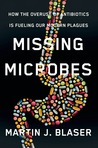
BOOK REVIEW: Missing Microbes by Martin J. Blaser, MD

Missing Microbes: How the Overuse of Antibiotics Is Fueling Our Modern PlaguesMissing Microbes: How the Overuse of Antibiotics Is Fueling Our Modern Plagues by Martin J. Blaser
My rating: 4 of 5 stars

Amazon page

This is one of several popular human biology books of recent years to take note of the fact that your body’s cells are outnumbered 10 to 1 by the bacteria that live in and on you—mostly in your digestive tract—and that our penchant for killing microbes has begun to show signs of harm as well as good. Since the germ theory took hold, we’ve been slaughtering all the little buggers we could, but increasingly we’ve learned that this isn’t without costs. In essence, we’ve been throwing out the baby with the bath water when it comes to our bacteria, while at the same time creating super-bugs.

As a first-worlder who’s been living in the developing world (India), I sometimes get ask if I get sick here a lot or at all. My stock response is to ask the asker whether they have Crohn’s Disease, IBS, Type II diabetes*, or any of the other diseases of affluence seen mostly in the first world. (*Type II diabetes is becoming much more prevalent in the developing world, notably in India where they like their deserts about 9000 times sweeter than, say, a fudge brownie. Furthermore, the disease has disproportionate effects in such countries because of limited treatment availability and late diagnosis.) In many cases, these developed world diseases are being tied to the killing off of our good gut bacteria.

Doctor Blaser’s book focuses on how overuse of antibiotics creates problems. For those who say, “I don’t get no stinkin’ antibiotics when I’m sick. I just suffer it out. Ergo, I don’t need to read this book,” there remain facts of which you should be aware. One such fact is that some of the antibiotics injected into the animals that become our food can act against our own personal microbiome. Yet another is that antibacterial soaps and gels are ubiquitous. Furthermore, the increased popularity of C-sections has starved infants of a source of good bacteria, and made them more prone to certain childhood illnesses.

“Missing Microbes” is organized into 16 chapters. The first discusses many of the “modern plagues” that have come about through the wholesale war on bacteria. The next couple chapters look at the role of microbes on the planet and in our bodies. There is a discussion of increasingly successful pathogens as well as the drugs that came along to take care of them. There is a discussion of over-prescription of antibiotics by dentists and doctors, their use in agriculture, and the transfer of good bacteria from mother to child and how rampant use of C-section negates this transfer. There are a couple of chapters on H. pylori and the lessons learned from trying to eliminate it after it became tied to ulcers. (In one of the most famous stories in modern medicine, a researcher swallowed a beaker of H. pylori to prove his theory to a skeptical audience of physicians.) Asthma is discussed as an example of an illness one might not expect to come about from destroying gut bacteria. One of the effects covered over two chapters is getting bigger (re: fatter as well as taller.) Staving off disease under crowded conditions isn’t the only reason modern agriculture uses antibiotics, it also makes for big, meaty animals—which when eaten by people may make big, meaty (actually, fatty) humans. Blaser then talks about how bad the situation might get (using the term “antibiotic winter,”) before discussing solutions. It’s, of course, true that humanity has gained a lot from antibiotics, and so putting the genie back in the bottle is not a solution. A nuanced approach is called for, and that’s what the author discusses.

I found this book to be informative, and would recommend it to anyone wanting to learn more about the risks presented by overuse of antibiotics.

View all my reviews

You’re So Evolved: Love Poem to a Hominid

Baby, I dig your bipedal ways
You could chase down wounded game for days
And walking around on just two feet
You can forage in the mid-day heat
When it’s too hot for those big ole cats
Who bully their way through our habitat


My dearest, it simply makes me drool
When I see you working with a tool
Thumbs opposable, and shoulders free
I’m awed when you throw stones at me
Just imagine how I shed a tear
When I see you chuck a pointy spear


And that prefrontal cortex, oh my lord
You could plan the move of a nomadic horde
One day you’ll be able to add, and subtract
You’ll think–and paint–in the abstract
You just need vocal cords of greater dexterity
To express yourself with heightened clarity
[not in grunts and stone throwing]


True, you’re not the strongest of the apes
And while tigers race you barely traipse
Monkeys climb, swinging tree to tree
You lack arm strength and dexterity
Still, there’s something about you that I just can’t deny
Though you share sixty percent DNA with a fruit fly
You’re so evolved

BOOK REVIEWS: Gut by Giulia Enders

Gut: The Inside Story of Our Body's Most Underrated OrganGut: The Inside Story of Our Body’s Most Underrated Organ by Giulia Enders
My rating: 5 of 5 stars

Amazon page

[I recently posted a review of Mary Roach’s GULP. I mention this because that book is likely to be the primary competitor if you’re looking for a tour of the alimentary canal in book form. While I’d recommend both books and point out that the two have different thrusts, if you’re set on reading just one book on poop and farts this year, the two reviews should help you determine which work is more up your alley.]

In this highly readable and humorous book, medical student Giulia Enders teaches us how to poop, what to do when we can’t, how our bodies extract resources from the stuff we shove in our pie holes, and what the bacteria that outnumber our body’s cells by an order of magnitude do for (and against) us. The book is in part a work of popular science, but it’s also a guidebook to the digestive tract. In other words, Enders not only tells readers about the wondrous job their digestive system does, but she also offers advice as to how to keep it running efficiently.

The book is divided into three parts. The first part lays out what the gut consists of and how it does its job. The second part introduces the reader to the enteric nervous system, which is the part of the nervous system that governs the digestive tract and determines when we vomit, poop, and—to some degree–experience emotional turmoil. The final part addresses the body as an ecosystem. The human body consists of 10 trillion cells and another 100 trillion microbes—cells that could theoretically live independently of your body provided the right conditions.

The strength of this book lies in Enders’s ability to put the complex physiological actions of our body into simple, understandable, and whimsical terms. This may mean anthropomorphizing a colon, but so be it—you’ll still get the drift. A prime example is the “Salmonella in Hats” section that equates antibodies with big floppy sombreros that interfere with the germ’s mobility and virulence. The author’s enthusiasm for this “under-rated” organ is infectious.

The book employs amusing, off-beat line drawings to help convey relevant ideas and to support the stories that the author uses to clarify the complex actions of the gut. The art is well matched to the tone of the text, which makes sense given they were drawn by the author’s sister.

As I mentioned in my GULP review, GUT is a very different book despite all they have in common. Enders spends the bulk of her time in the middle of the alimentary canal, where Roach spends most of her time talking about what happens at the two ends. Enders’s book is about the typical Joe’s digestive system, where Roach specializes in extreme cases and narrow (but fascinating) questions. Enders’s book is more of a tour of the digestive system rather than a series of tales of interesting things that happen in and around it. While Roach’s book deals in bizarre cases, Enders’s book is actually more light-hearted and informal in tone. (Whimsical is a good descriptor for GUT.)

I’d recommend this book for anyone who wants to learn more about how their digestive system works and what they can do to keep it working at its best. It’s funny and packed with fun facts.

View all my reviews

BOOK REVIEW: Gulp by Mary Roach

Gulp: Adventures on the Alimentary CanalGulp: Adventures on the Alimentary Canal by Mary Roach
My rating: 5 of 5 stars

Amazon page


This week I’m [improbably] doing two book reviews about works devoted to the human digestive tract. (Before you conclude that I’ve got a colon fetish, let me explain that I was spurred to this research by life events. I did some advanced yoga cleansing practices and wanted to learn more about the science of what was going on down below.) In addition to this book, Mary Roach’s “GULP,” I’ll be soon posting a review of Giulia Enders’s “GUT.” The two books have more in common than their monosyllabic titles beginning in “gu” and the fact that they each came out within the past couple years. They’re both light-hearted romps down your digestive tract. However, they’re also different in several key ways. GULP is quirkier; GUT is perkier, but more importantly the two books have different thrusts (yes, there’s just that much interesting stuff to learn about digestion (and the lack thereof)—which make the two books complementary. Cutting to the chase, I’d recommend both books, but if you only read one book about your alimentary canal this year, I hope my reviews will help you determine which one is for you.

Explaining how Roach’s book is “quirkier” will tell one a lot about Roach’s book and how it differs from Ender’s work. (And since Ender’s writing style could be described as quirky itself, it’ll help clarify that as well.) By “quirky,” I mean that Roach’s book is built around a set of narrow questions that address topics of a bizarre or strange nature. In GULP one will read about whether your pet really wants “paté in beef gravy” [spoiler: it does not], whether the story of Jonah and the whale is BS, how smugglers use their digestive tracts illicitly, what are the benefits of Fletcherizing (chewing your food more thoroughly—much more thoroughly), whether Thanksgiving dinner can split one’s stomach open (like it feels it does), and what’s the worst case flatulence scenario.

This isn’t to say that one doesn’t learn something about the basic science of digestion as one is reading about extreme cases of tasting skill, stomach fistulas, flatulence, constipation, and overeating. One does, but this book isn’t organized to educate one about the alimentary canal systematically and generally. It’s a work of creative nonfiction designed to make the reader keep saying “huh, I never would have thought” and it does an outstanding job of it. You may not have given much thought to some of these topics, but you’ll be craving answers by the time you get past the chapter heading. There’s a reason that Roach’s works top the charts of pop science books. She finds the interesting questions and the most fascinating examples.

There are 17 chapters in GULP, and while they collectively take one on a tour of the alimentary canal, Roach devotes more space to some parts than others. She spends more time on what goes at the head end (smelling, tasting, chewing, and salivating) than does Enders. Also, please don’t think the book is low brow or that it appeals to the lowest common denominator (8-year-old boys?) when I tell you that there are three chapters on various dimensions of flatulence.

As I said, you may not have thought much about some of these questions, but you’ll learn something nonetheless. A prime example can be seen in the chapter on smuggling via the digestive tract. I’d read stories of cocaine mules dying when a condom burst in their stomach, but I had no idea about the extent to which items and materials are smuggled down there. It’s not just drugs. One guy was explaining how he smuggled knives. Really. Knives. Plural.

There are a few topics that are well covered by both books. Take, for example, constipation. Roach elucidates the topic using the case of Elvis Presley and others who’ve been literally terminally constipated. (Ender’s—on the other hand—considers the everyman’s constipation, though with amusing drawings and commentary.)

I’d recommend this book for readers interested in learning more about how their food makes its way through—particularly if you like learning about the strange cases.

View all my reviews

BOOK REVIEW: The Tell-Tale Brain by V.S. Ramachandran

The Tell-Tale BrainThe Tell-Tale Brain by V.S. Ramachandran
My rating: 5 of 5 stars

Amazon page

A brain injury patient simultaneously becomes demented and develops a previously unwitnessed artistic talent. Another patient’s brain lights up identically when seeing another person being poked as it does when he, himself, is prodded. An amputee brushed on a specific area of the cheek has a sensation in a specific area of the lost limb—i.e. phantom limb sensations can be mapped to points on the face. A stroke victim develops “metaphor blindness,” and suddenly “the 800 pound gorilla” becomes an actual gorilla. A test subject’s right angular gyrus has an electrical charge delivered to it through an electrode and the person has an instantaneous out-of-body experience. There are temporal lobe epilepsy patients who literally feel one with other people—or, in some cases, the natural world in general. These are just a few of the fascinating cases that Dr. Ramachandran presents in “The Tell-Tale Brain.” Many of these phenomena would have once been attributed to purely psychological or spiritual causes, but now their biological origins in the brain are being revealed.

Dr. Ramachandran is a neuroscientist whose claim to fame is making a noteworthy contribution to our understanding of the brain using mostly low-tech and non-invasive experiments with subjects who have brain abnormalities or injuries. Before there was EEG (electroencephalogram) and fMRI (functional Magnetic Resonance Imaging) machines, much of what scientists learned about the brain came from determining what capabilities were lost (or, occasionally, gained) by patients who had specific brain damage. In this way, we gained a great deal of insight into what areas of the brain are responsible for what tasks and we’ve learned that many aspects of the mind that were largely thought to be beyond biology are—in fact–not. It’s fascinating to see what bizarre effects can result from brain damage or abnormalities, from people who think they are dead to others who want to have a limb amputated because it doesn’t feel like it belongs to them to yet others who think their loved ones are imposters.

The central question addressed by this book is best summarized by a quote from the book’s introduction: “Are we merely chimps with a software upgrade?” Ramachandran proposes that any answer to this question that can be scientifically investigated must reside in the brain. Most of our organs and our general structure are not that different from those of our primate brethren. But our brains are infinitely more capable than those of other species. In responding to the question, Ramachandran considers the brain’s role in topics like language, aesthetics, and belief that are the sole domain of Homo sapiens. One of the most interesting discussions is how our brains fill in the blanks and a give meaning to what we see, such that we sometimes find signs in random data streams. The final chapter deals with introspection and how we come to define ourselves by what we think and what we feel and here Ramachandran gets into some of the most fascinating conditions mentioned in the book, such as Cotard Syndrome in which subjects firmly believe that they don’t exist.

There are a few topics that he delves into in particularly deep detail. One of these topics is that of mirror neurons. These neurons are integral to our relationships with others and are essential to our ability to learn. They fire in mimicry of movement (e.g. facial expressions) we see others perform. The author also uses his work with phantom limbs and synesthesia to illuminate the workings of the brain. Phantom limbs occur when an amputee can still feel sensations in the amputated limb. While phantom limbs were at one time believed to be residue of the soul or the like, studies have offered insights into its origins in the brain. Synesthesia is when the brain is mis-wired such that there is a blending of the senses. As an example, a person might see a different color associated with each musical note or with each number. Synesthesia was once considered a delusion and people were institutionalized for this cross-wiring of the brain. Autism is also addressed in a chapter, and-in particular—the theory that this affliction may be linked to the mirror neurons.

I found this book to be fascinating and insightful. While it delves into our tremendously complex brains, it does so in a readable and comprehensible manner. The fact that Ramachandran’s focus is largely on low-tech and relatively simple experiments means that one can readily understand them in a manner that one might not with studies based on fMRIs or EEGs.

I’d recommend this book for anyone interested in the magnificent human brain.

View all my reviews

BOOK REVIEW: What is Life? by Addy Pross

What Is Life?: How Chemistry Becomes BiologyWhat Is Life?: How Chemistry Becomes Biology by Addy Pross
My rating: 4 of 5 stars

Amazon page

Dr. Pross’s book shares a title (but not a subtitle) with the seminal work by the renowned physicist Erwin Schrödinger from 1944. While Schrödinger addresses a wide range of topics on how life might be explained in terms of physics and chemistry, Pross’s focus is narrower. Pross asks—and proposes an answer for—the straightforward (but thorny) question of how abiogenesis could occur. Abiogenesis is life from the non-living. Darwin did an excellent job of explaining how we could get from single-celled organisms to the great complexity we see in our own bodies, but Darwin didn’t touch the question of how that very first ancestor became animated.

The subtitle of this work, “How Chemistry Becomes Biology,” gives one insight into how Pross proceeds. There’ve been many ideas about how life came to be on planet Earth over the years. For a time, the idea of panspermia—life arriving from an extraterrestrial source—was popular. Of course, the most popular belief has been that there was a force of life (i.e. an “élan vital”) breathed into non-living matter by a, presumably, supernatural force / entity. While the awe-inspiring nature of life made this idea appealing / believable, it took a hit from the Urey-Miller experiments. Said experiment exposed the four materials believed to have been the most common in our pre-biologic atmosphere (hydrogen, ammonia, methane, and water vapor) to lightning, and the result included a range of organic materials—including amino acids–the building blocks of… well, us, among the other life forms of the planet. Of course, Urey-Miller didn’t make abiogenesis a foregone conclusion, but the production of ever more complex self-replicating molecules under laboratory conditions has made it easier to digest the notion that life developed without any intelligent or supernatural push.

While Pross’s ideas are at the stage of hypothesis, he develops a compelling explanation that revolves around the idea of dynamic kinetic stability. “Dynamic Kinetic Stability” is a mouthful, and so it’s necessary to break it down. The best place to start is with the “stability” part. This is because the biggest problem for an abiogenetical theory of life is the Second Law of Thermodynamics. The Second Law tells us that entropy increases. There are many ways of restating this, such as that chemical reactions move to states that are of lower free energy. However, the most intuitive way is to say that a beer mugs break but do not spontaneously pop into existence. So if everything is getting simpler by deteriorating, breaking, and decomposing, how does one get / maintain a stable state of complexity? First and foremost, the answer involves adding a lot of energy and resources, but there’s more to it than that–as the author explains. “Dynamic” can also be explained in complex terms, but it’s most easily thought of as being like a river in that the river’s existence is stable, but it’s always a different river—ever changing water molecules arranged differently. (Critically, our bodies are the same way. Except for neurons, our cells are constantly being replaced.) The term “kinetic” speaks to how said replacement takes place; replication must be fast and decay slow.

The appeal of the ideas put forth by Pross is that they’re conceptually consistent with Darwinian Evolution. That is, an entirely new set of principles isn’t necessary to make sense of the origins of life. Pross argues that the self-replicating molecules that can most effectively put resources to use succeed in doing so, and—in the process–they drive others into extinction.

I found this book interesting and readable. The author uses good analogies to make his points (which often deal in complex matter) as clearly as possible. I can’t disagree with the other reviewers who’ve pointed out that the book is a bit repetitive and drags out a relatively simple statement of the argument. It’s not so egregious that I could say that it’s necessarily the result of a desire to pad the book out to a length necessary to sell in hard-copy form. (But it might have been.) The understanding of this topic is in its infancy, but that doesn’t mean this book isn’t a valuable contribution to popular understanding of abiogenesis.

I’d recommend this book for anyone interested in reflecting on from whence we came in a fashion that is open-minded to explanations that eschew the supernatural.

View all my reviews

BOOK REVIEW: Why We Run by Bernd Heinrich

Why We Run: A Natural HistoryWhy We Run: A Natural History by Bernd Heinrich
My rating: 5 of 5 stars

Amazon page

This book is actually several different books woven together. It’s part autobiography of the author’s running life, it’s part a study of comparative biology between various creatures with an endurance bent and humans, it’s part an examination of the evolutionary biology of humanity’s proclivity to run, and it’s part guide to preparing to engage in ultramarathons. Often I pan such books as being unfocused, ill-planned, and—most often—attempts to whip an article’s worth of material into a book length piece. However, Heinrich keeps it interesting enough that I don’t feel it necessary to level these criticisms. Still, my first warning to readers is that one has to read on for quite a while before one gets to the book that one thought one bought—i.e. one that answers the title question of “why WE (i.e. people in general and not the author specifically) run.” In short, you’ll need to have an eclectic set of interests to get through the whole book, but some may find reading only part of it gives them all they wanted from the book.

It should be noted that the book is on its second title. The original title was: “Racing the Antelope: What Animals Can Teach Us about Running and Ourselves.” The author explains in the front matter why the original name was changed (apparently some loud and obnoxious writer had a similarly titled book on a different subject and whined about it.) Changing the title wasn’t required because: a.) titles cannot be copyrighted, and b.) it wasn’t exactly the same title anyway. Still the new, more succinct, title may lead one to expect a succinct book, which this isn’t so much.

Some readers will enjoy Heinrich’s writing style; others will find that it ventures too far into flowery territory on occasion. I did enjoy it. However, I can see how a reader might find some of the descriptive sequences to be excessive–particularly toward the beginning of the book.

While there’s some overlapping and interweaving, one can think of the book in three sections. It’s written in twenty chapters. The first six tell the author’s story of getting into running and his youth. The next eight chapters deal in comparative and evolutionary biology. In general, these chapters look at the biology of other creatures as they pertain to said animals’ ability to engage in running (or activities that are like running in that they involve endurance of muscles and the cardiovascular system.) Also included in this section is the evolutionary biology of humans as it relates to becoming a species of runners. This is the core of the book and was the most interesting section for me. In it, Heinrich considers the endurance activities of insects, birds, antelopes, camels, and frogs. Each of these has a particular relevance. For example, camels are masters of endurance under harsh conditions. Frogs tell the story of the difference between fast and slow twitch musculature (relevant to sprinters versus distance runners.) Antelopes are, of course, the exemplars running in the animal kingdom, but the nature of their running is so different from that of humans (i.e. making quick escapes versus pursuing wounded prey.) The last six chapters can be seen as a guide to preparing for ultramarathon races, but it’s also a continuation of the author’s self-examination of his running life from the time he began ultramarathoning.

I’d recommend this book for readers who are interested in the science of human performance. It’s well written, and the insights it offers into the biology of other animals are fascinating. Whether you read the whole book or just the part that pertains to your interests, you’ll take something away from this book.

View all my reviews

BOOK REVIEW: Wired for Story by Lisa Cron

Wired for Story: The Writer's Guide to Using Brain Science to Hook Readers from the Very First SentenceWired for Story: The Writer’s Guide to Using Brain Science to Hook Readers from the Very First Sentence by Lisa Cron

My rating: 5 of 5 stars

Amazon page

There are countless books offering advice to writers. Some are good. Some are not. Good, bad, or ugly, few of these books offer anything new beyond particularly artful (e.g. humorous or poetic) explanations or superior examples. In other words, if you’ve read five writer’s guides you’ve read five thousand. Cron’s book is the rare guide worth a read even if you’ve read a hundred other such books. It’s not that Wired for Story offers radical or novel advice on story building (its writer’s tips are orthodox.) It’s the way this book couches the arguments for what can admittedly be hackneyed advice. As the title suggests, Cron’s book is about how our brains are wired to love stories–as long as said stories contain certain attributes that the brain finds appealing. (Conversely, there’s a reason why books that go wildly off the reservation with “experimentalism” are doomed.)

While I’ve read many a book on writing, I picked up Wired for Story more out of an interest in the subject of the neuroscience of story. The book doesn’t delve deeply into the science, but it does cite leading thinkers in the field as well as providing a good layman’s overview of the neuroscientific principles that inform the book’s tips. Cron’s background is in publishing and her bona fides to write this book are as someone who came from a career reading and rejecting / accepting manuscripts. However, I believe she did a good job of laying out science.

The central idea is that humans love stories because the narrative structure allows people to simulate a nasty chain of problems without suffering the real world consequences. The brain loathes uncertainty and randomness, and loves whenever it can learn about how to face a problem or make sense of the world. This is why we love conflict, tension, and an unrelenting unfolding of worst case scenarios in our stories even though we tend to hate those characteristics in our own lives. This results in both the tried advice to keep putting the protagonist through the wringer, and the qualifications that a writer should do so in a way that is believable (our brain’s BS-detector is ever on) and which will eventually force the protagonist to change. Cron offers a definition of story that has the usual elements: “A story is how what happens affects someone who is trying to achieve what turns out to be a difficult goal, and how he or she changes as a result.” As with many guides, the definitions of plot, the protagonist’s issue / goal, theme, and tone are elaborated at length—as well as being differentiated because these topics tend to be confused by neophytes—often resulting in a failure to clarify one or more of them.

Stories also give us an opportunity to anticipate what others will do, and forecasting the behavior of others gives one a nice little dopamine dump. The ability to foresee what others will do has always been a powerful evolutionary advantage, and those who did it better passed on their genes more than their oblivious counterparts. Owing to this idea, there is a great deal of advice about what should be in the book (only what is relevant), and how it should be revealed (in a way that eschews attempts to play “gotcha” with your readers.)

One may wonder why I’m so pleased with a writer’s guide that gives common advice about writing–just because it explains said tips in terms of evolutionary biology. The answer is that it’s far easier to keep these lessons in mind when they’re held together by a logic rooted in what all readers have in common (e.g. conscious and unconscious minds, emotions, instinctual drives, etc.) For example, knowing why readers hate an overly simple resolution for a problem that’s presented as insoluble (i.e. robbing them of dopamine reward for figuring it out) helps one better recognize this pitfall in all its forms and to avoid it. Such an approach allows for a deductive approach and is far more useful than having memorized “avoid deus ex machina” as a disparate tip that’s attached to a specific example. In short, it’s both easier to remember and broadly implement these ideas when one understands the rationale from the ground up.

Beyond the reason in the last paragraph, I enjoyed this book for reasons that have little to do with its advice to writers. While I now know that there are other books on the evolutionary biology of story that deal with the subject more from a scientific perspective (while I haven’t read it yet, you might try this book), this was the first book that I stumbled across on that topic. And, it’s a topic that’s well worth understanding whether you’re a writer or not. No matter what one does, understanding the universal appeal of a story can be beneficial, whether it’s in the context of teaching, parenting, or business.

I’d recommend this book for writers—particularly those who think about the world in scientific terms. Beyond writers, if you have cause to construct or use stories in your life—or suspect you should—you can benefit from this book.

View all my reviews

BOOK REVIEW: The Wild Life of Our Bodies by Rob Dunn

The Wild Life of Our Bodies: Predators, Parasites, and Partners That Shape Who We Are TodayThe Wild Life of Our Bodies: Predators, Parasites, and Partners That Shape Who We Are Today by Rob Dunn

My rating: 4 of 5 stars

Amazon page

Dunn’s book addresses a host of intriguing questions such as:

-Why are there diseases that disproportionately attack those in the richest parts of the world while being almost non-existent in poor countries?
-Why is obesity at epidemic proportions among modern humans?
-Why—while people have diverse tastes overall—do there seem to be universal preferences for sweet, salty, and fatty foods?
-Why are so many people’s lives wrecked by constant stress and worry?
-Is the Appendix really a vestigial organ with no apparent purpose?

As the subtitle suggests, this book is about the role that other species have played in human evolution and the way we look, behave, and think today. The message of The Wild Life of Our Bodies is that humanity’s proclivity to see itself as an island–uninfluenced by other species–has its cost.

The book is popular science–approachable to a layman but with the usual disdain for gratuitous assertions and shoddy reasoning that define the scientific though process. That being said, Dunn does put some editorial opinion out there in ways that might appear as fact in a slipshod reading. The most prominent example being Dunn’s suggesting that what best defines humanity is not our intelligence or ability for abstract representation (or even our physical appearance), but that we are the only (first?) species that has killed other species off not purely of self-defense or for food, but to exercise control over our ecosystem. I doubt this would strike a majority of impartial scientists as a fair and unbiased way to define humanity. Granted, this point not what The Wild Life of Our Bodies is about, and whether one thinks this it is fair or not is not critical to whether one will find the book to be of value. However, the idea (and the fact) that humans have zealously killed off other creatures is certainly relevant to the discussion at hand.

If “terraforming” is the term for how an alien race might environmentally engineer Earth to make it suitable for them to live here, perhaps we could call humanity’s assault on other species “bio-forming” of the planet—choosing a roster of species that strikes our fancy. All the time humans were trying to make ourselves more comfortable by getting rid of inconvenient species, we remained ignorant to the downside.

Dunn covers a broad range of mismatches between who we are evolutionarily and how we live in the modern world. The Wild Life of Our Bodies suggests that, like the pronghorn antelope, humans are in many cases over-designed because of the loss of species (parasites, predators, symbiotes, etc.) that helped to make us who we are today. (One question that once puzzled biologists was why pronghorns were so much faster than every species they faced.)

While it sounds good to be over-designed (at least relative to the alternative), it’s not without cost. In our case, we had guts that were supremely adapted to having parasites, but the lightning fast (on an evolutionary timescale) elimination of those parasites has left us with bodies that attack a non-existent enemy and this has resulted in a number of new diseases. We are used to diseases that succeed in the poorest—and, hence, least hygienic areas– but disease that mostly attacked in the cleanest places on Earth have puzzled us for some time. Crohn’s disease is a prime example. “Rewilding” (i.e. putting parasites back into) the guts of Crohn’s patients has shown positive results.

Dunn lays out a couple of the theories as to how the loss of our intestinal bacteria may result in a number of first-world ailments. Interestingly, some of these diseases aren’t even digestive in nature, and might seem to have no logical connection to gut bacteria. However, our body’s systems are a system-of-systems—i.e. they are integrally linked. One issue is that some parasites have been able to mask their presence, and our bodies have learned to present a heightened response to account for this veiled threat. Today our systems can’t tell the difference between our squeaky clean guts and a gut full of these sneaking parasites so it drops the immune system version of an A-bomb.

This is one example of why some diseases don’t exist in the third-world where the body knows what parasites it’s up against. One might say, “Yes, but these ailments of over-reactive systems can’t be as bad as the effects of the parasites.” That’s often not true. Most people with internal bugs (we all have them to some degree), don’t even realize it. The fact that people with Crohns’ are willing to have predators implanted in them speaks to this issue.

There has been concern for years about downside of the rampant use of anti-bacterials, antibiotics, and antiseptics, and this is a topic Dunn addresses as well. For example, there seems to be little evidence that such agents in soap do any particular good, but they decidedly do bad (encouraging drug resistant species.)

Perhaps the single greatest change in the nature of homo sapiens life resulted from the agricultural revolution, and Dunn delves into how this seminal event changed our bodies. With paleo-dieting all the rage, it will come as no surprise that there have been some major changes to the human diet since our hunter-gatherer ancestors roamed the Earth. Once again, we have bodies built on an evolutionary timescale, and they don’t necessarily cope well with our new diets.

One problem is that we have strong hardwired drives for foods that were a rarity in our species’ past, but which we now produce in abundance. For example, we eat far too much refined sugar because our bodies are wired to love sweet, but that kind of food was rare to our pre-agricultural ancestors. Hence we have the existence of diabetes, and its greater prevalence where high-sugar diets are common. Many people are also saddled with an evolutionary advantage to store fat because their ancestors come from a clime where food was not abundant year round. The problem is that now there’s a grocery store on every corner and this once great advantage is contributing to burgeoning waistlines.

I gave this book a high rating on the grounds that it presented a lot of food for thought, and that’s what I most value in non-fiction. Some of the theories may turn out to be incorrect, but this book offers one a lot to think about and clear explanations of the bases for what can otherwise seem a little outlandish. There is also some wit in places that contributes to heightened readability.

View all my reviews